California’s Digital Divide and the 2020 Census

The 2020 Census will be the first decennial census with a fully online component. Rather than mailing forms to every household, the US Census Bureau will instead send out postcards asking households to take the census online, hoping to achieve a 55% online response rate. Then, as in years past, census workers will visit those who did not respond and conduct in-person interviews.

California’s size and diversity present unique challenges to this effort. One significant challenge lies in how many households report having reliable high speed internet—essential to completing the census online.

The contrasts across counties are stark. For example, according to the most recent estimates, more than 89% of households in Santa Clara County report having high speed access at home. In contrast, in Trinity, Glenn, Modoc, Sierra, Tulare, and Imperial Counties, more than 30% of households say they do not.

What’s more, these estimates actually understate the disparity. In the counties of Colusa, Sierra, Yuba, Tulare, and Plumas more than 15% of households report having high speed internet only through their cell phone data plans and no other source, and in 11 other counties at least 10% of households report the same.
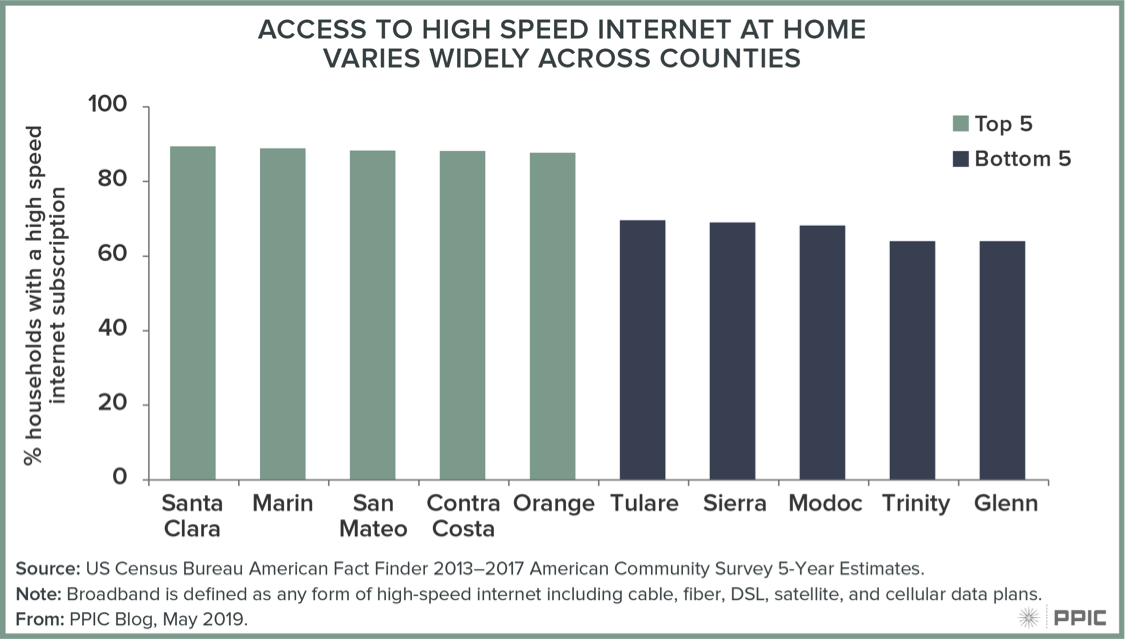
Figure - Access to High Speed Internet at Home Varies Widely Across Counties

Of further concern is that these counties are the very ones that have been identified as being hard to count. In addition to sparse internet access, communities may be hard to count because they contain higher rates of historically undercounted groups, such as noncitizens and African Americans, or because large shares of their residents rent rather than own their households.

These challenges are real, but California is working hard to overcome them. State agencies were allocated over $100 million in 2018-19—with another $54 million proposed—so they may partner with the Census Bureau to help identify hard to count communities, encourage participation, and better ensure an accurate count of all Californians.

Video: Californians and Education

Last week in Sacramento, Alyssa Dykman outlined the key findings from PPIC’s 15th annual survey on Californians and K–12 education, which tracks opinions on educational quality and school funding. This month’s survey was the first ever to be conducted with a fully online methodology.

A strong majority of Californians want Governor Newsom to prioritize K–12 public education, and majorities support many of the governor’s education-related budget proposals—including the expansion of special education and full-day preschool and kindergarten. Solid majorities also support teacher strikes for higher pay.

But Californians have mixed views on charter schools: most say they are an important option for parents in low-income areas, but many express concern about charters diverting funding from traditional public schools.

Other survey highlights:

  • Most Californians think the level of state funding for local public schools is not adequate.
  • More than half of residents across regions say teacher salaries in their community are too low.
  • Majorities of adults and likely voters would vote for a ballot measure that would amend Proposition 13 to create a “split roll” property tax system and direct some of the revenue to K–12 education.
  • Many parents think the goal of K–12 public education should be to prepare students for college—but many worry about the affordability of a college education.

New Approaches for the PPIC Statewide Survey

As the polling world knows, times—and survey methods—are changing. The rise of cell phones and decline in landline use has had an enormous effect on telephone polling methods. So have internet surveys. The PPIC Statewide Survey has kept abreast of these changes, evaluating and incorporating best practices throughout our 20-plus years in the business. The most recent update involves using online polling techniques for our next survey.

Online polling was initially viewed with great skepticism by experts in the field. However, significant progress has been made in this area. Today, a rigorous online survey using a random probability sample is widely accepted as an alternative to a rigorous live telephone survey using a random probability sample. Our research into this methodology—including extensive conversations with colleagues at peer organizations who are also using online and live telephone surveys, such as the Kaiser Family Foundation, Langer Research Associates, and the Pew Research Center—has provided us with strong assurances of quality.

Last fall, we conducted a simultaneous online and telephone poll to compare our results. We found that the online method we chose yielded results with the same high quality as our telephone polling (which includes both landline and cellphone participants).

This spring, we are conducting our first fully online-only survey, on the topic of Californians and education. This method will allow us to delve into more issues and in greater depth than we do in a live telephone survey. We are excited about this approach and looking forward to the results.

At the same time, the PPIC Statewide Survey will continue to rely on landline and cellphone polling techniques for the bulk of our work for the forseeable future, given the current limits in random probability samples for large online surveys in California and the reliability and proven track record of live telephone surveys.

As we move toward new frontiers, our survey methods will always place quality first and be completely transparent, with clear methodological explanations and detailed results available on our website. Most important, we will continue to provide a voice for all Californians—voters and nonvoters alike—raising awareness, encouraging discussion, and informing policymakers on critical issues of the day.