COVID-19 Highlights the Need for Statewide Student Data

The pandemic makes it clearer than ever that California would benefit from a data system that links information across educational institutions. Without it, California policymakers will continue to lack important information—including insights into the impact of the coronavirus pandemic on our students and educational institutions.

Better data would help determine who is most affected by the pandemic, where to direct support, and how to prepare for future crises. For example, is the pandemic affecting key educational transitions of some students more than others? Some regions more than others? Where should the state best direct its resources to ensure students keep moving through the educational pipeline? Right now, these questions cannot be fully answered.

The governor’s office remains supportive of building a statewide data system, and the state’s Cradle to Career Workgroup is still aiming to deliver a proposal to the legislature by the end of 2020.  At its most recent meeting, the workgroup endorsed creating a multifaceted system, including data tools for the general public and researchers, as well as ways for practitioners, students, and families to link data regarding transitions to and between colleges.

The workgroup also endorsed including early childhood data, to focus on early determinants of educational success and align with the governor’s focus on early childhood care. Over the summer and fall, the workgroup will decide on proposals that define the scope of the system, ensure privacy and security, and govern access.

Balancing the state’s need for connected data with the current economic downturn may be difficult. However, forgoing all of the recent progress could indefinitely stall this important effort, not only hampering the flow of critical information but also leaving the state flying blind during the next crisis.

PPIC will continue to participate in an advisory capacity for the Cradle to Career Workgroup and will also convene the California Education Data Collaborative to aid and inform the state in creating a useful data system that helps students and provides valuable direction for the state—during good times and bad.

Pointing Eligible Students to Available CSU Campuses

Large numbers of students are turned away from their campus of choice each year because many California universities receive more freshman and transfer applications than they can admit. At the California State University (CSU), campuses with more applications than they can admit are called “impacted.” All but 2 of the 23 CSU campuses have at least one program of study impacted for the 2020–2021 school year; at 7 campuses every program is impacted.

For CSU, students can easily apply to more than one campus. One application covers all campuses, and students pay a $70 per-campus fee for each school they select (although about half receive fee waivers). First-time freshman applicants and transfer applicants both apply to around 3 CSU campuses on average (3.3 campuses for freshmen, 2.6 for transfers).

About 32,000 eligible freshmen and transfer applicants were denied admission to their preferred CSU campus due to capacity issues in 2018. In 2019, CSU started a program to redirect denied students, offering admission to one of ten campuses with space. In the first year, about 20,000 students were offered admission at an alternate campus, and about 900 enrolled (4.5%), according the CSU Chancellor’s Office. The program was most successful among redirected transfer students, who enrolled at an 8.2% rate compared to freshmen at 1.9%.

We don’t know what happened to the students who did not enroll, as the state has no way of tracking student records between institutions. Some may have ended up at a UC, a private college, or other institution. Freshmen applicants may have decided to attend a community college with plans to transfer later. A statewide longitudinal data system can help the state create better policy around capacity in higher education.

As the CSU redirection program continues and applicants understand the process better, interest in the program—and enrollment rates—may increase. However, a similar long-standing program at the University of California has had similar low rates of enrollment from redirected students. CSU is considering ways to improve program timing and delivery; using their excess capacity to put almost 900 extra students on the road to a bachelor’s degree in the first year of the policy is already an important step.

Making Progress on Connecting Student Data across California

California students may fall through cracks in the state’s public education system because K–12 data and college data are not connected. For example, the state and its public universities are currently unaware of students who do not apply to UC or CSU despite being eligible, making it impossible to encourage these students to apply. Connecting education data can help California recognize and improve key transitions in student progress.

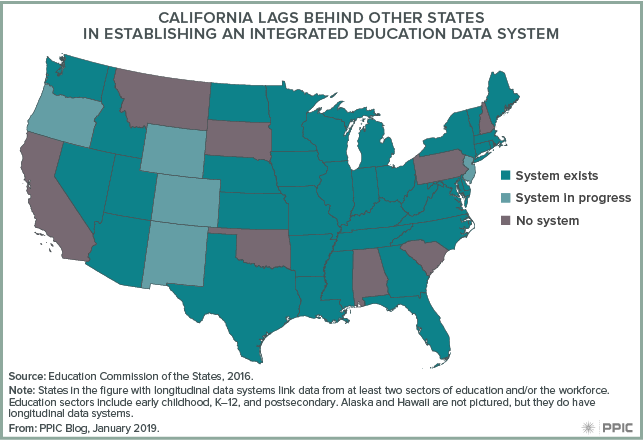
The current data system is fragmented across institutions, leaving California as one of eight states without a modernized approach to tracking its educational pipeline. By passing the 2019 California Cradle-to-Career Data System Act, the state is taking action toward linking education data across its many sectors.

As a first step, California has appointed a workgroup that will recommend a framework to the legislature and the Department of Finance within a year. This workgroup will determine relevant data elements to include—variables such as graduation, eligibility, and enrollment—along with when and how to combine data, where to store results, and who governs access to data.

So far the process has been inclusive and transparent, with representatives from all sectors of education, advocacy groups, researchers, technology experts, lawyers, and others stepping forward to serve on committees and advisory groups. Many member organizations of the California Education Data Collaborative, an organization convened by PPIC, are serving in advisory groups. Advisory group meetings are open to the public, and people can find information, meeting materials, and notes on the California Data System website. Public comments are encouraged at all meetings and on the website.

On January 16, PPIC attended its first meeting with the Policy and Analytics Advisory Group, where we discussed use cases around research and accountability, such as analyzing how financial aid offers to high school students impact college outcomes. The advisory group also agreed on a critical first step for the state: evaluation and analysis of student pathways from school to work. Advice from this advisory group and others will help the state’s workgroup make recommendations on January 30 to determine the scope and first phase of the data system.

PPIC will continue to participate in the advisory group and monitor the monthly workgroup meetings; notes and materials will be posted at California Data System, and we will update progress on this blog.

Integrating California’s Education Data

[vc_row][vc_column][vc_column_text]California needs an integrated data system that connects pieces of the education pipeline that are currently maintained separately.  An integrated system could perform a variety of critical functions and reach a diverse audience of stakeholders. For example, it could provide feedback to educational institutions on student outcomes, even after students graduate. It could also encourage better planning and coordination between educational sectors, increase the state’s ability to evaluate educational programs and policies, and provide students and families with better information about successful educational and workforce pathways.

The state has recently invested $10 million toward planning for this type of system, establishing the California Cradle to Career Data Systems Working Group to “recommend data system structural components, processes, and options” and to “advise ongoing efforts to develop, administer, and enhance the data system” (per Senate Bill 75).

The Public Policy Institute of California has also been focused on this issue, facilitating a group of research and policy organizations interested in the establishment of an integrated student data system in the state. Known as the California Education Data Collaborative, this group has met regularly throughout this year to discuss the opportunities and challenges associated with advancing education through connected data.[/vc_column_text][/vc_column][/vc_row][vc_row][vc_column width=”1/2″][vc_column_text]

The collaborative’s activities are designed to build knowledge and skills among diverse stakeholders involved in improving access, equity, and success across California’s educational systems. As a collaborative, we have engaged with national experts, leaders in successful data systems from other states, policymakers from California, and those with experience in working for an integrated data system in California.

As the state’s California Cradle to Career Data Systems Working Group takes shape, the collaborative is working to:

  • Engage with stakeholders—including students, parents, educators, and institutions—about how to implement a data system that best serves them.
  • Connect with policymakers to ensure that the data system answers critical questions about policies and programs to foster student success.
  • Provide research and advice on how to construct a system that will improve California’s education systems.
  • Examine issues of privacy and security to ensure confidentiality of student records.

[/vc_column_text][/vc_column][vc_column width=”1/2″][vc_column_text css=”.vc_custom_1567624867972{padding-top: 20px !important;padding-right: 20px !important;padding-bottom: 20px !important;padding-left: 30px !important;background-color: #384763 !important;border-radius: 4px !important;}”]

PPIC’s California Education Data Collaborative

California Competes
California College Guidance Initiative
California EDGE Coalition
California Policy Lab
Cal-PASS Plus
The Campaign for College Opportunity
Children Now
CORE Districts
Education Insights Center
The Education Trust- West
First 5 LA
Policy Analysis for California Education
Public Advocates
Public Policy Institute of California
Strategic Education Services
The Institute for College Access and Success
WestEd
[/vc_column_text][/vc_column][/vc_row][vc_row][vc_column][vc_column_text]Establishing an integrated, longitudinal student data system will take a multifaceted, sustained approach. In the long run, the value of this system will lie in the policy questions that can be asked—and answered with confidence—and the ability of practitioners, students, and families to access information that helps them make informed choices. To assess reforms accurately and comprehensively will require strong partnerships, clear long-term planning, identified goals—and good data.[/vc_column_text][/vc_column][/vc_row]

One Step Closer to a Statewide Educational Data System

Governor Newsom’s recently proposed budget includes $10 million in one-time funding for the planning, creation, and implementation of a statewide longitudinal data system—including early childhood education, K–12, higher education, the workforce, and health and human services. As we wrote in a recent PPIC report, this idea holds a lot of promise. An integrated data system could allow for improved feedback for educational institutions, more efficient use of public funds, and better evaluation and coordination for the state. The idea also has support in the state senate, where Senators Glazer and Allen proposed a similar system (SB 2) last December.

Each public education system—K–12, the community colleges, California State University, and the University of California—already recognizes the importance of data. They all collect, store, and analyze data on students within their respective systems to improve instruction and outcomes. However, few connections are ever made between educational sectors. Even though a high school senior may graduate from a K–12 school, attend a community college, and then transfer to a UC, data isn’t shared across those systems in any systematic way. So each system has no idea if students are successful in the next stage of their academic career. California is one of the few states that does not follow students across sectors.

The governor’s budget summary also suggests that the data system could be used to improve K–12 measures of career and college readiness. Current measures are based on high school test scores and high school course-taking. But connecting K–12 data to higher education and employment data could lead to more meaningful measures of whether students are able to take and succeed in college-level courses, or whether they work in a job with a living wage.

With the Newsom administration’s support, California may be closer than ever to establishing a data system that can answer key questions about how students move along the educational pipeline. Creation and implementation will involve security, privacy, and governance challenges, but California has 42 other states that can serve as models. This is a much-needed first step in helping the state develop effective policy solutions that will improve students’ progress through school and into the workforce.

Testimony: How an Integrated Data System Could Improve Education

Jacob Jackson, research fellow at the PPIC Higher Education Center, testified before the Senate Committee on Education in Sacramento today (April 11, 2018). Here are his prepared remarks:

Thank you Chair Allen, Vice Chair Wilk, and members of the committee for the opportunity to testify today. My name is Jacob Jackson and I am a research fellow at the Public Policy Institute of California. PPIC is a nonprofit, nonpartisan policy research organization and does not take positions on legislation. My comments today are about the potential benefits of a statewide, longitudinal student data system and are based on research that PPIC and others have conducted.

Right now, educational institutions and government agencies already collect plenty of data. The California Longitudinal Pupil Achievement Data System (CALPADS) tracks students from kindergarten through grade 12. Each public system of higher education (the community colleges, California State University, and the University of California) keeps track of its students while they are attending that institution. And the Labor and Workforce Development Agency collects data on the earnings of Californians over time. However, these data sources remain largely separate—which prevents the state from understanding how students move across educational institutions and into the workforce. Below are three key considerations in thinking about the potential value of an integrated data system.

A statewide longitudinal data system could help answer important questions for California. The lack of an integrated data system leaves California unable to answer basic questions about educational progress, workforce development, and equity. Such questions include:

  • Is the state’s educational pipeline working? Who applies to which colleges? Does starting at a community college hurt students’ chances of earning a bachelor’s degree?
  • How does education affect workforce outcomes? In what ways are academic coursework and performance during K–12 related to future earnings? What are the economic returns to different Career Technical Education (CTE) pathways?
  • Are state interventions working? Are districts that receive extra funding through the Local Control Funding Formula getting better at sending students to college?
  • Are state investments paying off? What are the impacts of early childhood education on long-term educational and economic outcomes?

College and career readiness is one area where a longitudinal data system could help inform policy. The Common Core State Standards and the Smarter Balanced assessments are aimed at preparing K–12 students for college and career success. PPIC projects that California will face a shortfall of 1.1 million college graduates if current trends in college-degree production and demand for college-educated workers persist. Getting students ready for college is an important goal for the state. In fact, California’s K–12 scorecard will soon start holding districts accountable for their college and career readiness. The College Career Indicator contains metrics about high school course completion and standardized test measures. But due to the lack of linked data, high schools do not actually know which of their students go to which colleges, whether students need remediation once they get there, and whether students succeed in their academic goals. High schools also lack data on if or when students enter the workforce and how successful they are in their career. A statewide longitudinal data system can connect high school performance with outcomes in college and career, which could in turn provide schools, researchers, and policymakers the feedback they need to improve college and career readiness policies and programs.

Though our current ability to link data across sectors is limited, doing so has already produced important insights. Occasionally, researchers or institutions can link together data on a project-by-project basis. Here I list two examples that uncovered important insights and that would not have been possible without longitudinal data. First, PPIC researchers Sarah Bohn and Shannon McConville’s work on Career Technical Education in health fields linked educational data from the California Community Colleges Chancellor’s Office with earnings data from the state’s Unemployment Insurance system. Their work showed that CTE credentials in health generally have sizeable economic returns. The research also indicated which certificates result in higher wages and showed that earning multiple, short-term credentials yields significant economic returns. My own research with Michal Kurlaender and Scott Carrell of UC Davis connected community college data to high school data to show that incoming student characteristics play a big role in determining college-wide outcomes and rankings. These findings are especially important given the initial conversations around performance funding for California’s community colleges.

It is clear that a statewide longitudinal data system could provide new information and insights that are not currently available or possible. There still may be concerns about organization, privacy, security, costs, and ownership of the data, but if the state is willing to meet those challenges—as many other states have done—this tool could help California evaluate and improve its system of education. Linking K–12, college, and earnings data would allow policy experts to determine which policies and programs produce the best and most efficient outcomes for students, colleges, and the state as a whole.