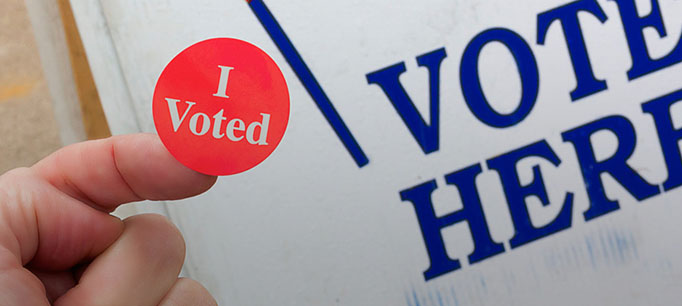
Commentary: California Leads in Voting Reform

When Gov. Jerry Brown recently signed Assembly Bill 1461, the New Motor Voter Act, he ushered in a new chapter of California electoral history. The law seeks to boost California’s recent record-low election turnout rates with a new system of automated registration.

Under existing law, citizens must register to vote before they can cast a ballot. The new law all but eliminates this step by registering anyone who applies for a new driver’s license, renews an old one or updates an address with the DMV, unless they opt out. With the stroke of a pen, California is now at the vanguard of American voting reform.

(Continue reading on sacbee.com.)

Electoral Reforms Face New Test

California’s political reforms—redistricting and the top-two primary—were meant to shake up the status quo through radically redrawn voting districts and a primary system that let voters choose any candidate of any party, and advanced the top two candidates (also regardless of party) to the fall election.

The first time out the gate, in 2012, the reforms didn’t disappoint: numerous incumbents retired, many seats were open, and a lot more candidates threw their hats in the ring. It was the shot across the establishment’s bow that supporters had been looking for.

Things are calmer in this year’s legislative and congressional races. The most obvious sign: an unusually large number of candidates facing no formal opposition. There were eight such races in 2012 and an average of 7 under the previous primary system. Today there are 20.

These candidates may not remain completely uncontested, since there are reasons to think we may see more write-in candidates this time around. The deadline for filing as a write-in—at least one whose votes are actually counted—comes after the normal candidate filing deadline. Under the top two, potential write-ins can wait to see whether a heavyweight ends up uncontested and then jump into the race for less money and effort. As the only other candidate, these write-ins will be guaranteed a spot in the fall campaign. This was not a popular approach in 2012, but candidates are still learning the system, so we may be seeing this strategy coming into its own. We will know more once the official write-in list is announced later this month.

In 2012, there were also a number of incumbents who faced challengers from within their own party. This was a sign, in part, of the better odds facing those challengers under the top two system: so long as they finished at least in second place, they would get another chance to topple the incumbent in the fall campaign. Nonetheless, only a handful of these challenged incumbents lost. Perhaps as a result, fewer incumbents overall face an intra-party challenge this time: 28% this year compared to 42% in 2012. And with only a couple exceptions, even those incumbents facing an intra-party contest are in a dominant financial position.

Finally, there are fewer open seats this year. In 2012, an extraordinarily large number of incumbents chose to retire or run for another office, leaving nine seats open for the U.S. House and 35 open for the state assembly (open seats for the state senate were more in line with past experience). This year, there are six open seats for the U.S. House—still high by historical standards, but less so. And the 23 open seats for the assembly aren’t all that many, at least in the era of term limits.

However, the seats that have come open are hotly contested, as open seats usually are. The great majority of these races feature at least three candidates, and a few have far more than that—with the prize going to Congressional District 33, where no fewer than 18 candidates are vying to replace retiring incumbent Henry Waxman. Moreover, fundraising in these races is much more evenly distributed across a range of candidates.

We are still early in the election cycle, and between the primary and the general there are still plenty of opportunities for surprises. But so far, it looks like the revolution, such as it was, is coming to a close, and a new status quo may be settling into place.

The Power of the Primary Voter

Voters are starting to think seriously about whether or not to vote on June 3—in fact, the first vote-by-mail ballots are already being returned. And because of a recent change to California’s primary system, this decision about voting will be more important than ever.

The voters who turn out in California’s primary elections have typically been different than the ones who vote in the fall. They have been older and less diverse, with a smaller share of Latinos and Asian-Americans. They have also tilted Republican in most cases. In short, the primary electorate is the California we once were, not the California we have become.

These differences mattered in the past, but not as much as they might have. Any party that placed a candidate on the primary ballot would be guaranteed to have a candidate on the ballot in the fall. Indeed, that was the point of the primary: to choose one person to represent each party in the general election. Now California has a radically open “top two” primary. Voters can vote for any candidate they like, and the top two candidates, regardless of party, advance to the fall election. That means a party is no longer guaranteed a spot in the final round.

Before the top two, the differences between the primary and the general electorate could affect the kind of candidate nominated by each party, but not whether the party nominated a candidate at all. Today, the primary electorate has much more say over what the general election will look like.

When the state first used this system in 2012, almost one-fifth of the races ended up with same party contests in the fall. This included Congressional District 31, where two Republicans faced off in a competitive district that otherwise leaned Democratic. If the general electorate had turned out in the primary, it almost certainly would have been enough to change District 31 into a race between a Democrat and a Republican—and the Democrat would have had a decent chance of winning. That’s a problem. Of course, this was just one district. But a bias in the primary electorate could create—or prevent—a same-party contest in a statewide race as well.

What’s the solution? Every primary system runs some risk of strange results, but the top two is especially aggressive at closing off alternatives. It might make sense to offer a sort of “safety valve”—the option of a third candidate in the fall in cases where there was enough demand for one. California used to allow both independent and write-in candidacies in the fall, but the top two banned both. The legislation removing these options was passed with a simple majority in the legislature, so it would be relatively easy to change. The bar for such safety-valve candidacies could be set high enough to ensure they would remain rare. (Of course, there could always be legal challenges, but the merits of that approach are better left to lawyers to determine.)

The top two offers a lot more choices to those who show up to vote in the primary. We should be careful about giving these voters too much power to then dictate the choices for everyone else.

California’s Quietest Reform

California has adopted a lot of high-profile political reforms recently, including a new way of drawing district lines and a radically open primary system. But there’s another reform that is transforming the state legislature without attracting nearly as much national attention.

In June 2012, California voters approved Proposition 28, an important change to the state’s term limits law. Before the reform, a single person could serve a maximum of three two-year terms in the Assembly and two four-year terms in the Senate, a total of 14 years. Under the new law, a person can serve up to 12 years in the Assembly, the Senate, or both. The reform sounds like a tightening of term limits—12 is less than 14—but because legislators no longer face a limit in each chamber, the average length of service will probably increase significantly.

A lot of people have blamed dysfunction in the legislature on the old term limits. Observers have argued that the legislature is short on the kind of relationships and expertise that develop over time, which has led to acrimony and reliance on the expertise of lobbyists. Also, it is often said that members looking to build their records as quickly as possible flood the legislature with unimportant bills, while big problems linger because they take too much time and expertise to address.

When will we know whether the new term limits are helping? Sooner than you might think. Turnover in the legislature has been high since the law took effect. Redistricting helped force a lot of retirements in 2012, a few incumbents lost to newcomers, and there have been several special elections in 2013 to fill vacated seats. As a result, more than half of the Assembly (42 out of 80) is already covered by the new limits.

The new law’s effect on the Senate has been smaller: only two senators, Richard Roth and Andy Vidak, are covered by the new limits. But that’s because termed-out members of the Assembly dominate Senate races and probably will for a while to come. So even though it may take longer for the Senate to switch over, it’s less important if we’re concerned about expertise: since most senators are former members of the Assembly, they already have legislative experience.

Regardless what happens in the Senate, the pace of turnover in the Assembly won’t slow down much. Sixteen assemblymembers will term out this year, and it looks like another seven will be stepping down anyway. When the dust settles this fall, no more than 17 members of the Assembly will be covered under the old limits. The rest will be legally free to serve for at least another 10 years—in some cases 12.

The new California Legislature is coming, ready or not.