Can Pretrial Decisions Be Improved?

Controversy over the cash bail system in California has led to a number of recent legal and legislative actions that may spell the end of cash bail in the state. If that happens, risk assessment systems would take on heightened importance in decisions about pretrial detention. At stake are concerns about equity, consistency, and transparency in the pretrial process.

Californians who have been arrested but not yet convicted are 84% more likely to be detained than defendants in other states. California’s high bail amounts contribute to this high rate. Of the defendants who are released on bail, nearly all secure their release via bail bondsmen, who require a nonrefundable deposit equal to 10% of the bail amount. The average bail amount in California in 2015 was $50,000—five times higher than the national average. Many poor and middle class individuals lack the means to secure pretrial release through bail—one study found that 40% of Americans do not even have $400 on hand to cope with an emergency.

State and federal courts have begun to address this inequity. Last year, a state appellate court ruled that defendants should not be held before trial solely because they cannot afford bail. More recently, a federal judge ruled against San Francisco’s use of bail schedules, which set bail amounts. The judge found that although bail schedules seem scientific and transparent, bail amounts are set inconsistently, their origins are unclear, and they do little to ensure public safety.

Additionally, judges can override recommended bail amounts based on their assessment of a defendant’s likelihood of misconduct—arrest or failure to appear in court—if he or she is released during the pretrial period. And they can do so without reporting why. The result has been inconsistency in pretrial detention decisions for defendants who committed similar crimes.

Concerns about inconsistency and lack of transparency motivated the recent passage of Senate Bill 10, which eliminates cash bail and mandates the use of risk assessment tools. These tools use mathematical models to predict pretrial misconduct. Pretrial detention recommendations based on these predictions are supposed to guide judges’ pretrial detention decisions. SB 10 will be subject to a November 2020 referendum—but it’s worth noting that 49 of California’s 58 counties already use some type of risk assessment tool.
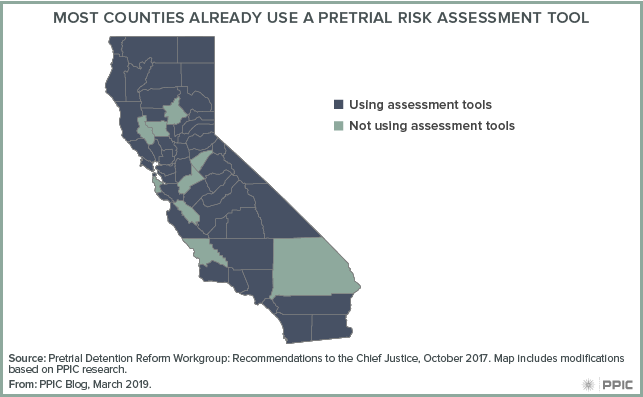
figure - Most Counties Already Use a Pretrial Risk Assessment Tool

Risk assessment tools are not without controversy. They have been challenged as unfair and can only surmount this challenge if they are used within transparent and consistent risk assessment systems. Importantly, judges will still be able to override recommendations from those systems.

To ensure more transparency, it will be critical to collect information about why judges override such recommendations. Only with court data that comprehensively records information used to make pretrial detention decisions can the essential work of ongoing evaluation take place. These evaluations are key to determining how well risk assessment systems protect individuals’ liberty while also ensuring public safety—and how potential sources of unfairness in them can be identified and addressed.

Pretrial Risk and Cash Bail

Most of California’s jail inmates are unsentenced defendants awaiting arraignment, trial, or sentencing—and this heavy reliance on pretrial detention has come under scrutiny in recent years. The goals of pretrial detention are to make sure that defendants appear at court hearings and to ensure public safety. But California’s high pretrial detention rates have not been associated with more defendants appearing in court or lower levels of rearrest. Reforming the current system by allowing more defendants to be released pending trial could allow the state to free up scarce jail beds and realize substantial cost savings—while maintaining public safety.

Last year, state lawmakers examined the issue of cash bail, the predominate means by which defendants can be released pretrial. Legislation to change the system is pending. Under cash bail, judges can order defendants to pay a certain amount—which varies based on the alleged offense—in order to secure release. In most cases, defendants contract with bail bond companies to deposit the full amount of the bond with the court in exchange for a service fee (usually 10% of the bond). If the defendant complies with all court orders during the release period, the bond company gets the deposit back and keeps the defendant’s premium as payment. The idea is that the threat of financial penalty helps prevent pretrial misconduct—for example, making offenders less likely to flee the jurisdiction and more likely to appear in court.

However, there are several flaws in the bail system. Bail is calculated by offense, making it more challenging for defendants cited for more serious offenses to obtain release. This may make intuitive sense, but it turns out offense category is not typically a strong predictor of future misconduct. For instance, PPIC research found that misdemeanor probationers were in fact more likely to be booked into jail at least two times after release (19.6%) than felony probationers (17.6%). Moreover, cash bail makes it more difficult for low-income defendants to obtain release, regardless of their risk to public safety, raising concerns about whether the system is treating wealthy and poor individuals equitably.

The primary alternative is a risk-based framework in which law enforcement employs tools called risk assessments to determine which offenders can safely be released pretrial. Risk assessments use demographic data and information pertaining to a defendant’s criminal history to predict a defendant’s probability of disobeying the terms of his or her release. Some of these models show great promise. For example, researchers found judges in New York could reduce the jail population by 42% without affecting crime rates by following their model’s release recommendations.

But these tools have limitations. California already uses a range of risk assessment tools at the state and county levels, but they vary in predictive power based on whether they have been validated. Validating a risk tool means testing it using local data from the community of offenders it will be assessing. Counties using unvalidated, out-of-the-box risk assessments could improve their tools’ predictive powers by following the example of counties like Riverside, where county agencies collaborated with academics to tailor a tool that had been originally developed in Virginia to Riverside’s unique characteristics—boosting the model’s accuracy.

Local validation studies consume a lot of time and resources. Riverside’s took two years and required data from over 500 offenders. However, if the state continues to emphasize risk-based reform and evidence-based practices to improve its corrections system, making these models work for California and its counties should be a priority.


Testimony: Bail and Pretrial Detention

The Alameda County Board of Supervisors Public Protection Committee, along with Assemblymember Bill Quirk, chair of the assembly Public Safety Committee, held a special hearing on the bail system on Friday, February 19, 2016, in Hayward. They invited Sonya Tafoya, PPIC research associate, to testify about the impact of bail on the jail system in California. Here are her prepared remarks:


Bail Overview

The purpose of California’s bail system is to ensure that defendants appear in court and to protect public safety (Cal Const. art I § 28(f)(3)). With the exception of capital crimes and certain felony offenses, bail is a right for most offenders (Cal Const. art I § 12, PC § 1271). If the court finds that defendants do not pose a risk of flight or a risk to public safety, it has the discretion to release them on their own recognizance.

The most comprehensive data source available, the State Court Processing Statistics (SCPS), indicates that for felony offenses, California’s large urban counties have had high rates of pretrial detention (59%) relative to the rest of the United States (32%). Some of this difference can be attributed to California’s high bail amounts. California’s median bail amount was $50,000, five times higher than the rest of the United States. Yet, even with relatively high rates of detention, California has had higher failure-to-appear rates (6.6% versus 2.9%), and higher rates of non-violent felony rearrests (12.4% versus 10.1%) than the rest of the United States. Re-arrests for violent felonies are only half a percentage point lower in California (1.4%) than the rest of the United States (1.9%) (Tafoya, 2015).

It should be noted that data collection for the SCPS was discontinued in 2009, and in the absence of more recent SCPS or other statewide data, we cannot determine whether these rates of detention, failure to appear, and re-arrest have persisted. The effect of Proposition 47 on median bail amounts is also unknown. But, as a practical matter, these results suggest that California has not gotten a very good return on its investment in high pretrial detention rates.

Jail Capacity Overview

A brief overview of jail capacity in California helps quantify the scope of this issue.

  • The average daily population of California jails was about 73,000 (2nd quarter, 2015, Board of State and Community Corrections). Most jail inmates (46,000) are unsentenced; the remaining 27,000 are sentenced.
  • California’s jails hold mostly those charged with or convicted of felony offenses (84%).
  • California’s jail system as a whole is operating near its rated capacity of about 80,000 (Board of State and Community Corrections, April 2015). Overall, the system is operating at about 91 percent of rated capacity.
  • The extent of jail overcrowding varies across counties; 37 facilities in 19 counties are operating under court-ordered population caps.
  • Facilities with population caps are required to release inmates when their populations reach a specified threshold (often 90% of rated capacity). In the 12 months following realignment, these facilities averaged about 12,000 capacity releases a month. In the wake of Proposition 47, the average has declined to about 10,000 per month.

Moving Forward

Demands for lower bail amounts are generally based on assertions that low-risk defendants are being held in jail solely because they lack the financial means to post bail. Lowering bail across the board would increase California’s rate of pretrial release (Tafoya, 2013). From a public safety perspective, however, this may not be the most prudent approach. A county jail population assessment would be a straightforward first step toward understanding the resources that are being devoted to detaining low-risk defendants. The assessment takes a snapshot of the jail population at a point in time and describes who is being held in jail, for how long and and why. It examines such factors as demographics, current offense, criminal history, status as a sentenced or unsentenced inmate, immigration or other agency holds, bail amounts, and length of incarceration.