Video: New Insights into California Arrests

Crime, policing, and community relations are subject to heated debate, but little is known about the first step in the criminal justice process: arrests. Who is arrested in California and what are they arrested for? How have arrest patterns changed over time and how do they differ across the state? Last week in Sacramento, PPIC researcher Magnus Lofstrom outlined findings from a new report and Brandon Martin—a PPIC research associate—moderated a panel discussion that put these trends in the context of state legislation and local police-community relations.

The PPIC report finds that overall arrest rates have dropped dramatically over the past few decades, largely due to declines in misdemeanor arrests. While there have been significant declines in arrests among juveniles and young adults, men, and African Americans, arrestees still tend to be younger, male, and nonwhite. After presenting these and other key findings, Lofstrom stressed that “this report raises more questions than it answers.” Future research, he said, will explore the factors that contribute to trends and differences in arrest rates across demographic groups and jurisdictions across the state. It will also look at the impact of recent criminal justice reforms.

The panelists focused on the importance of addressing the larger issue of long-term trust between law enforcement and the communities it serves. Gabriel Caswell, counsel to the California Senate Public Safety Committee, said that recent reforms such as the Racial and Identity Profiling Act have tried to strike a balance between officer safety and community transparency: “If the community has at least somewhat more access than they’ve been given historically, I think that will go a long way toward rebuilding trust.”

Marisa Arrona, local safety solutions project director for Californians for Safety and Justice, highlighted efforts to shift from reactive policing to the Blueprint for Shared Safety: “Shared safety is more than the absence of crime; it’s got to be the presence of well-being.” Instead of assessing safety only through crime rates, communities can also use other measures, such as harm reduction among vulnerable populations, access to victim services, or the number of former offenders who have access to jobs.

Daniel Hahn, Sacramento police chief, also cautioned against relying exclusively on crime numbers: “You’ve got to be very careful of what’s behind the numbers and make sure it’s actually meaningful to the community.” He stressed the need to look beyond simple solutions. In order to build trust between police and the communities, he added, “We gotta change the way we hire, change the way we train, include the community in the police department and the police department in the community.”

Toward Understanding Racial Disparities in Arrests

With tensions between law enforcement and minority communities continuing to make headlines, media outlets and academic researchers both report stark racial and ethnic differences in criminal justice experiences, including sentencing and incarceration. The disparity between African Americans and whites is especially striking. For example, the prison incarceration rate in California is 4,180 per 100,000 residents for African American men, compared with 420 for white men. It is likely that this inequality is significantly affected by the first step in the criminal justice process—arrests.

California’s various law enforcement agencies make a substantial number of arrests each year—1.35 million in 2016. While this is a staggering number, it’s also the lowest number of arrests since 1980 and marks a dramatic decline of more than one million arrests (64%) since a peak in 1990.

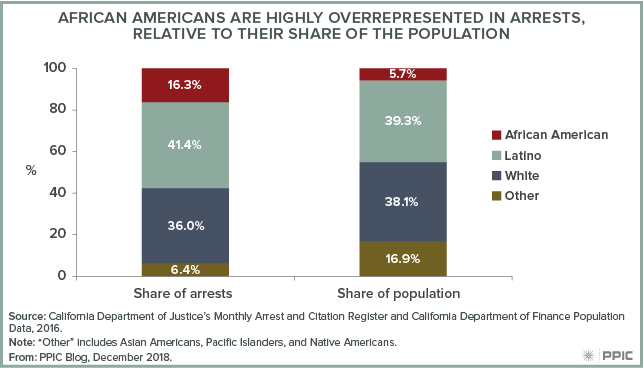
Looking at racial disparities, we find that African Americans are significantly overrepresented among those arrested in California. In 2016, African Americans made up less than 6% of the population but more than 16% of arrests. Latinos were slightly overrepresented in arrests as well, representing 39% of the population but 41% of arrests.

Though much of the penal code is determined by the state legislature, the state does not closely monitor how arrest decisions change over time or vary across jurisdictions, nor how these decisions may affect demographic groups differently. Two efforts—one implemented by the state legislature and one by PPIC—seek to fill this knowledge gap and will bring data-driven information into the broader discussion about policing and community relations.

In 2015, California’s legislature passed the Racial and Identity Profiling Act (AB 953). This legislation requires law enforcement agencies to begin collecting data in 2018 on all initial police interactions with the public, including reason, location, race/ethnicity, gender, and age. While this will provide an opportunity to learn more about law enforcement interactions, the data will not be available for statewide analysis until 2023 or later.

In the meantime, PPIC has launched a project to begin identifying areas in need of attention in California arrests and to frame the conversation for sustainable solutions at the state and local level. In our first report, we examine trends over time and provide a descriptive profile of arrestees, including patterns in race/ethnicity, gender, age, offense type, and the county where the arrest took place. Our interactive tool allows for deeper exploration of arrest rates across California counties.

Over the next two years, we will further examine whether arrestees were booked into jail or cited and released in the field. We will also seek to understand possible contributing factors to these arrest patterns—such as crime rates, law enforcement and correctional resources, economic conditions and expenditures, and demographics. This project uses unique data from the California Department of Justice’s Monthly Arrest and Citation Register (MACR).

As the state and local jurisdictions continue their data collection efforts on police interactions, PPIC’s research will provide a better understanding of long-term trends in arrests and differences throughout the state. Stay tuned for more insights on this critical but understudied aspect of California’s criminal justice system.