Video: Travis Allen’s Priorities

Mark Baldassare, PPIC president and CEO, asked Assemblymember Travis Allen, candidate for governor in 2018, to name the top three issues with major consequences for the state’s future—a question Baldassare has asked of all gubernatorial candidates appearing before PPIC audiences. Allen said his top priorities would be

  • Cutting taxes
  • Getting tough on crime, and
  • Fixing roads and expanding freeways

Allen, who is campaigning to repeal the state gas tax increase passed last year, said California is already collecting enough tax revenue to improve roads and unclog the freeways.

“We can fix our roads, we can expand our freeways, we don’t need to raise taxes further to do it,” he said. He added that voters should be the ones to decide if they want to raise taxes.

The conversation with Allen is part of the PPIC Speaker Series on California’s Future. PPIC is inviting all major candidates for governor to participate if they reach a certain threshold in the polls. The goal is to give Californians a better understanding of how the candidates intend to address the challenges facing our state.

Watch all candidate videos

Video: Feinstein on Her Role in a New World

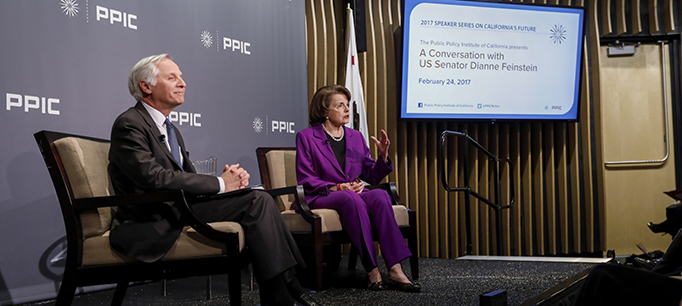
Senator Dianne Feinstein was clear about the challenges ahead for a California Democrat in contentious times.

“Here we are: outnumbered, outvoted, in the West, fairly liberal,” she said.

Speaking before an energetic capacity crowd in San Francisco, Feinstein said her office had received more than a million phone calls about Trump’s cabinet nominees. She described her approach to them: careful evaluation, rather than blanket opposition—an approach too conciliatory for some sign-carrying audience members. Feinstein said that in her role on the Senate Judiciary Committee, she needed to work with the administration officials in charge of national security and felt she could work with Trump appointees James Mattis, defense secretary; John Kelley, secretary of homeland security; and Mike Pompeo, CIA director. But she opposed other nominees because they lacked credentials for the job or they aren’t right for the county, she said. Nevertheless, they went on to win approval.

“The key for me is to figure out how we can begin to win some of these battles.”

Asked about Trump’s nominee to the Supreme Court, Neil Gorsuch, Feinstein wouldn’t say how she would vote. She said she will be particularly interested in his views on gun laws and on women’s reproductive rights.

Feinstein’s visit was greeted by dozens of protesters who marched outside, upset that she had not hosted a traditional town hall. Inside, Feinstein touched on a range of issues from climate change to immigration to health care, in a wide-ranging conversation with Mark Baldassare, PPIC president and CEO. His questions included a number that PPIC solicited online in advance of the event.

Video: PPIC’s Annual Survey on the Environment

As California pursues its goals to reduce greenhouse gas emissions—and considers still more ambitious ones—PPIC’s annual survey on environmental issues asked the state’s residents their views on climate change and energy. At a recent event in the capital, PPIC researcher Lunna Lopes provided the survey findings. Among the key points:

  • Californians see global warming as a serious threat—and most do not think action to reduce global warming will lead to fewer jobs.
  • There is strong support for the greenhouse gas emission reduction requirements in AB 32 and SB 32.
  • Californians favor the energy goals in SB 350, and they also favor state support for solar power and electric vehicles.
  • Many say water is the state’s top environmental issue—but most do not know the reduction targets of their local water district.

Briefing Focuses on Survey Election Findings

Less than two months before the election, PPIC’s latest survey looked at Californians’ views on the governor’s race and four statewide ballot measures. Dean Bonner, associate survey director, presented the findings at a briefing in Sacramento on Wednesday. As most of the media coverage noted, the survey found that Governor Brown is doing well in his reelection bid and that the water bond he approved is fairly popular.

The survey found that Proposition 2, labeled the Budget Stabilization Act in the ballot statement but known elsewhere as the rainy day fund, does not currently have majority support among likely voters. Proposition 45, which would regulate health insurance premiums, has a similar level of support, but Proposition 47, which would reduce sentences for some crimes, is favored by 62 percent of likely voters. The survey also found high levels of concern about the drought and mixed feelings about the Affordable Care Act and immigration policy priorities.

Drought Watch: Keeping Better Track of Water

This is part of a continuing series on the impact of the drought.

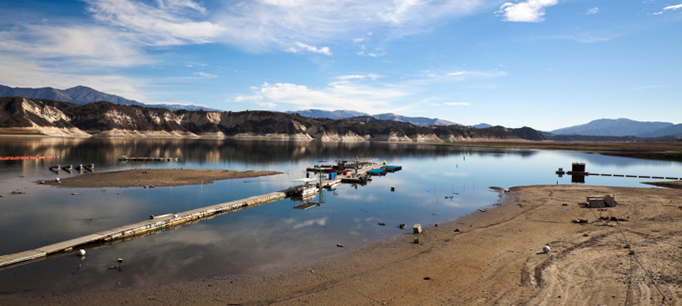
In most years, the arrival of May signals the end of the rainy season. As California transitions from hoping for rain to managing its absence, it is appropriate to assess how we have handled this drought so far. In a recent blog post, we, along with our colleagues at UC Davis, UC Hastings, and Stanford University, identified several key lessons from the current drought. One of these is the need to modernize the way we track water supply and use.

To illustrate, just this past week the State Water Resources Control Board released a series of graphs that summarize the gaps between projected supply and demand for this year. These graphs form the basis for determining who may be told to curtail the amount of water they take out of rivers when supplies are scarce. The take-away from these projections is that significant shortfalls will occur starting this month—when the irrigation season starts in earnest. Under California’s water rights system, irrigators holding junior water rights—i.e., rights established more recently—could be completely cut off in most areas. It also appears that unprecedented cuts will occur for senior water rights holders as well.

Although these demand and supply curves appear precise, the state board is handicapped by a lack of good information on water supply and use. To manage the drought more effectively, the board needs better information in two key areas.

First, there have been major advances in technology that can be used to measure flow. These include sophisticated remote sensing techniques, computer modeling, and sensor networks. Although there has been progress, the state has been slow to adopt these new technologies. For many rivers the board, and its partner the California Department of Water Resources, are, at best, making educated guesses. In addition, the state uses protocols for managing this information that were adopted in the early 20th century. In a drought there is need for real-time information and forecast-based projections to manage diminishing supplies.

Second, who uses how much water, and when, is acutely important when river flows are low, because a handful of users can have great impact. Although reporting on water use has improved since legislation passed in 2009, the board has not been in a position to verify the accuracy of self-reporting by thousands of water rights holders, including the oldest, most senior water right holders. Statewide, there is no comprehensive understanding of how and when water rights holders make use of alternative supplies, including the state’s overdrafted groundwater basins.

Since the economic, social and environmental consequences of water management during a drought are especially high, people understandably want to see the board administering diversion curtailments with precision and in real time. But during the wet periods, the legislature and state agencies tend to ignore this issue because there is more water to go around and little public pressure to correct information gaps. Then, when the wet inevitably turns to dry, there are insufficient time and resources to address the problem.

Droughts provide the political and economic motivation to get our water management system into better shape. Step one would be to invest in modernizing the way we measure, forecast, and administer water use—hopefully before the next drought.

Drought Watch: Essential Elements for a Water Bond

This is part of a continuing series on the impact of the drought.

In both houses of the California Legislature, multiple versions of a new water bond are being amended and debated to make the June deadline for replacing the $11.1 billion bond now slated for the November election. Originally intended for the November 2010 ballot, the bond has been twice delayed due to concerns it would not pass. The March 2014 PPIC Statewide Survey showed a bump in public approval since last year, with 50 percent of likely voters now saying they would approve it, up from 42 percent in March 2013. Survey responses to other questions about water suggest that this rise in support likely reflects concerns over the drought. For example, a record share of residents (15%) named water as the most important issue facing the state (up from 2% a year earlier).

As the legislature considers the final size and shape of this new bond, it is worth reviewing how bond funds have been used in the past and the areas that most need bond support in the future.

The 2000s were a big decade for water bonds, with approved funds totaling almost three times as much as the three previous decades combined. Even so, bond funds currently only contribute about $1 billion a year to the water sector, a small portion of the $30 billion that is spent annually on the state’s water system.

Moving forward, new bond funds are likely to be more limited (as shown by the current bond’s bumpy road to approval), so it makes sense to focus them on areas that lack sustainable and reliable funding sources. As we show in our report Paying for Water in California, these areas include small water systems in rural, low-income communities, flood protection, stormwater pollution management, aquatic ecosystem recovery, and integrated water management. The bond funds approved in the 2000s have been spent overwhelmingly in these areas, yet the need is still great.

For activities that more readily raise funds from local ratepayers—such as water supply and wastewater management—future bond support should be limited to projects that generate broad public benefits. This might include water supply projects that promote better integration of our water system (e.g., by capturing stormwater, which can improve both water supply and prevent pollution) or ecosystem recovery (e.g., by improving the quality or quantity of water to support fish and wildlife).
Even if a new water bond passes this fall, California will need to find other ways to pay for small system drinking water quality, critical improvements to flood protection, stormwater management, aquatic ecosystems, and integrated water management. As part of its deliberations, the legislature will need to think beyond bonds, and consider new statewide fees or special taxes—such as a small surcharge on water use or a small increment on the sales tax—to help fill these gaps with a reliable revenue stream.

Chart Source: Paying for Water in California.

Videos Highlight Water Finance Event

The drought has focused attention on water supply and highlights the crucial role of funding in supporting our water system, said Ellen Hanak, PPIC senior fellow, at a half-day conference PPIC hosted last week at the Sacramento Convention Center. The conference focused on the issues highlighted in the PPIC report Paying for Water, which pinpoints funding gaps in five key areas of water management. Hanak opened the conference with a presentation of her report, starting with an overview of how California pays for water. She noted that state general obligation bonds make up just a small part of the $30 billion spent annually on the water system.Most funding, about 85 percent, comes from local sources—rates, fees, and taxes. However, legal obstacles make it difficult for local agencies to raise money. Hanak then summarized the areas in which the state is failing to deliver the level of services California residents expect. She closed with a roadmap of recommendations for funding reform.

In the first panel discussion, experts from local water agencies and the governor’s office took up the issue of “fiscal orphans” for which there is no clear revenue stream—areas such as flood control, stormwater, and safe drinking water for small, disadvantaged communities. panelists talked about their challenges and successes in building better integrated systems in these orphan areas.

The second panel tackled a series of tough questions: How can the state partner with local and regional agencies to improve water management? What has the state done well and what can it do differently? Panelists with both state and local perspectives joined this lively discussion.

The third panel considered some of the legal challenges posed by Propositions 218 and 26. Panelists said these constitutional amendments have pushed water authorities to be more transparent in their use of taxpayer funds. But the measures and the courts’ interpretations of them have also made it more difficult to fund water solutions.

Video Highlights New Survey’s Key Findings

The March PPIC Statewide Survey examines several major issues in California, including water, high-speed rail, marijuana legalization, and taxes. The survey also finds that three months before the primary, Governor Jerry Brown remains a strong favorite for re-election this year.

The wide-ranging survey also looks at Californians’ views on national issues—such as immigration and health care reform, and abortion —and provides approval ratings on federal elected officials.

PPIC research associate Jui Shrestha presented the results of the survey at a luncheon briefing in Sacramento.

Testimony: Funding to Promote Drought Resilience

The Assembly Budget Subcommittee for Resources and Transportation–which oversees budget allocations for water-related state agencies–convened a group of experts on Wednesday to provide an update on the current drought. PPIC senior fellow Ellen Hanak gave the members an overview of state and federal emergency drought funding for California and suggested other fiscal measures that the legislature should consider to make California more drought resilient. Here are her prepared remarks.


Good morning and thank you for the invitation to address the committee. I’d like to focus my remarks on how the legislature can help California become more drought-resilient, both in the near term and over the longer term. And since your committee is tasked in particular with considering budget measures, I will highlight the question of funding.

As you all know, several weeks ago the legislature passed, and the governor signed, emergency drought legislation. These bills made $687 million available for a variety of programs. This state funding package came on the heels of an announcement of $222 million in federal drought funding for California—bringing the total to $909 million. In the state’s case, most of the funds (80%) come from previously authorized state general obligation (GO) bonds, with the remainder from the general fund (11%), new cap and trade auction revenues (6%), and a variety of other funds (3%). A large portion of the federal funds comes from the 2014 Farm Bill.

The table provides an overview of the allocation of these funds. About a quarter ($239 million) is for near-term emergency assistance to communities facing special hardship because of the drought. A small share (0.3%, or $2.3 million) is directed to emergency ecosystem support. And nearly three-quarters of the total ($668 million) is directed toward improving water use efficiency and reliability. Although some of the investments in this last category may help in the near term, most should be viewed as efforts to make the state more drought-resilient over the longer term.

This breakdown between near- and longer-term impacts of drought spending reflects the realities of drought response: In the very near term, cash can provide helpful support to affected communities, but it can’t fundamentally change the water supply situation. One of the very interesting lessons from the current drought is that two decades of investments by California’s major urban utilities—in areas such as water use efficiency, above- and below-ground storage, and non-traditional supplies like recycled wastewater and stormwater—has made these communities much more capable of getting through droughts. The new spending earmarked for improving efficiency and water supply reliability should help California continue to build its resilience to future droughts.

The drought has also renewed legislative attention on putting a new GO bond on the November 2014 ballot to fund water management in California. As we show in a new PPIC study on water finance, Paying for Water in California, state bonds approved since 2000 have helped fund a range of important water management activities. However, bonds can at best be just a part of the overall solution to meeting California’s critical water funding needs. The legislature can and should pursue other actions to give California a sustainable and reliable funding system for water. Some examples include:

  1. Adopting new state fees and special taxes to fill critical gaps. For instance, a small surcharge on water use could support integrated water management and protect our threatened aquatic ecosystems, and a small surcharge on chemicals could help fund pollution prevention and safe drinking water in affected communities.
  2. Passing enabling legislation to make it easier for local agencies—the front-line managers of water resources—to raise the funds they need. One example would be extending the authority to assess fees for groundwater pumping and basin replenishment—now available to just a handful of communities—to groundwater management agencies across the state.
  3. Providing guidance to the courts on how to interpret California’s Constitution so that local water agencies can improve water supply reliability. In particular, agencies should have the flexibility to adopt tiered, conservation-oriented rate structures and fund activities such as recycled wastewater and stormwater capture. In some cases, narrow judicial interpretations of Proposition 218—a voter-approved amendment passed in 1996—have created uncertainty about the ability of local agencies to use fee revenues to carry out such programs, which are essential for drought resilience.

In closing, it’s worth recognizing that droughts are a recurring feature of California’s climate. The current crisis presents an opportunity to continue improving our water system’s ability to cope with water scarcity in the face of population growth and a changing climate. By supporting the emergency funding package, the legislature has already taken some important steps to help alleviate the worst effects of this drought and to build future drought resilience. With additional steps, the legislature can help ensure that our water system can support a healthy economy, society, and environment over the longer term.

Table sources: California Senate Bills 103 and 104 (chaptered March 1, 2014); White House Fact Sheet on drought response (February 14, 2014).

Drought Watch: Roadblocks to Efficient Funding

This is part of a continuing series on the impact of the drought.

The drought has prompted California to redirect hundreds of millions of dollars of remaining state bond funds and other revenues to make the state more resilient in the future. These funds are certainly welcome, but it’s important to see this spending in perspective. As we show in a new PPIC report—written with a team of co-authors from other institutions—the contributions of state money are small change when it comes to spending on water. Most of the $30 billion spent annually to support California’s water system is raised by local and regional water agencies.

The good news is that California’s urban water and wastewater utilities are in relatively good fiscal health. Thanks to their significant investments to improve water supply reliability in the two decades since the last major drought, California’s major urban areas—and the state’s economy—will largely be able to weather this one. Crucially, these utilities have been able to make the needed investments by raising local water rates.

However, looming legal challenges may limit the ability of local agencies to make continued investments in modern, integrated water management—investments that would better prepare us for population growth, climate change, and future droughts. Proposition 218, a constitutional amendment adopted by the state’s voters in 1996, requires water bills to reflect the costs of service to each individual parcel. As some recent court cases have shown, a narrow interpretation of this requirement can present roadblocks to several important management tools:

  • Conservation pricing. Tiered pricing—which charges higher per gallon prices for larger amounts of water use—can promote conservation. And, because new water sources often cost more than existing supplies, higher-priced tiers are justified. But it is difficult to establish a precise link between the price paid and the amount of water saved at each property. As a result, these rate structures may be legally vulnerable even though they improve utilities’ ability to maintain reliable water service.
  • Use of new water sources. Non-traditional sources of water, such as recycled wastewater and stormwater, improve overall system reliability for existing customers, even if not all customers use those specific sources. But a recent trial court interpreted Proposition 218 to mean agencies could not charge customers for any part of water service (in this case, recycled water) that was not physically available to them.
  • Sustainable groundwater management. One promising way to stabilize California’s overtaxed groundwater basins is by charging a per gallon fee to limit pumping and to cover the costs of recharging basins with other supplies. But because groundwater overdraft doesn’t affect each parcel in exactly the same way, groundwater agencies have also faced court challenges regarding the legality of these fees.

To enable our water system to respond effectively to future droughts, the courts need to keep the entire water system in mind when responding to rate challenges. And over the longer term, California needs to better align its funding laws to the goals of modern water management. In a state where drought is a fact of life, this alignment will allow us to manage this crucial resource far into the future. Asking our water managers to account for the cost and location of each drop of water when developing their water rate structures will undermine recent momentum toward a more sophisticated and interconnected water system.