
Californians’ Attitudes Toward Gun Control

Following last week’s tragic shooting in Thousand Oaks, California, the national debate over stricter gun policies is once again at the forefront. So far in 2018, there have been more than 300 mass shootings in the United States, including more than 30 in California.

Currently, California’s gun control laws are some of the strictest in the nation. For example, the state bans assault weapons, mandates thorough background checks, and enforces a 10-day waiting period for new purchases. California also requires a minimum age of 21 for buying shotguns and rifles, and imposes lifetime bans on gun ownership for those convicted of domestic violence or involuntarily hospitalized more than twice in one year.

In PPIC’s October Statewide Survey, we asked Californians if in general, they thought the laws covering gun sales should be made more strict, less strict, or kept as they are now. A solid majority of Californians (64%) replied that laws covering the sale of guns should be stricter; 21 percent said they should be kept as they are now, and just 13 percent said they should be made less strict. Californians are just as likely as adults nationwide to say gun laws should be stricter and slightly less likely to say laws should be kept as they are now, according to an October Gallup poll (61% more strict, 30% kept as they are now, 8% less strict).

Across political parties, an overwhelming majority of Democrats (82%), about half of independents (49%), and one in three Republicans (31%) say gun laws should be stricter. Majorities across regions and age, education, income, and racial/ethnic groups prefer guns laws to be stricter. Women (73%) are much more likely than men (55%) to hold this view.

At least six in ten Californians have said that laws covering the sale of guns should be stricter in periodic PPIC surveys since 2015. Nonetheless, Californians’ perceptions on gun laws have fluctuated in response to gun-related incidents. For instance, the share of Californians in our March survey who thought gun laws should be stricter was 9 points higher than today (73% to 64%)–a high mark in PPIC surveys, occurring in the aftermath of the high school shooting in Parkland, Florida.
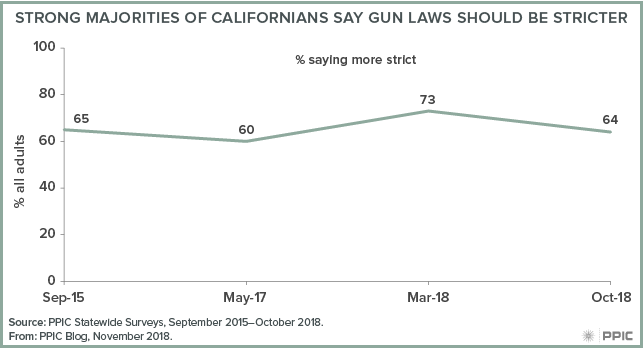
Notably, Californians across many political and demographic groups in our March survey were more likely than those in our October survey to be in favor of making laws covering gun sales to be stricter. Following last week’s shooting in Thousand Oaks, Californians’ preference for stricter gun laws may increase again.

Amid widespread support for stricter gun laws, California’s newly elected leaders are positioned to play a pivotal role in shaping the future direction of gun control in the state. Along with California Democrats in Congress, governor-elect Gavin Newsom is calling for tougher gun restrictions. As we head into the new year, PPIC will continue to track Californians’ attitudes toward gun laws and how statewide leaders are working to address this issue.

Video: Preview of the California Primary

As California’s June 5 primary approaches, the latest PPIC survey finds Democrat Gavin Newsom gaining ground over Antonio Villaraigosa in the governor’s race, while support for Republican John Cox rises among likely voters. In the US Senate race, Dianne Feinstein holds her double-digit lead over fellow Democrat Kevin de León.

Dean Bonner, PPIC associate survey director, detailed the findings at a Sacramento briefing last week.

The survey shows Newsom (28%) as the top choice among likely voters, followed by Cox (14%), Democrat Villaraigosa (12%), Republican Travis Allen (10%), and Democrats John Chiang (6%) and Delaine Eastin (5%). Yet a quarter of likely voters are still undecided, which raises questions about what will happen in the top-two primary.

A few other highlights include:

  • Governor Jerry Brown’s approval rating (54%) has held steady, despite state-federal tension over immigration policy. The legislature’s approval rating (45%) has also stayed consistent, in spite of sexual misconduct reports last fall.
  • The top issue voters would like gubernatorial candidates to talk about before the June primary is immigration, followed by guns or school safety.
  • Nearly half of Republicans (48%) are now joining an overwhelming number of Democrats (87%) and independents (68%) in saying there should be stricter gun controls.
  • Bipartisan support emerged for a water bond measure, with two-thirds of likely voters saying they would vote yes. Partisans were more divided on affordable housing projects.

Video: Survey Looks at Taxes and Pensions

As interest groups work to turn their ideas into initiatives for next year’s statewide ballot, the September PPIC Statewide Survey examined Californians’ views in two areas that may be put before voters in 2016: taxes and public employee pension reform.

Mark Baldassare, PPIC president and CEO, and Dean Bonner, associate survey director, presented the findings at a briefing in Sacramento last week.

Among the survey findings:

  • Half of likely voters favor extending the tax increases in Proposition 30 temporarily, but just a third favor making them permanent.
  • There is bipartisan support for raising taxes on cigarette purchases.
  • A majority of likely voters favor changing Proposition 13 to tax commercial properties according to their current market value.
  • Solid majorities of Californians see public pension spending as a problem, and most think voters should weigh in on changes to the system.
  • Most likely voters favor placing new public employees in a defined contribution system, similar to a 401(k) plan, rather than a defined benefits system.

The survey shows that Californians give their state leaders—the governor, legislature, and their own legislators—high approval ratings at the close of the legislative session. Baldassare offered his explanation at the briefing: there was little drama around the budget, the economy’s going well, and very few respondents in the survey mentioned fiscal issues as the most important ones.

Congress, on the other hand fares far less well in Californians’ eyes. Its 17% rating is not only much lower than the ratings likely voters give their state leaders, it is much lower than those of President Obama, Senators Barbara Boxer and Dianne Feinstein, and Californians’ own representative in the US House.

“Congress is a government institution that needs work, according to most Californians,” Baldassare said.

Californians and Congress

The recent announcement of Speaker Boehner’s resignation comes at a time when national approval ratings of the US Congress are in the teens (14% in September Gallup Poll). With the early talk of majority leader Kevin McCarthy stepping into the Speaker position, what are Californians saying about the powerful federal institution that the congressman from Bakersfield is well-positioned to lead?

In the latest PPIC Statewide Survey, we asked Californians to rate eight state and federal elected leaders and legislative bodies—interviewing was completed just before Pope Francis’ speech to Congress and Speaker Boehner’s surprise announcement. California likely voters give their lowest approval by far to the US Congress. Just 17 percent say they approve of the way the US Congress is handling its job.

Surprisingly, there is overwhelming consensus about Congress even in this era of hyper-partisanship. In the recent PPIC Statewide Survey, California likely voters of different political stripes are united in their low approval of Congress. By contrast, other political figures in Washington elicit highly partisan responses—including President Obama, Senator Boxer, and Senator Feinstein. Remarkably, approval among Republican likely voters of President Obama (13%) and Senator Boxer (15%)—both Democrats—is about the same as approval of Congress (17%), while Republican approval of Senator Feinstein (27%) and Governor Brown (29%) is higher than approval of Congress. It’s also noteworthy that Republicans (36%) are less likely than Democrats (62%) and independents (50%) to approve of their own House representatives—this may be related to their low approval of a Congress controlled by their party.

The 53 members of the California House delegation may take some solace in the fact that Californians are much more approving of their own representatives to the US House than of the Congress as a whole. And California’s US senators have approval ratings around 50 percent. Still, the California State Legislature has recovered from several years of low approval ratings while the US Congress has not. Moreover, the members of the California congressional delegation are working in an institution that is mostly seen as not doing its job. This raises doubts about their political futures, especially given the top-two primary—which takes away the certainty that candidates from both major parties will appear on the November ballot—and more competitive elections through independent legislative redistricting.

Low approval ratings of the US Congress have been a consistent feature in PPIC Statewide Surveys throughout this decade. Approval ratings of Congress among California’s likely voters have been in the mid-teens each September since the Republicans (and Speaker Boehner) took control of the House in January 2011. Under Democratic control (and Speaker Nancy Pelosi’s leadership, beginning in January 2007), approval ratings were somewhat higher. This could be partly because the California electorate leans Democratic, but it is worth noting that approval ratings of Congress under Republican leadership 10 years ago were higher than they are today.

Clearly, low approval of Congress is a national phenomenon tied to intense media focus on legislative gridlock and government shutdowns. But Californians do have fundamental policy disagreements with the current Congress that also affect their views of its job performance. Specifically, the recent PPIC Statewide Survey finds that Californians are more likely than people nationwide to express support for immigration reform, abortion rights, and stricter gun laws. The actions of Congress in recent years are at odds with California public opinion in all three of these controversial policy domains.

In the California context, immigration reform stands out as a special case. Sixty-nine percent of California likely voters—compared to 60 percent of adults in a national ABC News/Washington Post Poll in July—say that undocumented immigrants currently living in the United States should be allowed to live and work here legally if they pay a fine and meet other requirements. Moreover, majorities of likely voters across party groups (83% Democrats, 66% independents, 51% Republicans) support a way for undocumented immigrants to stay in the US legally. Importantly, 68 percent of those likely voters disapprove of Congress want there to be a way for undocumented immigrants to stay in the US legally. And among likely voters who support a way for undocumented immigrants to state in the US legally, 77 percent disapprove of Congress.

The next Speaker will face the major challenge—critical to the nation’s future—of restoring public trust and confidence in Congress. Our poll sheds light on the need for Congress to show leadership in addressing the complex problem of immigration, which is surfacing early and often as the defining issue for the Republican presidential candidates. The view from California is that the path to higher approval of Congress runs through immigration reform. It won’t be easy, but there is a way forward for a new leader who seeks to improve perceptions of the way that the Congress handles its job.