Video: Villaraigosa on His Priorities

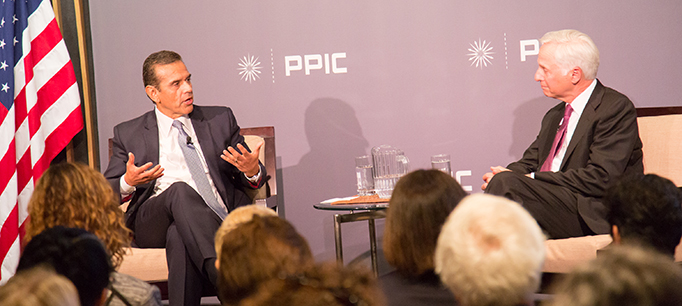
When Antonio Villaraigosa was asked to name the top issues most important to the state’s future, he started with the economy. His key concerns are poverty and the state’s business climate, its “byzantine and bureaucratic regulatory framework.”

Villaraigosa, candidate for governor and former mayor of Los Angeles, spoke at the Speaker Series on California’s Future sponsored by the Public Policy Institute of California (PPIC). As part of the series, PPIC is inviting all major candidates for governor to participate in a public event. Other highlights of his remarks:

  • Health care: He believes in universal health care but is skeptical about how to pay for the current plan before the legislature: “You’re selling snake oil when you say that single payer is something that’s going to happen any time soon.”
  • Infrastructure: He emphasized his long-term support for high-speed rail. He sees it as an economic development strategy to transform the Central Valley by connecting it to the two big centers of the economy, Los Angeles and the Bay Area.
  • Higher education: He said the state needs to look at how community colleges are funded and marshal its resources to make sure students get through the system and transfer to four-year colleges. But he’s not an advocate for making community college free to all: “It’s already free for poor people, and that’s who it should be free for.
Watch all candidate videos.

Video: Feinstein on Her Role in a New World

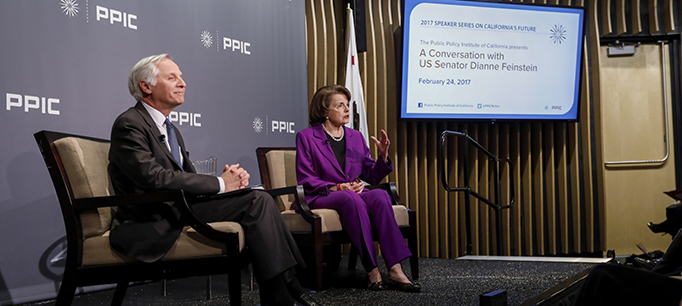
Senator Dianne Feinstein was clear about the challenges ahead for a California Democrat in contentious times.

“Here we are: outnumbered, outvoted, in the West, fairly liberal,” she said.

Speaking before an energetic capacity crowd in San Francisco, Feinstein said her office had received more than a million phone calls about Trump’s cabinet nominees. She described her approach to them: careful evaluation, rather than blanket opposition—an approach too conciliatory for some sign-carrying audience members. Feinstein said that in her role on the Senate Judiciary Committee, she needed to work with the administration officials in charge of national security and felt she could work with Trump appointees James Mattis, defense secretary; John Kelley, secretary of homeland security; and Mike Pompeo, CIA director. But she opposed other nominees because they lacked credentials for the job or they aren’t right for the county, she said. Nevertheless, they went on to win approval.

“The key for me is to figure out how we can begin to win some of these battles.”

Asked about Trump’s nominee to the Supreme Court, Neil Gorsuch, Feinstein wouldn’t say how she would vote. She said she will be particularly interested in his views on gun laws and on women’s reproductive rights.

Feinstein’s visit was greeted by dozens of protesters who marched outside, upset that she had not hosted a traditional town hall. Inside, Feinstein touched on a range of issues from climate change to immigration to health care, in a wide-ranging conversation with Mark Baldassare, PPIC president and CEO. His questions included a number that PPIC solicited online in advance of the event.

Video: An Early Look at Views of President Trump

The January PPIC Statewide Survey asked Californians for to assess their new leaders in Washington and found that just a third of Californians, or 30%, approve of the way President Trump is doing his job. Californians gave Congress a similar rating.

Dean Bonner, associate survey director, presented these and other key findings at a briefing in Sacramento. The survey also examined contentious issues that are the focus of national debate.

  • Solid majorities of Californians favor state action—independent of the federal government—to protect the rights of undocumented immigrants and to address global warming.
  • About half of Californians have favorable opinions of the Affordable Care Act, and a slight majority oppose repealing it.
  • Most Californians—across political parties—say the government should not interfere with a woman’s access to abortion.

The survey also looked at views of Governor Brown’s job performance and his proposed budget. The governor job approval rating is at a record-high 66%. But his budget proposal and his plan to fund maintenance of the state’s roads, highways, and bridges fares less well. Just under half of residents support his budget plan and 41 percent support his transportation proposal.

Learn more

Read the January PPIC Statewide Survey
Learn more about the PPIC Statewide Survey

Video: California’s Aging Population

California is on the verge enormous change. In 2030—when the youngest baby boomers have reached retirement age—the state’s senior population will be nearly twice as big as it is today. It will be more ethnically and racially diverse. And many more seniors are likely to be living alone.

These changes have already begun, and their policy implications are wide-reaching. The state’s growing and changing senior population will require more support services and health care professionals. How is California coping with the challenge? That was the question posed to a panel of experts at a PPIC event in Sacramento last week.

“We could be doing better,” said Assemblymember Cheryl Brown, chair of the Assembly Committee on Aging and Long-Term Care. She said information that can help caregivers is fragmented and not easily accessible.

Her assessment was shared by fellow panelists Karen Keeslar, executive director of the California Association of Public Authorities for In-Home Supportive Services, and Barbara O’Connor, a boardmember of AARP.

But Brown sounded a hopeful note. She predicted that as many more Californians—including legislators—begin care for aging loved ones the issue would become prominent. In fact, Brown and her fellow panelists are or have been caregivers for members of their own families. Keeslar noted the sheer number of Californians who are using in-home support services today—507,000, compared to 90,000 in 1980.

O’Connor advocated new models for senior living to help more Californians live as independently as possible—and not necessarily alone at home. Small senior communities are thriving as alternatives to nursing homes in other states, she said.

“It’s not just nursing home versus staying home,” she said.

Before the presentation, PPIC research fellow Laurel Beck provided an overview of a new report, Planning for California’s Growing Senior Population, which she coauthored.

Video: January PPIC Statewide Survey Briefing

State residents are feeling more optimistic than they have in years—about California’s elected leaders, the direction of the state, and their own economic futures. Dean Bonner, associate survey director, presented these and other key findings at a briefing last week in Sacramento. In addition to asking about government and fiscal issues, the January survey gauged opinions on four important issues being debated at the state and federal level. Among the findings:

  • Crime, police, and race relations. A solid majority of Californians say the police are doing either an excellent job or good job controlling crime in their communities. But blacks are much less likely than others to hold this view.
  • Water and drought. A majority of Californians say the supply of water is a big problem in their region, and most say the state and local governments are not doing enough to respond to the current drought.
  • Health care reform. A record-high 51 percent of Californians have a generally favorable view of the 2010 health care reform law, while 41 percent have an unfavorable view.
  • Immigration reform. A solid majority of residents support President Obama’s executive action to shield as many as 4 million immigrants from deportation, while about a third are opposed.

California’s New Leaders Focus on Poverty

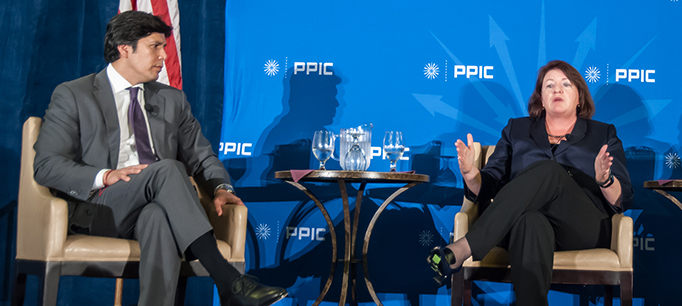
Assembly Speaker Toni Atkins and Senator Kevin de León, who will take over as senate president pro tem later this month, each told a Sacramento audience about growing up in poverty and the role it has played in their shared view of the state’s responsibility to those in need.

“We share similar values and similar stories that have made us care about the values and the issues that we’re talking about today,” said Atkins, who was raised in a poor, rural Virginia family and now represents the San Diego area. De León, who was born in San Diego and represents Los Angeles, said he is the youngest child of a single immigrant mother and the only family member to graduate from high school. Atkins and de León, both Democrats, were elected by their respective legislative chambers earlier this year to serve as leaders.

Both lawmakers cited a recent PPIC report — Child Poverty and the Social Safety Net in California by Caroline Danielson and Sarah Bohn — that said about 50% of California children live in poverty or near-poverty. The remarks, part of the PPIC 2014 Speaker Series, were made to a capacity audience of about 400 in the ballroom of the Sheraton Grand Hotel. The discussion was moderated by PPIC President Mark Baldassare and streamed live to hundreds more.

The wide-ranging conversation touched on a number of major issues—including health care, the drought, immigration, and taxes. Both leaders said that they believe the state should talk about changes to the state tax structure and consider whether to extend the temporary taxes that voters passed in Proposition 30. Atkins cautioned that it will be difficult to gain support from voters for an extension of the taxes.

De León expressed strong support for affirmative action, which he credited for his ability to attend college and become a legislator. He also said California should continue to lead on immigration issues because the federal government has been unable to pass a reform plan. And he noted that polls suggest Californians support health coverage for undocumented residents.

Atkins, meanwhile, encouraged more cities to follow San Francisco and San Jose, which recently increased the minimum wage. Both leaders also said they have worked together in the past and believe they will have a good working relationship going forward.

Briefing Focuses on Survey Election Findings

Less than two months before the election, PPIC’s latest survey looked at Californians’ views on the governor’s race and four statewide ballot measures. Dean Bonner, associate survey director, presented the findings at a briefing in Sacramento on Wednesday. As most of the media coverage noted, the survey found that Governor Brown is doing well in his reelection bid and that the water bond he approved is fairly popular.

The survey found that Proposition 2, labeled the Budget Stabilization Act in the ballot statement but known elsewhere as the rainy day fund, does not currently have majority support among likely voters. Proposition 45, which would regulate health insurance premiums, has a similar level of support, but Proposition 47, which would reduce sentences for some crimes, is favored by 62 percent of likely voters. The survey also found high levels of concern about the drought and mixed feelings about the Affordable Care Act and immigration policy priorities.

Now Hiring: Skilled Health Workers

Changing medical technology, an aging population, and new health care policies have raised important questions about the workforce that will be needed to care for patients in the future. These issues were featured in a new report from PPIC—California’s Healthcare Workforce Needs: Training Allied Workers—and discussed at a luncheon in Sacramento on Friday that included a briefing by coauthor Shannon McConville, PPIC research associate.

The report notes that California will have to add 450,000 jobs to its health workforce over the next decade. With nearly 40 percent of these additional health jobs expected to require some college training below a bachelor’s degree, training programs at California’s community colleges and private two-year institutions will play an important role.

Participating in the panel discussion were Dr. Jocelyn Freeman Garrick, director of the Alameda County Health Pipeline Partnership; Catherine Martin, vice president of the California Hospital Association; and PPIC research fellow Sarah Bohn, a report coauthor. The panel, which was moderated by PPIC research director Patrick Murphy, explored the challenges faced by both public and private higher education institutions in keeping up with rapidly advancing skills requirements in the health care industry. Topics included differences between public and private schools and programs and partnerships that can train Californians for health workforce needs.

The Uninsured and the Safety Net

Open enrollment in California has ended, and preliminary tallies indicate that more than 3 million Californians will be enrolled in health plans through Covered California or will become new members of the Medi-Cal program. While it is still too soon to tell how many uninsured people have gained coverage, projections suggest about 4 million Californians will still lack health insurance. About 30 percent of these uninsured residents are estimated to be eligible for Medi-Cal and can enroll at any time during the year.

Uninsured residents who are not eligible for ACA coverage because they are undocumented immigrants—and those who did not purchase coverage through Covered California during the open enrollment period—will continue to rely on county programs and safety net providers, such as health clinics and emergency departments (EDs).

Access to these resources varies considerably across the state. Eligibility for indigent programs differs across counties, as there are no state standards for services provided or populations served. For example, most county indigent programs do not cover undocumented immigrants; these residents rely on clinics and EDs, particularly in counties that do not operate public hospital systems. Also, many counties set relatively low income thresholds for their indigent programs, limiting the number of uninsured residents who qualify for services.

Because the Medi-Cal expansion will cover many of the people currently served by county indigent care programs, the state is shifting funds previously allocated to county health programs. This fiscal year, state funding for county health programs was reduced by $300 million (under AB 85); there will be deeper cuts in subsequent years, as more Californians gain insurance coverage. The state will determine future funding reductions in consultation with the counties. In most cases, counties have selected a formula-based approach that accounts for the actual costs and revenues associated with indigent care programs to determine how much funding will be shifted back to the state.

Over the next several years, it will be important to monitor how these and other changes affect both safety net providers—including counties and public hospital systems—and the communities that continue to rely on them for health care.

Video Highlights New Survey’s Key Findings

The March PPIC Statewide Survey examines several major issues in California, including water, high-speed rail, marijuana legalization, and taxes. The survey also finds that three months before the primary, Governor Jerry Brown remains a strong favorite for re-election this year.

The wide-ranging survey also looks at Californians’ views on national issues—such as immigration and health care reform, and abortion —and provides approval ratings on federal elected officials.

PPIC research associate Jui Shrestha presented the results of the survey at a luncheon briefing in Sacramento.