How California’s Digital Divide Affects Students

As the internet becomes increasingly essential for student learning and testing, California’s digital divide threatens to exacerbate preexisting inequities in education.

The good news is that K‒12 schools have largely made the digital transition. In 2018, 90% of California schools met the Federal Communications Commission’s (FCC) minimum threshold for digital learning and had the internet resources necessary to administer the state’s online assessment.

But at home not all students have reliable internet access or a traditional computer, such as a desktop or laptop. Overall, 16% of school-aged children in California do not have any internet access at home, and 27% do not have a high-speed connection, meaning they rely on slower connections like dialup or satellite. In addition, nearly 10% access the internet with a cellular data plan, which usually means slower speeds and suggests they are relying solely on a smartphone or tablet.

Gaps exist for several demographic groups. For example, 56% of low-income households with school-aged children have broadband subscriptions, compared to 75% of all households with school-aged children.
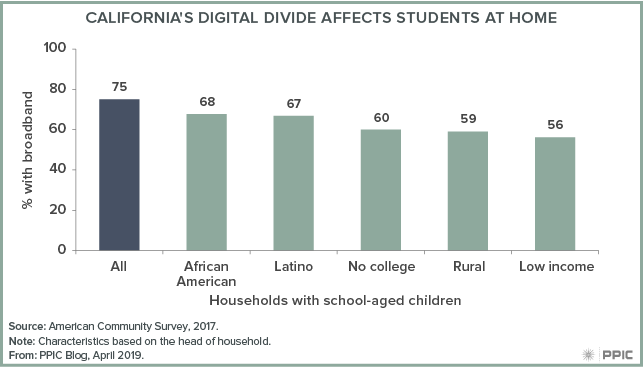
figure -California’s Digital Divide Affects Students at Home

This digital divide in broadband access at home—known as the “homework gap”—may affect student learning. An analysis by the Pew Research Center found 17% of teens say they are often or sometimes unable to complete their homework due to a lack of reliable internet or computer access, with about a quarter of low-income and African American teens saying this. Another study shows that eighth graders who do not have internet access at home score lower on national exams in reading and math than their peers. Similarly, students without computers at home score lower in their ability to use computers and other digital devices. These factors may worsen the disadvantages faced by lower-income students, who have lower high school graduation rates and lower standardized test scores than their wealthier peers.

While there are discounts available to lower-income families struggling to afford internet access, three in four California households without broadband are unaware of these discounts, according to a Berkeley Institute of Government Studies poll—suggesting that federal and state policymakers can do a better job promoting these programs.

Some districts have developed innovative approaches to address the digital divide. For example, a few years ago Coachella Valley Unified outfitted school buses with Wi-Fi and parked them throughout the district’s rural neighborhoods to serve as mobile hotspots. As more schools embrace digital learning, developing new ways to broaden internet access is key to closing equity gaps and ensuring that learning continues outside the classroom.

What Does the Repeal of Net Neutrality Mean for California Schools?

As the Federal Communications Commission’s (FCC) repeal of net neutrality phases in, concerns that Internet service providers (ISPs) could speed up or slow down traffic from certain websites or prioritize certain content loom large. Changes to Internet service, if any, will probably be slow and gradual; however, the repeal has potentially important implications for the digital divide in and outside of California’s schools.

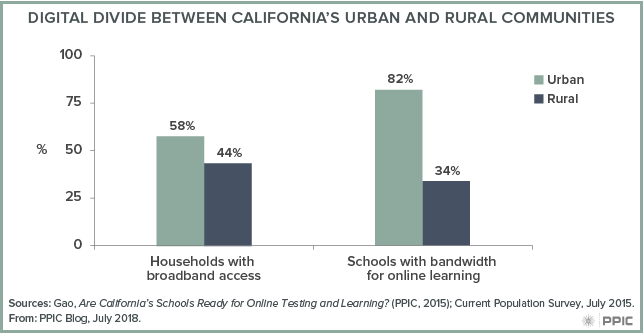
K‒12 schools rely increasingly on online content and management systems to deliver instruction (e.g., blended learning), administer standardized tests (e.g., Smarter Balanced assessments), and manage educational data (e.g., cloud computing). As online learning becomes ubiquitous, access to high-speed Internet is no longer optional—it’s a necessity. Most schools receive discounted Internet services through the federal E-rate program, but if providers decide to introduce tiered pricing based on content, students and educators could lose access to quality education programs. Tiered pricing could also exacerbate the digital divide between urban and rural districts. PPIC research shows that close to 70% of rural districts lack sufficient bandwidth for digital learning, compared to 18% of urban districts. If this gap persists or widens, students in rural areas may be left behind in the digital race.

Another concern is the homework gap. The FCC reports that 70% of teachers assign homework that requires access to broadband, while an estimated 860,000 (22%) households with school-age children in California do not have home Internet service. For many of these households, the cost is too high. Low-income families may get government subsidies (e.g., the Lifeline program) or discounts from ISPs. However, if providers create a fast lane for customers who pay premiums and a slow lane for those who don’t, the homework gap may widen. Rural residents may be particularly affected by these changes, because they tend to have more limited Internet access and fewer ISPs.

Federal and state policymakers have placed net neutrality near the top of their agendas. A major legislative effort to restore net neutrality fell short in the US House of Representatives. In California, two Senate bills (SB 822 and SB 460) that would establish a stringent net neutrality regime are being considered in the state legislature. Other states, including Montana, New York, and Oregon, are taking similar legislative or executive action

Video: Online Testing and Learning in California Schools

California is rolling out a new online testing system in K–12 schools this year in conjunction with the new Common Core curriculum standards. Are schools prepared?

At a recent briefing in Sacramento, PPIC researcher Niu Gao answered the question with findings from her new study. She found that there is a wide variation in readiness across the state. Many district technology officers express confidence in the quantity and quality of their hardware and network capabilities. But they are much less confident of their ability to handle software issues, such as the installation of secure browsers, distribution of IDs, and quick log-ins for students. Most districts also report that they do not have enough staff to provide technical support or do not provide sufficient training for teachers and IT staff.

Gao concludes that in the longer term, virtually all schools will need to upgrade their technology to adopt and fully benefit from digital learning—video conferencing, virtual field trips, and personalized audio-visual instruction.

Gao’s report is titled Are California’s Schools Ready for Online Testing and Learning?