Covering the Real Costs of College

Faced with the state’s high cost of living, California college students struggle to secure adequate food and housing. Even amid one of the largest and longest economic expansions in state history, 33% of students are housing insecure and 35% have low or very low food security, according to a California Student Aid Commission survey of 150,000 college students. As the state seeks to meet economic demand by producing more students with degrees and certificates, the full cost of college remains a barrier to progress.

Governor Newsom and the legislature have recognized the need to reform state financial aid programs to address the full cost of college. The 2019–20 state budget provided $41 million in ongoing funding to help colleges address food and housing insecurity, $19 million to support rapid rehousing programs, and increased the number of competitive state grants for non-traditional students from 25,750 to 41,000.  Additionally, the legislature increased the maximum award amount that students with children pay for non-tuition college costs from $1,672 to about $6,000.

However, broader reform of the state grant aid program remains elusive. Two recent bills sought to expand eligibility for Cal Grants by eliminating current age, time out of high school, and high school GPA requirements. The bills also sought to provide additional non-tuition aid to community college students and students in career education programs.  The bills did not make it to a vote; however, they will be re-examined in the next legislative session. Estimated at $2 billion per year, proposed reforms would nearly double the annual cost of the program.

Consequently, the California Student Aid Commission, the agency that distributes financial aid, intends to streamline these proposals to constrain costs while increasing access. Higher education is a vital tool that increases economic and social mobility; ensuring all students have equal access to an affordable education is paramount to modernizing California’s economy. An equitable and financially viable approach to financial aid will be critical if the state’s booming economy slows in coming years.

Strengthening Career Pathways in California’s Community Colleges

California lawmakers have made large state investments—totaling more than $1 billion over the past five years—to support and expand career education.  As the primary provider of career training in the state, California’s community college system was the recipient of much investment in this area, and their creation of the Strong Workforce program has established an ongoing source of funding to continue this work.

To assist policymakers, practitioners, and students to better understand how career education programs can meet regional workforce needs and connect students to well-paying, in-demand jobs, PPIC has engaged in a multi-year research agenda focused on community college career education pathways. We highlight our work in this area in a recent article, Strengthening Career Pathways in California’s Community Colleges, in Techniques magazine, a national publication that provides career education faculty and practitioners with timely analysis and insights to inform the delivery of high quality career education programs.

The article highlights recent research from PPIC’s Higher Education Center on the structure of career education pathways and their value to the students who complete them. Since many career education students are older than typical college-age students—and are likely to have work or family obligations (or both)—the article also highlights how various reforms being enacted by the community colleges could help students complete career training pathways, with a focus on the new online-only college, CalBright, that began enrolling students for the first time in October 2019.

Video: Career Education and Economic Mobility in California

[vc_row][vc_column][vc_column_text]

Career education, also known as vocational education or career technical education (CTE), prepares a wide range of Californians for employment and economic advancement. Community colleges are a major provider of career education in California, offering short- and long-term certificates along with associate degrees across a variety of fields of study.

In this video, senior research associate Shannon McConville discusses the importance of career education for California and what new PPIC research says about its economic benefits. Career education credentials can provide substantial earnings gains and also helps create a strong California workforce over the long term.

[/vc_column_text][/vc_column][/vc_row][vc_row visibility=”hidden-phone”][vc_column][vc_video link=”https://youtu.be/5qmlPVWwiEw” el_width=”70″ align=”center”][/vc_column][/vc_row][vc_row visibility=”visible-phone”][vc_column][vc_video link=”https://youtu.be/5qmlPVWwiEw”][/vc_column][/vc_row][vc_row][vc_column][/vc_column][/vc_row]

Training California’s Students for Well-Paying Jobs

California’s community college system is the largest provider of career education—also known as career technical education or vocational education—in the state. Career education programs play a critical role in training students, especially underserved and nontraditional students, for jobs that provide solid wages but don’t require a four-year college degree.

How can colleges identify these jobs? In a recent PPIC report, we compare occupational earnings to regional poverty thresholds to assess how future workforce needs connect to well-paying jobs that don’t require a four-year degree. Other work by the Brookings Institute focuses on “opportunity industries,” in which good jobs—those that provide stable employment, middle-class wages, and benefits—represent an above-average share of the industry’s total jobs and are filled by workers with only some college training.

Opportunity industries are largely concentrated in fields that align with many of the community colleges’ career education disciplines, including business, engineering, health, information technology (IT), and public and protective services. A critical question is whether students are successfully completing programs that will prepare them for careers in these fields.

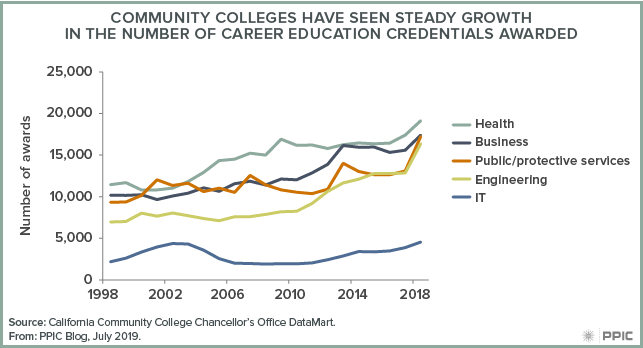
The good news is that over the past 20 years, there has been a consistent upward trend in the completion of career education credentials in California’s community colleges, with major gains observed in the last decade. This increase spans industries. Notably, more degrees and certificates are being earned in health than in any other discipline—this is important since health credentials are especially valuable in increasing students’ subsequent earnings.

Figure - Community Colleges Have Seen Steady Growth in the Number of Career Education Credentials Awarded

But not all credentials are associated with large economic gains. For example, in our analysis of wage returns, we find that career education credentials in business and IT do not provide much of a wage boost.

Furthermore, there seems to be a mismatch between the awards with the most value and the awards students are earning. While awards from longer programs generally tend to confer more value than those from shorter ones, completion of short-term awards has increased in several career education disciplines.

Community colleges and industry partners need to work together to ensure students have a path to well-paying jobs and the tools needed to succeed. As shown in our research, some of that work begins with colleges structuring effective pathways to these industries and clearly communicating the economic returns and opportunities available to students.

Moreover, strong partnerships between community colleges and nearby industries will be essential in creating a bridge between students and their industry of choice. Ultimately, these efforts can help improve the economic well-being of individual students and the state as a whole.

Video: Career Pathways and Economic Mobility at California’s Community Colleges

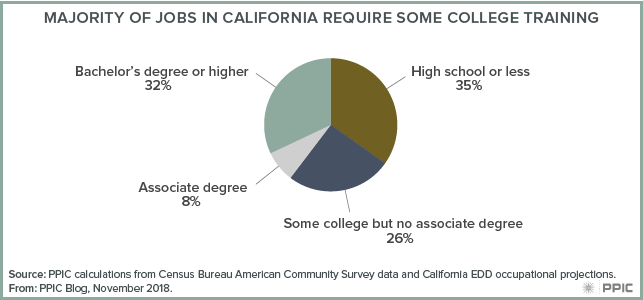
About a third of future jobs in California will require more than a high school diploma but less than a bachelor’s degree. By training workers for these jobs, career education—also known as career technical education or vocational training—plays an integral role in meeting California’s workforce needs and improving students’ economic well-being.

At an event in Sacramento last week, PPIC researcher Shannon McConville outlined the findings of a new report on career education and economic mobility, and a panel of experts discussed the implications for students, colleges, and the state as a whole.

McConville noted that completing a career education credential at a California community college confers a 20% wage gain, on average. But economic benefits vary greatly across program areas. For instance, returns to health credentials tend to be substantial, while business and IT credentials yield lower returns.

The panelists began by highlighting current efforts to improve students’ labor market outcomes. Marty Alvarado, executive vice chancellor for educational services at California’s community colleges, explained the system’s “two-pronged approach” to making sure programs connect to in-demand, high-return careers. One area of focus is regional infrastructure, which includes regional labor market centers that provide colleges with data on local industries. The second area includes tools to help students better navigate their program choices, “while also trying to make transparent the earnings projections for students as they move into these career options.”

Supporting students—especially low-income students from underrepresented demographic groups—in completing high-return credentials was another topic of conversation. Alvarado discussed efforts at the community colleges to streamline processes that may be creating “unnecessary barriers for students,” while Assemblymember Autumn Burke emphasized the importance of access to social safety net services so students can focus on their career.

Alma Salazar, senior vice president of the Center for Education Excellence and Talent Development at the Los Angeles Area Chamber of Commerce, noted that all stakeholders need to be involved. “How do we get the system as a whole to take ownership in helping us collectively solve for these problems? . . . It has to go beyond Sacramento. It has to go beyond the system’s leadership. It has to get to the institutional level and the people who work [there], who have to be equally committed.”

While many see the evolving nature of work and increasing automation as challenges, Assemblymember Burke was optimistic about providing a “just transition” for workers who may lose jobs in fast-changing industries. “We can train people for this new economy [and] prepare them now. . . . It’s a shortcoming to worry about losing minimum-wage jobs, because there’s so much opportunity on the other side.”

Testimony: Career Education Is Key to Meeting California’s Workforce Needs

Sarah Bohn, research director and senior fellow at PPIC, testified today, November 27, 2018, before the Assembly Select Committee on Career Technical Education and Building a 21st Century Workforce. Here are her prepared remarks.

Thank you for convening this informational hearing on higher education and the workforce. PPIC recently surveyed Californians on these topics and a large majority (75%) view the state’s higher education system as very important to the quality of life and economic vitality of California. Not surprisingly, the same share say that the higher education system should be a high or very high priority for the new governor. So this hearing is extremely timely and I’m so pleased to share PPIC research on education and workforce needs.

Most jobs require some college training

The majority of jobs today and in the future will require education beyond high school—split about equally between jobs that require a four-year college degree and those that require education or credentials provided at community colleges. Only about one-third of new jobs created in California over the next decade or so will be available to workers with no more than a high school diploma. These workforce needs are the result of long-term shifts toward a knowledge-based economy. It’s not just that there are new jobs that require more postsecondary education, but the need for credentials within professions has grown as well. For example, more office administrators now have a college education than in the past.
Better-paying jobs are more likely to need college training

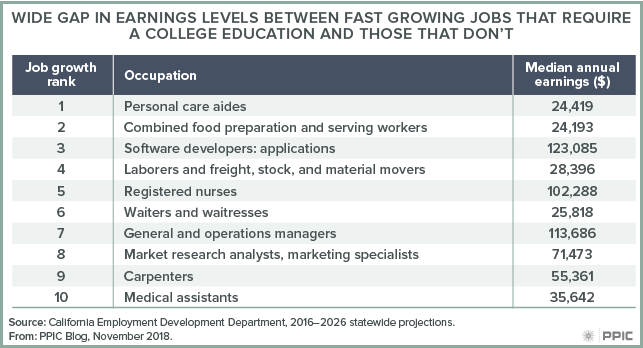
College credentials are also the route to accessing better-paying jobs. With the trend toward a knowledge-based economy comes an increasingly wide gap in terms of earnings between jobs that require a college education and those that don’t. Among the top ten occupations in terms of job growth you find many service sector jobs that pay less than $35,000 in annual earnings (personal care aides, food preparation, freight/stock movers, medical assistants) and do not require a college education. And you find a handful of jobs at the opposite extreme—which pay three to four times as much and require a college education (registered nursing, software developers, managers). This trend is likely to continue and might become more extreme with additional pressures like AI (artificial intelligence) and further automation.
California’s community college system is key to meeting state workforce needs

Ensuring we have the workforce to meet these demands—and ensuring future workers can access higher-paying jobs—requires a higher education system that is responsive to student and economic needs. The young workers of today and tomorrow are much more diverse than the current workforce, comprised of demographic groups with historically lower levels of college attainment (including racial/ethnic minorities and first-generation college students). And though we’ve made progress, there’s still room to broaden access to college—and narrow achievement gaps.

For that reason, community colleges—and career education programs in particular—are critical to educating our future workforce. The community colleges are the most common entry point to higher education for Californians, serving almost three times as many students as CSU and UC combined. They also serve a more diverse mix of students. In career education (or CTE) programs, the majority of students are nonwhite and low income. Students range from recent high school graduates to stranded workers (who lack the skills needed to succeed in the job market) to older workers in need of retraining. And these programs provide opportunities in a wide spectrum of careers. As just one mission of the community colleges, CTE is so consequential for meeting workforce needs and improving economic outcomes because it is often the fastest route to new and better careers.

Career education programs can pay off for students

Earning credentials in CTE pays off for students. Those who earn an associate degree see a 20–35% increase in their wages. The payoff wanes for shorter credentials but remains positive even for certificates that can be earned in less than a year (certificates of 6–18 units). But the choice of program or career matters a lot. If health programs are excluded from these calculations, the payoff is much lower on average (4–7% for an associate degree). The health field offers the highest returns across all broad program types. But there’s even variation in which health programs pay off (e.g., registered nursing is more remunerative than medical assisting).
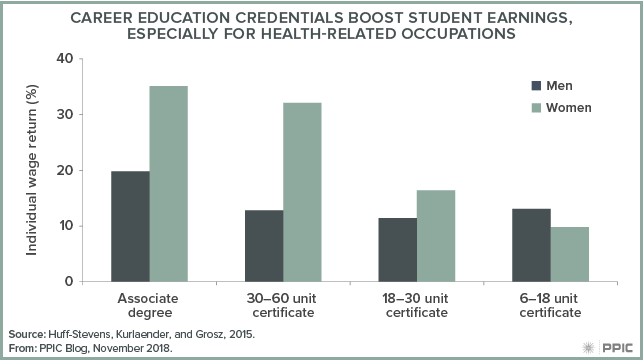
Because CTE credentials vary so much in terms of what they offer in the labor market, the choice of what to study can be as important as the choice to go to college. That information is critical for policymakers evaluating effectiveness and especially for students choosing programs. I commend the community colleges in sharing earnings potential data on their website through tools like Salary Surfer.

Some students may need new job skills to move along a career pathway to higher-paying jobs

Instead of pitting one type of credential or program against another, what we should be thinking about is improving long-term economic mobility for students. A lot of CTE students start by earning a short-term credential, which offers the lowest earnings bump, on average. But those credentials might help an individual switch to an industry with more opportunity in the long run or to start an educational career pathway toward higher-level achievement (i.e., earning “stackable” credentials). Unfortunately our research shows that only a small share of CTE programs (at most 18%) have well-defined career pathways and less than one-quarter of students who start with short-term certificates take additional steps toward broader career options.

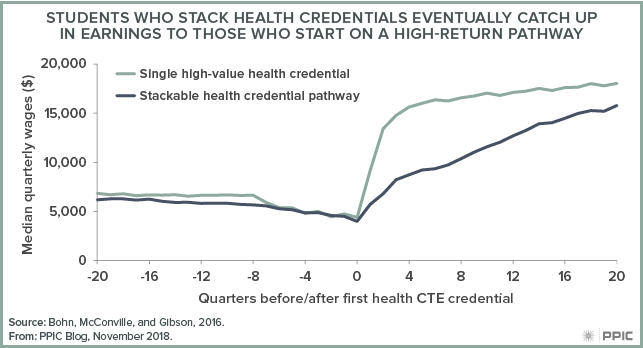
But there’s great promise in improving those career pathways. We found that students who “stack” credentials—in this example, in a health field—eventually catch up in earnings to those who started on a high-return pathway like registered nursing. Students who earn a single health credential (mostly high-return associate degrees) see a marked improvement in their earning trajectory. Those who complete a lower-value credential but then return and complete a second one later do nearly as well. Of course this takes time (which is not free), but it’s a reminder that a single credential is not the end of the road. Effective CTE programs can connect students to in-demand and high-return careers in many ways.
In closing, this research suggests state investments in CTE are worthwhile, both for improving student career outcomes and meeting workforce needs. But the state and colleges can’t operate alone; partnership with businesses will be key to making sure that programs address workforce needs and adjust as those needs change. Only then can the state be deliberate in its investments to make sure that CTE programs improve long-term outcomes for students and the state’s economy.


Career Technical Education: Funding & New State Oversight

President Donald Trump recently signed the Strengthening Career and Technical Education for the 21st Century Act, or Perkins V, which reauthorized $1.2 billion dollars in federal funds for career and technical educational (CTE) programs. The new law gives states more flexibility to set their own goals for CTE programs, along with reporting progress toward those goals. Who might benefit from these changes, and what new challenges do they present to the state?

Perkins V supports programs that integrate career skills and prepare students at the secondary, postsecondary, and adult education level for the workforce—for such careers as IT technician, accountant, or nurse. Funding is based on student enrollment, and each year California receives more than $110 million in Perkins dollars, the vast majority (85%) of which go to CTE programs in high schools and community colleges. During the 2017–18 school year, close to 780,000 (40%) high school students and 420,000 (35%) full-time community college students participated in CTE.

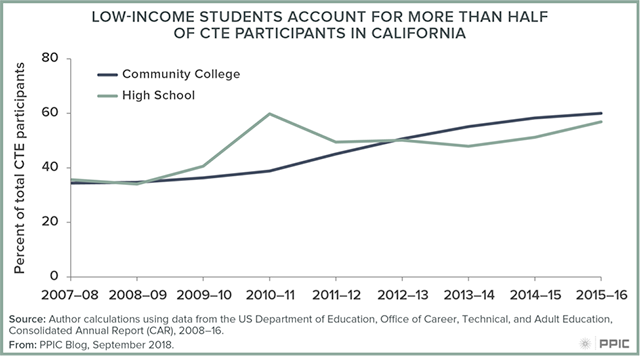
California’s CTE students generally reflect the demographics of the overall student population, though Asian American, Latino, and female students are slightly underrepresented. Over time, the overall number of students participating in CTE has decreased, but the percentage of low-income students who do so has increased. Today, low-income students account for more than half of CTE participants. Benefits associated with CTE programs include decreased high school dropout rates (for low-income students in particular), increased high school graduation rates, and higher wage returns (particularly in health fields).

Figure: Low-income students account for more than half of CTE participants in California

Although the new law provides states with greater flexibility, some of the provisions may present a challenge for those hoping to measure the impact of Perkins dollars in California. For example, under the new requirements performance indicators follow only students deemed to be “concentrators,” or those who complete a substantial number of courses in a single CTE program of study. Currently, concentrators account for less than half of CTE participants, so the indicators may not capture the outcomes of all who are served by Perkins funding. In addition, some of the core indicators—such as student placement in postsecondary CTE education—require the use of a comprehensive longitudinal database on student outcomes, a tool that California does not yet have. Furthermore, performance indicators are not broken down by industry sector, which makes it difficult to evaluate state-specific sectors, such as fashion and interior design or energy and utilities, which are unique to California’s economy.

Going forward, the Perkins reauthorization ushers in a new form of CTE program accountability at the state level. If California wants to continue to close the gap of 1.5 million workers with “some” college education, it needs to make inroads on designing, improving, and scaling up effective CTE programs—and on improving the quality of data on CTE programs and students.

Retraining Workers for the Future Economy

As the economy continues to shift toward computers and digital technology—and braces for a potential future with more robots—workers have been called upon to adapt and learn new skills. New industries and new kinds of jobs may lead to economic growth, but whether these gains are shared by all of California’s workers depends critically on their retraining. And that retraining, in turn, depends on the ability of educational institutions to also adapt to new labor market needs.

While workers can sometimes learn new skills on the job or on their own, other times retraining means obtaining a new credential and returning to the classroom. That’s especially true for people who work in technical industries that are being reshaped by forces like routinization, automation, and outsourcing.

California’s higher education system has an important role to play in delivering retraining options. The state’s community colleges are the primary provider, with hundreds of programs in skilled trades and applied sciences and technologies. Notably, community colleges offer retraining options at a much lower cost to students than do private for-profit two-year colleges, another major provider. In addition, many community college programs show substantial economic returns for students—especially in health professions.

Effective retraining through the state’s colleges would help ensure that all Californians are productive and self-sufficient, which would benefit not just families but also employers and the state economy. However, the current model of higher education was largely built for 18-year-old, first-time freshmen and does not necessarily work for older, returning students, who are almost certainly balancing training with career, family, and other demands.

Flexible course scheduling—for example, through online courses or “distance” education—is one way to better reach workers. California’s community colleges are the clear leader in offering online options. PPIC research has highlighted some limitations to online training and outlined ways to improve student outcomes. Online courses for technical programs may require additional innovation, especially those that require hands-on training. Governor Brown’s proposed budget for fiscal year 2018–19 includes funding for a fully online community college that has the potential to bring innovation to how retraining opportunities (and educational opportunities, broadly speaking) are offered to Californians.

For individuals or training programs not amenable to online options, expanding course offerings near job centers is key. Cal State Los Angeles’s satellite campus in downtown LA aims to do exactly this. Information about the job market is also crucial—and California’s community colleges have taken a big step in the right direction by providing easily accessible information on the labor market outcomes of different colleges and programs across the state.

Retrained workers may pursue all kinds of new skills, but career technical programs, most of which are in community colleges, are particularly important because they offer short-term credentials in industry-relevant fields. Efforts to make career technical programs more flexible—through, for example, online courses, convenient locations, and partnerships with employers—are critical to filling student, employer, and state needs in a rapidly changing workplace.

Learn more
Visit the PPIC Higher Education Center


Video: Strengthening Pathways to Health Careers

Health programs at California’s community colleges hold particular promise for helping students enter in-demand careers and addressing the state’s workforce needs, new PPIC research shows. These career technical education (CTE) programs, also known as vocational education, attract a large and diverse set of students. The state’s community colleges offer a broad range of programs—including nursing, respiratory therapy, medical and dental assisting, and health IT—that are linked to growing job opportunities in health services, a generally well-paying industry for Californians without a bachelor’s degree.

PPIC researchers presented two reports on the topic in Sacramento. Among the key findings summarized by report coauthor Shannon McConville: many students who have earned career tech credentials in health care have seen sizeable wage gains, and completion rates in these programs are relatively high. More than 70 percent of students who begin a program either obtain a degree or transfer to a four-year college within six years, while only about half of the overall CTE student population obtains a credential within six years.

But there is room for improvement. Completion rates vary substantially across health programs, ranging from 93% in dental hygienist programs to 44% in emergency medical services. And there are racial and ethnic achievement gaps across programs.

After the research presentation, an expert panel took up the topic. Anette Smith-Dohring, manager for workforce development at Sutter Health, underscored the need to diversify the health care workforce.

“We want our front-line health care providers to reflect the communities we serve because those are our patients,” she said. “We want them to come from [the] communities we serve—we don’t want to import health care providers.”

Linda Collins, executive director of the Career Ladders Project, which has worked with community colleges, said it is important both to expand career awareness of the range of allied health professions and to improve science proficiency in middle and high school. If a student has “a basic grounding in math and science from the high school level, that will allow a student to take almost any allied health occupation program and be successful,” she said.

All of the speakers provided examples of small-scale programs in community colleges that have improved student success rates—and expressed frustration that the funding has not been consistent enough to expand them.

Linda Zorn, statewide director of the California Community Colleges Health Workforce Initiative, summed up: “Programs that provide structure and clarity about what students need to take, and integrate both proactive and embedded student supports in the instructional experience, are critical.”

Learn more

Read Career Technical Education in Health: An Overview of Student Success at California’s Community Colleges
Read Health Training Pathways at California’s Community Colleges
Visit the PPIC Higher Education Center

Community Colleges and Career Technical Education

The governor’s January budget proposal allocates increased funding to support the Strong Workforce Program, which will enable California’s community college system to expand access to career technical education (CTE), commonly referred to as vocational education.

This proposal comes at a time of renewed attention to CTE. The federal 2014 Workforce Innovation and Opportunity Act focuses in part on improving community colleges’ engagement in workforce training. In California, in addition to the investment proposed by the governor, the California Career Pathways Trust—a pilot program created by 2014 legislation—aims to ensure the development and strengthening of career pathway training programs.

California’s community colleges have always played a key role in providing CTE training opportunities. While CTE training can start as early as high school, CTE at the community colleges provides a closer tie to workforce opportunities—to meet both student and employer needs. For-profit colleges, which offer a number of CTE programs, are under increased scrutiny due to poor graduation rates, mounting student debt, and questions about the value of their degrees—putting even more focus on the state’s public two-year colleges to provide training opportunities in high-demand programs.

Training programs in the health care field are a prime example. The health care sector in California is large and growing, providing essential services to the state’s population as well as employment opportunities to a wide variety of workers. And according to our recent report, nearly 200,000 new health care jobs over the next decade will require some college training but not a bachelor’s degree. Given the state’s interest in serving employment needs and diversifying the health care workforce, it is crucially important to understand the ability of California’s community colleges to effectively train health workers for needed jobs.

Beyond meeting the state’s workforce needs, career technical education also has the potential to substantively improve labor market outcomes for a wide range of students. Research has identified sizable labor market returns to obtaining a career technical credential, and the California Community College Chancellor’s Office makes this information publicly available through its Salary Surfer web tool. But much remains unknown, especially why economic returns vary across programs and student groups and why more students do not complete a credential at all. To ensure recent state and federal investments—and future reforms—are effective, it is important to fill the knowledge gaps on the student, institutional, and policy choices that lead to optimal outcomes.

Perhaps more importantly, if vocational training is to be a viable mechanism for improving economic mobility, especially for disadvantaged groups, we need a better understanding of the most promising pathways. Upcoming PPIC research will examine this very issue, looking at student success at California’s community colleges across health CTE programs and student demographic groups to provide a clearer picture of effective career technical education.