Lessons from the Great Recession Can Protect College Students Today

[vc_row][vc_column][vc_column_text]Budget cuts for state services are likely on the horizon due to the economic disruption of COVID-19. This means state funding for public higher education may well be reduced—leading to restrictions in access and lowered enrollments. California went through this very scenario during the Great Recession, with thousands of students turning to for-profit colleges in lieu of public colleges.

figure - Enrollments Spiked for California For-Profit Colleges during the Recession

While some students at for-profit colleges earned a degree, many did not graduate and ended up with large amounts of debt. State and federal government subsequently put restrictions around for-profit colleges, but upcoming changes at the federal level could weaken the federal rules.

The recently announced federal Education Stabilization Fund will disproportionately provide emergency relief funds to private for-profit colleges. In California, only 5% of the state’s undergraduates attend for-profit colleges, but these schools will receive 10% of federal funds.

In contrast, 55% of undergraduates attend the state’s community colleges, which will receive only 34% of federal aid. (That’s because many low-income students who attend community college rely on state aid rather than federal financial aid: these students are not counted in the federal emergency funding formula.)

During the Great Recession in 2008, higher education faced deeper cuts than other state services. With escalating tuition, fewer instructional staff, and a narrow application window, students had less access to the state’s public colleges, especially community colleges.

At the same time, some for-profit colleges began to market heavily, and thousands of students enrolled in expensive programs. By several measures—graduation rates, student debt, loan default rates, and employment outcomes—private for-profit institutions often have poor outcomes. Of course, some colleges have a better track record than others.

People hurt most by the recession—and lack of access to college—were saddled with debt they couldn’t pay back. In response, California and the federal government both instituted new regulations requiring for-profit colleges to be more transparent and accountable.

California went a step further than the federal government. The state required colleges to meet minimum standards of graduation and loan default rates to be eligible for Cal Grants, the state’s financial aid program for low-income students. Enrollments in for-profit colleges in California declined, and some of the largest for-profit institutions, like Corinthian and ITT Technical Institute, declared bankruptcy as the economy improved and funding to public higher education was restored.

California policymakers should seek to avoid the mistakes of the last recession by ensuring that access to public higher education is not restricted during this recession. The key is to find ways to limit budget cuts so that public higher education remains accessible to all Californians looking to advance their knowledge and improve their economic well-being.[/vc_column_text][/vc_column][/vc_row]


Covering the Real Costs of College

Faced with the state’s high cost of living, California college students struggle to secure adequate food and housing. Even amid one of the largest and longest economic expansions in state history, 33% of students are housing insecure and 35% have low or very low food security, according to a California Student Aid Commission survey of 150,000 college students. As the state seeks to meet economic demand by producing more students with degrees and certificates, the full cost of college remains a barrier to progress.

Governor Newsom and the legislature have recognized the need to reform state financial aid programs to address the full cost of college. The 2019–20 state budget provided $41 million in ongoing funding to help colleges address food and housing insecurity, $19 million to support rapid rehousing programs, and increased the number of competitive state grants for non-traditional students from 25,750 to 41,000.  Additionally, the legislature increased the maximum award amount that students with children pay for non-tuition college costs from $1,672 to about $6,000.

However, broader reform of the state grant aid program remains elusive. Two recent bills sought to expand eligibility for Cal Grants by eliminating current age, time out of high school, and high school GPA requirements. The bills also sought to provide additional non-tuition aid to community college students and students in career education programs.  The bills did not make it to a vote; however, they will be re-examined in the next legislative session. Estimated at $2 billion per year, proposed reforms would nearly double the annual cost of the program.

Consequently, the California Student Aid Commission, the agency that distributes financial aid, intends to streamline these proposals to constrain costs while increasing access. Higher education is a vital tool that increases economic and social mobility; ensuring all students have equal access to an affordable education is paramount to modernizing California’s economy. An equitable and financially viable approach to financial aid will be critical if the state’s booming economy slows in coming years.

Proposed Budget Prioritizes College Students in Need

Governor Newsom’s January budget proposal includes $1 billion in new funding for higher education. Much has been made of his plan to cover two years of tuition for first-time, full-time community college students. But that is just one aspect of an overall approach that provides extensive support to a wide variety of students.

Newsom’s proposal increases by nearly 15% the number of “competitive” Cal Grants—a distinct type of support available to students who do not qualify for entitlement grants. Recipients of competitive Cal Grants are often older, non-traditional students. Further, all Cal Grant recipients who have dependent children would receive an additional $6,000 to help with non-tuition related costs. In addition, Newsom’s budget allocates nearly $50 million to programs that address housing and student hunger—and those that provide legal services for undocumented students, staff, and faculty.

The governor’s focus on affordability aligns with Californians’ concerns regarding higher education. According to the latest PPIC survey on Californians and higher education, 58% of all adults noted that affordability was a big problem for California’s public higher education systems; just 14% said that it was not much of a problem. Most Californians also said that higher education should be a high priority for the new governor. This budget proposal suggests that Governor Newsom is listening.

The Growth of Cal Grants

The Cal Grant program is the primary program for providing tuition assistance and financial aid to California’s college students. It has allowed California to maintain access to college for low-income students during a time of rapid tuition increases. The program has grown significantly since its inception in 1955 and now serves more than 300,000 students at an annual cost of around $2 billion.

State law protects Cal Grant recipients from tuition increases at UC or CSU: when tuition rises, so do these students’ Cal Grants. Consequently, as tuition has increased and enrollment of low-income students has expanded, the program has grown rapidly. Next fall, tuition is scheduled to increase by $280 per year at UC and by $270 per year at CSU. In addition, UC, which has enrolled 7,400 new undergraduates in each of the last two years, plans to enroll an additional 2,500 in the fall of 2017‒18, the largest three-year increase in seventy years. CSU has added around 50,000 additional students over the past five years. The expansion of Cal Grants has drawn the attention of the governor. He noted in his May budget revision that “rising Cal Grant costs from tuition hikes will also limit the state’s ability to increase General Fund support in the future.”

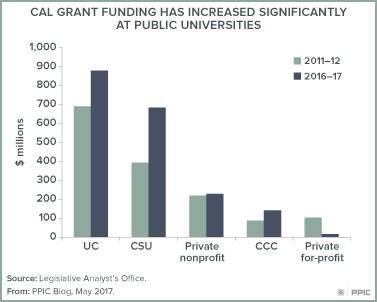
Figure: Cal grant funding has increased significantly at public univerisities

Nearly all of the Cal Grant funding increases have gone to students attending public institutions. CSU has seen a 75% increase in Cal Grant funds since 2011‒12, while the community colleges and UC have received a 61% and 27% increase respectively. Private nonprofit colleges, on the other hand, have seen their Cal Grant funding stagnate. The governor’s budget revision acknowledges this by reallocating $8 million that had been targeted to UC and CSU in his January budget proposal to non-profit private Cal Grant funding. These funds will prevent a planned cut to the maximum award for students attending a nonprofit private college.

By contrast, for-profit colleges have seen their Cal Grant funding decrease substantially over the past five years. The 2012‒13 budget introduced restrictions on access to state Cal Grants which affected many for-profit colleges. To some degree, for-profit colleges satisfy an unmet need for access to higher education for non-traditional students. But investigators have found that many of these colleges engage in predatory marketing and lending practices—targeting vulnerable students, making false statements regarding job placement, and overestimating the value of the degrees they provide. To address these issues the state established new institutional eligibility standards for Cal Grants. To be eligible, a higher education institution must now have a minimum graduation rate of 30% and a loan default rate of less than 15.5%. The 2012‒13 budget also cut the maximum award for a student attending a for-profit college from $9,708 to $4,000. These regulations have saved the state nearly $100 million since 2011‒12, reduced by more than half the number of for-profit colleges eligible for Cal Grants, and ensured that low-income and first generation students were not taken advantage of by higher education institutions that did not serve their economic interest.

Cal Grants are an essential tool for improving the economic mobility of the state’s neediest residents. They also allow the state to reduce the burden of federal loans on young Californians. Maintaining Cal Grants for high performing colleges— public and private—will improve access to college for all Californians.

Learn morEVisit the PPIC Higher Education Center

Testimony: Improving the Cal Grant Program

PPIC researchers Hans Johnson and Kevin Cook testified before the California Student Aid Commission last week at a hearing to provide information about improving the Cal Grant program. The program provides about $1.5 billion in grants to college students in California each year and is administered by the commission. The program provides grants to state residents attending approved institutions and is the largest source of state aid to California students. Here is a summary of the testimony.


Rapidly increasing costs to students, low completion rates, and lack of access to four-year colleges are key challenges facing the state and the Cal Grant program. Given relatively high rates of poverty among high school graduates, grant and scholarship aid is more important than ever in making college possible for many Californians. Currently, California ranks 47th among all states in the share of high school graduates that go to four-year colleges. Only about half of California State University (CSU) students earn a bachelor’s degree within six years, and less than half of community college students earn an associate degree or vocational certificate or transfer to a four-year college.

To improve outcomes, the California Student Aid Commission should invest in what works, taking into account both efficiency and equity. One possibility would be to provide incentives for completion by providing more funding for students taking a full course load of 15 units. Students who take only 12 units per semester are currently considered full-time students but will not acquire enough units to graduate in four years. Of course, making this change might require increasing the size of grants so that students would be able to cut back on the number of hours they work at jobs.

Student outcomes might also be improved by using Cal Grants to encourage enrollment at four-year colleges. One way to achieve this would be to provide tuition, as well as a living stipend, for students eligible for the University of California and CSU. Currently, some awards for the students with the lowest incomes provide a living stipend for four years but tuition support for only three years.

More and better data is necessary to properly evaluate these and other proposals for improving student outcomes. The best way to identify effective and equitable delivery of Cal Grant aid would be to develop a statewide longitudinal data base that follows students from high school through college and into the workforce. Such a database, already developed in many other states, would allow the commission to answer additional questions that would help them understand what works—and doesn’t—to effectively target grant aid in California.

View the presentation slides