The Rise and Fall of Enrollment at For-Profit Colleges

Increased demand for postsecondary education in California has contributed to dramatic growth in enrollment at for-profit colleges. But in recent years, this trend has begun to reverse. Many students who saw for-profit colleges as a viable alternative to public and private nonprofit institutions are in debt and without a degree, and some for-profit colleges are now the focus of state and national investigations, lawsuits, and sanctions.

California is home to almost 400 private, for-profit postsecondary institutions that are eligible to participate in federal financial aid programs. These colleges vary widely in size and mission, from small independent vocational schools enrolling only a few dozen students to large national chains that enroll thousands and offer graduate as well as bachelor’s degrees. Altogether, for-profit colleges make up more than half of all postsecondary institutions in the state and enroll one in eight postsecondary students.
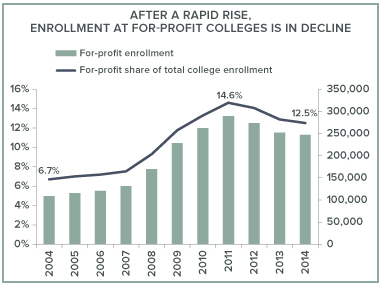
Enrollment at for-profit colleges in California almost tripled between 2004 and 2011, growing from 109,000 students to 289,000 students (as measured by full-time equivalent enrollment). Over the same period, enrollment in other colleges changed very little (increasing only 12%). By 2011, one in seven college students attended a for-profit institution. For-profit colleges enrolled more students than the University of California system and all private nonprofit colleges in the state.

But since 2011, enrollment in for-profit colleges has declined by more than 40,000 students, a 15% drop. Every sector of for-profit colleges experienced declines, with the sharpest reduction (29%) occurring among two-year institutions. Meanwhile, public and private nonprofit colleges saw slight enrollment increases during this same time frame.

What accounts for the rise and fall of enrollment at for-profit colleges?

Certainly, students were attracted to the easy access and convenient course times that for-profit colleges offered—something that other colleges can and have been learning from. But investigators have also found that a number of for-profit colleges engaged in predatory marketing practices, targeting vulnerable students and making false promises about job placement. Such practices may have helped enrollment growth at first, but as these practices became more well-known, and as regulatory and legal actions became more widespread, enrollment began to decline.

The decline also coincides with restrictions on institutional eligibility for the state’s large financial aid program, Cal Grants. In 2011, institutions with a high share of students receiving federal loans were required for the first time to meet minimum standards for graduation rates and loan default rates for their students to remain eligible for Cal Grants. In 2014, only 40 of the 383 for-profit colleges in California met these standards and remained eligible for Cal Grants. Enrollment declines were smaller (9%) at the for-profit colleges that retained Cal Grant eligibility. (Students at colleges that do not meet the minimum standards for Cal Grant eligibility can still receive federal financial aid.)

The future of for-profit colleges is uncertain. In the near term, enrollment losses are likely to continue. Though not yet available, 2015 enrollment data will show further declines due to the closing of Corinthian Colleges, the parent company for Heald, Everest, and WyoTech colleges, in California. Those institutions enrolled over 15,000 students in fall 2014.

Meanwhile, the US Department of Education has taken aim at the Accrediting Council for Independent Colleges and Schools (ACISC), the largest accrediting agency of for-profit colleges in the nation. Continued actions such as this one could eventually lead to a loss of accreditation and hence federal funds for hundreds of for-profit institutions nationwide. Without federal funding, many for-profit colleges would be unable to operate, leading to further enrollment declines.

Chart source: Integrated Postsecondary Education Data System (IPEDS), fall full-time equivalent enrollment in California.

Learn more

Visit the PPIC Higher Education Center

How the New FAFSA Can Help Californians

Last month the Obama administration unveiled a revamped Free Application for Federal Financial Student Aid (FAFSA). The new FAFSA is available in October rather than January, so high school seniors won’t have to wait until their spring semester to apply for aid. This means that students can factor their federal grant and loan eligibility into their college application process, instead of getting information about aid after they apply or even after they are admitted. The FAFSA will also be easier to fill out. In the past, students had to wait until their parents filed taxes in January (or later) and then fill out the FAFSA, but the updated form allows families to electronically transfer their tax data from the previous year’s IRS returns, which means that many income-related questions can be filled in automatically. This will drastically reduce the amount of time it takes to fill out the FAFSA.

These changes can benefit Californians in multiple ways. A streamlined FAFSA that families can fill out earlier may induce more students to complete the application, which is likely to lead to an increase in Pell Grants. According to nationwide estimates, 6 to 10 percent of college students from families with incomes under $48,000 fail to fill out the FAFSA; this suggests that many students in California and elsewhere are currently missing out on Pell Grants.

For Californians, the FAFSA is not just a federal aid application; it is also a prerequisite for participating in many state and institutional aid programs for students from low-income families. Cal Grants, the largest source of state aid, can cover up to the full tuition at a UC or CSU for students who qualify. UC’s Blue and Gold Opportunity Program combines federal, state, and local aid to ensure that students from families making less than $80,000 per year do not pay any tuition. But students who do not fill out the FAFSA are not eligible for any of these programs. National data show that about 20 percent of families who make from $48,000 to $75,000 do not fill out the form and therefore are potentially paying more than necessary for college.

Increased FAFSA completion rates may also benefit students from higher-income families. As PPIC has noted, the increases in tuition between 2007 and 2011 primarily raised the cost of attending a UC or CSU for many students from middle- and upper-income families. Filling out the FAFSA can help these students qualify for California’s Middle Class Scholarship, which covers a portion of the tuition and fees at UC and CSU for students with family incomes of up to $150,000 per year. In addition, FAFSA completion can help students qualify for federal loans and decrease their reliance on private loans, which can be more expensive and potentially riskier than federal loans.

Lastly, students who get financial aid—and who find out about it earlier in the application process—are better able to assess their college options. For instance, a student who knows that financial aid is available might apply to a four-year university instead of a two-year college. While the four-year school may be more expensive, research suggests that students who begin at a four-year institution are more likely to get a bachelor’s degree than if they begin at a community college with the intention to transfer to a four-year school. In other words, making the FAFSA process easier may not only help students afford college and take on less debt; it may also lead to higher baccalaureate degree completion rates.

Testimony: Low-Income Students and Financial Aid

As the legislature considers a number of bills aimed at increasing access and affordability of public higher education, the state assembly’s subcommittee on education finance invited PPIC to testify this week. The focus was the unmet financial aid needs of low-income college students. Hans Johnson, PPIC senior and Bren Fellow, presented data from the recent PPIC report Making College Possible for Low-Income Students: Grant and Scholarship Aid in California, which details the importance of federal and state grant aid in ensuring that higher education remains a ladder of economic opportunity for all Californians.

Johnson noted that as the state has cut funding for the University of California (UC) and California State University (CSU), tuition has increased and grant aid has become increasingly important to help students afford college. Research has also shown that grants and scholarships help students persist in their education and enables students to focus on their coursework and complete college faster. UC and CSU remain less expensive options for low-income students in terms of “net price”—the cost of attending college after accounting for federal, state, and institutional aid—than non-profit and for-profit private colleges. However, students whose family incomes are $30,000 or less still pay nearly a quarter of their incomes, or $8,000 per year, to attend a public four-year college.

Improving college access and completion is vital to California’s economic well-being, and aid for students has become increasingly necessary. The legislature’s attention to this issue comes at a time when 60% of California high school students qualify for free and reduced price lunch and three-quarters of California’s low-income college freshmen are enrolled in a UC or CSU.

Video: Making College Possible

At a time when California’s economy needs more college graduates, a new PPIC report examines the role of grants and scholarships in making higher education both accessible and helping students graduate. Hans Johnson, the report’s author and PPIC Bren Fellow, talked about his findings at a briefing last week in Sacramento.

He found that although total financial assistance available through federal grants, Cal Grants, institutional aid, and private scholarships has increased, it has not kept pace with the actual cost of attending California State University and community colleges. These are the California colleges that enroll most low-income students in California—a state in which nearly 60 percent of K–12 students qualify for free and reduced price lunch programs.

“If we want the economic ladder to success to work in California, we need more students to go to and complete college,” he said. “And given our student population, a lot of those students will be from very low-income families.”

He recommended strategies to make college more affordable and accessible. They include directing any additional aid to low-income students and helping more students complete financial aid forms.