
President Trump’s administration has announced the end of the Deferred Action for Childhood Arrivals (DACA) program, which allowed some undocumented immigrants who were brought to the United States as children to avoid deportation, obtain work permits, and continue their schooling. California is home to about 223,000 “Dreamers,” as DACA recipients are known, more than one-fourth of the national total. According to estimates cited by EdSource, about 70,000 Dreamers and other undocumented immigrants attend public colleges in California. The president gave Congress six months to come up with a legislative solution to address the issue before the decision takes full effect. Because California is home to a large share of the nation’s immigrants, including undocumented immigrants, changes in federal immigration policies are particularly important in the state.
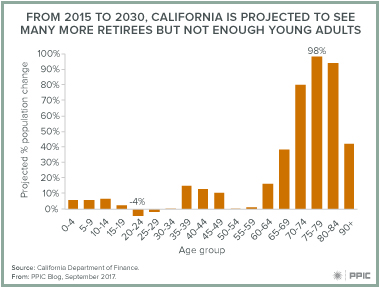
In California, as in the rest of the nation, a central economic challenge over the next couple decades will be to ensure an adequately sized and skilled workforce to meet the demands of a growing economy. This challenge is especially daunting in the face of unprecedented increases in the number of retirees. As the baby boomers—a large group that is highly educated—exit the labor market, California and the nation will be hard pressed to find an adequate supply of workers to replace them and help provide for their healthcare and other needs. According to the California Department of Finance, over the next 15 years, the number of people age 65 and over will increase by 3.4 million, while the number of young adults age 20 to 34 will decline by almost 200,000. Requiring the Dreamers to leave the country will deepen this decline. Many of the older adults, about one-third, have a bachelor’s or graduate degree. Largely as a consequence of this demographic certainty, PPIC has projected that the state will see a shortfall of 1.1 million workers with at least a bachelor’s degree by 2030. Were it not for highly educated immigrants, the skills gap would be even larger.
The solution to this demographic, economic, and educational challenge is to make sure that more young Californians acquire the skills necessary to replace those exiting the labor market and to ensure that California’s economy can continue to grow with high-skilled and high-wage jobs. Increasing the number of young Californians going to and graduating from college is essential to closing this workforce skills gap. Because DACA recipients must be high school graduates or attending school, the program helps increase the number of Californians who are on the educational trajectory we need. The large number of Dreamers in college is evidence that they hold promise for helping the state meet its future need for educated workers.
Read Higher Education in California: Addressing California’s Skills Gap
Visit the PPIC Higher Education Center.

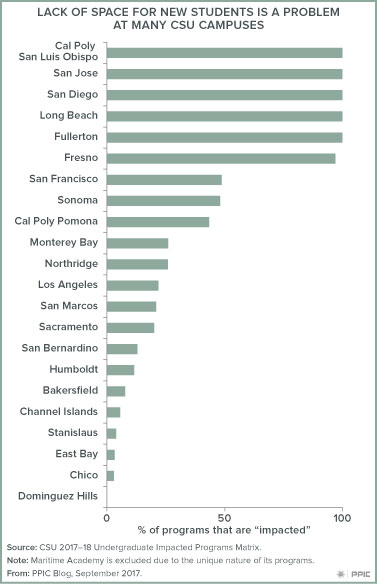 The state’s most recent budget aims to alleviate overcrowding at CSU, a problem that stems from an enrollment policy dating back to 2000. Under this policy, campuses established local admissions criteria that went beyond systemwide requirements for high-demand academic programs like nursing, business, and psychology. Currently, 6 of the 23 campuses are what CSU calls “fully impacted,” meaning that admissions requirements for local students in every major are significantly higher than those required systemwide. At Fresno State, 32 of its 33 programs are impacted. With higher admissions requirements, impacted programs often turn CSU-eligible students away. However, the rest of CSU campuses have fewer than half of their academic programs impacted. Six campuses—Bakersfield, Channel Islands, Stanislaus, East Bay, Chico, and Dominguez Hills—have less than 10% of their academic programs impacted. Unfortunately, unlike the University of California system where eligible applicants to an oversubscribed campus are referred to open campuses, CSU applicants who were eligible systemwide but did not meet the admissions criteria of their chosen impacted major or campus were denied admissions and not referred to a non-impacted campus.