Overcrowding at some California State University (CSU) campuses has had a serious effect on the system’s ability to increase the number of students graduating with bachelor’s degrees. This is an issue with broad implications for the state and for young Californians: PPIC research has shown that the CSU system will need to produce nearly half a million additional college graduates by the year 2030 to meet economic demand in California.
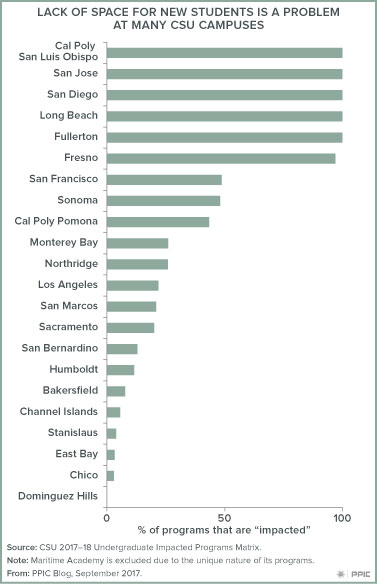 The state’s most recent budget aims to alleviate overcrowding at CSU, a problem that stems from an enrollment policy dating back to 2000. Under this policy, campuses established local admissions criteria that went beyond systemwide requirements for high-demand academic programs like nursing, business, and psychology. Currently, 6 of the 23 campuses are what CSU calls “fully impacted,” meaning that admissions requirements for local students in every major are significantly higher than those required systemwide. At Fresno State, 32 of its 33 programs are impacted. With higher admissions requirements, impacted programs often turn CSU-eligible students away. However, the rest of CSU campuses have fewer than half of their academic programs impacted. Six campuses—Bakersfield, Channel Islands, Stanislaus, East Bay, Chico, and Dominguez Hills—have less than 10% of their academic programs impacted. Unfortunately, unlike the University of California system where eligible applicants to an oversubscribed campus are referred to open campuses, CSU applicants who were eligible systemwide but did not meet the admissions criteria of their chosen impacted major or campus were denied admissions and not referred to a non-impacted campus.
In 2015–16 alone, CSU estimates that the system turned away nearly 30,000 eligible applicants due to overcrowding. While this did not necessarily prevent all of these students from attending college (many are likely to have attended other four-year colleges or community colleges), the practice of denying admissions to eligible students creates an unnecessary barrier in the education pipeline. Students who begin their higher education at a community college, for example, are less likely to complete a bachelor’s degree.
The 2017–18 state budget requires that CSU change its admissions process. Under the new policy, campuses must give first priority to local students applying to impacted programs and must automatically redirect eligible applicants who are denied admission to similar programs at other CSU campuses that have space. Given that a recent study commissioned by the California Governor’s Office of Planning and Research found that nearly 41% of high school students are eligible for CSU systemwide admission—an increase of nearly 10 percentage points since 2007—the creation of a referral pool could provide students with additional information about nearby campuses that are not impacted, allow them to attend those campuses, and give them a chance to pursue the major of their choice. Furthermore, the creation of this referral pool could more efficiently disperse enrollments across the system’s campuses, increase capacity, and improve bachelor’s-degree attainment in California as a whole.
Read center director Hans Johnson’s testimony about the workforce skills gap and CSU’s role in filling in.
Visit the PPIC Higher Education Center.

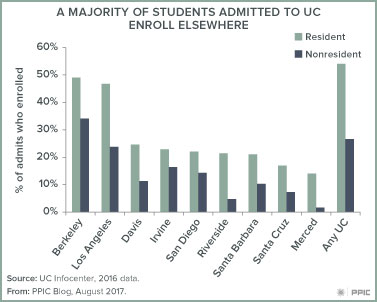 The proportion of admitted students who enroll is called the yield rate. The yield rate is a product many factors, including which campuses students are admitted to and whether they are California residents. UC’s systemwide yield rate was around 45% last year; at each campus, the yield rate for nonresidents (27%) is much lower than that for residents (54%). The Berkeley and LA campuses have the highest yield rates, with almost half of their admitted students enrolling. Only about one in five admitted students enroll at the other campuses.