Video: Californians and Their Government

As Governor-Elect Gavin Newsom prepares for his first term, half of Californians think he should take a different policy direction than Governor Brown. Four in ten approve of Newsom’s plans and priorities—while three in ten don’t yet know enough to have an opinion. These and other key findings of the latest PPIC Statewide Survey were outlined by Dean Bonner at a Sacramento briefing last week.

The survey asked Californians about four major policy areas that were highlighted in the governor’s campaign. Most see universal health coverage and free community college as top priorities, while fewer see universal preschool as a high or very high priority and only one in four prioritize high-speed rail.

The survey also asked how the state should use the projected surplus in the next budget year. A majority of Californians say they would prefer to use the surplus to increase funding for education and health and human services. Far fewer prefer to use it to pay down debt and build up a reserve or to spend on one-time funding for transportation, water, and infrastructure.

When asked to identify the state government’s highest priority in planning for the future, 39% name improving jobs and the economy, 20% say protecting the environment, and 15% say updating water and transportation infrastructure. Improving jobs and the economy is the highest priority across all parties and demographic groups.

Other survey highlights:

  • Two-thirds of Californians say the state is divided into two economic groups: the “haves” and the “have nots.” Four in ten characterize themselves as haves and 45% say they are have nots.
  • While more than half of Californians think the state is generally headed in the right direction, only about a third are satisfied with the way things are going in the nation. Half have no confidence that President Trump will make the right decisions for the country’s future.
  • Only two in ten likely voters approve of Congress; more than half see the shift in control of the US House from the Republicans to the Democrats as a good thing.
  • Two-thirds of state residents continue to see immigrants as a benefit, and there is still bipartisan support for allowing undocumented immigrants to stay in the US legally if certain requirements are met.
What Approval Ratings Say about Jerry Brown’s Legacy

Perhaps Governor Jerry Brown’s most important contribution—rooted in the higher approval ratings for the executive and legislative branches—was to restore public confidence in state government.

That’s my conclusion after we at the Public Policy Institute of California have taken 64 surveys since Brown took office in January 2011 asking the same question: “Overall, do you approve or disapprove of the way that Jerry Brown is handling his job as governor of California?”

For most of the time since 2011, political gridlock stymied Barack Obama, Donald Trump, and Congress.

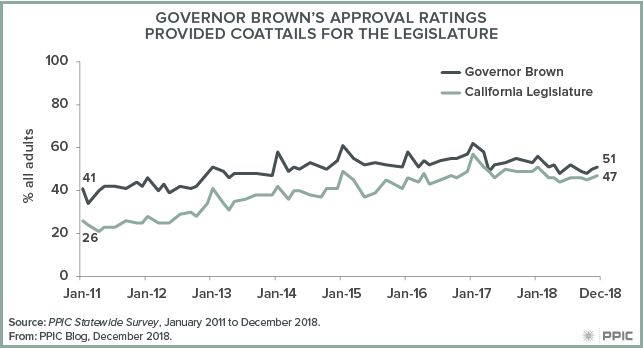
But in California, Brown and the state legislature were solving problems. Survey results show that the public responded. Brown’s latest (and our final) approval rating stands at 51 percent. That’s 10 points higher than his approval rating in our January 2011 survey. Brown’s approval rating surpassed 60 percent twice—after his 2014 reelection and after Trump’s election, when our January 2017 survey had the governor at a 62 percent approval rating. Not surprisingly, Brown’s highest approval ratings today are among Democrats and self-identified liberals, 68 percent and 69 percent, respectively, and is least popular among Republicans at 18 percent and self-identified conservatives at 36 percent.

Notably, his canoe theory of politics—paddle to the left, and then paddle to the right—seems to have worked well. About half of independents and moderates approve of the governor. Brown’s approval rating has never dipped below 47 percent since the voters passed his Proposition 30 tax increase in October 2012. The recent campaign for the Proposition 6 gas tax repeal and the race for his successor apparently had no effect on Brown’s popularity.

Brown steered through troubled fiscal waters that damaged other political careers. The approval rating for Gray Davis hit 31 percent in the September 2003 PPIC survey as he faced the recall that ended his time in office. His replacement, Arnold Schwarzenegger, had a 25 percent approval rating in the November 2010 PPIC survey, as the state suffered from massive budget deficits and he and the legislature struggled with unpopular spending and tax decisions.

The state legislature had been mired in low approval ratings for years. Perhaps the legislature rode the coattails of Brown’s success—its approval rating increased by 21 points, from 26 percent in the January 2011 PPIC survey to 47 percent in December. California’s fiscal recovery was certainly tied to more positive views of the governor and legislature. The perception that the state budget situation “is a big problem” fell by 25 points, from 68 percent in January 2011 to 43 percent in January 2018. At the same time, during Brown’s time in office, the belief that the state is generally going in the right direction grew by 16 points to 54 percent in December 2018.

Brown and the legislature took the drama out of the annual budget process, passed popular laws on education funding and climate change, responded to crises such as drought and wildfire, and maintained a united front against Trump’s unpopular policies.

Will Brown be be a hard act to follow for Gavin Newsom?

Maintaining fiscal stability and an effective partnership with the state legislature will be the key ingredients. Jerry Brown will be leaving office with Californians in a better state of mind than they were in eight years ago. His tenure offers a successful model for governing the state in the future.

California Politics and the Future

Jim Brulte, chair of the California Republican Party, says Governor Brown is “clearly the master of Sacramento.”

Jennifer Medina, national correspondent for the New York Times, says the governor hasn’t talked much about poverty or income inequality— an issue his Republican opponent used in the election this year.

And Garry South, longtime Democratic strategist, says the governor needs to take on the tough issue of fiscal reform because this can only be done by a Democrat.

These are a sample of comments from a panel of experts speaking at a briefing hosted by PPIC in Sacramento this week. The discussion focused on the challenges and opportunities ahead for the governor and legislature. The event began with a presentation of the results of the new PPIC Statewide Survey by Dean Bonner, associate survey director. The survey included a wide range of topics, including tax reform, health care, climate change, and the approval ratings of state leaders.


Video Highlights Survey’s Election Findings

The October PPIC Statewide Survey was the focus of a briefing last week in Sacramento, where research associate Jui Shrestha summarized the findings. After her presentation, David Lesher, PPIC’s director of government affairs, pointed to some survey findings to watch as the campaigns and election play out.

  • The governor’s race: Jerry Brown leads by 16 points among likely voters, but other findings are less overwhelmingly in his favor. Statewide, Brown has the support of just a slim majority of likely voters, 52 percent. And he trails Neel Kashkari among some groups of likely voters—those in Orange/San Diego Counties, for example.
  • Voter enthusiasm: Likely voters paid much more attention to news of the gubernatorial candidates in 2006—the last election in which there was an incumbent—than they are doing today. Likely voters overall are also showing lower levels of enthusiasm today than in the 2010 or 2012 elections. These findings suggest that low voter turnout is likely, which will color the results.
  • Proposition 2: Placed on the ballot in a bipartisan vote of the legislature and endorsed by both the California Republican Party and by Governor Brown, this constitutional amendment to create a rainy day fund is struggling for majority support. While support has increased since September, just 49 percent of likely voters favor it today. Less than half of those who live in the San Francisco Bay Area and of those with incomes of $80,000 or more say they would vote yes on Proposition 2.

A Cautionary Tale for Fiscal Reformers

One of the biggest surprises in the PPIC Statewide Surveys this fall has been the inability of Proposition 2 (aka the rainy day fund) to garner majority support from voters. The measure—which was placed on the November ballot by the governor and a unanimous vote of the legislature—allows for annual transfers of revenues into an account to be used only for fiscal emergencies and to pay off state debt.

Support did rise from 43 percent in our September poll to 49 percent in October. This may be a sign that Proposition 2 can defy the conventional political wisdom about ballot measures starting out with less than 50 percent support being doomed to fail. Certainly, its supporters find this trend encouraging. But, given the widespread support for the idea of a rainy day fund in earlier PPIC polls, why is Proposition 2 struggling to achieve majority support? Further analysis of our survey results offers a cautionary tale about the political pitfalls of fiscal reforms.

We have been tracking a wide array of fiscal reforms in our polls, including the idea of a rainy day fund: “Do you favor or oppose increasing the size of the state’s rainy day fund and requiring above-average revenues to be deposited into it for use during economic downturns?” In the five times this question was asked before Proposition 2 was put on the ballot, likely voter support hovered around 70 percent. Today, support for the rainy day fund idea has fallen to 55 percent among likely voters. This suggests a strong link between supporting the rainy day fund concept and voting yes on Proposition 2—in fact, 7 in 10 of those who would vote yes on Proposition 2 express support for a rainy day fund. More important, why has a fiscal reform that was consistently and highly regarded fallen out of favor with so many voters?

We looked at the possibility that Californians are less inclined to support a rainy day fund because the state’s finances have been improving. But our tracking question on state budget perceptions found that slightly more likely voters say that the state budget situation is a big problem today (62%) than in January (56%). Moreover, those who see the state budget as a big problem are less likely to favor a rainy day fund today (48%) than they were in January (65%).

The steep decline in support for a highly popular idea seems to have political overtones. Since January, support for the rainy day fund idea has dropped from a solid majority to below 50 percent among several groups: Republicans (72% January, 47% October), conservatives (69% January, 47% October), those who disapprove of the job performance of both the governor (65% January, 42% October) and the legislature (65% January, 47% October), and those who say the state is going in the wrong direction (67% January, 48% October). Meanwhile, Democratic governor Jerry Brown has been touting the virtues of Proposition 2 on the campaign trail, and Republican leaders who supported it have been silent.

In an election context, the rainy day fund idea has thus become politically polarizing. The governor’s success in rallying his supporters around Proposition 2 is reflected in its recent rise in the polls. But the rainy day fund idea has lost favor among Republicans and conservatives who used to be loyal supporters. Today, support for idea is much higher among Brown voters (68%) than Kashkari voters (43%). Governor Brown may need to do more to reassure the Democratic base of the long-term benefits of a rainy day fund to prevent Proposition 2 from falling short of majority support.

In short, a rainy day fund that once had strong backing across party lines has become a divisive idea. This is a reminder that even a seemingly uncontroversial issue with unanimous support in the legislature is subject to political redefinition in the heat of an election. Future tax and spending reforms may face an even more challenging path if they can’t ride on the coattails of an incumbent governor with a 54 percent approval rating and 52 percent supporting his reelection.

The lesson is that the popularity of any given reform can fade unless voters know that it is supported by leaders who share their partisan views and reflect their political values.

Majorities Favor State Government Downsizing

The recent PPIC Statewide Survey offers an early snapshot of voters’ choices as we enter the November election cycle. The majority support for Governor Jerry Brown’s reelection and the Proposition 1 state water bond was widely cited in the media last week. But the poll also reveals surprising news about the voters’ overall mood this year: by a wide margin, likely voters would rather pay lower taxes and have a state government that provides fewer services (53%) than pay higher taxes and have a state government that provides more services (41%).

What is so special about this finding? We have been observing a slow but steady rise in the preference for lower taxes and fewer services since November 2012—when voters approved the Proposition 30 tax increase. In the 24 times since we first asked this question in our February 2003 poll, the preference for lower taxes and fewer services has usually been below 50 percent. Moreover, this preference has never exceeded 55 percent, placing the current reading close to the historic high.

This finding seems to run counter to the strong support we found for the Democratic governor and the multi-billion dollar state water bond on the November ballot. It is also seems at odds with another Golden State mega-trend: the steady decline in the number of Republican voters. The secretary of state recently reported that Republicans now account for just 28 percent of the electorate.

While a preference for smaller government has long been expressed by Republicans, the 53 percent of California likely voters who want lower taxes and fewer services are a politically mixed group. Forty- eight percent are registered Republicans and 55 percent are self-described conservatives—which means that many who hold this view are Democratic and independent voters, and see themselves as political moderates. They are predominantly homeowners (81%), and most are white (66%). But only a slight majority are age 55 and older (54%), and less than half are college graduates (41%) or have annual household incomes above $80,000 (44%). So, this likely voter group has a diverse demographic profile.

What do they have in common? Seven in 10 say the state is headed in the wrong direction. Three in four say that the state budget situation—that is, the balance between government spending and revenues—is a big problem for the people of California. Eight in 10 say that major changes are needed in the state budget process in terms of both revenues and spending. In sum, they are the core audience for fiscal restraint and reform.

Governor Brown’s emphasis on fiscal prudence, including the downsizing of the state water bond, seems to have struck a chord here. Among those who prefer a smaller role for state government, one in three are supporting Jerry Brown in the governor’s race. This trend helps to explain the Democratic candidate’s sizable 21-point lead over Republican challenger Neel Kashkari. This group is also leaning toward support for the Proposition 1 state water bond (46% yes, 37% no), helping this multi-billion dollar spending measure to now have a commanding two-to-one lead.

This likely voter group may be a major hurdle for a Democratic Party seeking to regain a supermajority in the state legislature. Seven in 10 of these likely voters say they disapprove of the way that the state legislature is handling its job. Six in 10 say it would be a “bad thing” for the Democrats to gain a two-thirds majority in the legislature in the November election. Only 18 percent say that this would be a “good thing.”

Our poll’s findings on the preferred role of state government suggest that the election is unlikely to result in a mandate for expanding services and raising taxes—they also point to an opening next year to discuss fiscal reforms that the state needs for the 21st century economy.

The Vanishing Line-Item Veto

California officially has a budget for the coming fiscal year. The state plans to spend $156 billion, about 7.5% more than last year.

As in most other states, in California the governor has line-item veto power. After the budget passes, he can remove or reduce individual provisions without the legislature’s approval. That’s a lot of potential authority over the budget.

What did Jerry Brown do with such tremendous power? Not much. He removed or reduced only 10 budget items, cutting a total of $37.9 million. In the context of a $156 billion budget, that’s a rounding error.

And that’s par for the course with this governor. Brown made his highest number of vetoes (42) in the first budget after his election in 2011; these cuts amounted to one-fifth of one percent of the $267.4 million ultimately spent that year. Last year, he vetoed 30 items that added up to only $40.7 million—that’s like a typical California household reducing its annual spending by about $17.

Many governors have gone light on line-item vetoes, but Brown’s veto numbers are low even in historical context. His vetoes have averaged about a tenth of one percent of each year’s final budget. By contrast, Schwarzenegger (2004–2010) averaged two-thirds of a percent, Davis (1999–2003) and Wilson (1991–1998) about three-quarters of a percent, and Deukmejian (1983–1990) a whopping 2.5 percent. Brown himself, when he was governor in the late 1970s and early 1980s, averaged about three-quarters of a percent in line-item vetoes (we do not have data for 1975, his first year).

There are a number of reasons for the recent harmony between the governor and the legislature. But an important one is likely the new threshold for passing the budget. It used to take a two-thirds vote in each chamber, which required at least some members from each party to sign on. As of 2011, only a simple majority of each chamber is required, so Brown has been able to conduct all the negotiations within his own party. In today’s polarized political environment, that simplifies the process enormously—it also helps explain why each of Brown’s budgets has been approved roughly on time, ending a decades-long trend of budgets passing later and later.

Of course, this streamlining of the process entails sidelining Republicans from budget negotiations. Whether that is too high a price to pay depends very much on one’s perspective. But for better or worse, we may be settling into a new budget status quo.