Federal Funds and California’s Budget

California receives a lot of direct funding—more than $100 billion—from the federal government. Should federal officials make changes to the programs that provide these funds, the state would feel the impact quickly, with the most vulnerable Californians bearing the brunt. As lawmakers begin to work on the state budget in earnest, there is less certainty surrounding the contribution of federal funds than in prior years.

Governor Brown’s current budget proposal estimates that federal support will contribute about $106 billion dollars to state and local programs (a large share of the funds “pass through” state departments and are distributed to counties, school districts, and other entities). That would represent a record amount.
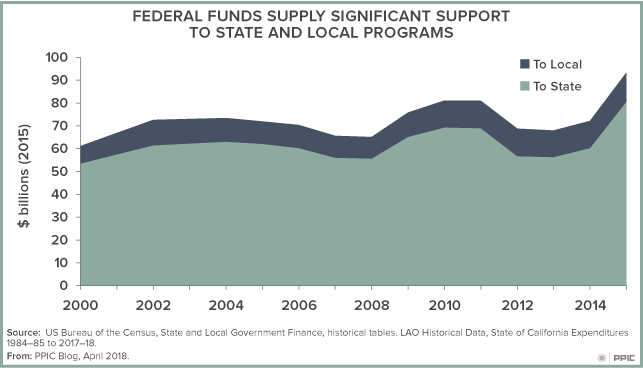
In the past, federal revenue to California hovered between $70 and $80 billion. After implementation of the Affordable Care Act (also known as Obamacare), the total level of federal assistance to the state rose beyond the $100 billion mark—mainly because of the expansion of Medi-Cal.

Though it is the largest, Medi-Cal isn’t the only state program that relies on the federal government for a significant share of total revenue. From CalTrans to the California Department of Education, billions of federal dollars provide support for state and local efforts.

Today, relying on that federal revenue could be hazardous. The Trump administration and congressional Republicans have expressed an interest in making significant changes to key programs. For instance, food stamps—known by its federal moniker as Supplemental Nutrition Assistance Program (SNAP) and as CalFresh here in California—may look very different over time. Trump’s proposal limits the ability of recipients to choose which foods they can purchase, claiming that these limitations will save money. These purported savings underpin a proposed 30% overall cut to the program over the next decade.

Should funding for these programs be cut, California—as the nation’s largest state—would bear the greatest dollar reduction. And the state’s poorest would feel the greatest impact. PPIC research has found that the state’s social safety net programs often spell the difference between being in or out of poverty for hundreds of thousands of residents. For example, CalFresh moves 800,000 people out of poverty.  The impact of CalWORKs—the state’s welfare program—is smaller, but significant (400,000 moved from poverty). The effect of funding reductions today could be amplified in the next recession, when unemployment rises, incomes fall, and more people seek these benefits.

In the past, California, like other states, could look to the federal government as a reliable source of revenue for many of its programs, especially those making up the social safety net. In fact, the federal government has even served as a partial fiscal buffer during economic downturns, increasing spending when state generated revenues fell. The state, however, cannot take the level of federal support as a given and, for now, will have to navigate in an environment of fiscal uncertainty, particularly with regard to programs that serve the poor. In this budget building season, state leaders will need to consider how best to cope with the possibility of reduced federal assistance in the immediate future.


Ecosystems Need Groundwater Too

Groundwater is a critical resource for most living things in California. But while human communities can increase groundwater pumping when surface supplies diminish during droughts, ecological systems often have no backup supply. We talked to Sandi Matsumoto, associate director of the Nature Conservancy’s California Water Program, about determining which ecosystems are particularly dependent on groundwater and what can be done to help them cope with dropping water levels.

PPIC: What are “groundwater-dependent ecosystems”?
Sandi Matsumoto: These are familiar places to everyone—wetlands, rivers, estuaries, springs, and associated plants and animals that rely on groundwater to meet some or all of their needs. They’re found in nearly all of the state’s groundwater basins and are often supported by surface waters, such as rivers and streams fed by rain or melting snow. Even deserts have them—where springs support desert oases, for example.

The Nature Conservancy has been working with California’s Departments of Water Resources and Fish and Wildlife to develop a comprehensive statewide map of vegetative indicators of groundwater-dependent ecosystems. Using plants as the prime indicators, we’ve mapped 2.2 million acres of groundwater-dependent ecosystems.

PPIC: How well do we understand the connections between groundwater and the ecosystems that depend on it?

SM: We’re definitely early in our understanding of this complex relationship. To fully understand it you’d have to get a hydrogeologist and an ecologist in the same room together—and you don’t see that pairing very often.

I like to think of rivers and streams as expressions of a healthy groundwater system. In California, rivers can flow well into summer months, long after the snowpack has melted. In areas with high groundwater levels, a lot of that river flow can come from groundwater. High levels of pumping can reverse this dynamic—when groundwater levels drop lower than the bottom of the river channel, water starts seeping into the aquifer. It’s called a “losing stream.”

Going forward, I think the Sustainable Groundwater Management Act (SGMA) will bring a much greater understanding of ecosystem conditions. By monitoring certain vegetation types we could improve our understanding even more. For example, we can look for signs of declining health in plants or changes in the number of acres of these “indicator plants.”

The trend has been a decline of groundwater-dependent ecosystems. The goal of SGMA is to stabilize things, but if groundwater sustainability agencies make a concerted effort, we may even be able to reverse the decline. For example, colleagues at the Nature Conservancy in Arizona are doing groundwater recharge projects near rivers, boosting their flow and improving conditions for riparian ecosystems. In California we’re trying to mimic seasonal wetlands by flooding farmland to support migratory birds. These kinds of projects help farmers while also providing habitat and even groundwater recharge benefits.

I also think that SGMA will force us to figure out what we care about and how to sustain those things. To get to groundwater sustainability we have to talk to each other, and experts will have to come out of their silos. If SGMA is done right, we’ll see hydrogeologists working with ecologists and other unlikely pairings. That’s what I’m most hopeful about.

The Gender Gap in California Politics

In the past year, women have led large-scale political protests nationwide and an increasing number are running for elected office. In California, likely women voters have a numeric edge over men (53% to 47%), according to PPIC’s analysis. With the midterm elections quickly approaching, will women make a pivotal difference?

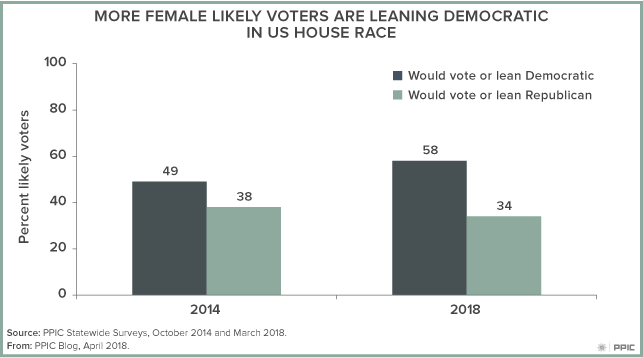
PPIC’s March 2018 survey offers some insight: nearly six in ten women (58%) support the Democratic candidate on the generic ballot for the U.S. House of Representatives—a 9-point increase since 2014. Preferences among men are unchanged.

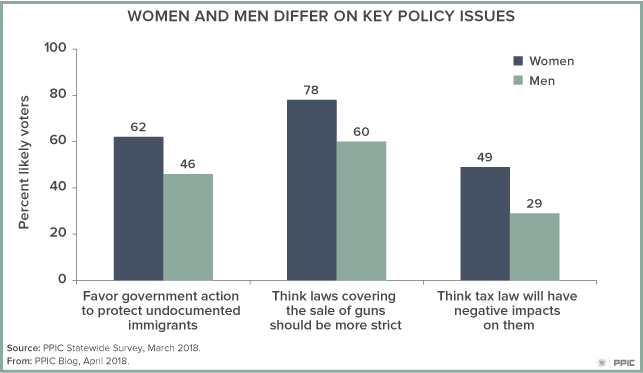
Although PPIC surveys show female likely voters are much more likely than their male counterparts to disapprove of President Trump (67% to 52%), issues like immigration policy, gun control, and taxes also reveal degrees of a gender gap. Examples include:

  • Immigration policy. Six in ten female (62%) likely voters are in favor of state and local governments making their own policies—separate from the federal government—to protect the rights of undocumented immigrants; fewer than half of men (46%) are in favor.
  • Gun control. While solid majorities of men and women think laws covering the sale of guns should be stricter, more women (78%) than men (60%) hold that view.
  • Federal tax law. Differences are also apparent between women (49%) and men (29%) who believe that the tax laws will have a negative impact on their families in the coming years.

However, it is important to note the role that party plays in policy preferences. For each of the aforementioned issues, there are sizable differences between Democratic women and Republican women. It’s also notable that among Republican likely voters, more women (54%) than men (38%) think gun laws should be stricter.

California is often mentioned as a battleground state in the 2018 elections, and tension between the federal and state governments is palpable. California’s government stands in opposition to many policies coming out of Washington and several of its congressional seats could be up for grabs—potentially determining the party that will lead the next US Congress. As a result, the nation will be watching California. And the PPIC Statewide Survey will continue to follow the perceptions and preferences of California’s likely voters, with particular interest in the gender gap.

Expanding Health Care Coverage for Undocumented Immigrants

As efforts to create a state-based single-payer health system confront complex questions of costs and federal uncertainty, advocates and state lawmakers are pushing forward with incremental policy measures to expand access to health coverage. The largest group of Californians that remain without comprehensive health insurance are undocumented immigrants, who were largely excluded from the coverage expansions created by the Affordable Care Act. Estimates suggest that almost 60% of uninsured Californians are undocumented.

Today, the Senate Health Committee is holding a hearing on SB 974 (Lara), which would allow all income-eligible California residents, regardless of immigration status, to enroll in comprehensive coverage through Medi-Cal (the state’s Medicaid program). California has already extended Medi-Cal coverage to undocumented children under 19, who have been eligible for comprehensive health benefits since May 2016. At the end of last year, nearly 220,000 undocumented children were enrolled in Medi-Cal, with costs estimated at $280 million in the recent fiscal year’s budget. No cost estimates are available yet for covering undocumented adults. But comprehensive coverage for the undocumented population must come from state funds, since federal Medi-Cal funding can only be used to support emergency services for undocumented immigrants.

In previous research, we estimated that about half of California’s undocumented population would likely qualify for Medi-Cal based on their income levels if restrictions on immigration status were removed. But this varied across regions. In Los Angeles County and parts of the Central Valley, more than half of undocumented immigrants had incomes below the Medi-Cal eligibility threshold of 138% of the federal poverty level, or FPL ($34,600 for a family of four). Bay Area counties had lower shares of income-eligible undocumented immigrants.

Currently, undocumented adults rely on the health care safety net—including community clinics, public hospital systems, and emergency departments—to access needed medical care. These providers play an integral role in caring for both those that remain uninsured and those covered by our vastly expanded Medi-Cal program. As policymakers consider ways to expand comprehensive health coverage, it is important that they continue to support the state’s safety net providers.

Testimony: Reforming Key Policies at the Community Colleges

Olga Rodriguez, research fellow at the PPIC Higher Education Center, testified before the Assembly Higher Education Committee in Sacramento today (April 3, 2018). Here are her prepared remarks:

Thank you for the opportunity to testify this afternoon. My name is Olga Rodriguez and I am a research fellow at the Public Policy Institute of California. PPIC is a nonpartisan policy research organization and does not take positions on legislation. My comments are based on research we have conducted at PPIC on California’s community colleges.

Every year, California’s community colleges identify hundreds of thousands of students as not ready for transfer-level courses in math and English. Since these courses are required to transfer to a four-year college, students deemed underprepared are placed in developmental (also known as remedial or basic skills) courses to prepare for college work. These placement decisions have profound effects: our study finds that 80% of entering students take at least one developmental course in math, English, or both, and very few of those students complete a college-level math or English course, or transfer to a four-year college after six years.

Despite the critical role of assessment and placement, historically there has been little clarity about how colleges across the state assess and place students into math, English, and English as a Second Language (ESL) sequences. The overwhelming majority of colleges do not have this information publicly available in their college catalog or on their website. To help fill this information gap, in spring 2016 we surveyed all 113 community colleges in the state; 82 of the colleges participated in the survey. They reported on the policies used to assess and place students into transfer-level math and English as well as the highest level of ESL during the 2014–15 academic year. The broad goal of the survey was to provide policymakers and practitioners with a descriptive landscape to improve understanding of the policies used across the state to assess and place students into math, English, and ESL courses. These results provide an important baseline prior to the implementation of assessment and placement reforms. I describe our findings below.

  • First, community colleges varied in how they identified college-ready students. We find that the use of assessment tests was widespread; 100% of colleges reported using assessment tests for math, English, and ESL placement. However, there was variation in the types of tests used and how they were used. For example, while more than half of colleges reported using the Accuplacer test to assess college readiness in math, cut scores ranged from 25 to 96 out of 120. A student with a score of 58 (the median score used by colleges) would be deemed college ready at half of these colleges, but not at the other half. The lack of consistency means that access to college courses—credit-bearing courses that students need in order to transfer to four-year colleges—is determined not only by students’ performance on the test, but also by the policies at the college where they enroll. This wide variation may be especially challenging for the 40% of students who eventually enroll in more than one community college campus, as they could be deemed college ready at one college but referred to remediation in another. These policies end up undermining opportunities to transfer between campuses and provide mixed signals about what it means to be ready for college-level courses. Furthermore, assessment and placement practices have implications for equity. Students of color are more likely to attend colleges that set higher math cutoff scores, which means these students have less access to the math classes they need to advance.
  • Second, the use of multiple measures was sparse and unsystematic. In California, the use of other measures in addition to placement exams (known as multiple measures) is mandated by law. In fact, research shows that measures such as high school achievement data do a comparable or better job at predicting college success compared to assessment tests. But while assessment tests were standard practice, there was substantial variation in the types of other measures used across colleges and across subjects. Additional measures included high school GPA, grades in prior English and math coursework, results from the Early Assessment Program (EAP), and counselor or instructor recommendations, among others. Overall, we find that 61% of colleges used grade in last math course, and 40% used grade in last English course; but only about one-third of colleges used high school GPA for placement into math and English courses. Even fewer colleges used these measures for ESL placement (8–12%). In addition, while some colleges used multiple measures in a systematic way for all students, up to 30% of colleges only used multiple measures if students requested it or challenged their placement. Uneven implementation of multiple measures may aggravate inequities if students with cultural and social capital are more likely to take advantage of these policies.
  • Third, assessment and placement in ESL needs more attention. Each year, about 30,000 students enroll in ESL, and these students may be especially disadvantaged by current policies. Compared to English and math, in ESL, fewer colleges offered exemption opportunities and test preparation activities. Additionally, our findings suggest that a lower proportion of colleges used high school achievement data for ESL placement, indicating that English Learners may not be benefitting from one of the most promising methods of improving placement accuracy.
  • Finally, ongoing reforms aim to promote more consistent and accurate placement policies. With the support of the governor, the legislature, and the system office, a significant amount of resources have been devoted to improving assessment and placement at community colleges. The passage of Assembly Bill 705 will help address this issue by mandating that all colleges use high school achievement data for the assessment and placement of all students. Still, if colleges have the autonomy to set their own rules for placement, and if colleges do not fully inform students of their placement rules, this will be a cause for concern as uneven access to transfer-level courses has significant implications for student success.

In sum, assessment and placement policies should help students reach their academic goals—not stand in the way of those goals. As colleges work to enhance the efficacy of developmental education, implementing evidence-based practices that accurately assess students’ college readiness will be critical. A more equitable and efficient system for assessment and placement is a vital step in helping all students achieve their academic goals.