Evaluating Student Success at the City College of San Francisco

In July 2013, the Accreditation Commission for Community and Junior Colleges reaffirmed its earlier decision to pull accreditation from the City College of San Francisco (CCSF). Citing a “lack of financial accountability as well as institutional deficiencies in the area of leadership and governance” as the “main obstacles to the college’s turnaround,” the commission allowed CCSF 12 months to prepare to cease operation. San Francisco’s city attorney and City College faculty have filed lawsuits against the commission, and in January a court granted an injunction placing the loss of accreditation on hold. The California Community College Chancellor’s Office, which oversees the state’s 72 community college districts, is working closely with City College to address the commission’s concerns and avoid the loss of accreditation. And the state legislature is considering a bill that would stabilize CCSF funding for the next two years. Meanwhile, students are responding to the controversy: City College reports a 16 percent decline in spring enrollment in 2014 compared to 2013.

The fight over CCSF’s accreditation is focused on a number of issues and concerns. But it raises important questions about how colleges should be evaluated. Many states have begun funding higher education institutions based on performance, and California officials are discussing similar performance measures. Most would agree that student outcomes are an important measure of any college’s effectiveness. Of course, good student outcomes for a college might simply reflect the strength and preparation of incoming students.
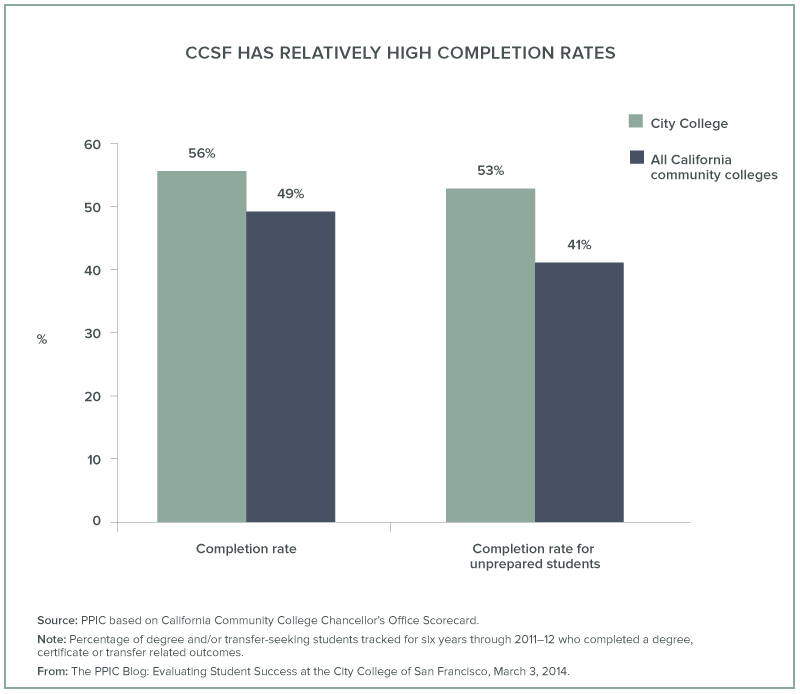
Because the California Community College Chancellor’s Office does an excellent job of providing information on student success, we have a wealth of data to examine student outcomes at CCSF. By most measures, City College fares well relative to other community colleges in the state. The share of students who complete college by earning a degree or certificate, or by transferring to a four-year college, is higher at CCSF than in the rest of the state. This advantage holds even when we limit our analysis to students who are initially unprepared for college-level work, which suggests that it is not simply the mix of students drawn to City College that drives its outcomes. (Although it is possible that CCSF’s unprepared students are closer to college level than unprepared students at other colleges.)

Of particular interest is how effectively a community college prepares students for transfer to four-year colleges or universities—this is arguably the most important mission of community colleges. Among students defined by the chancellor’s office as intending to transfer, City College has a higher success rate than most other college districts, ranking 6th out of the state’s 72 community college districts and 4th among the state’s larger districts—those with at least 2,000 students intending to transfer. The other top districts are a who’s who of the state’s most highly regarded: Foothill-De Anza, South Orange County, San Diego, Pasadena, and Santa Monica. By this important measure, City College is in very good company.

On some outcomes, City College performs below average. For example, its success rates in math remediation are significantly lower than the state average, and the share of career technical, or vocational, students who earn a certificate is slightly lower than the state average. However, City College fares well in most other measures. For example, the share of students who successfully complete remediation in English is higher than the statewide average, as is the share of students who successfully complete ESL courses.

Student outcomes are not the only way to assess a college. But they are an important measure of success. CCSF has provided thousands of students with a pathway toward meeting educational and occupational goals. That is no small feat.

Testimony: Community Colleges’ New Scorecard

The Select Committee on Community Colleges held an oversight hearing, “The State of California Community Colleges,” on February 18. The committee invited PPIC Bren Fellow Hans Johnson to testify on the Community College Chancellor’s Office efforts to provide new information on student outcomes through its Student Success Scorecard. Here are his prepared remarks.


Thank you Chairman Fox and committee members. My name is Hans Johnson. I am a Bren Fellow with the Public Policy Institute of California. PPIC has produced a number of studies on California’s higher education systems. Our focus in those studies is on student outcomes, and how we can improve those outcomes. I appreciate the opportunity to testify today about the Community College Chancellor’s Office efforts to provide more and better information on student outcomes through their “Student Success Scorecard.”

Community colleges play an especially important role in California. They enroll the large majority of undergraduates in our state, far more than UC, CSU, or private institutions. As a state, from a budget and enrollment perspective, we place more emphasis on community colleges than do most other states. Helping more community college students to achieve degrees, certificates, and transfer is key to our state’s wellbeing.

As an independent researcher, I have had the opportunity to work with the Chancellor’s Office, and I have been very impressed with their professionalism and their knowledge. The scorecard is a step in the right direction for several reasons. First, the scorecard offers the right kind of information on the right kinds of student outcomes. For numerous critical measures, such as completion rates, the scorecard provides information on outcomes for each of the state’s community colleges, with breakdowns for key demographic groups.

Second, the scorecard is transparent and accurate. It reflects the impressive data collection efforts and expertise of the Chancellor’s Office. Details about the scorecard measures and how they were created are readily accessible.

Third, the scorecard presents information in a user-friendly format. Graphs and tables are well-presented and easy to follow. This is critical for parents and prospective students as they consider their college choices.

Finally, the scorecard is a useful tool for policymakers, policy researchers, and the colleges themselves. The scorecard makes it easy for colleges to identify where they stand relative to other colleges and to measure their progress over time. For policy researchers, this information is useful in answering questions about student progress. For example, using the scorecard we find that there is a wide range in completion rates across colleges (with completion defined as earning an associate’s degree, a certificate, or transferring to a four year college). Some of this variation can be attributed to differences in the academic preparation of incoming students, as can be shown using scorecard data.

The scorecard is an important tool, but it could be enhanced by incorporating additional measures. This would be easy to do, because the Community College Chancellor’s Office already has very useful data available elsewhere. For example, through its Salary Surfer the Community College Chancellor’s Office provides data on salaries of community college students before and after earning a degree or certificate. Adding this information to the scorecard would provide valuable labor force information for prospective students. The Chancellor’s Office provides even more data on student outcomes through its online Data Mart query tool. Some of that data, such as transfer rates to four year colleges, should also be incorporated into the scorecard.

California’s community colleges are doing a very good job of collecting and sharing important data, and the scorecard is an important example of those efforts. However, the Community College Chancellor’s Office still faces a big challenge in getting the scorecard into the hands of prospective students and parents when they need it most.

Finally, it must be noted that the scorecard is only a tool. The information provided in the scorecard can prompt action, but the real key to increasing student success depends on improving student pathways to transfer, degree completion, and certificate completion.