
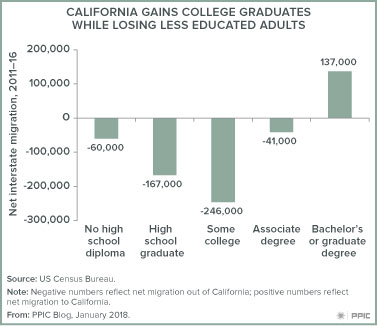
[vc_row][vc_column][vc_column_text]California’s heyday of rapid population growth—the post-World War II era—was fueled by millions of migrants coming to the state from the rest of the country. Those days are long gone. California’s population continues to grow (through births and international migration), but every year it loses tens of thousands of people to other states. And yet there is one group that California continues to attract: college graduates.
This interstate migration pattern—gaining large numbers of college graduates while losing large numbers of less educated adults—doesn’t happen anywhere else in the country. Over the past five years, California has attracted 162,000 more college graduates (adults with at least a bachelor’s degree) from other states than it has lost. Over the same period, the University of California (UC) awarded about 300,000 bachelor’s degrees at its nine undergraduate campuses. In other words, interstate migration provides California with half as many college graduates as the entire UC system.

College graduates come to California from all over, but eight states send California substantially more college graduates than they get in return. Between 2012 and 2017, net gains of college graduates from New York (51,000), Illinois (31,000), Pennsylvania (24,000), New Jersey (20,000), Massachusetts (20,000), Florida (16,000), Michigan (13,000), and Ohio (11,000) totaled more than 186,000. California experienced smaller but still sizable net losses (totaling 80,000) to five states: Texas (29,000), Oregon (16,000), Nevada (13,000), Arizona (12,000), and Washington (10,000).
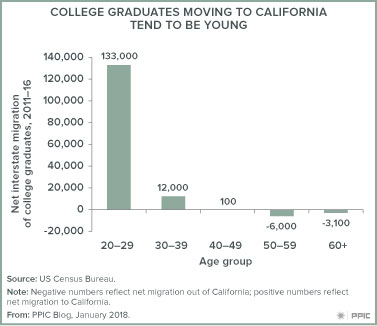
The new migrants to California tend to be quite young. Indeed, college graduates age 20–29 account for almost all of the net gains. (In contrast, California experiences small net losses of older college graduates.) From a labor market perspective, attracting young college graduates is especially advantageous. Young adults with college degrees are at the start of their careers and provide the state with much-needed highly educated workers.

In fact, college graduates moving to California are more likely to be employed than those leaving the state. The largest gains are primarily in majors that are in relatively high demand in the labor market, including engineering (33,000), communications (18,000), business (18,000), and computer science (17,000).
The migration of young college graduates to California is a consequence of the state’s growing demand for highly skilled and highly educated workers. But the numbers are not high enough to fully meet the state’s changing needs. Although many college graduates move to California from other states, the most important source of highly educated workers in California are the state’s own colleges and universities. Policies and practices to improve college access and completion in the state will ensure that more Californians are able to help create and benefit from a strong economy.[/vc_column_text][/vc_column][/vc_row]
 College graduates come to California from all over, but seven states send California substantially more college graduates than they get in return. Between 2011 and 2016, net gains of college graduates from New York (45,000), Illinois (32,000), New Jersey (20,000), Pennsylvania (17,000), Michigan (15,000), Florida (14,000), and Massachusetts (14,000) totaled more than 150,000. California experienced sizable net losses of college graduates to just four states: Texas (-26,000), Oregon (-20,000), Nevada (-14,000), and Arizona (-11,000).
 The migration of young college graduates to California is a consequence of the state’s growing demand for highly skilled and highly educated workers. But the numbers are not high enough to meet the state’s changing needs. PPIC’s research has shown that