2020 Primary: Funding Higher Education Facilities

The state legislature recently passed a $15 billion bond measure to fund upgrades to education buildings and facilities. Voters will decide whether to support this bond as part of the March 2020 primary ballot.

For higher education, the measure would provide $6 billion to the state’s three higher education systems, the University of California (UC), the California State University (CSU), and the California Community Colleges (CCC). These funds would be distributed equally ($2 billion each)—even though the systems enroll significantly different numbers of students.

The legislature will approve specific projects as part of the annual budget process. As a condition of making funds available, the bill requires UC and CSU to develop affordable housing plans for their students.

figure - Proposed Bond Funding Varies on a per Student Basis

The last time the state proposed and passed a ballot measure supporting higher education was more than a decade ago. Proposition 1D (2006) passed with almost 57% support. The total amount of funding for higher education in that initiative was about half of what is proposed in the current measure ($3.1 billion compared to $6 billion).

figure - 2020 Initiative Proposes Much More Funding for CSU and CCCs than the 2006 Measure

During the Great Recession funding for UC, CSU and the community colleges fell. One of the ways the systems responded was to defer maintenance on buildings, foregoing repairs and upgrades as a way to save money in the short run. Our estimate of the cost of addressing the resulting backlog of capital projects tops $30 billion for the UC and CSU systems. The proposed ballot initiative would provide bond authority to cover a little more than 10% of that.

The state’s community colleges are in a slightly different position. Local community college districts can issue their own bonds and make most of their own capital finance decisions. Since passage of Proposition 39 (2000), which made it easier for community colleges to pass bond measures, community college districts have been relatively successful in funding their capital needs. From 2001 to 2016, voters approved $35 billion in borrowing for local community college capital projects. In addition, Proposition 51 (2016) provided community colleges with $2 billion in state bond funding.

We know that bond measures for education generally have the support of voters, and recent PPIC polling suggests that a $15 billion education bond has a slim margin of support. Time will tell whether voters will be persuaded this time around.

New Laws Address Safe Drinking Water, Groundwater Recharge, River Health

It’s been an eventful year for California water policy. A milestone law to address the state’s drinking water challenges, which was signed by Governor Newsom earlier this year, established a $1.3 billion Safe and Affordable Drinking Water Fund. In line with its broader policy focus on climate resilience, the administration is also creating a Water Resilience Portfolio Initiative, a collaborative effort by various state agencies to ensure water resilience in the face of a changing climate. A number of bills recently signed into law build on the progress made in this area. Here are some highlights:

  • Safe drinking water: Continuing the forward momentum of the drinking water fund, two new laws tackle water quality and supply, especially in rural, disadvantaged communities. Assembly Bill (AB) 508 authorizes the State Water Board to order water system consolidations in communities with domestic wells that consistently fail to provide safe drinking water. The bill also requires the board to ensure the consolidation is financially and technically possible, and to compensate for financial losses experienced by the water system that takes over the small system. And Senate Bill (SB) 513 authorizes the State Water Board to provide immediate relief for households whose wells have gone dry due to droughts or other disasters.
  • Groundwater recharge: A new law will also make it easier for water users to bring their groundwater basins into balance—another key to long-term water resilience. AB 658 seeks to enable more recharge of depleted basins, one of the most promising approaches for addressing groundwater overdraft. The bill streamlines the permitting process for groundwater sustainability agencies (GSAs) and other local agencies to divert surface water for groundwater recharge. This tool is timely for the GSAs; those in the most overdrafted basins are now finalizing plans to manage their basins under the Sustainable Groundwater Management Act.
  • Health of rivers, lakes, and streams: Challenges with freshwater quantity and quality for ecosystems were addressed by two new laws. SB 19 addresses a key data gap that makes it harder to manage water for ecosystems, especially during droughts. California currently lacks stream gages—which help monitor water levels—on half of the rivers and streams that support critical habitats. The bill requires the Department of Water Resources and the State Water Board to develop a plan to modernize and expand the state’s stream gage network. And to address a growing water quality threat, AB 834 establishes a program to mitigate harmful algal blooms in California’s rivers, lakes, and estuaries, which pose a health threat to people and animals. The program will assess and monitor algal blooms, and publish the incidents and the resulting action online.

There is no one-size-fits-all solution for California’s complex water challenges. This legislative cycle brought a range of solutions, from those with a broad scope, like data collection, to more targeted tools to address groundwater recharge and dry wells. Both types of approaches are needed to strengthen existing policies and take our water management forward.

New Laws Help Prepare Communities for Wildfire

California has taken a number of steps over the past two years to reduce the pervasive threat of wildfires to the state’s communities and mountainous forests. Last year, Governor Brown focused on fostering more active management of headwater forests to improve their resilience to fire, drought, and pests. CalFire has begun spending the $1 billion allocated for forest health and fire prevention on projects across the state. These efforts are especially important to improve the health of headwater forests, which have become overly dense as a result of fire suppression.

This year, the legislature and Governor Newsom have shifted the focus to making communities more resilient to wildfire, including efforts to improve prevention, response, and mitigation. For example, the governor’s budget included nearly $1 billion in additional funding to bolster wildfire emergency response and mitigate threats to communities. The governor also signed several new laws to address community wildfire risks. Here are some highlights:

  • Help homeowners and communities become more fire resistant: New laws will increase the number of homes, businesses, and other properties that are resistant to damage from wildfires. Assembly Bill (AB) 38 creates a new program that will direct state and federal money to modify buildings and manage vegetation around properties. Senate Bill (SB) 190 requires the State Fire Marshal to develop model “defensible space” guidelines that local governments can use to enforce rules on reducing flammable vegetation around at-risk homes.
  • Improve wildfire emergency preparedness: Several bills will improve communication about impending wildfire threats and help communities prepare, including by setting up clean air centers. SB 209 creates a centralized state office for predicting and communicating wildfire weather threats to electric utilities, firefighters, and communities. SB 670 improves local emergency operations by requiring the Office of Emergency Services to share information about outages with 911 telephone services in threatened areas.
  • Manage flammable vegetation: Governor Newsom’s state-of-emergency proclamation in advance of this year’s fire season temporarily streamlined environmental review for CalFire fuel reduction projects in fire-prone communities. But CalFire will need to obtain environmental permits to continue that work under non-emergency conditions. SB 632 accelerates the approval of permits for fuel reduction to mitigate wildfire risk.
  • Increase oversight of electric utilities: A suite of new laws increases oversight of electric utilities. SB 70 requires utilities to justify decisions not to bury power lines, which can reduce wildfire risk. Vegetation management activities required by utilities’ annual wildfire mitigation plans will be subject to increased oversight by the California Public Utilities Commission under SB 247. And SB 167 requires those plans to also evaluate how power system shutdowns can affect vulnerable populations (such as people with medical conditions) and consider ways to mitigate these impacts. SB 560 requires utilities to provide advance warning about power shut-offs to entities that are essential to wildfire response, including public safety offices, health care facilities, and mobile telephone carriers.

Reducing wildfire risk in California’s many wildfire-prone landscapes is a multifaceted issue. Improving community safety and forest health are both key components of living with wildfire. Recent state policies have expanded the tools we can use to build resilience in our communities and forests. Going forward, much more can be done to improve our ability to live with wildfire.

Video: Californians and Their Government

As California’s 2020 Democratic presidential primary draws closer, Elizabeth Warren, Joe Biden, and Bernie Sanders lead the rest of the field by a wide margin. However, many voters say they would consider supporting a candidate other than their current choice. These and other key findings from PPIC’s latest statewide survey were outlined by Rachel Lawler in Sacramento last Thursday.

Likely voters identifying as registered Democrats or as Democratic-leaning independents support Elizabeth Warren (23%), Joe Biden (22%), and Bernie Sanders (21%) at levels well above Kamala Harris (8%) and Pete Buttigieg (6%). No other candidate is preferred by more than 3 percent, and 9 percent say they don’t know which candidate they prefer. More than half of voters who expressed a preference would consider supporting another candidate.

The survey asked about a $15 billion bond for school and college construction that has been approved by the legislature for the March 2020 ballot. It has the support of two in three adults—but only 54 percent of likely voters. This narrow margin of support coincides with concern about the state’s economic outlook. Fewer than half (41% adults, 37% likely voters) expect good times financially in California during the next 12 months.

A potential November 2020 ballot measure that would amend Proposition 13 to tax commercial properties at their current market rate and direct some of the new revenue to K–12 public schools is favored by 57 percent of adults. However, fewer than half (47%) of likely voters favor the measure, and this share is down somewhat from April 2019 (54%). A potential state bond measure to fund water infrastructure is favored by 68 percent of adults and 57 percent of likely voters.

Other survey highlights:

  • Californians are most likely to name homelessness (15% adults, 16% likely voters) and jobs and the economy (15% adults, 13% likely voters) as the top issue facing the state. Other issues named include housing costs, immigration, and the environment.
  • Most Californians view immigrants as a benefit to the state, and half are at least somewhat worried about someone they know being deported as a result of increased federal immigration enforcement.
  • Two in three Californians think the Supreme Court should not overturn Roe v. Wade; more than half think some states are making it too difficult to get an abortion.
  • Half of Californians say they have a disaster plan and six in ten have a disaster supplies kit. Six in ten are very (28%) or somewhat (32%) worried about personal injury, property damage, or a major disruption of their routine as the result of a disaster.


Video: Key Factors in Arrest Trends and Differences in California’s Counties

Police officers make more than a million arrests per year in California. Arrests to enforce laws and protect public safety can have wide-ranging consequences for individuals and communities, and there have long been concerns about racial disparities. But little is known about the factors that contribute to arrest trends across the state. At a recent event in Sacramento, PPIC researcher Brandon Martin outlined major findings from a new report on arrests, and a panel of experts offered state and local perspectives.

Martin pointed out that arrest rates have fallen significantly over the past few decades, largely in tandem with declining crime rates. He also noted that arrest rates are higher in relatively poor counties, while racial disparities are largest in more affluent counties. These and other findings add up to a broad view of arrests that can inform efforts to reduce overall rates and racial disparities.

Shirley Weber, who represents California’s 79th Assembly District, said that the racial disparity findings are not new to the African American community. She noted that African Americans who commit offenses are “more likely to be arrested and incarcerated . . . rather than just being picked up and talked to,” and that confrontations that lead to uses of force are also more likely. These disparities have significant effects on employment and family stability, among other things.

Edgar Boyd, pastor of First African Methodist Episcopal Church in Los Angeles, emphasized the need for police and communities to reduce disparities: “When you look at . . . the conflict that exists between communities and law enforcement across the state, you’ll find that there’s a possibility of less negative impact, if it’s worked on.” Tod Sockman, chief of police for the city of Galt, agreed: “Law enforcement spends a lot of time doing community outreach. I think that’s key to everything we’re doing.”

The panelists also agreed that while local efforts are critical, the state has an important role to play in monitoring disparities. Weber—who championed Assembly Bill (AB) 392, a measure that sets statewide standards for police use of force—said that it would be irresponsible for state lawmakers to view criminal justice challenges as local matters. After AB 392 passed, a number of police officers told her that they were pleased because “they had ideas of working to de-escalate . . . and now this bill says we gotta do it, and so they can blame it on me. And that’s OK! Because sometimes there are things at the local level that prevent you from moving in a direction.”

Recent criminal justice reforms have led to further reductions in arrest rates, seemingly without a major impact on public safety. But there is still room for improvement. Sockman pointed to increases in theft and the continuing challenge of addressing addiction and mental illness, and Weber noted the difficulty of changing course after decades of reliance on incarceration.

Boyd, who serves on the state’s Racial and Identity Profiling Advisory Board, made the case for ongoing dialogue: “Our work on this, our dialogue together . . . is all important. Every one of us has a role and a responsibility in that.”

Californians Favor Funds for School Construction

With little time to spare, the legislature last week passed a $15 billion school construction bond. A signature from Governor Newsom will place the bond measure—called the Public Preschool, K–12, and College Health and Safety Bond Act of 2020—on the March 2020 primary ballot. Given Californians’ general support for funding education, how do they feel about bond measures for school construction projects?

It’s important to note that the PPIC Statewide Survey has not yet asked Californians about this particular measure, which would provide funding across K–12 and higher education systems. However, we have consistently found that Californians are supportive of bonds for each system individually. (We did not ask about specific dollar amounts.)

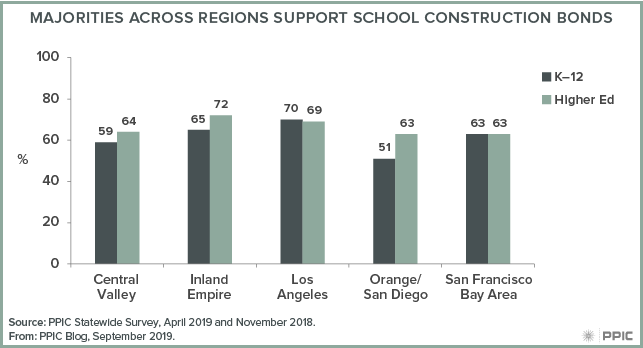
In our April survey, about six in ten adults (62%) and likely voters (57%) said they would vote yes on a bond for K–12 school construction projects, while in November 2018 two in three adults (66%) and about six in ten likely voters (57%) supported a bond to pay for construction projects in California’s public higher education system. In both surveys, there was majority support across regions and demographic groups—except among whites (47%) for the K–12 bond. For both types of bonds, support was lower among whites than other racial/ethnic groups, and support decreased as age and income levels rose.

figure - Majorities across Regions Support School Construction Bonds

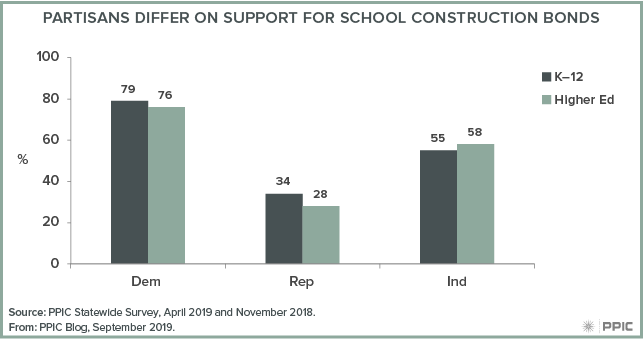
Despite this widespread support for these bonds, we found a significant partisan divide. For both bond questions an overwhelming majority of Democrats as well as smaller majorities of independents have been in favor; far fewer Republicans have been.

figure - Partisans Differ on Support for School Construction Bonds

With California set to play a prominent role in the March Democratic presidential primary—potentially drawing large numbers of Democratic voters—this partisan divide could play a role in passing the bond.

We still don’t know how Californians will perceive this particular bond—in terms of the dollar amount or the joint funding of K–12 and higher education. Stay tuned for more from the PPIC Statewide Survey as we will track support for this bond, as well as many other important 2020 election issues.

How Are School Districts Spending Their LCFF Dollars?

Since the enactment of the Local Control Funding Formula (LCFF) in 2013–14, funding for K–12 education has risen to record highs. Much of the increase is due to the improved state economy, which has seen nearly a decade of continuous growth and led to dramatic expansions in the state budget. Even so, the LCFF has significantly altered the funding landscape, with the intention of providing more resources to the districts, schools, and students who need them most. Six years in, what can we say about how this system is faring?

Under the LCFF, districts with more high-need students (those who are low income, English Learners, homeless, or foster youth) have seen larger funding increases. Between 2013–14 and 2017–18, high-need districts (those with student populations that are at least 55% high need) increased student spending more than $500 more per-pupil than did lower-need districts (where fewer than 30% of students are high need). Districts with especially large shares of high-need students (80% or 90%) saw an even greater funding increase under the new funding formula.

Are higher-need districts spending differently than lower-need districts? We can address this question by comparing the changes in spending between 2012–13—the year prior to LCFF’s enactment—and 2017–18, the most recent year for which K–12 financial data is available.

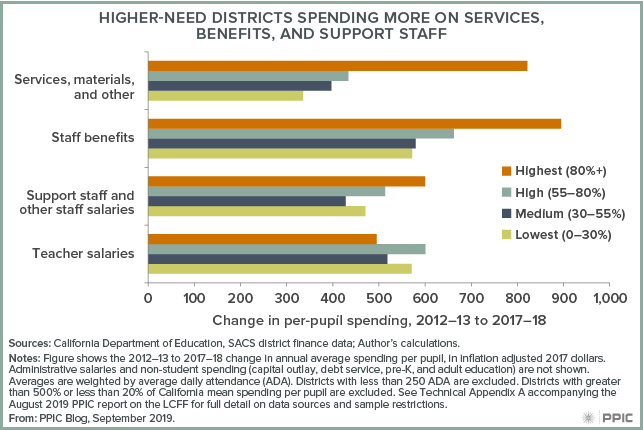
The data reveal two patterns of note. First, despite greater total increases, spending on teacher salaries actually grew more in lowest-need than in the highest-need districts: $570 per student in the lowest-need districts (where fewer than 30% of students are high need) vs $495 in the highest-need districts (where more than 80% of students are high need). Higher-need districts hired more teachers and saw greater reductions in teacher-pupil teacher ratios. However, a greater reliance on novice teachers (whose salaries are lower) reduced the overall spending increase among these districts. Benefits spending also increased by much more in higher-need districts, mainly due to the greater increases in staffing levels.

Second, higher-need districts have been spending more on support staff and other non-teaching staff. They have also spent more on services, materials, and other student spending (excluding capital outlay, debt service, pre-K, and adult education): these expenditures increased by $822 per student in the highest need districts, as opposed to $336 in the lowest need districts. Higher-need districts are most likely attempting to address the additional challenges that higher-need students face outside the classroom. The hope is that these additional services and support staff will translate into improvements in academic performance that will narrow achievement gaps. Research on similar reforms in other states suggests that this approach will eventually pay off.

figure - Higher-need Districts Spending More on Services, Benefits, and Support Staff

Currently, however, concerns are growing about whether additional funding is reaching the highest-need students within districts. Because districts are not required to report their school-level spending publicly, it is difficult to assess how this funding is allocated within a district. However, public staff records and salary schedules do allow us to examine differences in teacher spending across schools in the same district. Such comparisons show that districts tend to spend more on their highest-need schools but that the difference is modest.

Fortunately, federal requirements will soon make more comprehensive school-level spending data available. While we don’t yet know how accurate and comparable it will be, this data will bring new and much-needed transparency to our K–12 finance system.

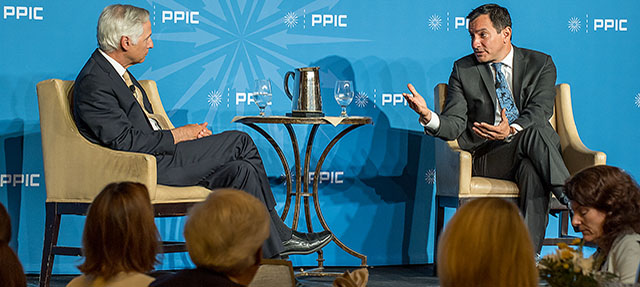
Video: A Conversation with Assembly Speaker Anthony Rendon

When Anthony Rendon was elected to the California State Assembly in 2012, he thought he would focus on early childhood education. “I came to Sacramento after working in early childhood education for 20 years . . . probably thinking that I would work on that.” However, he continued, “You come here and you realize the extent to which all of these issues impact one another. I think it’s dangerous to isolate any single issues.”

As he noted in his conversation with PPIC’s Mark Baldassare last Thursday, Rendon has focused on many individual measures in this legislative session, including a recently signed bill to modify the criteria for police use of deadly force and a bill to address predatory lending. In the wake of the Gilroy shooting, he has also prioritized a package of gun control bills. He sees these measures as part of a broader focus on improving opportunity for all Californians.

Rendon became Speaker in 2016, when Jerry Brown was governor. At first, he found working with Brown to be “a little frustrating,” but “eventually, we did a lot together. . . . There was a very narrow focus, two or three things—criminal justice reform, climate change, but that was about it. Those are still the things he cares about.” Governor Newsom focuses on a wider range of issues. And, Rendon said, “He’s also more sort of open-ended. He’ll come in and say, ‘Hey, housing, what do you think?’”

One of the issues Newsom cares about is early childhood education—which is still a major priority for Rendon. While Brown “helped us to start down the path” to reinvesting in this area, “now we have a governor who believes that . . . it has a positive impact on families and communities and children.” Newsom’s belief translated into significant funding increases for early childhood education in this year’s budget. “The budget was phenomenal,” said Rendon. Early childhood education is particularly important, in his view, because it’s “not trying to fix something that’s already broken. It’s a way of addressing issues early on, it’s a way of breaking the cycle of poverty.”

Although the Democratic Party controls both the governor’s office and the legislature, Rendon believes it’s important to work with Republicans whenever possible. He sees some common ground on issues such as climate change and education—“the real issues that really impact Californians.” More generally, it is important that state leaders represent all Californians: “I want to be able to tell people . . . ‘I’m working for you.’”


Video: School Resources and the Local Control Funding Formula

The Local Control Funding Formula (LCFF) was enacted in 2013-14 with three major goals: to simplify California’s K–12 school finance system, increase local control over spending, and provide additional funding to districts with large shares of high-need students—those who are low income, English Learners, homeless, and/or foster youth. At a lunchtime event in Sacramento last Thursday, PPIC researcher Julien Lafortune shared key findings from a new report that looks at increased spending under the LCFF. Then, a panel of experts offered state and local perspectives on the successes and challenges of directing funding to high-need students.

The PPIC report offers new statewide evidence on how school resources have been affected by LCFF; it also examines the extent to which these resources are reaching the highest-need students. It finds that LCFF funding is, for the most part, reaching the high-need students for whom it was intended. But the funding formula imperfectly targets high-need students in lower-need districts.

Kent Kern, superintendent of schools for the San Juan Unified School District, highlighted the challenges of serving high-need students in a district with wide disparities across schools. At 54.5%, his district’s share of high-need students is just below the LCFF’s “high need” funding threshold; however, 19 of its 64 schools have shares of high-need students that are 80% or above. “One of my schools that’s actually at the 99th percentile is a mile away from a school in another district. If we received the same funding as that district got, [our] school would be generating $1.4 million more.”

Not surprisingly, Kern would welcome a change to the LCFF that could benefit the high-need students in his district: “I think there would be some threshold that would allow schools with high-need concentrations to get more money.”

From a statewide perspective, however, the LCFF’s district-level approach is important. Michael Kirst, professor emeritus at Stanford and a key LCFF architect, emphasized the importance of providing additional funding to districts with the highest concentrations of need, to help them address particularly difficult educational challenges: “I would continue to support the theory of concentration, though I realize there are tradeoffs.” Samantha Tran, senior managing director at Children Now, pointed out that when the LCFF was being developed, many stakeholders were concerned that a school-level funding model could create perverse incentives: “If a border line could be drawn that allows for deeper concentration that draws down more state dollars . . . that is not the policy we want in place. We don’t want to perpetuate segregation.”

Asked what they would change about the LCFF, Kirst and Tran agreed on the need for more money as well as greater transparency on spending. Kirst noted that “it takes more than money” to retain teachers and improve student outcomes, but there are clear links between spending and achievement. And Tran said that while she has “no interest in bean counting,” the state needs a clearer understanding of trends in spending and outcomes.

From both the state and the local perspective, the LCFF has been successful in focusing attention on high-need students. As Tran put it, “We’re actually having a conversation about high-need schools . . . that’s a success.” One of the biggest challenges, from Kern’s perspective, is that people expect “too much change too fast. . . . I think we just need to stay the course.”


Record Growth Puts Money in the Bank for California

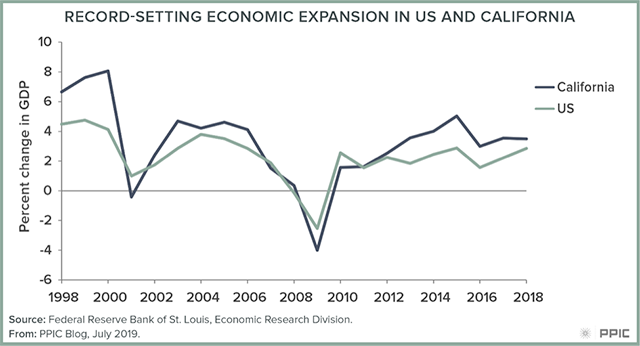
This July marks the longest period of economic expansion in US history. For 121 months and counting, the national and state economies have experienced continuous growth.

Figure: Record-Setting Economic Expansion in US and California

One consequence of this sustained economic growth? An increasing stream of tax revenue flowing into the state’s treasury. This, in turn, has shaped a new state budget that contains record-breaking levels of spending.

In terms of fiscal sustainability, however, the most intriguing element of the new budget may be the dollars that weren’t spent. The budget that the legislature passed and governor just signed includes total budget reserves of more than $20 billion—also a record for the state.

The continued accumulation of budget reserves represents important progress toward preparing the state for an economic slowdown. Because of California’s tax structure, recessions hit the state’s budget particularly hard. Past recessions have caused deep drops in the level of General Fund dollars available, leading to a combination of spending cuts, tax increases, and borrowing to balance the state’s budget.

Building budget reserves should enable California to reduce the impact of a recession. Our estimates suggest that the current level of reserves would allow the state to weather the impact of a mild recession. However, they would be insufficient in the face of a moderate to severe downturn. In other words, there is still work to be done.

None of this matters if the economy never slows down. Just because the economy has gone up for so long, doesn’t mean it must fall—there is no equivalent to gravity when it comes to economics. But history suggests that recessions have a way of interrupting periods of growth. And there are some signs that clouds are gathering on the economic horizon: bond rate curves, drops in consumer confidence, and uncertainty surrounding tariffs and trade. At the same time, the stock market just finished a very positive first half of the year.

Forecasting the timing of the next recession is a much more difficult proposition than asserting that there will be one. The same could be said of California’s earthquakes. But as with earthquakes, the fact that we don’t know exactly when the next recession will hit shouldn’t stop the state from preparing for it.