K–12 Education and the New State Budget

The recently enacted 2019–20 budget allocates 28% of the total state budget for all K–12 education programs: $103.4 billion ($58.8 billion from the General Fund). Proposition 98, passed by the voters in 1988, establishes a minimum annual funding level for K–12 schools and community colleges. This year, the Proposition 98 funding level is $81.1 billion, bringing K–12 per-pupil expenditures to nearly $12,000. According to the Department of Finance, total per-pupil funding, including all federal, state, and local sources amounts to $17,423.

In addition, the rainy day fund requires the state to set aside savings for future education spending based on specific criteria, including General Fund tax revenue and Proposition 98 funding levels. This year, for the first time ever, the budget triggers a deposit into Public School System Stabilization Account at $376.5 million.

figure - K-12 Funding Is at a New High

The Local Control Funding Formula (LCFF) is the primary manner in which funds are distributed to support students. This year’s budget brings the total LCFF funding to nearly $63 billion, a $1.9 billion increase from last year, accounting for a statutory cost-of-living adjustment.

This year’s enacted budget also includes funding to address a wide range of concerns, including pensions, special education, and full-day kindergarten. For teacher pensions (CalSTRS), the budget pays down the state’s ($2.9 billion) and the districts’ share ($1.6 billion) of the unfunded liability. Another $500 million for fiscal year 2019–20 reduces by 1.03% school districts’ contribution rate to CalSTRS and CalPERS (pensions for public employees). The budget adds $350 million to reduce that contribution rate by an additional 0.7% in 2020–21.

The budget aims to mitigate rising special education costs to districts by adding more than $600 million to support students with disabilities.

A $300 million one-time payment goes to the Full-Day Kindergarten Facilities Grant program, which allows districts to construct new facilities or retrofit preexisting ones for the purposes of ensuring access to full-day kindergarten.

Despite the record funding level this year, two longer-term finance issues loom. The CalSTRS funding plan, as governed by AB 1469, has set school districts’ share of teacher pension costs to increase to 18.1% in 2019–20 and to 19.1% by 2020–21. While the budget’s funding toward the districts’ contribution rate will provide much-needed relief, growing pension costs will remain challenging.

Finally, in a time of growing costs, declining student enrollment is hampering districts across the state. Over the past five years, nearly half of all districts experienced enrollment losses—and this trend may continue over the next decade. Given that the state’s funding model is based on average daily attendance, declining enrollment is likely to persist as an important fiscal issue over the long run.


Budget Takes Baby Steps Toward Special Education Reform

The new 2019–20 state budget recently signed by Governor Newson provides significant new funding for K–12 special education programs. It also makes substantial revisions to the state funding model for services to students with disabilities—and signals policymakers’ intent to make even more extensive changes in this policy area next year.

Passage of the Local Control Funding Formula (LCFF) in 2013 generated questions about the fiscal and planning effects on local special education programs. Our work in this area (in 2016 and 2018) has found that district special education costs have risen much faster than state funding over the previous decade and has recommended several changes to make state funding more responsive to local costs. The new state budget includes two of our key recommendations:

  • Equalize special education funding. This year, $153 million was added to partially equalize per-pupil special education funding levels. Our report recommends equalizing local per-pupil funding rates up to the 90th percentile of current levels. Funding rates across Special Education Local Plan Areas (SELPAs) range from about $500 per pupil to more than $1,000. The new funding would bring the lowest local rate up to $557, which is about the 75th percentile of existing rates.
  • Fund early childhood special education. Another $493 million in this year’s budget will provide grants of about $9,000 for 3- and 4-year-olds who participate in special education preschool programs. State special education formulas fail to provide any state support for these children, and our reports conclude that the lack of funding could discourage districts from aggressively seeking children who could benefit from early services.

Because the new funding helps districts pay for their existing special education programs, these appropriations provide welcome fiscal relief. But the budget attaches a giant question mark to the long-term future of these new appropriations. Specifically, in 2020–21, the budget makes the two new grants conditional on broader special education reforms, and even holds out the possibility of revising those grants. Issues for further discussion include:

  • More changes to special education funding. Problems with the main special education funding formula were not addressed in this year’s budget. We have suggested the state peg annual budget increases to a better predictor of future costs, such as LCFF increases or past changes in special education costs.
  • Refining the role of SELPAs. We have also suggested giving districts greater leeway in determining how students with disabilities are educated, consistent with LCFF’s local control focus. SELPAs perform a wide range of services locally, including planning how students are served and supporting district special education programs that exhibit sub-par performance.
  • Improving local special education programs. The budget identifies two specific areas for attention: serving more students in their regular classroom (rather than in separate special education classes) and ensuring that student subgroups are not identified for special education in disproportionate numbers. By including this issue in the budget language, policymakers are signaling they want faster progress in these areas.

Interview: Citizenship and the 2020 Census

This post is part of a series examining challenges involved in the 2020 Census and what’s at stake for California. 

photo - Eric McGheeAfter a heated legal battle, the Supreme Court has ruled that the Trump administration cannot for now include a question on the 2020 Census asking if residents are US citizens. We spoke with PPIC senior fellow Eric McGhee about what this decision means for California.

PPIC: Why is the citizenship question controversial?

Eric McGhee: First, the question could significantly discourage responses among immigrants, who might fear the data would be used to target them. It didn’t go through the normal testing process for new questions, and many Census Bureau employees recommended against adding it because of concerns about data quality.

Second, the Trump administration says the question is necessary to properly enforce the Voting Rights Act. But advocates for immigrant communities dispute this justification and argue that current citizenship data is sufficient to protect against voting discrimination.

Third, it could have a huge impact on political representation and how congressional and state legislative districts are drawn. Districts are currently drawn based on total population. But this question could make it possible for states to use citizens or voting-eligible residents instead, which would tilt representation in favor of those groups.

PPIC: What does all this mean for California?

EM: Response rates will likely be better if the question is not added. But there’s also concern that the damage has already been done—immigrants still might not be inclined to respond. Immigrants make up about a quarter of California’s population, so we’re particularly vulnerable.

A large undercount could result in less federal funding for California. We’re also the only state at risk of losing a congressional seat from an undercount—other states with high immigrant populations like Arizona and Texas might not gain as many seats, but they probably won’t lose a seat they already have, even if there’s a bad count.

Households with undocumented members are the most likely to be undercounted. PPIC research looked at the possibility of a 10% undercount of these households, a reasonable assumption based on existing research. It would mean missing about half a million Californians.

The reality is that census data is thoroughly protected, even from law enforcement agencies like the FBI and ICE. But our May PPIC survey—conducted before the Supreme Court decision—found 63% of Californians were concerned the Census Bureau will not keep responses confidential. Latinos (74%), immigrants (71%), and African Americans (70%) were especially likely to be concerned.

There are other uncertainties too. The 2020 Census will use a new internet-based approach, which hasn’t been comprehensively tested. And people in general are becoming more reluctant to respond to the census. This means the bureau has to do more follow-up, which is expensive and increases the likelihood of problems arising.

PPIC: What can California do to ensure a complete and accurate count?

EM: California is way ahead of other states in terms of funds it has dedicated to census outreach. The state has already appropriated about $100 million to support a better count, and Governor Newsom has proposed another $50 million or so. Philanthropic organizations have chipped in about $30 million. There’s been a great deal of planning at the state and local levels to get the best count possible.

Addressing concerns about confidentiality could go a long way toward encouraging people to respond. Research also suggests that raising awareness about the census’s role in funding public services like health care, roads, highways, and fire and police departments is another promising approach.

Video: Recidivism of Felony Offenders in California

Over the past decade, California has implemented several corrections reforms—including public safety realignment in 2011 and Proposition 47 in 2014. The aim was to reduce incarceration levels and improve offender outcomes without reducing public safety. The rate of rearrest and reconviction, or recidivism—which has long been quite high in California—is an important indicator of the impact of the reforms. At a briefing in Sacramento last Thursday, PPIC researcher Mia Bird outlined the findings of a new report on recidivism among all types of felony offenders—including those sentenced to prison, jail only, jail followed by probation, or probation only.

Recidivism is often used to capture changes in reoffending in response to a policy change. However, it is important to note that these rates may also reflect changes in the practices of criminal justice agencies. The PPIC analysis, which draws on data collected from 12 representative counties, finds that overall recidivism rates for felony offenders declined between 2011 and 2015. Bird outlined several other key findings:

  • Rearrest and reconviction rates fell sharply for felony drug offenses; rearrest rates went up slightly among individuals convicted of offenses against a person (including violent offenses), but the reconviction rate did not change.
  • Recidivism rates declined for all four sentencing groups. Initially, there were increases in recidivism among individuals who were sentenced to probation, with or without jail time, but these rates decreased in later years and under Proposition 47.
  • Individuals released from prison had the highest reconviction rates; this finding is consistent with previous research that has found little evidence of a link between more-severe sanctions and lower recidivism.
  • Rearrest rates for felony offenses increased in the last several months covered by the analysis.

Bird noted that there are several possible interpretations of these findings. There are grounds for optimism: “We do see that we’ve achieved a really large reduction in incarceration and we haven’t seen big increases in recidivism. In many ways that suggests that we’ve managed this transition quite well.”

However, she underlined the need to recognize that recidivism rates are linked to multiple factors: “They may partially represent individual behavior and they may partially represent criminal justice practice.”

Asked what the PPIC analysis indicates about future steps the state should take, Bird said, “Policy that supports data collection, data integration, and monitoring and evaluation . . . is essential. We know we can do better if we know more.”

Interview: Filling the Gaps in California’s Education Data

California is one of only a few states without a database showing how students advance from K–12 schools to college and into the workforce. As part of his “cradle to career” initiative, Governor Newsom has proposed $10 million to develop such a system.

photo - Dr. Jessica CunninghamWe talked to Dr. Jessica Cunningham, interim executive director of the Kentucky Center for Statistics (KYSTATS), about Kentucky’s preschool-to-workforce data system and what California can learn from their experiences.

PPIC: What are the benefits of an integrated student database?

Jessica Cunningham: One major benefit is improving current programs and education-to-career pathways. We work with K–12 career technical education (CTE) programs to provide them with better labor market data to guide their offerings. We’ve also evaluated the impact of expanding work-ready scholarships for students earning high-demand associate degrees at community colleges.

Our research helps policymakers, practitioners, agencies, and the public make more informed decisions. We recently showed that students who completed K–12 CTE programs earned more than their peers. This information contributed to the state’s decision to include CTE pathways as an alternative to the standard high school equivalency test.

PPIC: What hurdles did you encounter establishing the system?

JC: Funding is an ongoing challenge. We’re 85% funded by federal grants, so we face some financial uncertainty year to year. We’re currently looking at the potential for state appropriations as a more sustainable funding source.

More broadly, managing the data system is like working on a puzzle. Sometimes there are missing pieces, since you’re only able to report on the data you have. For example, we don’t have data on private K–12 schools or on children’s experiences prior to preschool or Head Start, so we need to be mindful of those gaps.

Also, some benefits of a data system take time and it’s important to set expectations accordingly. When we published our very first report on high school graduates, readers were eager for information on college completion rates and earnings. But we needed many more years of data before we could examine those long-term outcomes.

PPIC: What recommendations do you have for California?

JC: In Kentucky, we’re legislatively authorized to receive education and workforce data. A governance structure that includes different stakeholder groups (K–12, higher education, workforce development, financial aid) is also critical.

In the early stages, it’s necessary to figure out the key questions for the state—and to determine who should be engaged in that process. Those questions will drive decisions about the data you collect. You won’t be able to do everything at once, so developing a strong research agenda is essential.

Setting up a centralized system makes things easier. This way, no one has to recreate all the necessary data connections for every report or request. Our reporting data warehouse has zero personally identifiable information. We do everything in house—we don’t have to send data back and forth to a vendor and we know that we’re maintaining confidentiality and following the rigorous rules outlined in our data use and access policy.

We also emphasize that we’re nonpartisan. We provide data and results, but policymakers and other leaders are the ones driving the conversation about how to use this information to improve programs and policies.

Video: Mobilizing the Inland Empire for the Census—and for the Future

As California’s diverse regions prepare for the 2020 Census, community-based organizations and local leaders are playing key roles. An event last week in Riverside offered insights on the Inland Empire’s outreach strategies for the Census and beyond. Cosponsored by PPIC and the Center for Social Innovation at the University of California, Riverside, the event featured a panel of state and local experts.

The discussion was moderated by Michelle Decker, president and CEO of the Community Foundation. She began by asking Eric McGhee, PPIC senior fellow, to explain the importance of an accurate census count in California. The census helps determine the distribution of federal funding to the states; gathers information about the population that is valuable to policymakers and businesses alike; and is the basis for reapportionment and redistricting. As McGhee pointed out, an undercount of California’s population could be costly in all of these areas.

McGhee noted that California has large shares of “the kinds of groups that tend to be undercounted—Asian Americans, African Americans, Latinos, renters, very young children, noncitizens.” Finally, he outlined concerns about inadequate funding, which has prevented a thorough testing of the process, and the climate of fear in immigrant communities, which could result in lower response rates even if the Supreme Court rules against the inclusion of a question on citizenship later this month.

But there is some good news: “It wouldn’t take that much for California to overcome some of these challenges,” McGhee said. California is arguably more mobilized than any other state, and the Inland Empire is one of the state’s most mobilized regions.

Deborah Phares, Census 2020 project manager at the Community Foundation, sees the census as a great opportunity for policymakers and organizations across Riverside and San Bernardino Counties. The region’s collaborative efforts were galvanized by a state request for information about innovative census outreach strategies. “We decided that we were going to pursue and support and advocate for allocation of resources based on need,” said Phares, adding that the regional plan is designed to avoid overlapping efforts and to integrate data so that organizations could work together “in a very deep way.”

Karthick Ramakrishnan, founding director of the Center for Social Innovation, underscored the significance of a two-county approach to census outreach that draws from a wide range of communities-—geographic sub-regions and demographic groups. “I think the kind of work that’s happening in the Inland Empire is the envy of the rest of the country. . . .We’re building some pretty amazing tools that will stand the test of time.”

Kathleen Kelly Janus, the newly appointed senior advisor on social innovation in the Governor’s Office, agreed: “I think there’s a huge opportunity to invest in capacity building through all these census dollars that are coming in.” She added that the cross-sector approach involving foundations, community-based organizations, policymakers, and other groups “is a model that we can use not just for the census but for all of these other issues that Governor Newsom wants to address.”


Video: Californians and Their Government

Less than a year before California’s presidential primary, likely voters who are Democrats or who lean Democratic are divided on strategy: is it more important for the party to nominate the candidate who seems mostly likely to defeat President Trump or the candidate whose positions align most closely their views? But almost all Californians see voting in the 2020 elections as very important. At a lunchtime briefing in Sacramento last Thursday, PPIC researcher Dean Bonner outlined these and other key findings from the latest statewide survey.

Two in three California likely voters say they will definitely or probably choose a candidate other than Trump. There is a huge partisan divide on this question: 93% of Democrats and 66% of independents would definitely or probably vote for another candidate if the election were held today, while 82% of Republicans would definitely or probably vote for Trump.

Most Californians say that the investigation by special counsel Robert Mueller did not clear the president of wrongdoing, and Californians are more likely that the nation as a whole to say impeachment proceedings should begin. But here, too, there is a partisan divide: 66% of Democrats say Congress should begin the process, compared to only 39% of independents and 9% of Republicans.

Other survey highlights:

  • A majority of Californians say their housing costs cause a financial strain; six in ten favor the governor’s plan to allocate $1 billion to address homelessness, and similar shares favor proposed new rules intended to create more affordable housing.
  • Three-quarters of Californians see participation in the 2020 Census as very important—but most have concerns about confidentiality.
  • An overwhelming majority are concerned about rising electricity bills in the wake of the PG&E bankruptcy.
  • Californians are concerned that the recent outbreak of measles could spread; most believe that vaccines are very safe and an overwhelming majority say vaccination against measles and other diseases should be required.

CSU’s Prudent Saving Strategy

The California State University system is taking significant steps to improve its financial position and increase transparency with a new public, online Financial Transparency Portal. It shows that CSU is building both capital and operating reserves that could help soften the blow in the event of an economic downturn.

The new Transparency Portal shows that CSU’s reserves have grown in recent years, for both capital spending—which includes equipment acquisition, facilities maintenance and repairs, and capital improvement and construction—and operations. To put this growth into context, in CSU’s 2017–18 budget a little more than one third of total expenditures went toward salaries and wages (about $3.6 billion). The system’s operating reserve for that year was about $800 million, meaning that if that system spent its entire reserve it would still only be able to cover a very modest cut in state appropriations.

figure - CSU’s Capital Reserves have Grown Significantly in Recent Years

The portal also shows that some of the greatest growth has occurred in funds for capital improvement and construction. These funds are typically allocated to upgrade existing facilities and build new ones. This is very good news in terms of long-term planning, and provides a good example for the state’s other higher education institutions.

There also has been modest progress in accumulating savings to simply maintain facilities, an area that saw deep cuts during the Great Recession.

figure - A Majority of Capital Reserves are Aimed at Capital Improvements and Construction Projects

The growth in capital reserves is promising and helps to safeguard CSU’s ability to meet the needs of its future students. Similarly, building operating reserves is key to preserving access and maintaining strong student outcomes during the next recession.

Making financial information transparent, including campus-level information, is also a positive step. It clarifies the allocation of resources and reveals the details of CSU’s reserve strategy—making important information available to public officials and the attentive public.

California 2020: Census and Elections Are Important to Californians

The 2020 Census is fast approaching. With political representation and billions in federal funds on the line, the importance of an accurate count cannot be overstated. Californians recognize this, according to our latest survey—but many have concerns about the confidentiality of the information they provide. Even more Californians say that the 2020 elections are important. Both are critical to the future of the state.

California has invested substantially in raising awareness and preparing local communities for what will be a monumental census effort. Governor Gavin Newsom has proposed adding another $54 million toward state census activities, on top of a previous allocation that was just north of $100 million. These funds—along with a sustained effort at building partnerships around the state—are meant to counter California’s particular vulnerabilities when it comes to ensuring an accurate census: large shares of immigrants and other hard-to-count populations.

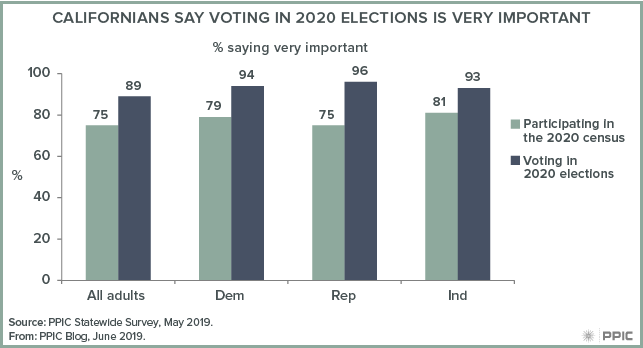
With so much at stake, participation in the census is critical. Are Californians aware of the importance of being counted? Currently, three-quarters of all adults (75%) say it is very important to participate in the 2020 Census. Overwhelming majorities agree across regions, political parties, and all demographic groups—from age, income, and education level to racial/ethnic and citizenship status groups. Naturalized citizens are the most likely to say that participation in the census is very important (80%).

Later this month, the US Supreme Court is expected to rule on the legality of adding a question about citizenship status to the 2020 Census, as the Trump administration has proposed. This question has not been asked on the decennial census since 1950, and opponents argue that it would depress the count among immigrants who might be fearful about revealing their status.

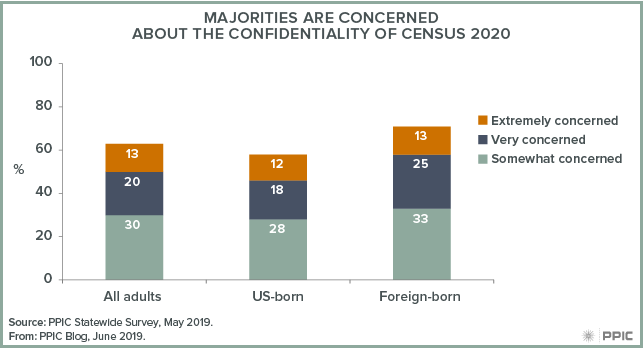
A solid majority of Californians (63%) are concerned that the Census Bureau will not keep 2020 Census answers confidential. This concern is highest among Latinos (74%) and African Americans (70%), followed by Asian Americans (64%) and whites (52%). US-born Californians (58%) are less likely than foreign-born residents (71%) to say that confidentiality is a concern.

figure - Majorities Are Concerned about the Confidentiality of Census 2020

The upcoming census will coincide with another pivotal event—the 2020 presidential election. Election outcomes will have additional lasting effects this cycle, as state legislators (or redistricting commissions) will use the new 2020 Census data to redraw district lines that will last a decade. Today, nearly all Californians recognize the importance of voting next year.

While three in four say it is very important to participate in the census, even more—nine in ten—say that it is very important to vote in the 2020 elections. More than nine in ten across political parties hold this view, as do more than eight in ten across regions and demographic groups.

figure - Californians Say Voting in 2020 Elections Is Very Important

With a presidential primary in California next March and the census in April, Californians are heading toward a consequential season—for the state and the nation. Efforts to boost participation in both of these essential civic events will be critical to ensuring that all Californians are heard—and counted.

The Citizen’s Redistricting Commission: Open for Business

Today marks the first day of the open application period for California’s next Citizens Redistricting Commission (CRC).  The CRC is the state institution vested with the authority to redraw district lines for the state legislature, board of equalization, and Congress. This process occurs after every decennial census to reflect population shifts. The commission’s 14 members will use the new 2020 census data, along with testimony from the public, to draw new districts by August 2021.

If this sounds like the operation of a typical government agency, it is anything but. The CRC is a bold departure from the status quo that was first used in the last redistricting process, in 2011. Most observers felt it worked well the first time around. Today, the state embarks on a second attempt that hinges on a key question: can it work again?

In the past, authority to draw district lines resided with the state legislature. Legislators are of course chosen by the general public in normal elections, where many different issues are always at stake. They are politically connected by definition. When legislators were responsible for drawing the lines, they were not required to (nor did they) hold many public hearings about the redistricting process. Their decisions were subject to few constraints and did not need to be justified or even explained.

The CRC now follows a very different process. The commissioners are chosen through a public application process run by the nonpartisan state auditor. The potential applicant pool is incredibly broad: any registered voter who has been continuously registered with the same political party for five years and has voted in two of the last three statewide elections can apply. (There are a few conflict of interest provisions but they don’t apply to many people.) All the commission’s proceedings must be conducted in public. The lines it draws are subject to a long list of constraints, and the commission is required to produce a report explaining and justifying its decisions.

These rules and constraints may sound good on paper, but the success of the CRC ultimately rests on the quality of the people who serve on it. That requires a deep applicant pool, and the state was fortunate to get one the first time around. The auditor initially received almost 25,000 qualified applications, of which almost 5,000 were willing to fill out a far more detailed follow-up application.

Numbers this large might seem like overkill for a 14-member commission. But a surplus was helpful because the first applicants were not representative of the state as a whole. One of every two initial applicants was a non-Hispanic white male, well out of proportion with their share of the state’s population. Northern California was also overrepresented relative to Southern California, with Sacramento itself producing double the applicants that would be expected from chance alone.

However, with such a large pool to work with, the auditor was able to select a group of final candidates who looked much more like the state as a whole. The final commission was well balanced ethnically, geographically, and politically. Even more than that, the commissioners had a mix of experience and professional backgrounds. The members included a principal, a chiropractor, and a bookstore owner; they also included two civil rights attorneys, several people with experience in city planning, and a former director of the US Census.

The CRC helped to launch a redistricting reform movement that is now sweeping the country.  Four states recently adopted commissions, and the first bill out of the US House this year included a commission reform modeled on the California experience. Many eyes are watching to see if the CRC can work a second time.

Needless to say, success the first time does not guarantee success again. The auditor will need a lot of applicants to create a diverse commission fully representative of the state. Anyone who supports the CRC’s mission and meets the basic requirements should consider throwing their hat into the ring.

The open application period closes on August 19.