Commentary: Obama’s Community College Plan No Panacea

This commentary was published today by the Washington Post.

President Obama’s proposal to make community colleges free is a valiant effort to address the rising demand for skilled workers throughout the nation and to improve college access for low-income students. As states consider his proposal, they would be wise to look to California . . .

(Continue reading on washingtonpost.com.)

Dividing California’s Higher Education Pie

The tuition increase recently approved by the University of California Regents has ignited a debate about how the state allocates money for higher education. A brief look at the history of state funding can provide some much-needed perspective.

Each higher education system—UC, the California State University, and the community colleges—receives substantial funding from the state. Most of the remaining funds for instruction come from tuition paid by students. (In this analysis, we look at allocations from the state General Fund and property taxes so that we can compare institutions across time.)

Since 1965, the share of higher education funding provided directly by the state has shifted from the four-year systems to the community colleges. In the mid-1980s, the community colleges received about a third of the state allocations to public higher education institutions. In 2014‒15, the community colleges got more than half of the pie. Meanwhile, the share allocated to CSU and especially UC has been shrinking. UC’s share fell from 38% in 1965 to 24% in 2014‒15, and CSU’s share declined from 25% to 22%. The governor’s proposed 2015‒16 budget includes a funding increase of $843 million to the state’s public colleges and universities—71% ($600 million) of which would go to the community colleges.

The large increase in state allocations to community colleges is linked to increased enrollment. But enrollment has increased just as much at UC and CSU. Indeed, on a full-time equivalent basis, UC, CSU, and the community colleges each serve about the same share of the state’s public higher education students today as they did 50 years ago. So what explains the shift in the share of funding from UC and CSU to the community colleges?

The short answer is Proposition 98.

After Proposition 13 passed in 1978, the state’s community colleges—which unlike UC and CSU relied partly on property taxes—saw a sharp reduction in their share of state and local support. Ten years later, voters passed Proposition 98, which guaranteed K–12 schools and community colleges a minimum percentage of the General Fund and property tax revenue. Proposition 98 guarantees that K–12 schools and the community colleges get about 40% of these allocations—and about a tenth of that share goes to the community colleges. Some have argued that Proposition 98 acts as a funding ceiling for K–12 schools and community colleges, but it also serves as a floor.

UC and CSU lack the same funding protection. While many budget areas outside of higher education are at least partially protected by dedicated funding streams, court orders, or matching federal funds, UC and CSU are vulnerable when state revenues decline. The universities have faced disproportionately large cuts in their general fund allocations during times of economic hardship. From this vantage point, a funding floor—even one that doubles as a ceiling—is preferable to a funding drop-off.

The three higher education systems also receive indirect forms of state support such as Cal Grants, fee waivers, and middle-class scholarships. Grant aid has increased for students at all institutions of higher education in California. Our best estimates suggest that community college students receive slightly more of these state funds (41% of the total in 2011‒12), than UC students (40%) and much more than CSU students (18%).

The debate over higher education funding could benefit from a clearer understanding of how the pie is divided. But the most important issue for the state’s young people is that the pie is not keeping pace with demand. Our four-year colleges have record numbers of applicants and the shares of students who are academically qualified to attend them have increased. The future prosperity of Californians and their state depends on access to higher education. To address these issues, policymakers need to focus on improving vocational programs and pathways from community colleges to four-year colleges and improving access and enrollment at UC and CSU.

Notes (TOP FIGURE): 2012-13 to 2014-15 numbers are from the governor’s budget; earlier data is from the California Postsecondary Education Commission. We include property tax allocations which are a component of the state’s obligation to community colleges pursuant to Proposition 98.

Video: Making College Possible

At a time when California’s economy needs more college graduates, a new PPIC report examines the role of grants and scholarships in making higher education both accessible and helping students graduate. Hans Johnson, the report’s author and PPIC Bren Fellow, talked about his findings at a briefing last week in Sacramento.

He found that although total financial assistance available through federal grants, Cal Grants, institutional aid, and private scholarships has increased, it has not kept pace with the actual cost of attending California State University and community colleges. These are the California colleges that enroll most low-income students in California—a state in which nearly 60 percent of K–12 students qualify for free and reduced price lunch programs.

“If we want the economic ladder to success to work in California, we need more students to go to and complete college,” he said. “And given our student population, a lot of those students will be from very low-income families.”

He recommended strategies to make college more affordable and accessible. They include directing any additional aid to low-income students and helping more students complete financial aid forms.

Now Hiring: Skilled Health Workers

Changing medical technology, an aging population, and new health care policies have raised important questions about the workforce that will be needed to care for patients in the future. These issues were featured in a new report from PPIC—California’s Healthcare Workforce Needs: Training Allied Workers—and discussed at a luncheon in Sacramento on Friday that included a briefing by coauthor Shannon McConville, PPIC research associate.

The report notes that California will have to add 450,000 jobs to its health workforce over the next decade. With nearly 40 percent of these additional health jobs expected to require some college training below a bachelor’s degree, training programs at California’s community colleges and private two-year institutions will play an important role.

Participating in the panel discussion were Dr. Jocelyn Freeman Garrick, director of the Alameda County Health Pipeline Partnership; Catherine Martin, vice president of the California Hospital Association; and PPIC research fellow Sarah Bohn, a report coauthor. The panel, which was moderated by PPIC research director Patrick Murphy, explored the challenges faced by both public and private higher education institutions in keeping up with rapidly advancing skills requirements in the health care industry. Topics included differences between public and private schools and programs and partnerships that can train Californians for health workforce needs.

Fulfilling the Promise of Online Education

Online learning has become a topic of great debate in higher education. Its advocates have high hopes that it will expand opportunities and rein in costs. Policymakers in Sacramento have taken note. The new state budget provides tens of millions of dollars to support online learning.

When most people think of on online education, they think of MOOCs—massive open online courses—which provide free access to classes taught by faculty from the nation’s top universities. MOOCs have garnered headlines and been the subject of much debate about their potential to reinvent higher education. Meanwhile, California’s community colleges have quietly created an extensive set of offerings in online education. They now provide more online credit courses than any other public higher education institution in the country—a testament to the community colleges’ willingness and ability to innovate.

Enrollment has soared from just a few thousand students a dozen years ago. By 2012, online course enrollment in the state’s community colleges totaled almost one million, representing about 11 percent of total enrollment. Among students taking credit courses in 2011–12, one of every five took at least one online course. Indeed, practically all of the community college enrollment increases over the past ten years have occurred in online courses.

The Public Policy Institute of California has completed an analysis of student success in these courses that points out both the opportunities and challenges in providing online education. We found that online courses are providing some students with an important and useful tool that helps them achieve their community college goals. For example, students who take at least one online course are more likely to earn a degree, transfer to a four-year college, or earn a certificate than students who take only traditional courses.

But there are significant problems. First, the digital divide is evident. Latino students are less likely than students from other ethnic groups to take online courses. Moreover, the achievement gap is exacerbated in online settings. African Americans and Latinos have lower success rates in traditional classes than Asians and whites, and the achievement gaps are even wider in online courses.

And finally, even though online students tend to be stronger academically, they are less likely to successfully complete online courses than traditional courses. This lower course success rate is true across all types of students, a wide set of subjects, and almost all colleges. Indeed, once we controlled for student characteristics—such as overall grade point averages and other factors such as colleges and course subject—students are at least 11 percentage points and as many as 14 points less likely to successfully complete an online course than otherwise similar students in traditional format classes.

California’s community colleges need both more information and a more strategic approach before online learning can fulfill its promise. Little is known about the cost of developing and providing online courses. We won’t know if online learning is less expensive than traditional course work—as some of its advocates believe—unless we begin to systematically collect cost information.

The colleges won’t be able to improve outcomes for the rich diversity of their students unless they take a number of steps. They need to evaluate the online courses being taught now, identify the most successful instructional and technological approaches, and provide professional development for faculty to create and deliver high-quality online learning. They need to provide services for online students to help improve success rates. And they can use the power of technology to track students’ progress in detail, and offer instruction that is more targeted and customized.

Once high quality courses are identified and developed, it will be a challenge to ensure that those courses are readily available to students across California’s vast community college system. The community college’s Online Education Initiative is an important step in the right direction. Its goals are consistent with our recommendations to identify best practices and implement them widely. Its success will depend on identifying and implementing effective policies and programs that improve student outcomes. Going forward, a strong strategic approach will help California to make the most of its investments in online learning.

Online Courses and Achievement Gaps

This commentary was first published in the Sacramento Bee on May 15, 2014.

Online learning is a hot topic in higher education. Certainly the MOOCs, massive open online courses offered for free and featuring faculty from top universities in the country, have garnered a lot of attention. But perhaps more important has been the rise of online courses—for credit—in the nation’s accredited public colleges. Here in California the state’s community colleges have taken the lead, with course enrollments of about 1 million—more than in any other public higher education system in the nation.

Online learning offers the promise of expanded access to and success in higher education. To truly fulfill that promise, it must do so across the diverse population of California students. Currently, it’s falling short.

At the Public Policy Institute of California, we have recently completed an analysis of student access and success in online courses offered by the state’s community colleges, an important access point for students who are underrepresented in higher education. Online courses offer convenience to students who are often juggling family and work responsibilities. The rapid growth in enrollment in online courses, from just a few thousand 10 years ago to around 1 million today, is a testament to the increasing demand for higher education. Enrollment has grown rapidly among all the state’s ethnic groups. But in a reflection of the state’s digital divide, growth among Latinos has lagged that of other groups.

Perhaps most troubling, achievement gaps are exacerbated in online courses. Completion and success rates for traditional courses are lower among Latino and African American students than among white and Asian students. That gap is even wider online. In traditional classes, the achievement gap between white and African American students is 12.9 percentage points. It is 17.5 percentage points in online courses. Similarly, the gap between whites and Latino students is 7.3 percentage points in traditional courses, but is 9.8 percentage points in online courses. In contrast, white students tend to perform slightly better than Asian students in traditional courses, with an achievement gap of 1.4 percentage points. But they do slightly worse than Asian students in online courses, with an achievement gap of -1.4 percentage points.

Achievement gaps exist among other groups as well. Our research found that older students—those over 25—perform better than younger students in traditional courses. This performance gap widens in online courses, from 10.2 percentage points to 14.8 points. The achievement gap between female and male students is 1.9 percentage points in traditional courses and 3.1 percentage points in online ones. In other words, when demographic groups differed in their performance in traditional courses, these differences tend to be magnified online.

For online learning to reach its full potential, California’s community colleges need deliberate strategies and plans to improve student outcomes in online courses, with a special focus on narrowing achievement gaps among underserved and underrepresented students. Community colleges need to ensure high standards of quality for online courses and provide professional development for faculty to design and deliver them. They also need to incorporate student support tools—both technical and instructional. The community colleges’ new Online Education Initiative is currently pursuing these strategies.

There are ways in which online learning has the untapped potential to yield better student outcomes than the traditional setting does. Online courses can enable instructors to track students’ progress in detail and provide more targeted and effective guidance—potentially offering customized instruction that can address achievement gaps.

Online learning is here to stay.  With smart and informed policies and programs, it can reach many more students and do so much more effectively.

Visit the PPIC Higher Education Center.

Boosting Transfers From Community College to CSU

To increase the number of college graduates in California, state policymakers are working to make it easier for community college students to transfer to four-year institutions, particularly the California State University (CSU) system. Legislation in 2010 required state community colleges to create a special degree that would ease the transition to CSU campuses.

Researchers Colleen Moore and Nancy Shulock provided a progress report on the implementation of this new degree at a PPIC briefing on Friday. These two researchers are from the Institute for Higher Education Leadership and Policy at CSU Sacramento and are the authors of a new report for PPIC, From Community College to University: Expectations for California’s New Transfer Degrees.

They found that the new degrees have improved pathways for community college students. But many community colleges still offer transfer degrees in only a few majors, and some CSU campuses accommodate the degree in only some of their degree programs. In other words, the program still has a long way to go before it is fully implemented.

Evaluating Student Success at the City College of San Francisco

In July 2013, the Accreditation Commission for Community and Junior Colleges reaffirmed its earlier decision to pull accreditation from the City College of San Francisco (CCSF). Citing a “lack of financial accountability as well as institutional deficiencies in the area of leadership and governance” as the “main obstacles to the college’s turnaround,” the commission allowed CCSF 12 months to prepare to cease operation. San Francisco’s city attorney and City College faculty have filed lawsuits against the commission, and in January a court granted an injunction placing the loss of accreditation on hold. The California Community College Chancellor’s Office, which oversees the state’s 72 community college districts, is working closely with City College to address the commission’s concerns and avoid the loss of accreditation. And the state legislature is considering a bill that would stabilize CCSF funding for the next two years. Meanwhile, students are responding to the controversy: City College reports a 16 percent decline in spring enrollment in 2014 compared to 2013.

The fight over CCSF’s accreditation is focused on a number of issues and concerns. But it raises important questions about how colleges should be evaluated. Many states have begun funding higher education institutions based on performance, and California officials are discussing similar performance measures. Most would agree that student outcomes are an important measure of any college’s effectiveness. Of course, good student outcomes for a college might simply reflect the strength and preparation of incoming students.

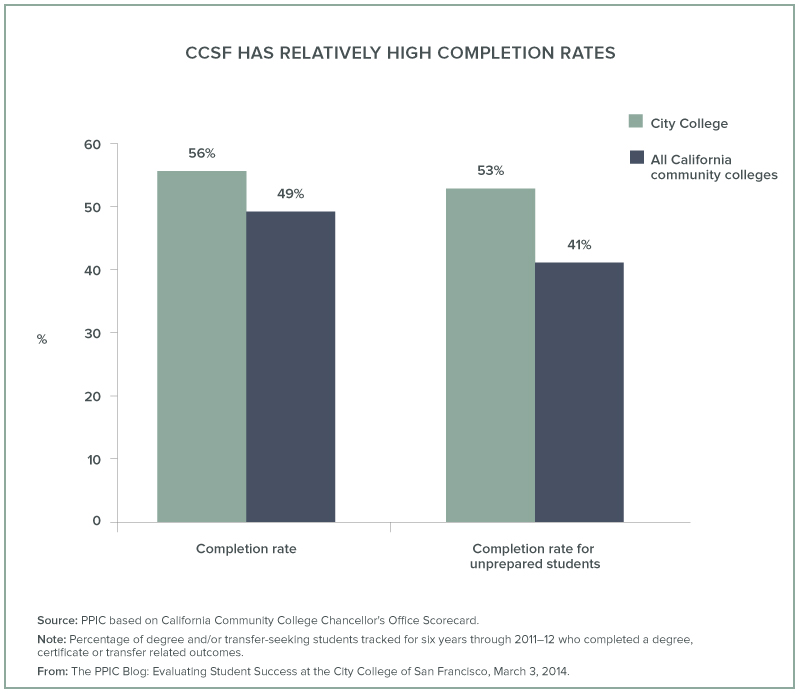
Because the California Community College Chancellor’s Office does an excellent job of providing information on student success, we have a wealth of data to examine student outcomes at CCSF. By most measures, City College fares well relative to other community colleges in the state. The share of students who complete college by earning a degree or certificate, or by transferring to a four-year college, is higher at CCSF than in the rest of the state. This advantage holds even when we limit our analysis to students who are initially unprepared for college-level work, which suggests that it is not simply the mix of students drawn to City College that drives its outcomes. (Although it is possible that CCSF’s unprepared students are closer to college level than unprepared students at other colleges.)

Of particular interest is how effectively a community college prepares students for transfer to four-year colleges or universities—this is arguably the most important mission of community colleges. Among students defined by the chancellor’s office as intending to transfer, City College has a higher success rate than most other college districts, ranking 6th out of the state’s 72 community college districts and 4th among the state’s larger districts—those with at least 2,000 students intending to transfer. The other top districts are a who’s who of the state’s most highly regarded: Foothill-De Anza, South Orange County, San Diego, Pasadena, and Santa Monica. By this important measure, City College is in very good company.

On some outcomes, City College performs below average. For example, its success rates in math remediation are significantly lower than the state average, and the share of career technical, or vocational, students who earn a certificate is slightly lower than the state average. However, City College fares well in most other measures. For example, the share of students who successfully complete remediation in English is higher than the statewide average, as is the share of students who successfully complete ESL courses.

Student outcomes are not the only way to assess a college. But they are an important measure of success. CCSF has provided thousands of students with a pathway toward meeting educational and occupational goals. That is no small feat.

Testimony: Community Colleges’ New Scorecard

The Select Committee on Community Colleges held an oversight hearing, “The State of California Community Colleges,” on February 18. The committee invited PPIC Bren Fellow Hans Johnson to testify on the Community College Chancellor’s Office efforts to provide new information on student outcomes through its Student Success Scorecard. Here are his prepared remarks.


Thank you Chairman Fox and committee members. My name is Hans Johnson. I am a Bren Fellow with the Public Policy Institute of California. PPIC has produced a number of studies on California’s higher education systems. Our focus in those studies is on student outcomes, and how we can improve those outcomes. I appreciate the opportunity to testify today about the Community College Chancellor’s Office efforts to provide more and better information on student outcomes through their “Student Success Scorecard.”

Community colleges play an especially important role in California. They enroll the large majority of undergraduates in our state, far more than UC, CSU, or private institutions. As a state, from a budget and enrollment perspective, we place more emphasis on community colleges than do most other states. Helping more community college students to achieve degrees, certificates, and transfer is key to our state’s wellbeing.

As an independent researcher, I have had the opportunity to work with the Chancellor’s Office, and I have been very impressed with their professionalism and their knowledge. The scorecard is a step in the right direction for several reasons. First, the scorecard offers the right kind of information on the right kinds of student outcomes. For numerous critical measures, such as completion rates, the scorecard provides information on outcomes for each of the state’s community colleges, with breakdowns for key demographic groups.

Second, the scorecard is transparent and accurate. It reflects the impressive data collection efforts and expertise of the Chancellor’s Office. Details about the scorecard measures and how they were created are readily accessible.

Third, the scorecard presents information in a user-friendly format. Graphs and tables are well-presented and easy to follow. This is critical for parents and prospective students as they consider their college choices.

Finally, the scorecard is a useful tool for policymakers, policy researchers, and the colleges themselves. The scorecard makes it easy for colleges to identify where they stand relative to other colleges and to measure their progress over time. For policy researchers, this information is useful in answering questions about student progress. For example, using the scorecard we find that there is a wide range in completion rates across colleges (with completion defined as earning an associate’s degree, a certificate, or transferring to a four year college). Some of this variation can be attributed to differences in the academic preparation of incoming students, as can be shown using scorecard data.

The scorecard is an important tool, but it could be enhanced by incorporating additional measures. This would be easy to do, because the Community College Chancellor’s Office already has very useful data available elsewhere. For example, through its Salary Surfer the Community College Chancellor’s Office provides data on salaries of community college students before and after earning a degree or certificate. Adding this information to the scorecard would provide valuable labor force information for prospective students. The Chancellor’s Office provides even more data on student outcomes through its online Data Mart query tool. Some of that data, such as transfer rates to four year colleges, should also be incorporated into the scorecard.

California’s community colleges are doing a very good job of collecting and sharing important data, and the scorecard is an important example of those efforts. However, the Community College Chancellor’s Office still faces a big challenge in getting the scorecard into the hands of prospective students and parents when they need it most.

Finally, it must be noted that the scorecard is only a tool. The information provided in the scorecard can prompt action, but the real key to increasing student success depends on improving student pathways to transfer, degree completion, and certificate completion.