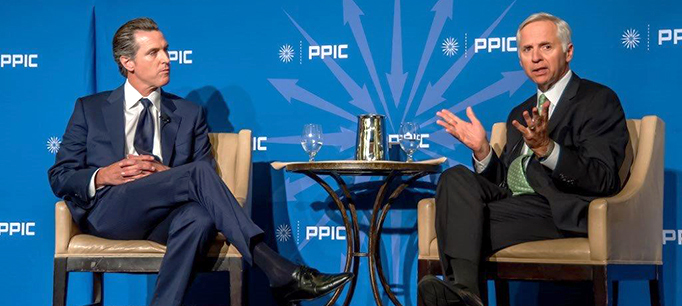

“The world is radically changed,” Gavin Newsom, California’s lieutenant governor, told a Sacramento audience this week.
“We’re competing against billions and billions of people, not just competing against cheap labor now, but against cheap genius,” he continued.
Newsom—who is also a University of California regent and California State University trustee—spoke in a conversation with Mark Baldassare, PPIC president and CEO. PPIC’s new report Will California Run Out of College Graduates? provided the context for the discussion. The report concludes that California will fall 1.1 million college graduates short of economic demand by 2030, if current trends persist.
Newsom said that “there is not a major industrialized nation in the world that is not focusing with intention on radically transforming their education system. One of the remarkable things about California is that we do not have a plan.”
He summed up: “We need goals. And we need to be able to measure those goals. And those goals must emanate from the state itself.”
Newsom was not the only speaker at the PPIC event to use words like “radical” and “revolution” to describe changes needed in higher education.
At a subsequent panel discussion, state assemblymember Catharine Baker said she is concerned that the state is falling short of the workforce needed even now. She noted that there is bipartisan agreement in the legislature that higher education is important but not about the need for major change. “There is a lot more focus on issues around the margins, that is, on how many students are we admitting, what few changes we can make in the community college system.”
Eloy Ortiz Oakley, superintendent-president of the Long Beach Community College District, said, “We almost need a revolution in our system. We started to get there when we were in crisis mode.”
“During the recession, we saw more creativity than ever before in the community college system and we began to focus,” he said. “I fear that post-recession that focus will start to dissipate.”
Hans Johnson, coauthor of the PPIC report and PPIC senior fellow, said the big challenge for the state is replacing the retiring baby boom generation with young, well-educated workers.
“I think there is a very clear path to closing that skills gap,” he said. “We need to have more students going to colleges—especially four-year colleges. We need improve completion rates—that opens up room for more students. We need to improve transfer rates from community colleges to the four-year colleges. And if we do all of those things—and these are all decisions we can make, as policymakers and higher education officials—we can actually close that skills gap.”
Timothy White, California State University chancellor, said CSU can do its part to fill the workforce skills gap—with the help of its educational and funding partners. He called the PPIC report “a very sobering clarion call that is of crisis proportion— not for the CSU or for the University of California, or the community colleges, but rather for California. And I hope we take it with the seriousness that it deserves.”
 Still, it is instructive to compare the earnings of former students across institutional sectors. The table shows what you would see if you looked up earnings profiles for different types of California colleges. We chose colleges with median earnings that were closest to the median of each sector.
 What the scorecards don’t show is that the difference between colleges is far smaller than the difference within colleges. The figure shows the variation in earnings at the same campuses included in the table above. First, note the tremendous overlap: many students who start at community college end up earning more than some students who started at UC and CSU. The difference in median earnings between the typical CSU and the typical UC is approximately $10,000. But the difference between the 25th percentiles and the 75th percentile of UC Davis student earnings is almost $50,000.
 The fact that most 11th-grade students are not yet ready for college is not necessarily news for California. Since 2004, California students have been able to participate in California’s Early Assessment Program (EAP), which used an optional statewide test to determine college readiness levels of 11th-grade students. The college readiness identification component of the new tests is based on the EAP and informs 11th grade students whether they are ready, conditionally ready, or not ready for college.
  But there is also some good news here for California. For students, new ratings regarding college readiness come early enough for the information to help before they enroll in their 12th-grade classes.
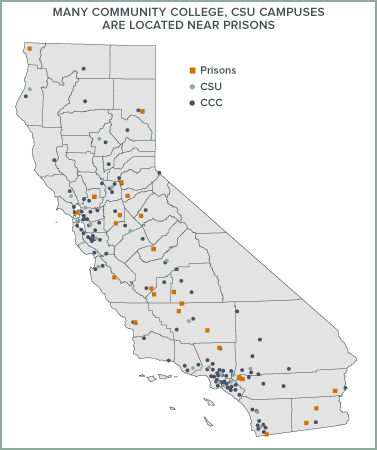 California currently supports community college education for all low-income students, including inmates, through fee waivers. However, these waivers are not available for students who wish to pursue four-year degrees. These students rely on other forms of aid, including federal Pell Grants. The Pell Grant pilot program presents an opportunity for CSU to begin working with CDCR to leverage federal dollars to expand access to high-quality, onsite higher education for inmates in state prison.


 The University of California has agreed to bring in more transfer students as part of its budget agreement with the governor. Specifically, UC has committed to enrolling one new transfer student for every two new freshman. This means that one third (33%) of entering students will be transfers system-wide and at each campus (except Merced) by 2017. It also means that unless there is funding to increase enrollment, there may be fewer places for entering freshman.