Californians Support Actions to Address Climate Change

Today, world leaders converge in New York City for the United Nations Climate Action Summit. The summit comes at a time when the federal government is moving in a different direction than California in the area of climate change and energy policy. Just last week, the Trump administration announced it would rescind the state’s authority to set its own vehicle emission standards—a decision challenged on Friday in a lawsuit filed by California and 22 other states.

Over the past two decades, California has taken a multifaceted approach to reduce greenhouse gas (GHG) emissions, and Californians have consistently shown strong support for the state’s recent actions.

To reduce emissions from the transportation sector—the largest emitter, with 41% of the state’s GHG emissions in 2017—California expanded its vehicle pollution standards to cover smog-forming pollutants and GHG emissions. Other policies include low-carbon fuel standards, a major effort to ramp up electric vehicles, and integrating land-use and transportation investments.

California has also committed to decarbonizing the electricity sector. In 2018, then-governor Jerry Brown issued an executive order that calls for California to provide 100% of its electricity from renewable and carbon-free sources by 2045, and at least 60% by 2030. The state is on its way to meeting this goal, with about a third of electricity provided by renewable sources in 2017.

California was also the first state to enact a cap-and-trade program to reduce GHG emissions, which allows businesses to trade emissions permits. This program now covers 85% of the state’s GHG emissions.

New policies that target the reduction of carbon, methane, and other harmful GHGs are underway. Since carbon dioxide can be removed from the atmosphere by plants and stored in vegetation, soils, and the ocean, the state is developing a strategy to use integrated land-use approaches. These approaches will produce the environmental and economic benefits that traditionally come from natural and working lands, while offering potential carbon storage.

Californians have consistently expressed support for strong climate change policies. A recent PPIC Statewide Survey found 71% of California adults are in favor of the state’s 100% renewable energy goal, including more than six in ten across regions and demographic groups. Two in three residents are in favor of the state law (Senate Bill 32) that requires California to reduce its GHG emissions to 40% below 1990 levels by 2030. Overwhelming majorities of Californians are also in favor of requiring automakers to further reduce greenhouse gas emissions from new cars.
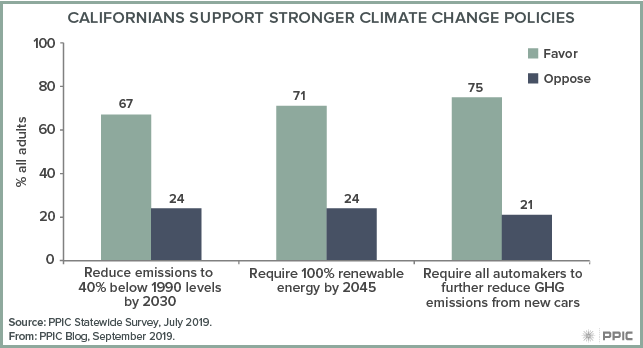
figure - Californians Support Stronger Climate Change Policies

This support will be critical in the state’s ongoing efforts to reduce emissions. In addition, adapting to the new realities brought on by climate change will be essential. Despite California’s goals and policies, some of the effects of a changing climate are already underway—and would persist even if all global emissions ended today. PPIC will continue to track California’s climate change policies and proposals, as well as residents’ opinions about this important issue.
Californians Favor Stronger Efforts to Reduce Greenhouse Gas Emissions

Last month, California officials reached a groundbreaking deal with four major auto manufacturers to toughen greenhouse gas emissions. According to PPIC’s latest survey, an overwhelming majority of Californians (75% adults, 76% likely voters) favor requiring all automakers to reduce the emissions of greenhouse gases from new cars. Californians express strong support for other efforts to reduce emissions as well.

The new emissions standards are more stringent than those proposed by the Trump administration and counter the administration’s efforts to restrict states’ ability to set emissions guidelines. Under the agreement, automakers will increase the fuel economy of their new vehicles by improving fuel efficiency and selling more electric vehicles and hybrids. While the stricter standards only apply to California, the automakers said the agreement is meant to show general support for a national emissions standard.

While most Californians favor requiring automakers to reduce emissions from new cars, support is slightly lower than it was when we first asked this question in 2002 (81% adults, 79% likely voters). Today, Democrats (90%) are much more likely than independents (73%) and Republicans (49%) to favor this policy. Strong majorities (at least seven in ten) across regions and demographic groups are in favor.

A strong majority of Californians (74%, 68% likely voters) also express support for encouraging local governments to change land use and transportation planning so that people can drive less. Support has declined somewhat since this question was first asked in July 2008 (81% adults, 79% likely voters). Today, Democrats (87%) are nearly twice as likely as Republicans (45%) to favor the proposal, and three in four (75%) independents express support. Majorities across racial/ethnic groups are in favor, but Asian Americans, Latinos, and African Americans express the highest levels of support. Strong majorities across regions favor the proposal.

figure - Strong Majorities across Racial/Ethnic Groups Favor Efforts to Reduce Emissions

While three in four Californians favor these specific policy approaches, slightly fewer adults (67%) and likely voters (63%) support Senate Bill 32, the state law requiring California to reduce its greenhouse gas emissions to 40% below 1990 levels by 2030. Although partisans are deeply divided, majorities across regions and demographic groups are in favor, with Asian Americans (77%), San Francisco Bay Area residents (76%), and college graduates (76%) expressing the strongest support.

figure - Partisans are Divided on the Reduction of Greenhouse Gas Emissions Required by SB 32

Earlier this year, Senator Scott Wiener introduced legislation (Senate Bill 50) that would require local governments to change zoning for new developments from single-family to multi-family housing near transit and jobs centers—one goal of the bill is to encourage less driving. In our May survey, 62% of Californians (57% likely voters) favored this proposal. Although the bill failed to advance out of a key committee, it is likely to be reconsidered in the 2020 legislative session.

As California’s leaders continue to pursue a variety of climate change and energy policies, PPIC will monitor emerging legislation on greenhouse gas emissions as well as the views of Californians on these proposals.

Environmental Priorities and the Midterm Election

Just three months ahead of a consequential midterm election, California and the federal government continue to move in very different directions on environmental policy. Last week, the Trump administration’s efforts to roll back strict automobile emission standards were strongly criticized by the Brown administration. State officials have also pushed back on federal efforts to increase offshore oil drilling and the president’s decision to exit the Paris Agreement on climate change. Meanwhile, personal experiences with a prolonged drought and recent severe wildfires are raising Californians’ awareness about the impacts of climate change. Where do California voters stand on environmental issues and what are the implications for November?

Californians’ support for environmental protection runs deep. Consider emissions standards. In the July PPIC survey, 60% of California registered voters say that they are in favor of setting higher emissions standards for automobiles. Majorities of voters across age, education, gender, income, and racial/ethnic groups support this environmental policy. Majorities of Democrats (74%) and independents (62%) and 34% of Republicans are in favor. Notably, 52% of registered voters living in the nine competitive House districts—as rated by the Cook Political Report—favor higher auto emission standards.

Or take another area of state-federal policy conflict over the environment, offshore oil drilling. Sixty-six percent of California registered voters are opposed to more drilling off the California coast. Opposition is high among Democrats (82%) and independents (66%), and reaches 40% among Republicans. Majorities oppose it in both the coastal and inland regions of the state and across age, education, gender, income, and racial/ethnic groups. As for the registered voters living in the nine competitive House districts, 56% are opposed to allowing more offshore drilling off the California coast.

These views on particular environmental policy issues are similar to larger concerns related to global warming. About two in three California registered voters believe that global warming has already begun (67%), say that they are very concerned about its possible impact on more severe wildfires (64%), and favor the state law that requires California to reduce its greenhouse gas emissions (67%). Majorities of Democrats and independents share these views, along with substantial proportions of Republicans and majorities of voters across regions and age, education, gender, income, and racial/ethnic groups. In the nine competitive House districts, majorities of registered voters believe that global warming has already begun (59%), say they are very concerned about the impact of global warming on more severe wildfires (56%), and favor the state law that requires greenhouse gas emission reductions (62%).

Personal views about global warming could shape the size and profile of the electorate this year. Majorities of California voters say that the issue of global warming is extremely or very important to them personally (62%). If this high level of personal concern motivates voter turnout, it will provide a partisan advantage (80% Democrats, 61% independents, 29% Republicans). It could also serve as a catalyst in several Democratic-leaning groups with a low propensity to vote (64% under age 35; 68% earning less than $40,000; 69% renters; 70% Latinos). Moreover, in the nine competitive House districts, majorities of registered voters (55%) say that global warming is extremely or very important to them personally.

In the midterm election context, Californians are indicating strong opinions on environmental matters. A record-high number of registered voters say that the gubernatorial candidates’ positions on the environment are very important in determining their vote (39% 2002, 46% 2006, 42% 2010, 40% 2014, 53% 2018).

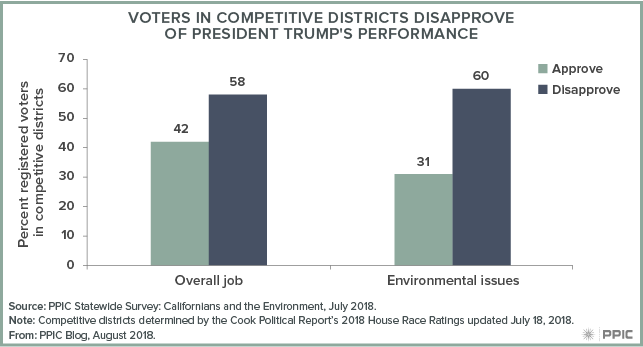
California voters say that they want statewide candidates to push back rather than work with the Trump administration on environmental issues (53% to 40%), and a majority disapprove of the way that President Trump is handling environmental issues (67%). Since the midterm elections are in part a referendum on the president, it is perhaps most significant that a majority of registered voters living in the nine competitive House districts disapprove of President Trump’s handling of environmental issues (60%)—similar to their disapproval of his overall job performance (58%).

Californians’ environmental priorities are high on our list of political wildcards in this important midterm election. Stay tuned as the PPIC Statewide Survey monitors this trend and other topics in our pre-election polling.