Californians Support Actions to Address Climate Change

Today, world leaders converge in New York City for the United Nations Climate Action Summit. The summit comes at a time when the federal government is moving in a different direction than California in the area of climate change and energy policy. Just last week, the Trump administration announced it would rescind the state’s authority to set its own vehicle emission standards—a decision challenged on Friday in a lawsuit filed by California and 22 other states.

Over the past two decades, California has taken a multifaceted approach to reduce greenhouse gas (GHG) emissions, and Californians have consistently shown strong support for the state’s recent actions.

To reduce emissions from the transportation sector—the largest emitter, with 41% of the state’s GHG emissions in 2017—California expanded its vehicle pollution standards to cover smog-forming pollutants and GHG emissions. Other policies include low-carbon fuel standards, a major effort to ramp up electric vehicles, and integrating land-use and transportation investments.

California has also committed to decarbonizing the electricity sector. In 2018, then-governor Jerry Brown issued an executive order that calls for California to provide 100% of its electricity from renewable and carbon-free sources by 2045, and at least 60% by 2030. The state is on its way to meeting this goal, with about a third of electricity provided by renewable sources in 2017.

California was also the first state to enact a cap-and-trade program to reduce GHG emissions, which allows businesses to trade emissions permits. This program now covers 85% of the state’s GHG emissions.

New policies that target the reduction of carbon, methane, and other harmful GHGs are underway. Since carbon dioxide can be removed from the atmosphere by plants and stored in vegetation, soils, and the ocean, the state is developing a strategy to use integrated land-use approaches. These approaches will produce the environmental and economic benefits that traditionally come from natural and working lands, while offering potential carbon storage.

Californians have consistently expressed support for strong climate change policies. A recent PPIC Statewide Survey found 71% of California adults are in favor of the state’s 100% renewable energy goal, including more than six in ten across regions and demographic groups. Two in three residents are in favor of the state law (Senate Bill 32) that requires California to reduce its GHG emissions to 40% below 1990 levels by 2030. Overwhelming majorities of Californians are also in favor of requiring automakers to further reduce greenhouse gas emissions from new cars.
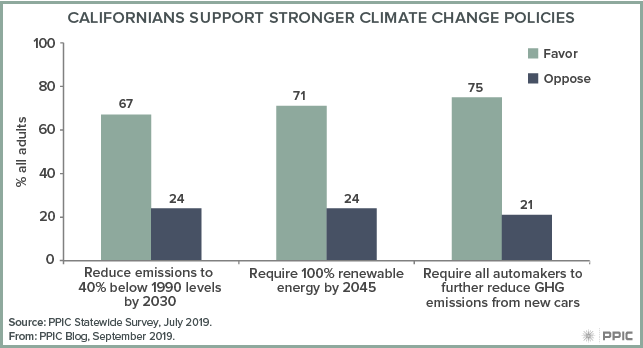
figure - Californians Support Stronger Climate Change Policies

This support will be critical in the state’s ongoing efforts to reduce emissions. In addition, adapting to the new realities brought on by climate change will be essential. Despite California’s goals and policies, some of the effects of a changing climate are already underway—and would persist even if all global emissions ended today. PPIC will continue to track California’s climate change policies and proposals, as well as residents’ opinions about this important issue.
Californians Favor Stronger Efforts to Reduce Greenhouse Gas Emissions

Last month, California officials reached a groundbreaking deal with four major auto manufacturers to toughen greenhouse gas emissions. According to PPIC’s latest survey, an overwhelming majority of Californians (75% adults, 76% likely voters) favor requiring all automakers to reduce the emissions of greenhouse gases from new cars. Californians express strong support for other efforts to reduce emissions as well.

The new emissions standards are more stringent than those proposed by the Trump administration and counter the administration’s efforts to restrict states’ ability to set emissions guidelines. Under the agreement, automakers will increase the fuel economy of their new vehicles by improving fuel efficiency and selling more electric vehicles and hybrids. While the stricter standards only apply to California, the automakers said the agreement is meant to show general support for a national emissions standard.

While most Californians favor requiring automakers to reduce emissions from new cars, support is slightly lower than it was when we first asked this question in 2002 (81% adults, 79% likely voters). Today, Democrats (90%) are much more likely than independents (73%) and Republicans (49%) to favor this policy. Strong majorities (at least seven in ten) across regions and demographic groups are in favor.

A strong majority of Californians (74%, 68% likely voters) also express support for encouraging local governments to change land use and transportation planning so that people can drive less. Support has declined somewhat since this question was first asked in July 2008 (81% adults, 79% likely voters). Today, Democrats (87%) are nearly twice as likely as Republicans (45%) to favor the proposal, and three in four (75%) independents express support. Majorities across racial/ethnic groups are in favor, but Asian Americans, Latinos, and African Americans express the highest levels of support. Strong majorities across regions favor the proposal.

figure - Strong Majorities across Racial/Ethnic Groups Favor Efforts to Reduce Emissions

While three in four Californians favor these specific policy approaches, slightly fewer adults (67%) and likely voters (63%) support Senate Bill 32, the state law requiring California to reduce its greenhouse gas emissions to 40% below 1990 levels by 2030. Although partisans are deeply divided, majorities across regions and demographic groups are in favor, with Asian Americans (77%), San Francisco Bay Area residents (76%), and college graduates (76%) expressing the strongest support.

figure - Partisans are Divided on the Reduction of Greenhouse Gas Emissions Required by SB 32

Earlier this year, Senator Scott Wiener introduced legislation (Senate Bill 50) that would require local governments to change zoning for new developments from single-family to multi-family housing near transit and jobs centers—one goal of the bill is to encourage less driving. In our May survey, 62% of Californians (57% likely voters) favored this proposal. Although the bill failed to advance out of a key committee, it is likely to be reconsidered in the 2020 legislative session.

As California’s leaders continue to pursue a variety of climate change and energy policies, PPIC will monitor emerging legislation on greenhouse gas emissions as well as the views of Californians on these proposals.

Uncertain Future for Cap-and-Trade

To date, California’s actions to combat climate change have been funded mostly through its cap-and-trade program, which allows the state to collect funds from greenhouse gas emitting sources. California was the first state to institute a cap-and-trade program. To date it has collected more than $4 billion in auctions of permits to companies and significantly reduced greenhouse gas emissions through the program. But the state program has been challenged in the courts, and its statutory authority is set to expire in 2020. At least in part due to the program’s uncertain future, there has been a drastically reduced collection of revenues this year.

The program is an interesting blend of regulation and free-market practices. The Air Resources Board—the agency in charge of the program—sets a cap on state’s greenhouse gas emissions and allocates emission permits for each company that releases them. Usually the permitted amount of emissions is lower than the company’s current level of emissions. To make up the difference, companies have the option to buy more permits from the state or from other companies that can reduce their emissions at lower cost. These permits, both private and public, are auctioned quarterly in a public online market. This market-based mechanism enables the state to promote technological innovation and brings flexibility to the effort to reduce emissions.

The funds collected also serve to pay for mitigation and adaptation programs. Under the current law, 60 percent of cap-and-trade proceeds are continuously appropriated to public transit, affordable housing, sustainable communities, and high-speed rail. The remaining funds are appropriated on a one-time basis each year to programs for disadvantaged communities, clean transportation and the environment. As of this September nearly $2.3 billion had been appropriated, including more than $700 million for high speed rail, almost $500 million for affordable housing and sustainable communities programs, $325 million for low carbon transportation, more than $200 million for transit programs, and the remaining for a variety of other programs including energy efficiency, agriculture, forests, and other environmental programs.

This year’s one-time investment will go to support programs that reduce greenhouse gases while benefiting disadvantaged communities, support clean transportation, and help protect ecosystems. The legislature and governor were unable to come to an agreement to spend all of the discretionary funding, and reserved an additional $462 million for future appropriations. This decision may have been motivated by uncertainties surrounding the future of the cap-and-trade program.

Virtually all allowances that were offered for sale in cap-and-trade auctions in 2015 by the Air Resources Board were sold. However, that has not been the case in 2016. The February 2016 auction saw a small amount of allowances go unsold. In the May and August 2016 auctions, the Air Resources Board sold less than 2 percent of the allowances offered. As a result, the May 2016 auction brought in only $10 million, and the August auction brought in $8 million—compared to $517 million from the February auction.

If the state does not address these uncertainties, revenues may continue to be small, forcing the state to cut spending on programs funded by cap-and-trade or look for other ways to meet its ambitious actions to address climate change.