
New national polling shows a big divide has opened up between Democrats and Republicans on higher education. A Pew Research Center poll taken in June shows that a majority of Republicans and those who lean Republican (58%) think colleges and universities have a negative effect on the way things are going in the country, while a vast majority of Democrats and those who lean Democrat (72%) think colleges and universities have a positive impact. This is a big change from two years ago, when majorities in both parties said higher education institutions had a positive impact on the direction of the nation.
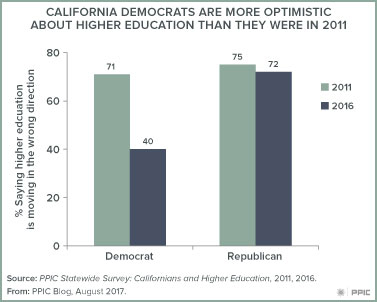 Is there a similar partisan divide over higher education in California? The PPIC Statewide Survey found a similar divergence over the past few years when we asked a different question: Is the state’s public higher education system generally going in the right or wrong direction? In 2016, California Republicans were far more likely than Democrats to say the system is headed in the wrong direction. This marked a change in the five years since we’d last asked this question. When we asked the question in 2011—toward the end of the recession and after large tuition increases—Californians in both parties overwhelmingly said higher education was moving in the wrong direction. Unlike national polling, which shows a shift in Republican opinion, PPIC surveys show a shift in the opinions of Democrats, who have become more positive, while Republicans have remained about the same.
Californians’ responses to other survey questions about higher education point to longer-term partisan divisions. Republicans have generally been more likely than Democrats to say that the overall quality of education in California’s public colleges and universities is a big problem or somewhat of a problem. Views about the direction and overall quality of public higher education are reflected in attitudes about California’s three public higher education systems. Currently about half of Republicans say that each of the systems—community colleges, California State University, and University of California—are doing an excellent or good job. More Democrats—about three-fourths—express this view.
Partisans have also historically differed on higher education funding. Compared to Republicans, Democrats are more likely to say that higher education does not receive enough funding, and Democrats are generally willing to pay higher taxes to support higher education.
Interestingly, there is some evidence that Californians’ views about the importance of college for individual success differ along party lines. A majority of Democrats (68%) say a college education is necessary for a person to be successful in today’s working world, while a majority of Republicans (72%) say there are other pathways to success. It is also true, however, that Californians in both parties have become more optimistic about the chances of success without a college degree since 2011—when the state was recovering from recession.
Finally, there are some areas of agreement. We find that members of both parties generally think that college affordability is a problem and students have to borrow too much money. Perhaps most significant is our finding that overwhelming majorities of both Republicans and Democrats say that the state’s system of higher education is important to California’s economic future and quality of life.
Visit the PPIC Higher Education Center
 Today, when many policy preferences are often divided along party lines, there is partisan consensus on this issue: at least 70% of Californians across parties say they would be unwilling to increase student fees to fund higher education. Indeed, less than a third of Californians across all regions and demographic groups say they would be willing to increase student fees.
 Another way to increase funding for California’s public colleges and universities would be to admit more out-of-state students, who pay higher tuition. Californians are somewhat divided on this issue, with half saying they would not be willing to admit more out-of-state students, while 46% say they would be willing to do so. However, only 21% of Californians support admitting more out-of-state students if this would mean admitting fewer in-state students. This view holds across party lines: only one in four Republicans (25%), and even fewer independents (21%) and Democrats (16%), are willing to admit more out-of-state students if this would mean admitting fewer in-state students. UC has proposed increasing systemwide out-of-state tuition and fees by over $1,600 to almost $40,000.