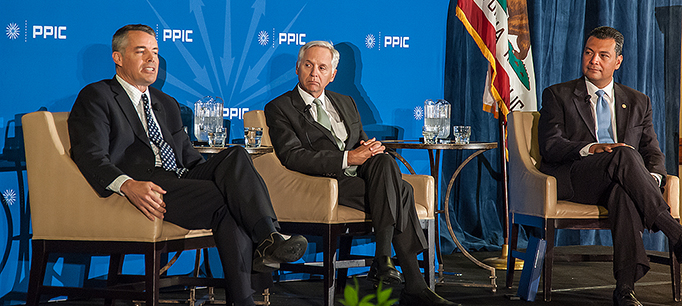
California’s Secretary of State Candidates in Conversation

The two candidates running for California secretary of state bring different resumes to the campaign but found much to agree on in a conversation sponsored by PPIC Thursday. Alex Padilla, California state senator, and Pete Peterson, executive director of the Davenport Institute at Pepperdine University, talked about their priorities in a question-and-answer session moderated by Mark Baldassare, PPIC president and CEO.

Both candidates advocated improving the use of technology—to engage voters and improve the voting experience, speed up the disclosure of campaign contributions, and improve the business registration process. Both advocated better use of data and research from outside organizations—from civic engagement groups to the U.S. Census to think tanks and universities—to more proactively register and inform voters. Some of the research PPIC has done on voter participation figured into the discussion of voter engagement, including Voter Turnout in Primary Elections and Expanding California’s Electorate: Will Recent Reforms Increase Voter Turnout?

Each candidate listed a number of goals for their term in office, if elected. Asked to reduce their voter turnout goals to a number, Padilla said he was committed to the addition of 1 million more active voters to the rolls and Peterson said he expected to generate an increase in turnout of 5 or 10 percent.

The event was part of PPIC’s 2014 Speaker Series on California’s Future. PPIC does not support, endorse, or oppose any political parties or candidates for public office.
Improving the Vote-by-Mail System

For the first time in eight years, there is no incumbent running for California secretary of state. This offers a great opportunity to step back and consider where California’s elections are, and where they ought to go next. (You can hear what the candidates have to say about the future of elections at a PPIC event on Thursday, September 11.)

Any such assessment must take a hard look at voting by mail. We see more voters using this option in every passing election, with the growth actually accelerating in recent primaries. If the trend continues, about 57 percent of the ballots in this fall’s election will be cast this way.
The question is no longer whether vote-by-mail is a sensible way to run our elections; it is now how best to manage the vote-by-mail elections we already have. This has put a number of critical issues on the table:

  1. Signature verification. The signature on a vote-by-mail ballot must be compared to the one on file to ensure that the appropriate person cast the ballot. This slows down the process, leaving the outcomes of a few races in doubt for weeks after Election Day. Some counties have been moving to verification by computer to deal with the backlog, but the standards for this sort of verification are murky. The new secretary of state can help clarify which technology is permissible and how this technology should be used.
  2. Late ballots. In a recent PPIC report, we noted that, while the vast majority of vote-by-mail ballots arrive on time, thousands of ballots arrive late and are not counted at all. The legislature has passed a bill (SB 29) that would allow most of these late ballots to be counted. If Governor Brown signs this bill, the next secretary of state will need to monitor the new status quo as it unfolds. In particular, county registrars may face a surge in late ballots as more voters take advantage of the new relaxed standard.
  3. Shrinking postal service. As email and the Internet have grown in popularity, the U.S. Postal Service has been forced to lay off staff and consolidate processing centers. Our PPIC analysis suggests that these changes have not yet created problems for vote–by-mail, but it is a development that deserves constant monitoring.
  4. All vote-by-mail? When 70 percent of the ballots in an election are vote-by-mail, one wonders whether it’s time to abandon the old polling place approach and mandate the vote-by-mail system for everyone. Colorado, Oregon, and Washington use such a system, and it has generally worked well. There are a number of arguments for the change. The persistence of a dual system may add to the complexity of counting ballots, especially with yet another system—same-day registration—coming on-line in the next few years. Moreover, while the evidence for vote-by-mail’s effect on voter turnout is mixed, it generally suggests a small but positive effect. Finally, given the fact that county registrars continue to struggle with small budgets and increasing demands, an all vote-by-mail system would offer a much-needed cost savings.

We will probably never reach a point where every voter voluntarily votes by mail. There will always be some, both young and old, who prefer to show up at a polling place. But we must think carefully about accommodating the new reality of a mostly vote-by-mail system, and how best to make it work for everyone.

Six Takeaways from the June Primary

For those of us involved in polling and election analysis at PPIC, the just-released California Secretary of State’s (SOS) Statement of the Vote offers a treasure trove of data about how our democracy is working. The latest SOS report also deserves close scrutiny because the top-two primary, which had its debut in June 2012, operated in statewide contests—such as the governor’s race—for the first time this year. My colleagues Eric McGhee and Daniel Krimm have provided an excellent analysis of the outcomes of legislative district races. Here, I’m going to focus on six election trends—regarding statewide offices, state propositions, and voter participation—that surfaced in my read of the final numbers.

  1. Advantage Incumbents. The big winners in the statewide races were current officeholders: the governor, lieutenant governor, attorney general, insurance commissioner, school superintendent, and controller (now running for treasurer). The number two vote-getters trailed these state officials by wide margins in each race, even while PPIC’s polling indicates that half of likely voters say the state is headed in the wrong direction. These primary results underscore the uphill battle faced by political newcomers in statewide elections. This is best exemplified by first-time GOP candidate Neel Kashkari, who received just 839,767 votes or 19% of the vote—even after spending millions of his own dollars on his gubernatorial campaign. The six Democratic incumbents start out with huge numerical advantages in their statewide races in November.
  2. Major Parties Rule. The top-two primary winners in the eight statewide races are all major party members. The November ballot includes seven statewide races in which Democratic and Republican candidates face off. Only the nonpartisan school superintendent’s race has a Democrat facing a Democrat. The candidates from minor parties—which used to have their own primaries—clearly have a harder time prevailing under top-two primary rules. But the statewide candidates with no party preference—also known as independents—were also shut out, even though they are members of a large voting bloc. The absence of minor party and no party preference candidates could result in a depressed voter turnout in November. In California, 28% of voters belong to a minor party or have declared as no party preference, and PPIC polling indicates that many likely voters have unfavorable views about the Democratic and Republican parties.
  3. Legislature Wins Big. Two measures placed on the ballot by the legislature passed easily: State Proposition 41 (Veterans Housing and Homeless Bond Act), with 65 percent of the vote, and State Proposition 42 (Public Records, Open Meetings, Reimbursements), with 62 percent. These two measures attracted little discussion or media interest. Their success in June is consistent with the high pass rate for legislative ballot measures over time. Still, many likely voters say they disapprove of the legislature, making the easy passage of these measures rather surprising. At the same time, this trend bodes well for the legislature’s propositions on the November ballot, such as a rainy day fund proposal and a possible state water bond.
  4. Knowledge Gaps Loom Large. State Senator Leland Yee, who was embroiled in a political scandal, accused of committing felony crimes, and withdrew his name as a candidate, still placed third in the secretary of state’s race. In fact, he received 380,361 votes or 9% of the vote. His surprising showing raises fundamental questions about the level of voter knowledge and the effectiveness of both the state’s media and the official voter guides in providing election information.
  5. Voters Are Disengaged. The primary turnout this June fell to an all-time low of 25% for registered voters and 18% for eligible adults. Even more troubling: turnout among registered voters in Los Angeles (17%), San Bernardino (19%), Riverside (22%), and Orange (24%) Counties was even lower than the statewide average. Since the top-two candidates are chosen in the primary, low primary turnouts may undermine the legitimacy of November elections over time. Moreover, these numbers raise a larger question: Are low turnouts in four populous Southern California counties symptomatic of a deeper civic malaise?
  6. Results Are Slow. A record 69.4% of primary voters mailed in their ballots this year. While this method is growing in popularity, we are learning that it results in a slow vote count that leaves the outcome of tight races in limbo for weeks. This year, the controller’s race was one of the closest in state history, with a 481-vote margin of victory, and the top-two winners were not known until the last day of June. In the future, we could be waiting for weeks to learn the winner in a tight governor’s race, or California’s outdated voting system could be exposed in a close presidential election. The 58 county registrars will need prodding and assistance by the SOS office to apply modern technology to speed up their vote-by-mail counts. Moreover, given the popularity of voting by mail, we should be looking for ways to make it easier for voters to do so—in part to increase voter participation.

Every election occurs in a unique political context. The 2014 primary results could be an anomaly rather than indicative of some flaws with the top-two primary system. The 2016 presidential year and the 2018 gubernatorial year may feature competitive statewide primary races that lead to different outcomes. Still, the six issues that surfaced in this primary also reflect longer-term trends that are worthy of serious consideration.

PPIC has invited California’s two secretary of state candidates to participate in a conversation with me about the future of California’s elections on September 11 in Sacramento. Stay tuned for more information about how you can attend or watch this PPIC event.

How Can California Increase Voter Turnout?

Days after a California primary that may set a record for low voter turnout, election experts gathered to take stock: What happened last week and how can the state engage more Californians in elections?

PPIC research fellow Eric McGhee first provided a brief overview of how California’s electoral reforms have worked so far. He noted that the top-two primary probably did not worsen voter turnout but did nothing to reverse the decline either. In the absence of an exciting race or issue, it’s unlikely that a primary reform alone will draw more voters to the polls, he said.

The consensus among panelists is that there is no single reform that will reverse declining primary turnout. Improving outreach, educating voters, making registration and voting easier—all are needed to increase engagement.

Jill LaVine, Sacramento County voter registrar, highlighted the importance of voter education. Because there were no high-profile candidates or issues in the June primary, there wasn’t much advertising on television—where many voters get information. She noted the efforts that election officials have made to make voting easier—for example, an app to help voters find polling places, and phone banks to help answer questions. But many Californians are confused by the number of changes in the state’s primary, from the date to the process of voting itself. Along with other panelists, she stressed the importance of fully funding election programs that are mandated by the state. For example, the state no longer provides funding to counties to carry out the permanent vote-by-mail program, which is used by a majority of the state’s voters.

Ethan Jones, chief consultant of the Assembly Elections and Redistricting Committee, said the legislature is addressing structural barriers to voting, such as allowing residents to register and vote on the same day. This reform, which will go into effect in future elections, will allow Californians who become engaged in an issue or candidate at the last minute to participate. There have also been efforts to address attitudinal barriers, to allow 16- and 17-year-olds who are taking civics classes to “pre-register” to vote and be added to the voter rolls when they are 18, for example.

Astrid Garcia, deputy director of the nonpartisan Future of California Elections, noted that in a state as large and diverse as California, it’s crucial to address all the steps that lead up to voting and make the experience positive, so that voters turn out again in the next election. She noted that beginning this year, legal permanent residents can be poll workers, which will educate these Californians about the process and train a cadre of bilingual poll workers for the future. She also noted the importance of “meeting voters where they are,” by allowing residents to register to vote when they seek government services. She also said that it will take time to realize the results of these reforms.