Guaranteeing Transfer Admission to the University of California

Improving transfer from community colleges to four-year universities is an important step in meeting the state’s future workforce needs. In April 2018, the California Community College Chancellor’s Office and the University of California (UC) entered an agreement to guarantee admission to community college students who meet certain qualifications. If sufficient funding and space exist, the guarantee could take effect in fall of 2019.

There are already several pathways for community college students to enroll in UC. For example, all but three campuses (Berkeley, Los Angeles, and San Diego) have a guaranteed admission program for students from certain community colleges. UC has also established academic road maps in 21 majors to help prepare students who plan to apply to transfer. However, completing an academic road map does not guarantee admission.

The new plan would guarantee admission for eligible community college students to a UC campus, but not necessarily to their preferred campus. Specifically, it creates a referral pool—a way to redirect students away from full campuses toward campuses with space. This transfer referral pool would be similar to UC’s referral pool for freshmen. At this time only one campus, UC Merced, accepts applicants from the freshman referral pool. In 2017, thousands of eligible students were redirected to UC Merced, but few actually enrolled.

How might a referral pool work for transfer students? Currently, three campuses—Santa Cruz, Riverside, and Merced—are having a particularly difficult time enrolling sufficient numbers of transfer students. These campuses would need to absorb redirected transfer students. However, it’s not certain that redirected students would enroll, even if offered admission. Right now, many transfer applicants decline their offer of admission to these campuses.

To improve transfer pathways for community college students, UC and the state should consider both expanding capacity at high-demand campuses and exploring ways to encourage students to attend other campuses.

Testimony: Transfer Is Key to Closing the Workforce Skills Gap

Hans Johnson, director and senior fellow at the PPIC Higher Education Center, testified March 20, 2018, before the Senate Select Committee on Student Success.

Here are his prepared remarks.

California faces a shortage of highly educated workers. Specifically, economic projections to 2030 show that about two in five jobs will require at least a bachelor’s degree, while demographic projections suggest that only about one in three Californians will attain this level of education. This shortfall equates to 1.1 million workers. To close the gap, all higher education systems will need to play a role, increasing access, transfer, and completion. Improving access and outcomes among groups historically underrepresented in higher education—including low-income students, first-generation college students, Latinos, and African Americans—is essential if we are to close the workforce skills gap.

The good news is that California’s students are rising to the challenge. College preparation among high school graduates has increased, with the share of students completing the college preparatory requirements of UC and CSU now at an all-time high. Strong demand for UC and CSU is likely to continue as college preparation improves and the transfer pathway becomes more efficient and effective. In addition, new initiatives, including reforms in remedial education at the community colleges and CSU, have the potential to substantially improve student success rates and boost transfer. Finding ways to accommodate all these students remains a central challenge, but one that must be met in order to ensure a better future for all Californians.

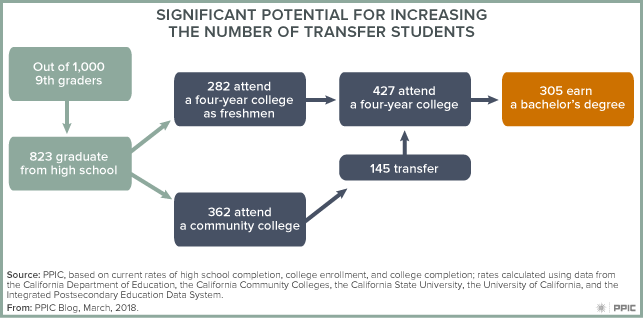
In this testimony, I will focus on the importance of transfer. California enrolls a disproportionate share of students in community college. We rank 47th in the nation in the share of recent high school graduates enrolling in four-year colleges and 5th in the nation in the share enrolling in community colleges. This means that we must do more to ensure that community college students reach their educational goals—since the vast majority of recent high school graduates attending community colleges say that they want to transfer and earn a bachelor’s degree. As shown in the chart below, there is a lot of room for improvement—only 40% of recent high school graduates who go to community college will end up transferring to a four-year institution.

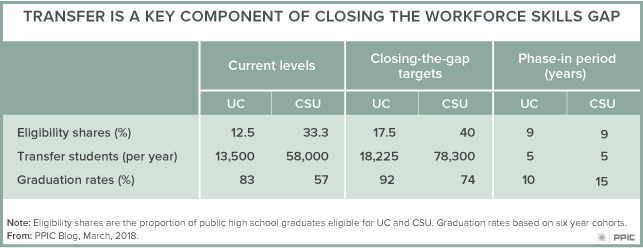
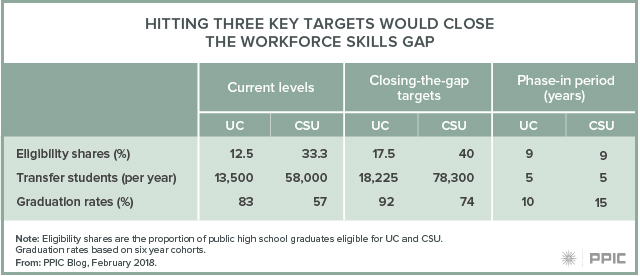
PPIC has identified ambitious targets that would close the workforce skills gap. As shown in the table below, doing so will require large increases in access to UC and CSU, both for first time freshmen and for transfer students. In its Vision for Success, a blueprint for improving student outcomes, the community colleges have established new goals for transfer that align exactly with the PPIC targets. Those targets include a 35% increase in the number of transfer students at UC and CSU, increasing from about 72,000 combined in 2015 to almost 100,000 by 2020.

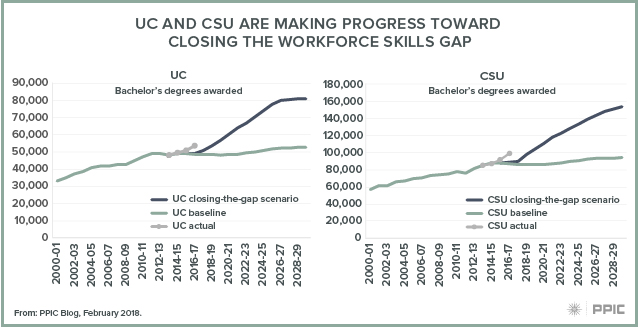
I’m pleased to say that the colleges are currently on track to meet those targets. We are now two years into PPIC’s projections, and both UC and CSU have met the closing-the-gap targets (see charts below). The concerted efforts of policymakers, higher education officials—including staff and faculty—and, of course, students have led to these early gains.  State general fund allocations for each system have increased since the Great Recession, allowing for increased enrollment. At UC, those budget allocations were partially tied to increasing enrollment, hence the sharp rise in transfers from 2015 to 2016.  New articulation agreements, such as the Associate Degree for Transfer (ADT), have streamlined the pathway from community colleges to four-year colleges, especially CSU. And an increased focus on improving student outcomes in the community colleges has led to multiple substantive reforms designed to increase persistence and completion (including transfer).

These early successes are very promising. Still, California needs to build on them if it is to close the degree gap.  We offer the following recommendations for moving forward:

  • First, the state should work with the systems to ensure that students who are eligible for transfer successfully make the transition. Some students who are eligible to transfer never even apply to do so. More work needs to be done to understand factors that prevent those students from moving on, including an assessment of equity implications. At the same time, many transfer-eligible students do apply to transfer, but are not admitted because of insufficient resources at UC and CSU. Because of budget constraints, CSU reports turning away more than 32,000 transfer applicants from 2013–14 through 2016–17, even though they had met CSU admission requirements (based on systemwide unduplicated counts of California resident applications). UC does not report how many qualified applicants have been turned away, partly because UC eligibility is less clearly defined. UC has general transfer requirements, including courses and grade point average requirements, but advises students that “meeting these basic requirements doesn’t guarantee admission to the campus or major of your choice.” Enrolling more students will almost certainly require more funding, either from the state via the general fund or from students and their families through tuition increases.
  • Second, the pathway from community college to UC and CSU needs to become systematically and comprehensively streamlined. The Associate Degree for Transfer is a step in the right direction. Students earning an ADT are guaranteed admission to CSU in a major aligned to their course of study. But these degrees are offered only in some majors at some colleges. While the number of students earning an ADT has grown rapidly, it is still the case that the majority of transfers to CSU do not have the degree. As shown in the chart below, institutional participation in the program varies by college and by major. Some majors, including engineering, have no ADT at all.  Moreover, UC does not formally participate in the ADT guarantee. At UC, transfer admission requirements vary by campus and by majors within campuses.  For example, UC Berkeley’s College of Engineering has much higher standards than the UC minimum requirements for transfer, including a 3.5 grade point average and the completion of courses that are not offered at all community colleges.

  • Third, the state and its higher education institutions need to plan for potentially large increases in the number of community college students prepared and ready to transfer. New reforms in the community colleges hold the promise of dramatically increasing persistence and completion. Assessment and placement reform, spurred by AB 705, is likely to lead to an enormous increase in the number of students placed directly into college-level English and math courses—bypassing traditional remedial classes that have been the single largest impediment to student success. Other new initiatives, including “guided pathways” intended to provide a clear road map to students on courses of study and the supports needed to succeed, could lead to further gains. Because most transfer students enroll in CSU and UC, capacity issues at those institutions must be addressed. The state’s private nonprofit colleges are also an important destination for transfer students, and continued efforts should seek to gain greater participation and enrollment in that vital sector.

Through thoughtful planning—and yes, additional funding—closing the workforce skills gap is possible. Improving the transfer pathway is a necessary and critical component. And because community colleges are highly representative of California’s economic and demographic diversity, improving transfer pathways will ensure that more low-income, first-generation, and underrepresented students have access to a four-year degree.

Testimony: How Can California Produce More College Graduates?

Hans Johnson, director and senior fellow at the PPIC Higher Education Center, testified today, February 6, 2018, before the Assembly Budget Subcommittee No. 2 on Education Finance and the Assembly Higher Education Committee. The master plan defined a strategy to meet the state’s education needs in 1960—but today, California faces new challenges. The topic of today’s hearing: how to meet the state’s future economic need for more college graduates. Here are his prepared remarks.

PPIC’s work has revealed a serious gap between the number of highly educated workers that California’s future economy will need and the number the state is on pace to produce. We call this the workforce skills gap—and it’s quite large. To meet economic demand and secure a more prosperous future for our state, California’s higher education institutions will need to produce 1.1 million more college graduates by 2030.

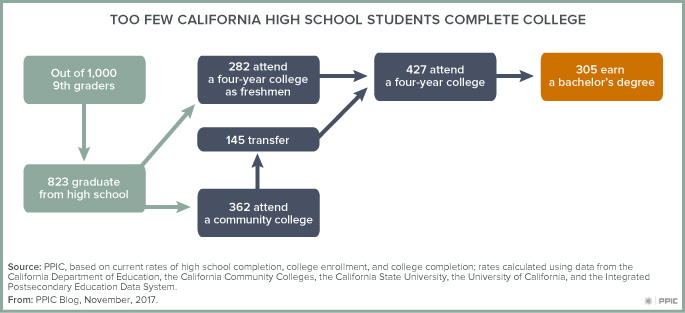
Admittedly, doing so is an ambitious goal. But there is significant room for improving how many students graduate from college—especially if we consider that currently only about 30 percent of California’s 9th graders will earn a bachelor’s degree.

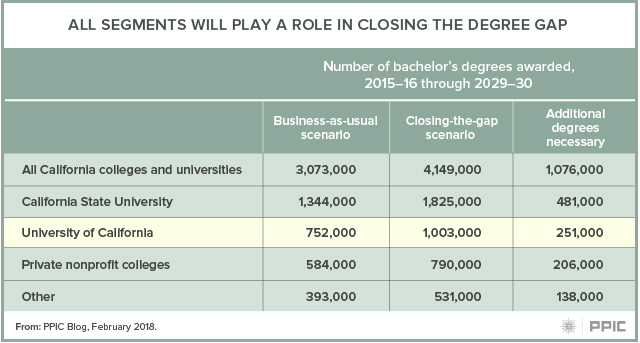
PPIC has quantified the role of each university segment—the University of California, the California State University, and private nonprofit colleges in California—in closing the workforce skills gap. Overall, the number of bachelor’s degrees would need to increase by about one-third over baseline projections. Almost half of the gains would need to occur at CSU, the nation’s largest public university system. UC and private nonprofit colleges would also play an important role.

Most immediate to today’s conversation about goal setting for the state’s public systems, PPIC has identified the combination of increases in freshman eligibility, transfer, and completion rates necessary to close the gap.

Our preferred approach—a closing-the-gap scenario—combines increases in eligibility, transfer, and graduation rates, as shown below. Along with increases in enrollment and completion at private institutions, reaching these targets would fully close the workforce skills gap.

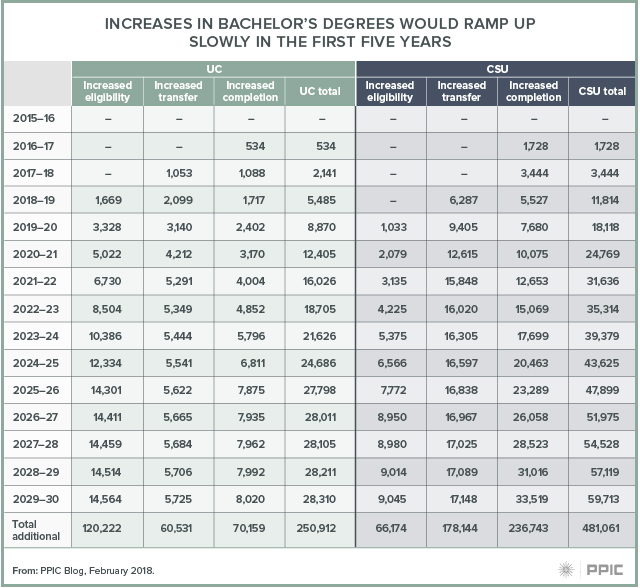
In our scenario, each target would be reached gradually through a phase-in period. In the first few years, projected increases would be minimal as the systems would enroll more students and implement policies to improve completion and transfer. But within five years, the increases would become quite large. By 2020–21, CSU would award almost 25,000 additional bachelor’s degrees; UC would award more than 12,000.

For the purposes of setting annual goals, we are identifying annual targets in new freshmen enrollment, transfer, and completion rates that would match the closing-the-skills gap degree targets. Enrollment and transfer targets depend on graduation rates and time to degree—meaning that enrollment increases could be lower if graduation rates improve and students complete their degrees more quickly. For example, students who take 12 units per semester will take five years of continuous enrollment to earn the 120 units necessary for graduation.  If those students instead took 15 units per semester, they would graduate in four years and free up additional space for other students.

It has been a couple years since PPIC first developed our projections, and we’ve now been able to chart early progress by the systems. Later you will hear in detail from the segments about their plans, but right now I am happy to report some good news: the number of bachelor’s degrees awarded at UC and CSU is actually higher than our initial scenario called for.

Of course, we are just at the start of our projection period, and to close the gap the numbers must ramp up quickly after the first few years. Nonetheless, growth in graduation rates and enrollment has led to a notable expansion in degrees awarded at both systems. Over the past two years, UC and CSU combined have awarded 295,000 bachelor’s degrees—21,000 more than in our closing-the-gap-scenario and 23,000 more than in our baseline scenario. In addition, the number of transfer students has increased 8%, also higher than in our closing-the-gap scenario.

In addition, community colleges and CSU have adopted new goals for student success that are entirely consistent with PPIC’s closing-the-gap scenario. CSU’s new graduation initiative calls for reducing time to degree and increasing both four-year and six-year graduation rates. CSU’s goal of a 70% six-year graduation rate by 2025 is in line with and in fact slightly more ambitious than our scenario. In their new “Vision for Success,” the community colleges have adopted a goal to increase transfer to UC and CSU by 35% over the next five years, a goal that is entirely consistent with our work.

There is an important additional benefit of meeting these goals: reducing equity gaps. Today, students who have been underrepresented in higher education—including Latino, African American, low-income, and first-generation students—make up a majority of California’s high school graduates. Strong increases in college preparation among the state’s high school graduates are expanding the pool of potential college graduates, with the share of students—including African American and Latino students—completing the college preparatory requirements of UC and CSU reaching an all-time high. Ensuring that the growing number of prepared high school graduates have meaningful access to and success in higher education will not only help California meet its economic challenges, it will ensure that higher education continues to serve as a ladder of economic and social mobility.

Our focus at PPIC has been on college graduates with at least a bachelor’s degree, but we acknowledge the importance of other postsecondary training. We have a series of reports and ongoing projects that identify successful vocational pathways and high value awards (certificates and associate degrees) offered by the state’s community colleges. Lande Ajose of California Competes will discuss in more detail the need for sub-baccalaureate post-secondary education. We also acknowledge the importance of post-baccalaureate education, including professional and academic graduate degrees offered primarily by UC and the state’s private nonprofit colleges. Those degree holders have the best labor market outcomes in the state.

Figuring out how to pay for all these increases is no easy task and will be discussed later in this hearing.  Let me alert you to two projects underway at PPIC that will help shed light on this issue. One will examine the role that tuition policy could play and the other will focus on capital finance. In addition, we will continue to monitor affordability issues, including student debt, identified by respondents to the PPIC Statewide Survey as the number one higher education issue.

Finally, it is worth noting that the governor has proposed a funding formula for the community colleges that for the first time will provide additional funding based on student outcomes and enrolling low-income students. PPIC has argued that this approach has the potential to incentivize investment by the state’s higher education systems in areas that further state priorities.


Funding Increase for Community Colleges

Nearly 70% of new funding for higher education—or $570 million—in Governor Brown’s proposed budget goes to the state’s community colleges. This continues a trend that has seen community colleges get an ever-growing portion of higher education funding even as overall funds for higher education have shrunk—from 18% of the General Fund 40 years ago to just under 12% now. This trend is likely to continue—mostly because Proposition 98, passed by the voters in 1988, sets minimum funding levels for the state’s K–12 and community college systems.

Blog figure: 2018-19 Budget, Community College FundingThese mandated minimum funding levels have protected community colleges from the kind of budget cuts that have affected California’s other public higher education institutions. In addition, Governor Brown has prioritized investments in the community college system, which serves 2.1 million students and is the gateway to higher education for the vast majority of California students.

Governor Brown and the legislature have vastly increased investment in community college programs intended to improve student outcomes and eliminate achievement gaps, including programs focused on adult education and career technical education. Moreover, last year the governor provided a one-time allocation of $150 million to develop the Guided Pathways program, aimed at integrating disparate student success programs into one model and creating clear pathways for students to earn a certificate or degree, or transfer to a four-year college.

The governor’s current budget proposal also contains a new funding formula for the community colleges. This formula would shift future funding to districts with higher proportions of low-income students and those that have achieved better student outcomes. Under this formula, each district would get 50% of its funding based on enrollment, 25% based on enrollment of low-income students—those who receive a tuition waiver or Pell grant—and 25% based on district performance. Performance would be measured by the number of degrees and certificates provided, the number of students who complete a degree or certificate in three years or less, and the number of Associate Degrees for Transfer granted.

California’s community colleges have long struggled with low completion rates, low transfer rates, and persistent achievement gaps. Additional funds and a new funding formula may help to address these issues and lead to greater student success—which, for most community college students, means transferring to a four-year institution. Today, more than half of CSU students are community college transfers, as are nearly one-third of UC students. If current investments in community colleges do in fact improve student outcomes, then California’s four-year institutions will need to be ready for even more transfers.


College Graduates and California’s Future

The University of California Board of Regents invited Mark Baldassare, PPIC president and CEO, and Hans Johnson, PPIC senior fellow and director of the PPIC Higher Education Center, to present their perspectives on the role of higher education in California’s future, November 16, 2017. Here are their prepared remarks:

Good morning, I am Mark Baldassare, president and CEO of the Public Policy Institute of California (PPIC). I am here with my colleague and PPIC’s higher education center director Hans Johnson to present the institute’s research findings on the need for college graduates in California’s future economy. To kick off this session, I am going to make a few remarks about public opinion to place this issue in perspective.

The November PPIC Statewide Survey points to the importance of this topic for most Californians. Eighty percent of California adults say that the state’s higher education system is very important to the quality of life and economic vitality of the state, and another 14% say it is somewhat important. Strong majorities across political, regional, racial/ethnic, and demographic groups say that the state’s higher education system is very important. In fact, strong majorities of Californians have been saying that higher education is very important to the state’s future since we first asked this question in 2007.

In the context of the 2018 governor’s race, 63% of California adults say that candidate positions on higher education are very important, and another 28% say they are somewhat important to them. Majorities across political, regional, racial/ethnic, and demographic groups hold this view.

When asked about the current workforce, 83% of Californians say that a four-year degree from a college and university prepares someone very well (30%) and somewhat well (53%) for a well-paying job in today’s economy. Fifty percent of Californians think that a college education is necessary for a person to be successful in today’s work world, with majorities of Latinos (67%), Asian Americans (54%), and African Americans (51%) and fewer whites (35%) holding this view. Moreover, about half of Californians, with pluralities across the state’s major regions, say that California will not have the college-educated residents needed for the jobs and skills likely to be in demand 20 years from now.

In sum, the importance of a higher education and the need for college graduates are issues on the minds of many residents today. Hans will provide the demographic and workforce analysis that demonstrates why the state’s higher education system is essential for a better future for all Californians.

PPIC has produced a series of reports on California’s future population and economy. Our report Will California Run Out of College Graduates? provides projections of the demand for and supply of workers across all levels of educational attainment to 2030. Our primary finding is that California faces a shortage of highly educated workers. Specifically, economic projections to 2030 show that about two in five jobs will require at least a bachelor’s degree, while demographic projections suggest only about one in three Californians will have at least a bachelor’s degree. This shortfall equates to 1.1 million workers.


In this presentation, I first describe how California’s population and economy are changing and then identify how the state and its higher education institutions can increase college enrollment and completion to produce more college graduates.

California’s economy increasingly demands highly educated workers

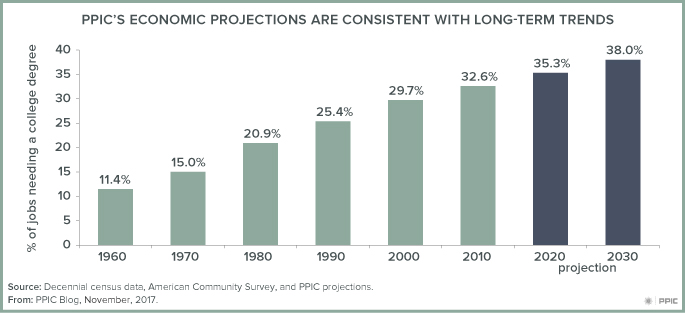
To develop our economic projections, we apply trends in educational attainment levels to occupational projections developed by the California Employment Development Department. We examine changes in labor market demand that are occurring due to shifts both in occupational structure and changes in educational attainment within occupations. Our primary finding is that the state’s economy will continue along a well-established trajectory, with a growing share of jobs requiring at least a bachelor’s degree.

There are two key drivers of increasing demand for college graduates: (1) faster growth in occupations that commonly require a college degree (e.g., computer technology), and (2) increases in demand for highly educated workers within occupations (e.g., nursing). In recent years, most (74%) of the increased demand for highly educated workers has occurred because of faster job growth in occupations that commonly require a college degree. Among occupations with at least 100,000 full-time year-round workers, there have been especially rapid growth rates for software developers (56% increase between 2010 and 2015), computer scientists and systems analysts (42% increase), and managers (35% increase). These and other highly skilled occupations have experienced faster growth than most occupations that require lower levels of education.


That said, the increase in educational attainment within occupations has been significant. For example, the share of registered nurses with a bachelor’s degree has grown from 57% in 2000 to 68% in 2015. From 2010 to 2015, about 26% of the increase in jobs for college graduates was attributable to growing demand for highly educated workers within specific occupations.

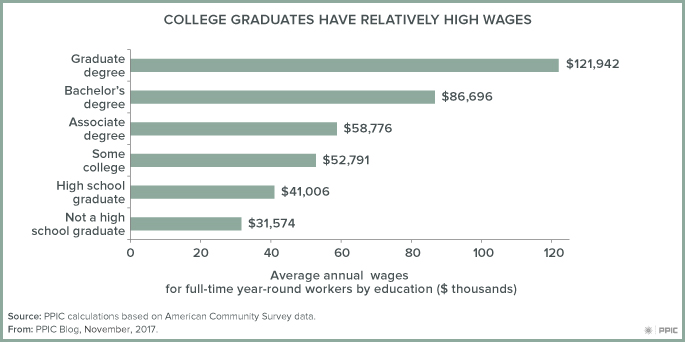
Are college degrees really necessary for these jobs? To answer this question, we examined a number of labor market outcomes. Within and across occupations, we find that workers with bachelor’s degrees have higher labor force participation rates, lower unemployment rates, and higher wages than those without—and that, in general, as educational attainment increases, wages also increase. Overall, the wage premium for college graduates relative to less-educated workers has grown. By 2015, the average annual wage for full-time year-round workers was more than twice as high for workers with a bachelor’s degree than for those with only a high school diploma.
Within each of 51 occupational groupings we see higher wages for college graduates than for high school graduates. Among registered nurses, for example, those with a bachelor’s degree earned 12% more than those with an associate degree.

California’s educational institutions are not keeping up with demand

Too few Californians are graduating from college. At current college enrollment and completion rates, only 30.5% of 9th graders in California will eventually earn a bachelor’s degree either in California or elsewhere in the United States. Among all states, California ranks 47th in the share of high school graduates who enroll in four-year colleges and 5th in the share who go to community colleges. Low rates of transfer from community colleges to four-year colleges exacerbate the problem.

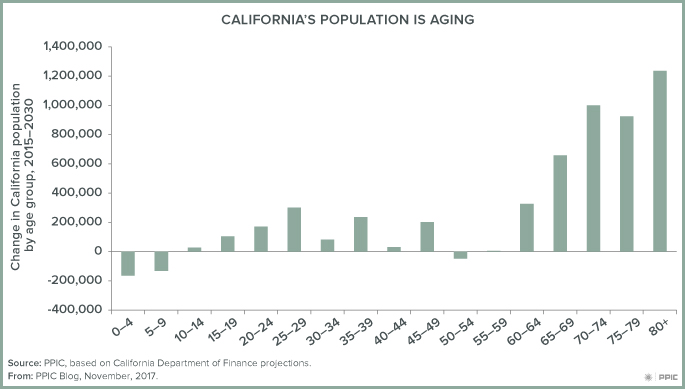
A critical challenge is the retirement of the baby boom generation. Called the “silver tsunami” by some, this is the first time in California’s history that such a large and well-educated group is exiting the labor force. In contrast, the number of young adults in California is projected to increase only modestly.

Not all degrees are equal

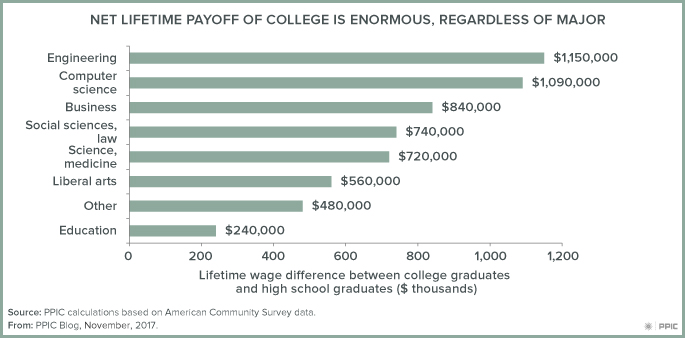
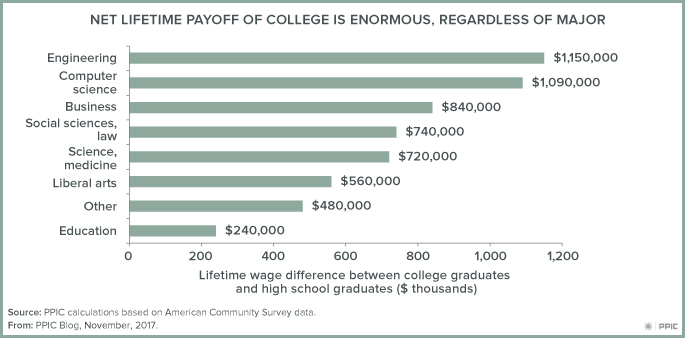
On average, college graduates have very strong labor market outcomes. At any point in time, some college graduates are working in jobs that do not necessarily require a college degree, but over the course of their careers the vast majority of college graduates will move into occupations that reward their educational training. Our estimates show that students who earn bachelor’s degrees in engineering and computer science fare very well in the labor market, but even those with less remunerative majors, such as education and the liberal arts, will earn far more in wages than less-educated workers, even after taking into account all the costs of going to college.

How to close the degree gap

To close the degree gap, California and its higher education institutions need to establish new policies and practices to enroll more students, especially in our four-year colleges and universities, and improve graduation rates among students already in college. In previous testimony, PPIC has identified targets for each of the state’s public systems with respect to admission, transfer (from community colleges to four-year colleges), and improved graduation rates.

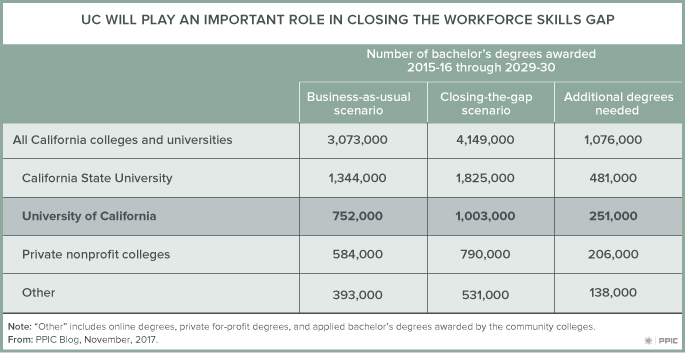
The University of California (UC) will play a central role. In our scenario, UC would need to award approximately one-quarter of the additional degrees necessary to close the gap. This is an ambitious target, but the increase over current levels (and over the baseline projection) would not be without precedent. For example, between the 1999–2000 and 2016–17 academic years, the number of bachelor’s degrees awarded by UC increased 62% (from slightly more than 33,000 to almost 54,000). Our closing-the-gap scenario would require UC to award about 81,000 degrees by 2029–30, a 51% increase over current levels.

Improving access and success among groups historically underrepresented in higher education—including low-income students, first-generation college students, Latinos, and African Americans—is essential if we are to close the degree gap. Compared to other public research universities, UC has an impressive record in enrolling low-income and first-generation students.

The California State University (CSU) system and the California Community College system have adopted new goals that are entirely consistent with PPIC’s targets. New initiatives, including remediation reform at the community colleges and at CSU, have the potential to substantially improve student success rates. CSU’s new graduation initiative aims to increase graduation rates and eliminate gaps between groups of students. College preparation among the state’s high school graduates has also increased, with the share of students completing the college preparatory requirements of UC and CSU reaching an all-time high. Strong demand for UC is likely to continue as college preparation continues to improve and the transfer pathway is better articulated. UC has seen consistent increases in graduation rates for many years, and new efforts to improve on-time graduation are likely to continue this trend.

Finding ways to accommodate all these students remains a central challenge, but one we must meet in order to ensure a better future for all Californians.

Testimony: The Need for College Graduates in California’s Future Economy

Hans Johnson, director and senior fellow at the PPIC Higher Education Center, testified today, November 1, 2017, before the Assembly Select Committee on the Master Plan for Higher Education in California. The master plan defined a strategy to meet the state’s education needs in 1960—but today, California faces new challenges. The topic of today’s hearing: ensuring that the master plan meets workforce needs.

Here are his prepared remarks.

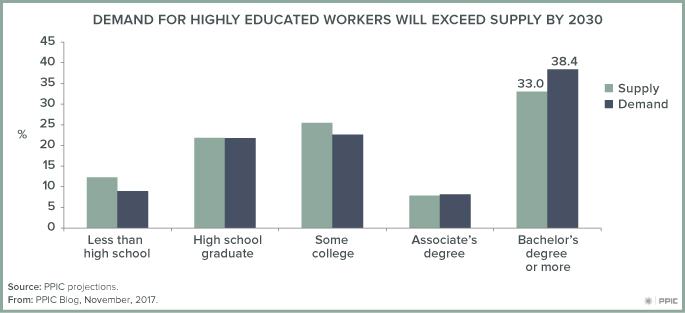
PPIC has produced a series of reports on California’s future population and economy.  Our report Will California Run Out of College Graduates?, provides projections of the demand for and supply of workers by educational attainment to 2030. Our primary finding is that California faces a shortage of highly educated workers. Specifically, economic projections to 2030 show that about two in five jobs will require at least a bachelor’s degree, while demographic projections suggest only about one in three Californians will have at least a bachelor’s degree. This shortfall equates to 1.1 million workers.

figure - Demand for Highly Educated Workers Will Exceed Supply by 2030

In this testimony, I first describe how California’s population and economy are changing, and then identify how the state and its higher education institutions can increase college enrollment and completion to produce more college graduates.

California’s economy is increasingly demanding highly educated workers

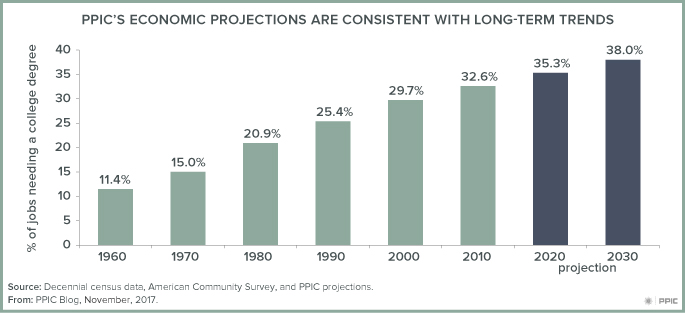
To develop our economic projections, we apply trends in educational attainment levels within occupations to occupational projections developed by the California Employment Development Department. We examine changes in labor market demand that are occurring due to shifts in the distribution of occupations and changes in educational attainment within occupations. Our primary finding is that the state’s economy will continue along a well-established trajectory, with a growing share of jobs requiring at least a bachelor’s degree.

figure - PPIC's Economic Projections Are Consistent with Long-term Trends

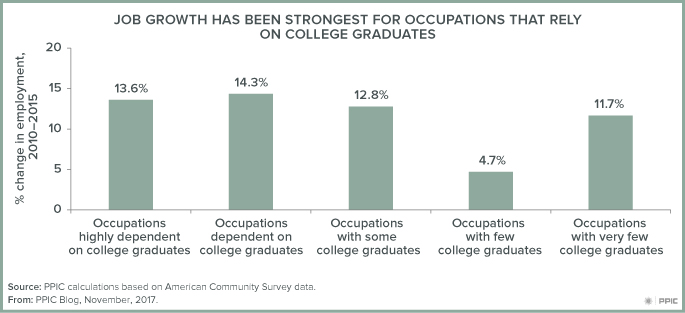
The two key drivers of increasing demand for college graduates are: 1) faster growth in occupations that commonly require a college degree (e.g., computer technology occupations), and 2) increases in demand for highly educated workers within occupations (e.g., nursing).  While both drivers are important, in recent years most of the increased demand (74%) for highly educated workers has occurred because of faster job growth in occupations that commonly require a college degree. Among large occupations (with at least 100,000 full-time year-round workers), those with especially rapid growth rates over the past five years include software developers (56% increase between 2010 and 2015), computer scientists and systems analysts (42% increase), and managers (35% increase). These and other highly skilled occupations have experienced faster growth than most less skilled occupations.

figure - Job Growth Has Been Strongest for Occupations that Rely on College Graduates

The second key driver of demand has been an increase in educational attainment within occupations.  For example, the share of registered nurses with a bachelor’s degree has grown from 57% in 2000 to 68% in 2015.  Altogether, over a five year period (from 2010 to 2015) about 26% of the increase in jobs for college graduates has occurred as demand for highly educated workers has grown within specific occupations.

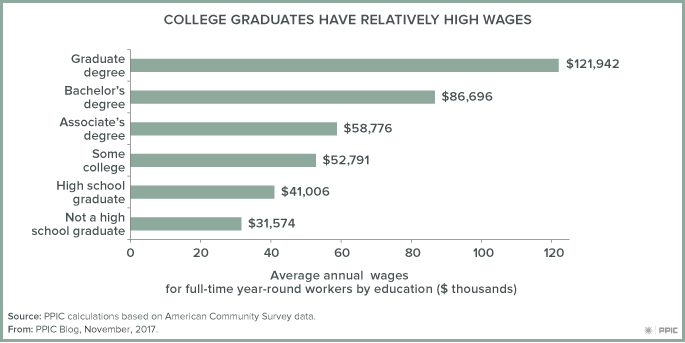
Are college degrees really necessary for these jobs? We examine a number of labor market outcomes to answer this question.  Within and across occupations, we find higher labor force participation rates, lower unemployment rates, and higher wages for workers with a bachelor’s degree than for those without. And in general, as educational attainment increases, wages also increase. Overall, the wage premium for college graduates relative to less educated workers has grown. By 2015, the average annual wage for full-time year-round workers was more than twice as high for workers with a bachelor’s degree than for those with a high school diploma.

figure - College Graduates Have Relatively High Wages

Within each of 51 occupational groupings we see higher wages for college graduates than for high school graduates. Among registered nurses, for example, those with a bachelor’s degree earned 12% more than those with an associate’s degree.

California’s educational institutions are not keeping up with demand

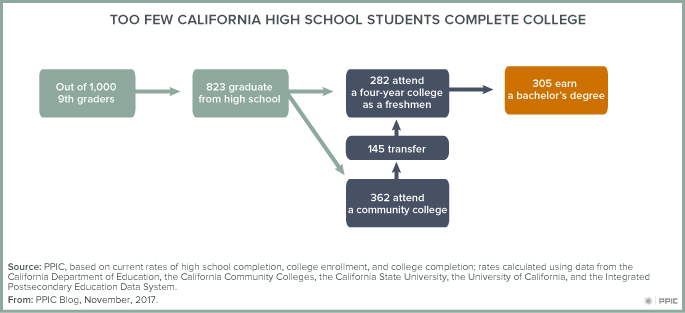
Too few Californians are graduating from college. At current college enrollment and completion rates, only 30.5% of 9th graders in California will eventually earn a bachelor’s degree either in California or elsewhere in the United States.  Compared to other states, California ranks 47th in the share of high school graduates that enroll in four-year colleges and 5th in the share that go to community colleges. Low rates of transfer from community colleges to four-year colleges exacerbates the problem.

figure - Too Few California High School Students Complete College

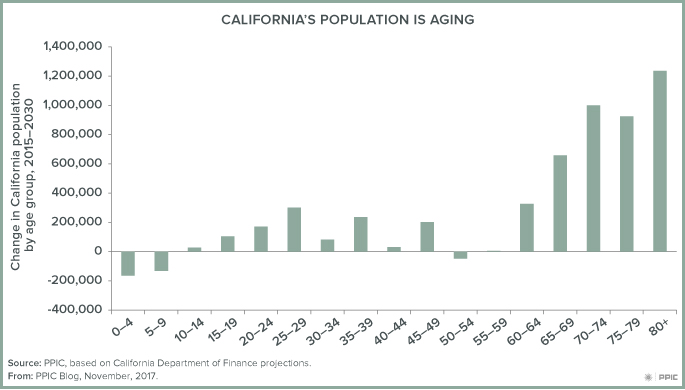
A critical challenge is the retirement of the large and relatively well-educated baby boom. Called the “silver tsunami” by some, this aging out of the labor force of millions of older adults is the first time in the history of California that such a large and well-educated group is exiting the labor force. In contrast, the number of young adults in California is projected to increase only modestly.

figure - California's Population Is Aging

Not all degrees are equal

On average, college graduates have very strong labor market outcomes. While at any point in time, some college graduates are working in jobs that do not necessarily require a college degree, over the course of their careers the vast majority of college graduates will move into occupations that reward their educational training. Our estimates show that students who earn bachelor’s degree in engineering and computer science fare very well in the labor market, but even those in less remunerative majors such as education and the liberal arts will still earn far more in wages than less educated workers, even after taking into account all the costs of going to college.

figure - Net Lifetime Payoff of College Is Enormous Regardless of Major

How to close the degree gap

To close the gap, California and its higher education institutions will need to establish new policies and practices to enroll more students, especially in our four-year colleges and universities, and ensure greater success of students already in college. In previous testimony, PPIC has identified targets for each of the state’s public systems with respect to admission, transfer (from community colleges to four-year colleges), and improved graduation rates. Improving access and success among groups historically underrepresented in higher education, including low-income students, first-generation college students, Latinos, and African Americans is essential if we are to close the degree gap.

The good news is that new goals adopted by the California State University (CSU) system and the California Community College system are entirely consistent with PPIC’s identified targets. New initiatives, including remediation reform at the community colleges and at CSU, have the potential to substantially increase student success. CSU’s new graduation initiative aims to substantially increase graduation rates and eliminate gaps between groups of students. Strong increases in college preparation among the state’s high school graduates are also a positive sign, with the share of students completing the college preparatory requirements of UC and CSU reaching an all-time high.

Finding ways to accommodate all these students remains a central challenge, but one we must meet in order to ensure a better future for all Californians.
Learn moreVisit the PPIC Higher Education Center

Testimony: Cybersecurity Needs and Higher Education

Hans Johnson, director of the PPIC Higher Education Center and PPIC senior fellow, testified at the Joint Legislative Oversight Hearing on Cybersecurity Education and the Needs of the Workforce before the Assembly Committee on Higher Education in Sacramento today (October 10, 2017). Assemblymember Jose Medina chairs the Higher Education Committee and Assemblymember Jacqui Irwin chairs the Select Committee on Cybersecurity. Here are Johnson’s prepared remarks.

Thank you Chair Medina, Chair Irwin, and committee members.  My name is Hans Johnson, and I am the director of the Higher Education Center at the Public Policy Institute of California. My role today is to provide a brief overview of cybersecurity labor market needs in the state. First, I’ll define cybersecurity occupations, next I’ll provide data on labor market trends, and finally I will discuss educational awards related to cybersecurity. Sources of information and data used in this testimony include the United States Department of Labor, the California Employment Development Department, the United States Census Bureau, and reporting by California colleges and universities to the United States Department of Education.

As an occupation, cybersecurity is identified by the US Department of Labor as “information security analyst” and resides within a broader set of computer and mathematical occupations. In this testimony, I will focus on the information security (IS) analyst occupation. However, it is important to note that other computer and information technology occupations include individuals who work at least partly on security issues. According to the US Department of Labor: “Information security analysts plan and carry out security measures to protect an organization’s computer networks and systems. Their responsibilities are continually expanding as the number of cyber attacks increases.”

The IS analyst occupation is a high wage, high demand occupation. It is growing but still relatively small. Increasingly, employers are hiring workers with at least a bachelor’s degree to fill IS analyst jobs, but a notable share of jobs are still filled by workers with less than a four-year degree.  California colleges and universities have substantially increased the capacity of their institutions to award degrees in computer science and related fields. Even so, unemployment rates remain very low—an indication that employers could be having a hard time finding workers.

In California, EDD estimates the state was home to about 8,000 IS analysts in 2014, with that number projected to increase to 10,100 by 2024, a growth rate (26%) slower than other computer occupations (29%) but much faster than the state’s overall employment growth rate (15%). Still, it is important to note that IS analysts make up less than 1% of employment in computer occupations in California and less than 2% in the nation (see chart below). IS analysts work in a broad range of industries, including technology, banks, higher education, insurance, and health.

EDD estimates that IS analysts in California had a median wage of $53 per hour in the first quarter of 2017, which amounts to $110,000 on a full-time annual basis. Nationwide, the unemployment rate for IS analysts has been around 2% for several years now (based on my analysis of American Community Survey data from 2012 through 2015), with similarly low unemployment rates in California. Unemployment rates that low are a sign of high labor market demand.


Of critical concern for workers, and for these committees, are the education and training requirements for IS analysts. According to the U.S. Department of Labor:

Information security analysts usually need at least a bachelor’s degree in computer science, programming, or a related field. As information security continues to develop as a career field, many schools are responding with information security programs for prospective job seekers. These programs may become a common path for entry into the occupation. Currently, a well-rounded computer education is preferred.

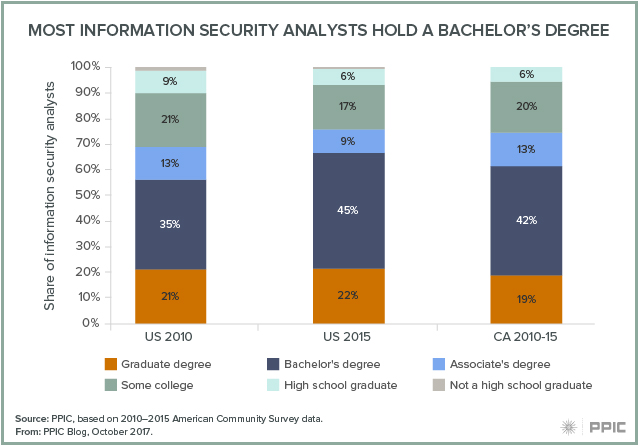
The number of IS analysts has increased nationwide in the last five years and so has their educational attainment. In the US, 67% of IS analysts had at least a bachelor’s degree in 2015 compared to 56% in 2010. In California, about two-thirds of analysts have at least a bachelor’s degree. The share of IS analysts in the US with an associate’s degree has declined from about 15% to less than 10%. The vast majority with a bachelor’s degree majored in one of three fields: computer science (including information systems), engineering (including electrical engineering and computer engineering), and business (including management information systems). In California, annual average earnings for IS analysts with a bachelor’s degree are about 70% higher than for those with some college or an associate’s degree, who in turn earn about 20% more than those with only a high school diploma. Unemployment rates are low for IS analysts, especially those who have some postsecondary education and those who have a bachelor’s or graduate degree.


California is home to dozens of colleges and universities that offer degrees in computer and information sciences. The state’s universities, especially the University of California, have quickly responded to the strong demand for these degrees (see chart below). The total number of bachelor’s degrees awarded increased from less than 3,000 in 2010 to 6,000 by 2016, with UC and CSU accounting for 65% of the total in 2016. The most common major is computer science, followed by computer and information science.


California’s community colleges also offer postsecondary training in computer and information sciences, ranging from short-term certificate programs to associate’s degrees. Importantly, they also provide lower division courses necessary for transfer to a four-year college or university. The total number of associate’s degrees in computer and information sciences and support services doubled between 2010 and 2016, from 719 to 1,490. The number of short-term certificates (completed in less than one academic year) increased from 1,605 in 2010 to 1,838 in 2016, and the number of longer-term certificates (completed in at least one but less than two academic years) increased from 225 to 321. In all, the number of postsecondary awards totaled more than 3,600 by 2016. PPIC is currently developing research that explores information technology awards at the community colleges and is working with the Employment Development Department and the Chancellor’s Office of the California Community Colleges to secure access to student and wage data.

In thinking through the roles of the different segments of higher education in California, it is important to keep in mind that the segments are designed to work as a system. The strong demand, both on the part of students and employers, in technology fields should be met by each institution and by the segments working together. For example, improving transfer from community colleges to UC and CSU in technology fields through better articulation—including Associate Degrees for Transfer—is necessary if students are going to fully realize the economic benefits of these fields. Moreover, cybersecurity occupations are but one part of a larger technology sector. Developing a larger industry-wide and cross-system approach to meeting demand is necessary. Innovations—such as locating some CSU bachelor’s degree programs at community college campuses—offer the promise of reaching more students, including those underrepresented at our four-year colleges. California can best serve the growing number of students who want to pursue technology jobs by taking advantage of the strengths of each segment of its public higher education system—and helping those segments work together to meet the economic need for these highly skilled workers.

Learn moreVisit the PPIC Higher Education Center

UC May Struggle to Meet Transfer Requirement

Governor Brown’s May budget proposal withholds $50 million from the University of California (UC), which must undertake a series of reforms to restore the funds. One requirement—the result of a deal made during the 2015 budget process—is that UC meet its fall 2017 target of enrolling only two new in-state freshmen for every in-state transfer student, both systemwide and at each campus (except Merced). In 2016, the system enrolled 2.3 freshmen for every transfer student. The 2:1 target is intended to increase the number of transfer students served by UC. But reaching this freshmen-to-transfer ratio while responding to growing freshmen demand could prove very difficult this year and in the future.

UC has made progress in enrolling more transfer students but has not come closer to meeting its target ratio. In the last year, UC enrolled almost 2,000 more transfer students, a 13% increase and the biggest jump in more than a decade. However, UC also enrolled more than 5,000 additional freshmen compared with the previous year (a 17% increase)—leaving the freshmen-to-transfer ratio slightly higher.

In recent years, demand to attend UC has increased much faster for freshmen than for transfers. This year, there are more than 3.5 freshmen applicants for every transfer applicant. Since 2011, freshmen applications have increased by 31%, while transfer applications have declined by 1%.

Can UC attain a 2:1 ratio while responding to growing demand for freshmen slots in 2017? To do so, the system would need to draw more transfer students from a smaller applicant pool—especially if officials also plan on increasing freshmen enrollment. Compared to last year, 1,000 fewer in-state transfer students and 6,000 more in-state freshman applied. This problem is particularly acute at Santa Cruz and Riverside, which enrolled more than 3.5 freshmen for every transfer student in 2016 and may not meet the 2:1 goal this year.

UC may also have trouble meeting its target freshmen-to-transfer ratio in the future. If the number of freshmen applicants keeps increasing while the number of transfer applicants stagnates, UC may have to turn away more in-state freshmen applicants to meet its goal. To increase the quantity and quality of future transfer pools, the system is working to expand existing transfer agreements between UC campuses and nearby community colleges. In addition, UC’s new Transfer Pathways program helps prepare community college students in the most popular majors to transfer as juniors to any UC campus. The new program could start showing results in the next couple of years.

Though transfer demand at UC is sluggish, transferring is still a popular path for students elsewhere. California State University (CSU) has seen 14% growth in transfer applications since 2011 and, in 2016, received over 106,000 transfer applications (about three times as many as UC). UC could look to a recent success at CSU, which worked with the California Community Colleges to develop the Associate Degree for Transfer (ADT). Like the Transfer Pathways program, the ADT prepares community college students for junior-level entry at any CSU campus. But the ADT goes further by guaranteeing that students will only need 60 more units at CSU to graduate from their major. It also guarantees students admission to the CSU system and offers priority consideration at a local CSU campus. The ADT is quickly becoming a popular option, with 30,000 ADTs awarded in 2015–16 alone. Of course, students are considering other factors, such as cost, distance, eligibility, and availability when choosing where to apply for transfer. Guaranteed pathways to a degree and priority consideration in admission, however, are likely to entice potential transfers.

It will be difficult for UC to achieve its 2017 transfer requirement, especially at Santa Cruz and Riverside—putting into question whether the system will receive the $50 million withheld in the governor’s budget proposal. With increasing demand for freshmen slots, UC must work to increase the pool of transfer applicants to meet both the 2:1 goal and freshmen demand going forward.

Learn more

Read the report Higher Education in California: Expanding College Access
Visit the PPIC Higher Education Center

Guided Pathways in Community College

In California and across the country, community colleges are working hard on reforms aimed at increasing college completion, particularly among students historically underrepresented in higher education. Yet many promising innovations have not moved the needle. One reason is that many of these reforms, while innovative, focus on only a small proportion of the student body, or improve only one part of the students’ college experience. As a result, colleges have begun to adopt a more comprehensive institutional reform known as “guided pathways.”

Guided pathways are based on a set of scalable design principles, outlined in the 2015 book Redesigning America’s Community Colleges: A Clearer Path to Student Success. These principles include

  • Helping students choose and enter a program pathway
  • Mapping pathways to students’ end goals
  • Keeping students on path
  • Ensuring that students are learning

Implementation may occur in a variety of ways, but colleges have found it essential to focus on the following areas:

  • Guided exploration for undecided students. This includes clustering hundreds of programs into a handful of broad focus areas. In addition, some colleges offer foundational courses to help students select a major. In some cases, all students enroll in a foundational course within their broad field of interest. Mentored by faculty, students may research different careers, interview or shadow individuals in a particular field, and get a taste of the different competencies within each major while honing their research skills.
  • Clearly delineated program requirements. Cross disciplinary teams of instructional and counseling faculty, staff, and administrators create “program maps” to show the path necessary for labor market success and further education. Students may take elective courses that are not on the program map, but they will also know which courses each program requires.
  • Proactive and integrated academic and non-academic support. When support services are optional, students may fail to identify the services they need or lack the confidence to ask for help. Services can take many forms, from embedding academic support in the classroom to providing specialized counselors. At Guttman Community College in New York City, an entering group of students is split into “houses,” and a team of instructional faculty, counseling faculty, and peer mentors is responsible for each house. Faculty and peer mentors meet regularly to discuss individual student progress, coordinating their actions and communications with each other and the students.
  • Developmental education transformation. Developmental education—also known as remedial education or basic skills—has traditionally focused on courses such as college algebra and English composition. Reforms would create accelerated pathways aligned with a small set of broad programs (e.g., liberal arts, STEM, business, and health). Our recent research has found that the reform efforts happening across the state—for example, as part of the California Acceleration Project—are well positioned to create developmental education pathways that are better aligned to programs of study. PPIC’s ongoing research aims to shed light on the most promising developmental education reforms.

Opportunities for California Community Colleges
The last six months have seen tremendous momentum and support for guided pathways in California. This support has emerged at all levels, including the governor, legislature, the Chancellor’s Office, national foundations, and college faculty and administrators. Last month, with the support of the College Futures Foundation, the Bill and Melinda Gates Foundation, the James Irvine Foundation, and the Teagle Foundation, the Chancellor’s Office awarded grants to twenty colleges as part of The California Guided Pathways Project. Last year, three community colleges in California were awarded the American Association of Community Colleges Pathways grant to assist them with planning and implementing a pathways framework. In addition, the Governor’s Budget proposal for 2017‒18 includes $150 million one-time Proposition 98 funds to support new guided pathways programs in community colleges. Finally, Senate Bill 539, introduced during the 2017 legislative cycle, proposes to use an incentive grant to help establish guided pathways that would boost completion and transfer. Given this wide-ranging support, much can be learned from the experiences in other states and systems. It will also be critical for colleges to conduct deep examinations of how existing college initiatives, such as those involved with the Basic Skills Student Outcomes and Transformation program, can be integrated into guided pathways. In an upcoming blog post, we will explore how developmental education reform intersects with the guided pathways framework..

The Growth of College Promise Programs

A majority of Californians believe that college affordability is a big problem for the state, according to the PPIC Statewide Survey. Low family incomes and the high cost of living have made it difficult for many students to pay the full price of college. This is true even though California’s public colleges and universities have some of the lowest tuition levels in the country and the majority of community college, UC, and CSU students receive grants to cover the cost of tuition. Policymakers have taken notice of the public’s concerns.

Many local governments, school districts, colleges, and business communities have been addressing the issue of access and affordability through “promise programs.” The “promise” label has been adopted to represent a wide range of programs that share at least two specific characteristics: they are limited to individuals in a particular geographic area, such as a city or school district, and they provide some level of financial support for postsecondary education. Nearly 80 promise programs have been launched nationwide since 2001. In California, according to WestEd, 23 of these programs have been created since 2008—13 of them in the past two years.

The most well-known California-based promise program is the Long Beach Promise, which offers all public school students in the district a tuition-free first semester at Long Beach Community College. It also guarantees admission to Long Beach State University for students who complete required college preparatory courses with the necessary grades.

College promise programs often couple financial incentives with extensive outreach to middle-school students and improved student services like tutoring and counseling. In California, the vast majority of these programs are focused on getting students to enroll in community colleges—most offer one semester of free community college tuition and do not provide enrollment guarantees to a four-year college.

While it’s important to ensure that students who might not otherwise consider college be given incentives to attend, the state’s biggest challenge is ensuring that college students stay in school and earn a degree or certificate. Only about half of California community college students receive an associate degree or certificate, transfer to four-year schools, or complete 60 transferable units within six years of enrolling. There is some anecdotal evidence that promise programs improve college-going rates, but they do not seem to boost college completion. In order to improve completion rates, programs may need to provide support services for participants who have entered college.

More generally, the wide range of program designs makes it difficult to assess their effectiveness—even within California, promise programs have different residency requirements, eligibility criteria, grades of entry (middle school vs. freshman year of high school), financial awards, support services, and levels of financial sustainability. Defining the basic elements of promise programs and developing effective standards for program design and implementation will help ensure their future success.

Learn more

Read the PPIC Statewide Survey: Californians and Higher Education
Visit the PPIC Higher Education Center