Video: Implementing New K–12 Science Standards

California’s K–12 schools are implementing the Next Generation Science Standards (NGSS) to improve the way science is taught. The standards, adopted in 2013, represent a paradigm shift for science education. Although awareness of the new standards is high, implementation has been uneven, according to a new PPIC report.

Report coauthor Niu Gao presented the analysis in Sacramento last week. She said many districts report that instructional materials are a big challenge, and most also struggle with inadequate science labs and equipment. Insufficiently credentialed science teachers and challenges in professional teacher training are two other ongoing concerns. These problems are exacerbated by California’s chronic teacher shortage.

Gao concluded with a brief summary of the report’s policy recommendations, which include a greater emphasis on science in the early grades and three science courses—instead of two—as a high school graduation requirement. Gao’s presentation was followed by a discussion among a panel of experts who work in this area.

Jessica Sawko, executive director of the California Science Teachers Association, explained the rationale for teaching science in the early grades. Since NGSS builds upon the previous years’ instruction, this can put older students at a disadvantage if they’re not taught science early. “If you’re not teaching science in grade two, then you’re underpreparing students” for courses taught in grades three to five, she said.

When asked about the upcoming field test of the NGSS, Trish Williams, a member of the California State Board of Education, called it a “great opportunity” to collect data and get a snapshot of where we are—and what to do next. But she acknowledged that test results could vary. With a large state like California, Williams said, we can’t expect everyone to “knock it out of the park” on the first try. She also expressed concern about economic issues that put “low-performing districts at a terrible disadvantage.”

Stacey Lerma, a professional development specialist with the Moreno Valley Unified School District, added, “It’s going to take time for teachers to be comfortable with everything the test is assessing and for students to be prepared” for the new standards. Despite the challenges ahead, Lerma expressed deep support for the NGSS. When kids are dreaming about what to do when they grow up, “they need to think of things besides teacher, fire fighter, police officer, and think astronaut, scientist, and engineer.”

Californians and the Gas Tax Repeal

Governor Brown’s 2018–19 budget proposal includes a large boost to transportation funding because of recently passed legislation. In 2017, California raised the gas tax for the first time in 23 years, increasing gasoline and diesel fuel by 12 and 20 cents per gallon, respectively. The state also created a new annual fee based on vehicle value. The taxes and fees are estimated to raise over $4.6 billion in the next year to repair state and local roads, highways, and bridges, and to strengthen mass transit. However, a Republican-led initiative to repeal the bill continues to collect signatures to qualify for the November ballot.

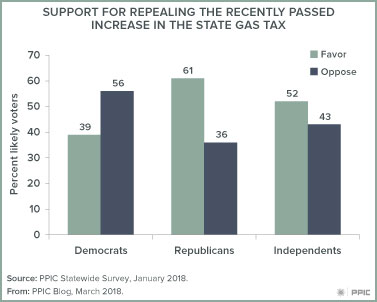
In January, the PPIC Statewide Survey asked whether Californians favor a repeal of the recently passed increase in the gas tax. We found California’s likely voters are divided, with 47% favoring repeal and 48% opposed. But there are partisan differences: 61% of Republican and 52% of independent likely voters favor a repeal, compared to 39% of Democrats. Regionally, Republican (68%) and independent (60%) likely voters on the southern coast are the most likely to favor a repeal, while inland Democrats (62%) are the most likely to oppose it. We also saw strong partisan disparities on the importance of repeal in our December survey: among likely voters, Republicans (85%) were far more likely than independents (46%) and Democrats (36%) to say repeal of the recently passed gas tax was very important to them.

Opponents of the repeal argue that the gas tax increase was necessary to fund much-need repairs to the state’s infrastructure. Conversely, proponents—in addition to generally opposing tax increases—reason the state is well situated to fund transportation projects through other funding sources. For example, Republicans in the state assembly have introduced a measure that would dedicate at least 2% of General Fund revenues to infrastructure projects.

Changes to federal policy could also affect the state’s transportation funding. Last month, the White House released a plan that aims to generate an unprecedented $1.5 trillion—including an allocation of $200 billion in federal spending over the next decade—to repair and upgrade the nation’s infrastructure. To be eligible for matching federal funds, California would need its own state and local revenue streams, whether through the new gas tax or other sources. The White House also expressed interest in raising fuel taxes by 25 cents per gallon to help pay for the plan. This would represent the first increase at the federal level since 1993 and could create an additional burden for Californians, who already face one of the highest gas prices in the nation.

As California engages in its ongoing debate over how best to fund transportation projects, upcoming federal and state policy decisions may have major consequences for residents.

An Alternative Approach to Managing the Delta

The State Water Board is updating the water quality plan for the Sacramento–San Joaquin Delta. This plan sets flow and water quality standards for the Delta and its watershed, affecting water supply to more than 25 million Californians and millions of acres of Central Valley farmland. Parties that would be affected by this plan—water suppliers, fish and wildlife managers, environmental nonprofits—are negotiating voluntary agreements to present to the board for consideration.

Members of Governor Jerry Brown’s administration asked PPIC to assemble a small group of independent experts on the Delta to develop ideas about how to resolve the linked challenges of water quality, habitat, and water supply in the Delta and its watershed. This group—most of whose members are in the PPIC Water Policy Center research network—proposed a new approach, detailed in three commentaries posted on UC Davis’s California Waterblog. The recommendations are summarized below.

Tackle a manageable set of problems. Rather than trying to solve all of the Delta’s problems simultaneously, the board and those involved in negotiations should identify a smaller, well-defined set of issues that can be addressed over the next 15 years through this plan. Priorities include: (1) reversing declines in food resources for the Delta ecosystem, (2) maximizing a high-quality habitat that favors native plants and animals, and (3) managing nutrient pollution to reduce harmful algal blooms. Given the inadequacies of past efforts focused on single species recovery, these actions should instead focus on improving overall ecosystem function and condition.

Coordinate the management of freshwater flows, tides, and changes in the landscape. Traditional approaches to improving habitat in the Delta have tended to focus separately on freshwater flows and landscape changes. Where possible, an integrated, ecosystem-based approach—in which freshwater flows, tidal flows, and landscapes are managed together—is more likely to be successful and to result in a more efficient use of water and financial resources. Efforts should be concentrated in the north Delta and Suisun Marsh, and include strategies for reducing harmful algal blooms.

Bolster current science programs to guide implementation of the plan. Although there is a strong scientific basis for undertaking the approach outlined here, there are still many uncertainties about which specific strategies will bring success. This is why a robust science effort is needed to guide actions and evaluate progress. Scientific research on the Delta and its watershed is not well organized to do this. A new program—housed within the state’s existing Delta Science Program—should develop the science necessary to implement the Water Quality Control Plan. To make this program successful, a Delta Science Joint Powers Authority (JPA)―made up of the various agencies engaged in Delta management―should be established. The JPA would pool resources to fund the Delta Science Program and broader efforts in Delta science. The JPA would also be a forum for agencies, water users, and other stakeholders to develop consensus on science-based management. This will increase the efficiency of scientific efforts and reduce conflict over findings.

Is this ecosystem-based approach legal? In a word, yes. Management of the Delta needs to shift away from efforts to recover a few species of endangered fish and toward improving ecosystem conditions to meet a broader range of objectives. If the regulatory agencies can document the benefits of this approach, there are no barriers under current law.

These recommendations challenge some historical approaches to management of the Delta.  But ecosystem-based approaches that use an array of tools have the prospect of being a more efficient use of resources—including the critical resource of water for the environment—with broad benefits for fish and wildlife as well as the people who rely on Delta water.

Learn more
Read California’s Water: The Sacramento–San Joaquin Delta (PPIC Briefing Kit)
Watch a short video on the Delta
Visit the PPIC Water Policy Center’s Delta resource page

Californians and Immigration Policy

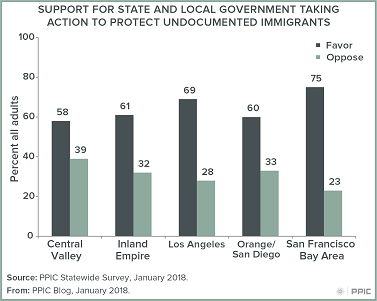
During President Trump’s first year, perhaps no issue caused more conflict between the state and federal government than immigration. In January, California became a sanctuary state. Yesterday, the US Justice Department filed a lawsuit against California over three state immigration-related laws that were passed by the California Legislature in 2017. How do residents feel about the state and local governments making their own policies and taking actions, separate from the federal government, to protect the legal rights of undocumented immigrants?
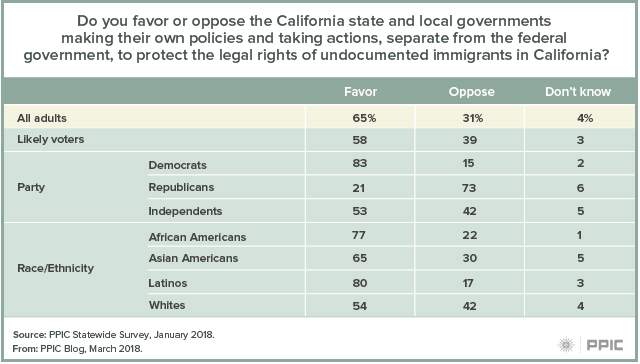

In January, we found that most Californians are in favor (65% adults, 58% likely voters), as we also found a year ago (65% adults, 58% likely voters). Today, eight in ten Democrats are in favor, compared to half of independents and two in ten Republicans. Majorities across regions support state and local government action.

We also find support across age, education, income, and racial/ethnic groups. Latinos and African Americans are more likely than Asian Americans and whites to be in favor.

Read “Californians and DACA” (PPIC blog, February 6, 2018)


Prioritizing Computer Science in California Schools

More than half of the fastest-growing and highest-paying jobs nationwide require computer science (CS) knowledge. To help students acquire the skills they need to thrive in a technology-driven world, many states have added computer science to the roster of courses that satisfy high school graduation requirements. California has a way to go before it can join these states.

Currently, California has no statewide CS requirement. Individual school districts can allow CS course credit to substitute for math, science, or some other graduation requirement. In some districts, such as San Francisco Unified, CS classes can satisfy the “college preparatory elective” requirement but can’t replace classes in core subject areas.

In 23 other states and the District of Columbia, CS courses can count toward high school math requirements; nine of these other states also allow CS classes to count toward science requirements. For example, one of three required science courses may be a CS class, as long as the other two cover traditional science subjects. Half of the states that include CS in their high school graduation requirements require three years of math, while the other half require four years. Moreover, these states require students to complete foundational coursework in math and science before they can take CS courses that count toward high school graduation.

Before California can add CS to its high school graduation requirements, it needs to make several other changes. To ensure that students have the foundational knowledge required to do CS coursework, the state must increase the number of required math and science classes—its current requirement of two years in each subject is among the lowest in the nation.

California also needs to increase the number of rigorous CS courses taught statewide. Statewide CS course offerings are low and most courses are not rigorous enough to prepare students for college and beyond. During the 2016–17 school year, fewer than half (49%) of K–12 schools offered computer education courses. Furthermore, most courses do not meet the University of California or the California State University entrance requirements.

Finally, the state needs to dedicate funding to teacher professional development. Currently, schools and districts struggle to find qualified CS teachers. From 2000 to 2016, the number of computer education teachers remained around 3,000, while the number of teachers in other subject areas has grown substantially.

California can improve and broaden computer science education in its K–12 schools. But the experience of other states underlines the need for a multi-pronged effort.


Video: Improving English Courses at California’s Community Colleges

California’s community colleges are in the midst of numerous reforms to improve developmental—or remedial—education. Developmental education is supposed to help prepare students for college work but it has long been an obstacle to student success: most students in developmental classes never go on to complete a college-level course in English or math. A recent report by the Public Policy Institute of California (PPIC) looks at the effectiveness of some of these reforms in English. It finds that one reform in particular shows real promise. Called one-semester acceleration, it’s a highly intensive course that leads directly to a college composition class. Still, there is much room for improvement, especially for underrepresented students.

PPIC researcher Marisol Cuellar Mejia presented findings from the report in Sacramento this week. In a discussion following the presentation, panelists talked about promising initiatives underway in developmental education. Many of the current efforts to more accurately place students in appropriate classes and transform course sequences are motivated by AB 705, a legislative proposal signed into law by Governor Jerry Brown last fall. Assemblymember Jacqui Irwin, who authored the bill, said it provides flexibility to the state’s individual community colleges “but with clear requirements that colleges use the best of multiple measures—including high school performance—in placing students.” The bill also instructs colleges to maximize the possibility that students pass a transfer level class within a year.

Laura Hope, executive vice chancellor for educational services at the California Community Colleges Chancellor’s Office, described the central challenge involved in full-scale implementation of reforms across the state’s 114 community colleges as an instructional paradigm shift. “It’s about changing minds and hearts about student capacity and the belief that they don’t come to us just a jumble of deficits . . . It’s about shifting that mindset away from fixing students into activating students.”

Summer Serpas, assistant director of the California Acceleration Project, underscored the professional support that teachers will need as a larger and more diverse group of students move out of developmental courses and into transfer-level ones: “These students are capable of doing the work, but they come in needing [additional] support.” Serpas said it will be critical to learn from colleges that have already adopted successful reforms, including accelerated pathways and the “co-requisite” model, in which students enroll directly in college composition with concurrent support.

Californians and Sacramento’s Handling of Misconduct

During fall 2017, the #MeToo movement took the entertainment, sports, and business worlds by storm. Statehouses across the nation were also affected. Here in California, allegations of sexual harassment came to light and have led to resignations, including the recent resignation of State Senator Tony Mendoza, who was on the precipice of a formal expulsion vote. No member of the California Legislature has been expelled since 1905.

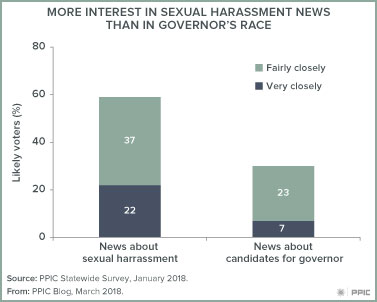
In our January survey, prior to this latest development, we found that nearly half of Californians are following news about sexual harassment and misconduct in the state legislature very (18%) or fairly (28%) closely. Women (49%) and men (43%) are similar in how closely they were following the news.

Interest in this topic is bipartisan: most Democrats (56%) and Republicans (56%) are closely following this story. However, Democrats are about twice as likely to be following it very closely.

Interest is also widespread: more likely voters (59%) are closely following news about sexual harassment than about candidates for governor (30%).

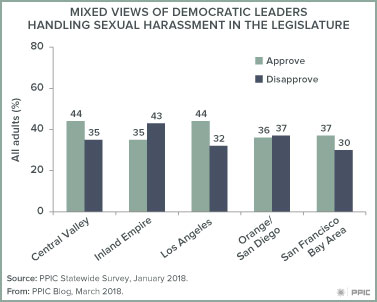
How are Democratic leaders handling the issue of sexual harassment in the statehouse? Californians’ opinions are divided (39% approve, 36% disapprove), with 25 percent unsure. Notably, women (40% approve) and men (38% approve) hold similar views. Similarly, fewer than half of Californians across regions and age, education, income, and racial/ethnic groups approve of the way Democratic leaders are handling the issue. Not too surprisingly, Democrats (52%) are nearly twice as likely as independents (28%) and three times as likely as Republicans (18%) to approve.

So far, the issue of sexual harassment in Sacramento hasn’t played a large role in the primary races. Stay tuned to see if that changes as the June election draws closer.