Californians and Their Tax Burden

It’s April 15—the perfect day to explore how Californians feel about the state and local tax system and how much they pay in taxes. According to the most recent PPIC Statewide Survey, seven in ten Californians believe that California currently ranks near the top (48%) or above average (22%) in state and local tax burden per capita. The public’s perception is somewhat in line with fiscal facts: California’s state and local tax collections per capita in 2015 were 10th-highest in the nation (Tax Policy Center, September 2018).

Notably, Republicans (65%) are much more likely than Democrats (47%) and independents (48%) to say California’s state and local tax burden is near the top. The share of Californians expressing this view increases with rising income (39% under $40,000, 52% $40,000 to $80,000, 61% $80,000 or more) and this view is more common among whites (57%) than among other racial/ethnic groups (47% Asian Americans, 44% African Americans, 38% Latinos).

Half of Californians (52%)—a record-high share—say that the state and local tax system is either not too fair (25%) or not at all fair (27%). This marks a 10-point increase since March 2017 and a 21-point increase since the first time we asked this question in June 2003. There are notable differences along partisan lines. More than two in three Republicans (69%) see the state and local tax system as not too or not at all fair, as do nearly six in ten independents (58%), compared to about four in ten Democrats (43%).

The belief that the system is not fair is widely held across regions, ranging from a high of 60% in the Inland Empire to 45% in the San Francisco Bay Area. Lower-income adults (46%) are somewhat less likely than more-affluent adults (60% $40,000 to $80,000, 54% $80,000 or more) to say that the current state and local tax system is not fair.
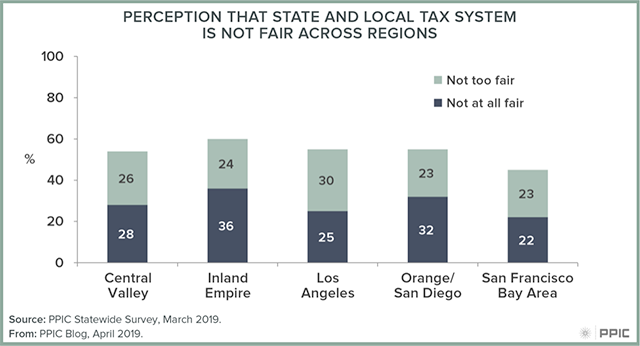
Figure 1: Perception That State and Local Tax System is Not Fair Across Regions

A record-tying 60% of Californians say they pay much more (39%) or somewhat more (21%) than they should in state and local taxes. The share saying they pay much more than they should is a record high and has increased 13 points since we first asked this question in February 2003. This view is widely held across regions and demographic groups. Notably, Republicans (61%) are more than twice as likely as Democrats (25%) and much more likely than independents (42%) to say they pay much more than they should.

Figure 2 - Shares Saying They Pay Much More in State and Local Taxes Than They Should

That said, California voters have passed tax increases in recent years, including extending the Proposition 30 income tax increases in 2016 and rebuffing an effort to repeal the recently passed increase to the state gas tax in 2018. Further, voters across the state have been more than willing to pass local tax measures. With a new governor and a supermajority of Democrats in the state legislature, are new taxes on the horizon? Stay tuned as the PPIC Statewide Survey gauges public support for any new proposals.
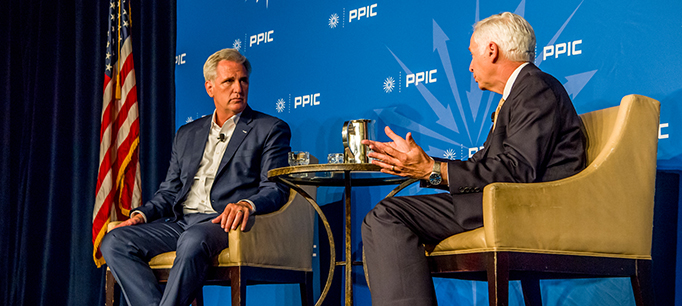
Video: A Conversation with Congressman Kevin McCarthy

As part of our Speaker Series on California’s Future, PPIC is inviting elected leaders across the political spectrum to participate in public conversations. The purpose is to give Californians a better understanding of how our leaders are addressing the challenges facing our state.

House Majority Leader Kevin McCarthy and PPIC president Mark Baldassare had a wide-ranging conversation in Sacramento last week. They focused on the relationship between California and the federal government in several areas, including tax reform, immigration, health care, water policy, wildfire management, and fuel emissions standards.

When asked about the impact of the recently passed federal tax law on Californians, he emphasized the bigger economic picture. The focus, he said, should be on the overall Republican agenda and whether it inspires optimism about the future: “Do you feel better off? How many quarters of economic growth have you had?”

McCarthy criticized the state’s leadership for its “backwards thinking” on the gas tax and other issues, and its oppositional stance to the Trump administration. He also talked about the need for bipartisan compromise in Congress. “I try to work with everybody,” he said, citing the work he did with Senator Feinstein to pass “the first major piece of water legislation in quite some time.” He returned to this theme after the conversation was briefly interrupted by a pro-DACA demonstration, asking why we can’t “sit down and communicate with one another” and decrying “elected officials who stand up and say ‘Divide us, not unite us’.”

Nonetheless, he seemed confident about finding ways to address major issues. About immigration policy, he said “I think we’re going to solve this problem” in the next congressional session. Asked about the 2020 Census, he said that Congress is making sure there will be an accurate count. “It is a big job,” he added, “and this is always the big fear before a census—are we prepared for it?”

Finally, when asked why he wants to become Speaker of the House, he said, “I want to make sure a Republican can be Speaker,” so that the party can continue to enact its agenda. He went on to describe the electoral landscape leading up to the November midterms, offering up a key takeaway: “This will be the year of the woman.”

Californians and the Gas Tax Repeal

Governor Brown’s 2018–19 budget proposal includes a large boost to transportation funding because of recently passed legislation. In 2017, California raised the gas tax for the first time in 23 years, increasing gasoline and diesel fuel by 12 and 20 cents per gallon, respectively. The state also created a new annual fee based on vehicle value. The taxes and fees are estimated to raise over $4.6 billion in the next year to repair state and local roads, highways, and bridges, and to strengthen mass transit. However, a Republican-led initiative to repeal the bill continues to collect signatures to qualify for the November ballot.

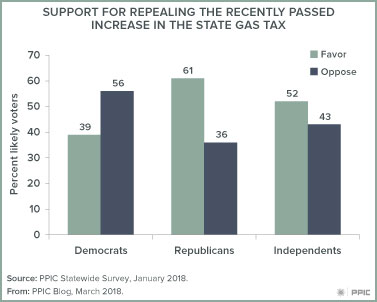
In January, the PPIC Statewide Survey asked whether Californians favor a repeal of the recently passed increase in the gas tax. We found California’s likely voters are divided, with 47% favoring repeal and 48% opposed. But there are partisan differences: 61% of Republican and 52% of independent likely voters favor a repeal, compared to 39% of Democrats. Regionally, Republican (68%) and independent (60%) likely voters on the southern coast are the most likely to favor a repeal, while inland Democrats (62%) are the most likely to oppose it. We also saw strong partisan disparities on the importance of repeal in our December survey: among likely voters, Republicans (85%) were far more likely than independents (46%) and Democrats (36%) to say repeal of the recently passed gas tax was very important to them.

Opponents of the repeal argue that the gas tax increase was necessary to fund much-need repairs to the state’s infrastructure. Conversely, proponents—in addition to generally opposing tax increases—reason the state is well situated to fund transportation projects through other funding sources. For example, Republicans in the state assembly have introduced a measure that would dedicate at least 2% of General Fund revenues to infrastructure projects.

Changes to federal policy could also affect the state’s transportation funding. Last month, the White House released a plan that aims to generate an unprecedented $1.5 trillion—including an allocation of $200 billion in federal spending over the next decade—to repair and upgrade the nation’s infrastructure. To be eligible for matching federal funds, California would need its own state and local revenue streams, whether through the new gas tax or other sources. The White House also expressed interest in raising fuel taxes by 25 cents per gallon to help pay for the plan. This would represent the first increase at the federal level since 1993 and could create an additional burden for Californians, who already face one of the highest gas prices in the nation.

As California engages in its ongoing debate over how best to fund transportation projects, upcoming federal and state policy decisions may have major consequences for residents.

Video: Countdown to the Primary

Less than four months before the June primary, Democrats Gavin Newsom and Antonio Villaraigosa are in a virtual tie among likely voters in the gubernatorial race. But a quarter of likely voters are undecided—as many as support either of the front-runners in the top-two contest. In the US Senate race, Dianne Feinstein continues to lead fellow Democrat Kevin de León by double digits, with a third of likely voters undecided.

These are among the key findings in the January PPIC Statewide Survey, presented by researcher Lunna Lopes at a Sacramento briefing last week.

Among other highlights of the survey:

  • Likely voters are divided on two ideas that may be on the fall ballot: repeal of the recently passed increase in the state gasoline tax and a change in the strict limits on commercial property taxes imposed by Proposition 13. Under the property tax proposal, commercial properties would be taxed according to their fair market value but limits on residential property taxes would remain in place.
  • Most Californians favor the governor’s proposed budget and believe the governor and legislature will be able to work together and accomplish a lot. However, expectations of cooperation are low for the president and Congress.
  • Many Californians closely following news about sexual misconduct in the state legislature, and they are divided about how Democratic leaders are handling this issue so far.
  • Californians are most likely to name immigration as the top issue facing the state today, and majorities across parties favor the DACA protections.

Learn moreRead the January PPIC Statewide Survey: Californians and Their Government
Find out more about the PPIC Statewide Survey