
During fall 2017, the #MeToo movement took the entertainment, sports, and business worlds by storm. Statehouses across the nation were also affected. Here in California, allegations of sexual harassment came to light and have led to resignations, including the recent resignation of State Senator Tony Mendoza, who was on the precipice of a formal expulsion vote. No member of the California Legislature has been expelled since 1905.
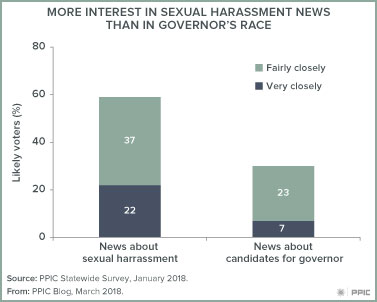 In our January survey, prior to this latest development, we found that nearly half of Californians are following news about sexual harassment and misconduct in the state legislature very (18%) or fairly (28%) closely. Women (49%) and men (43%) are similar in how closely they were following the news.
Interest in this topic is bipartisan: most Democrats (56%) and Republicans (56%) are closely following this story. However, Democrats are about twice as likely to be following it very closely.
Interest is also widespread: more likely voters (59%) are closely following news about sexual harassment than about candidates for governor (30%).
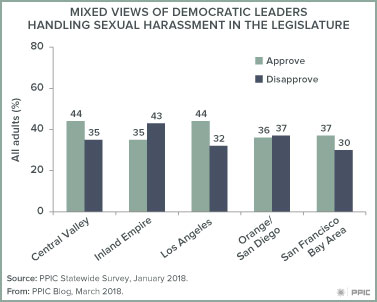 How are Democratic leaders handling the issue of sexual harassment in the statehouse? Californians’ opinions are divided (39% approve, 36% disapprove), with 25 percent unsure. Notably, women (40% approve) and men (38% approve) hold similar views. Similarly, fewer than half of Californians across regions and age, education, income, and racial/ethnic groups approve of the way Democratic leaders are handling the issue. Not too surprisingly, Democrats (52%) are nearly twice as likely as independents (28%) and three times as likely as Republicans (18%) to approve.
So far, the issue of sexual harassment in Sacramento hasn’t played a large role in the primary races. Stay tuned to see if that changes as the June election draws closer.
