CSU Ends Remedial Courses

Last fall, more than one in three students starting as freshmen at the California State University (CSU) system had to take a remedial course in either English or math before they could take college-level courses in those subjects. These remedial courses generally cover material from high school and don’t count toward a degree—even though they cost the same amount and require as much class time as a college course. But this situation is about to change. Starting in 2018, all CSU freshmen will be placed in college-level courses. Those who are underprepared will receive some kind of extra support.

This is the most recent in a series of CSU reforms intended to place freshmen students into college-level courses. In 2004, the Early Assessment Program (EAP) began giving 11th graders an indication of their readiness for CSU and identified the courses they would need to complete their senior year to avoid remediation. More recently, incoming students who were required to take remediation were enrolled in Early Start, which used summer courses to prepare students for college coursework in the fall. The elimination of all remedial courses is a big change: while previous programs aimed to prepare students for college-level work before their freshmen year, CSU will now focus on helping students complete college-level work regardless of their preparation.

This policy change comes as CSU embarks on its new graduation initiative, whose goal is to raise graduation rates and close achievement gaps by 2025. What kind of impact might the elimination of remedial courses have on college completion? Students who require remediation in one or more subjects are about half as likely to graduate within four years as their peers who are ready for college-level work. The share of CSU students identified as needing remediation has been dropping for some time, and as remediation rates have fallen, six-year and four-year graduation rates have increased.
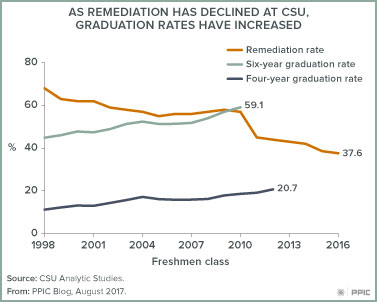
The general decline in remediation indicates that students have become better prepared over time, either in K–12 or through programs like Early Start. Though eliminating remediation will not affect how prepared students are when they start college, there is still reason to believe CSU could see an increase in graduation rates. As PPIC’s study of community college remediation showed, long remedial course sequences leave students many points of exit and can be barriers to success. Indeed, about 13% of CSU students who entered remediation in 2015 failed to complete remediation and were not at the university by their second year. With the end of remediation at CSU, students will have fewer potential exit points, they will be able to earn more college credits in their first year, and many may experience more success in college-level courses due to additional support. These potential benefits could help more students graduate and shorten their time to degree.

In addition to eliminating remediation, CSU is making changes to the Early Start program and course placement policies to further prepare students and help them find the right classes. These changes could help narrow the graduation gap between races. In 2016, only about 18% of white CSU students required some form of remediation, while about half of Latino and about 60% of African American students needed remediation in at least one subject. If these new policies do increase graduation rates, many traditionally underserved students may benefit.

Learn more

Visit the PPIC Higher Education Center
Read the PPIC report Preparing Students for Success in California’s Community Colleges
Regional Action to Boost College Success

California needs 1.1 million more workers with bachelor’s degrees by 2030 to keep up with economic demand, PPIC research has found. Three regions will play an especially critical role in addressing this challenge: Los Angeles County, the Inland Empire, and the San Joaquin Valley.

Improving college enrollment and graduation rates in these regions could help close more than half of this projected statewide skills gap, according to a new PPIC report, Meeting California’s Need for College Graduates: A Regional Perspective. It analyzes the challenges ahead and recommends ways to meet them. At a Sacramento event, report coauthor Kevin Cook summarized the findings and a panel of experts described promising initiatives already underway in these regions. Report coauthor Hans Johnson, director of the PPIC Higher Education Center, moderated the panel discussion.

Panelist Benjamin Duran, executive director of the Central Valley Higher Education Consortium, said his group has created a partnership of public and private colleges and universities, as well as community college districts, from Kern through San Joaquin Counties. One of the consortium’s projects involves improving remedial education, which has traditionally consisted of non-transferable classes that delay—and all too often end—students’ college careers. Under the newer approach championed by the consortium, students deemed underprepared for college work are able to enroll in college-level courses right away but also get supplementary support.

The Central Valley consortium is also working to encourage more students—particularly those in the community colleges—to take 15 units per semester or 30 per year so that more of them graduate on time. “When you’re able to go to school full time, the research is showing that you’re far less likely to drop out—you’re going to finish quicker,” Duran said.

Alma Salazar, senior vice president of the Center for Education Excellence and Talent Development at the Los Angeles Area Chamber of Commerce, said, “We do what all great organizations do—we take someone else’s idea and try to make it better.” The result, she said, is the L.A. Compact, modeled after an effort in Boston. It is a collaboration among area organizations, educational institutions, unions, and local government leaders. The focus is on three goals:

  • All students graduate from high school;
  • All students have access to and are prepared for success in college; and
  • All students have access to pathways to sustainable jobs and careers.

Ken O’Donnell, associate vice president of the Student Success Program Integration and Assessment at California State University, Dominguez Hills, talked about his campus’s success in improving its six-year graduation rate from about 30% to 42% in a few years. O’Donnell echoed the PPIC report, which finds that improving success rates for those already in college will have the greatest impact on the statewide skills gap. “You’ve already improved capacity without adding a single additional seat,” he said.


Learn more

Read the report Meeting California’s Need for College Graduates: A Regional Perspective
Visit the PPIC Higher Education Center

Guided Pathways in Community College

In California and across the country, community colleges are working hard on reforms aimed at increasing college completion, particularly among students historically underrepresented in higher education. Yet many promising innovations have not moved the needle. One reason is that many of these reforms, while innovative, focus on only a small proportion of the student body, or improve only one part of the students’ college experience. As a result, colleges have begun to adopt a more comprehensive institutional reform known as “guided pathways.”

Guided pathways are based on a set of scalable design principles, outlined in the 2015 book Redesigning America’s Community Colleges: A Clearer Path to Student Success. These principles include

  • Helping students choose and enter a program pathway
  • Mapping pathways to students’ end goals
  • Keeping students on path
  • Ensuring that students are learning

Implementation may occur in a variety of ways, but colleges have found it essential to focus on the following areas:

  • Guided exploration for undecided students. This includes clustering hundreds of programs into a handful of broad focus areas. In addition, some colleges offer foundational courses to help students select a major. In some cases, all students enroll in a foundational course within their broad field of interest. Mentored by faculty, students may research different careers, interview or shadow individuals in a particular field, and get a taste of the different competencies within each major while honing their research skills.
  • Clearly delineated program requirements. Cross disciplinary teams of instructional and counseling faculty, staff, and administrators create “program maps” to show the path necessary for labor market success and further education. Students may take elective courses that are not on the program map, but they will also know which courses each program requires.
  • Proactive and integrated academic and non-academic support. When support services are optional, students may fail to identify the services they need or lack the confidence to ask for help. Services can take many forms, from embedding academic support in the classroom to providing specialized counselors. At Guttman Community College in New York City, an entering group of students is split into “houses,” and a team of instructional faculty, counseling faculty, and peer mentors is responsible for each house. Faculty and peer mentors meet regularly to discuss individual student progress, coordinating their actions and communications with each other and the students.
  • Developmental education transformation. Developmental education—also known as remedial education or basic skills—has traditionally focused on courses such as college algebra and English composition. Reforms would create accelerated pathways aligned with a small set of broad programs (e.g., liberal arts, STEM, business, and health). Our recent research has found that the reform efforts happening across the state—for example, as part of the California Acceleration Project—are well positioned to create developmental education pathways that are better aligned to programs of study. PPIC’s ongoing research aims to shed light on the most promising developmental education reforms.

Opportunities for California Community Colleges
The last six months have seen tremendous momentum and support for guided pathways in California. This support has emerged at all levels, including the governor, legislature, the Chancellor’s Office, national foundations, and college faculty and administrators. Last month, with the support of the College Futures Foundation, the Bill and Melinda Gates Foundation, the James Irvine Foundation, and the Teagle Foundation, the Chancellor’s Office awarded grants to twenty colleges as part of The California Guided Pathways Project. Last year, three community colleges in California were awarded the American Association of Community Colleges Pathways grant to assist them with planning and implementing a pathways framework. In addition, the Governor’s Budget proposal for 2017‒18 includes $150 million one-time Proposition 98 funds to support new guided pathways programs in community colleges. Finally, Senate Bill 539, introduced during the 2017 legislative cycle, proposes to use an incentive grant to help establish guided pathways that would boost completion and transfer. Given this wide-ranging support, much can be learned from the experiences in other states and systems. It will also be critical for colleges to conduct deep examinations of how existing college initiatives, such as those involved with the Basic Skills Student Outcomes and Transformation program, can be integrated into guided pathways. In an upcoming blog post, we will explore how developmental education reform intersects with the guided pathways framework..

Testimony: Accurately Assessing College Readiness

Olga Rodriguez, research fellow at the PPIC Higher Education Center, testified before the Senate Education Committee in Sacramento today (April 19, 2017). Here are her prepared remarks.


Thank you for the opportunity to testify this morning. My name is Olga Rodriguez and I am a research fellow at the Public Policy Institute of California. PPIC is a nonpartisan policy research organization and does not take positions on legislation. My comments are based on research we have conducted at PPIC on California’s community colleges.

As you heard during last month’s remediation hearing, every year, California’s community colleges identify hundreds of thousands of students as not ready for transfer-level courses in math and English. Since these courses are required to transfer to a four-year college, students deemed underprepared are placed in developmental (also known as remedial or basic-skills) courses to prepare for college work. These placement decisions have profound effects: a sizeable portion of students in remedial classes never earn a degree or certificate, or transfer to a four-year college. Our study finds that 80% of entering students take at least one developmental course in math, English, or both, and most of those students never complete a college-level math or English course.

Despite the critical role of assessment and placement, there is little clarity about how colleges across the state assess and place students into math, English, and English as a Second Language (ESL) sequences. Prior studies conducted in California relied on a small sample of community colleges and examined policies in place before 2010. To help fill this information gap, in spring 2016 we surveyed all 113 community colleges in the state; 82 of the colleges participated in the survey. They reported on the assessment and placement policies used to place students into transfer-level math and English as well as the highest level of ESL during the 2014–15 academic year. The broad goal of the survey is to provide policymakers and practitioners with a descriptive landscape that will improve understanding of the policies used across the state to assess and place students into math, English, and ESL courses, prior to the implementation of reforms associated with the Common Assessment Initiative. I describe our findings below.

  • First, colleges vary in how they identify college-ready students. We find that the use of assessment tests is widespread; 100% of colleges reported using assessment tests for math, English, and ESL placement. However, there is variation in the types of tests used and how they are used. Over half of colleges used the Accuplacer for placement into math and English courses; the Compass, which was taken off of the market last November due to poor predictive validity, was the most commonly used assessment test for ESL (33%), and was used by over 20% of colleges for math and English. It is very important to note that even when colleges use the same test, they apply different rules for the minimum scores that qualify as college ready. For example, while more than half of colleges reported using the Accuplacer test to assess college readiness in math, cut scores ranged from 25 to 96 out of 120. A student with a score of 58 (the median score used by colleges) would be deemed college ready at half of these colleges, but not at the other half. The lack of consistency means that access to college courses—credit-bearing courses that students need in order to transfer to four-year colleges—is determined not only by students’ performance on the test, but also by the policies at the college where they enroll. This wide variation may be especially challenging for the 40% of students who eventually enroll in more than one community college campus, as they could be deemed college ready at one college but referred to remediation in another. These policies end up undermining opportunities to transfer between campuses and provide mixed signals about what it means to be ready for college-level courses. Furthermore, assessment and placement practices have implications for equity. Students of color are more likely to attend colleges that set higher math cutoff scores, which means these students have less access to the math classes they need to advance.
  • Second, the use of multiple measures continues to be sparse and unsystematic. In California, the use of other measures in addition to placement exams (known as multiple measures) is mandated by law—in fact, research shows that measures such as high school achievement data do a comparable or better job at predicting college success. But while assessment tests were standard practice, there was substantial variation in the types of other measures used across colleges and across subjects. We find that the majority of colleges used additional criteria to determine placement into math (94%) and English (90%), but just over half did so for ESL (52%). Colleges used, on average, three measures to assess and place students in English and math courses, and two measures to assess and place students into ESL courses. Additional measures included high school GPA, grades in prior English and math coursework, results from the Early Assessment Program (EAP), and counselor or instructor recommendations, among others. Overall, the use of high school records was more common for math and English, but much less so for ESL. In addition, while some colleges used multiple measures in a systematic way for all students, up to 30% of colleges only used multiple measures if students requested it or challenged their placement. Uneven implementation of multiple measures may aggravate inequities if students with cultural and social capital are more likely to take advantage of these policies.
  • Third, assessment and placement in ESL needs more attention. Each year, about 30,000 students (6% of incoming community college students) enroll in ESL, and these students may be especially disadvantaged by current policies. Compared to English and math, in ESL, fewer colleges offered exemption opportunities (28% offered none at all in ESL vs. 4–5% in English and math) and test preparation activities (40% offered practice tests in ESL vs. 70–74% for English and math). Additionally, our findings suggest that a lower proportion of colleges used high school achievement data for ESL placement, indicating that English Learners may not be benefitting from one of the most promising methods of improving placement accuracy.
  • Finally, ongoing reforms aim to promote more consistent and accurate placement policies. With the support of the governor, the legislature, and the system office, a significant amount of resources have been devoted to improving assessment and placement at community colleges. The Common Assessment Initiative, for example, will establish a shared assessment system. Our survey finds that over 80% of colleges reported having discussions about the Common Assessment Initiative for English and math; just under 80% of colleges did so for ESL. Still, colleges will have the autonomy to set their own rules for placement, and that’s a cause for concern if the inconsistencies described above continue. The Multiple Measures Assessment Project (MMAP) is a collaborative effort led by Cal-PASS Plus and the RP Group to support colleges in implementing multiple measures in a more consistent and effective way. About half of colleges reported having discussions about multiple measures, and those that did frequently did so as part of their participation in the MMAP. Collaborative efforts such as this one can help ensure consistent placement policies across the state’s community colleges.

In sum, assessment and placement policies should help students reach their academic goals—not stand in the way of those goals. As colleges work to enhance the efficacy of developmental education, implementing evidence-based practices that accurately assess students’ college readiness will be critical. A more equitable and efficient system for assessment and placement is a vital step in helping all students achieve their academic goals.

Equity and Remedial Education at Community Colleges

PPIC research has shown that students from groups that are historically underrepresented in higher education are more likely to take a remedial—or developmental—course at some point in their college career. Our research also shows that these students are less likely to complete a college-level course in math or English—and less likely to meet their educational goals. At a time when California faces a shortfall of college-educated workers, this has profound implications for the state’s future. Given that more than half of Latinos and African Americans who pursue higher education attend community college, policymakers need to focus on closing access and achievement gaps.

A recent PPIC report found that 87% of both Latino and African American community college students took at least one developmental math or English course, compared to 70% of Asian and 73% of white students. Likewise, 86% of recipients of fee waivers from the California Community Colleges Board of Governors (BOGW) or Pell Grants—our proxy for low-income status—took at least one developmental math or English course.

A closer look reveals that Latino, African American, and low-income students are likely to be placed in developmental education at lower levels than other groups of students. This requires students to take a longer sequence of developmental courses—up to four semesters’ worth—and dramatically alters college trajectories. African American and Latino students make up 61% of students who enter the developmental math sequence four levels below college ready, but only 41% of students who begin one level below. Similarly, the share of low-income developmental math students who start four levels below college ready (82%) is significantly higher than the share that begin one level below (64%). This means that Latino, African American, and low-income students are more likely to spend valuable time and financial aid on courses that do not count toward a degree or transfer.

Equity issues are apparent not only in students’ participation in developmental education, but also in their outcomes. When we examine the completion of college-level math and English courses among students who started out in developmental education, we find that rates are lower for most underrepresented groups. For example, 39% of Asian students and 30% of white students who took a developmental math passed a college-level math course, compared to 24% of Latino and 14% of African American students. The same pattern holds true for English, where 59% of Asian students and 49% of white students successfully completed a college-level English course, compared to 42% of Latino and 28% of African American students. However, low-income students who enrolled in developmental education courses completed college-level courses (26% math and 45% English) at about the same rate as developmental students overall (27% math and 44% in English).

It is also important to look at the assessment and placement policies that place students into developmental courses. Our research found that these policies vary widely across the state’s 113 community colleges. As a result, some Latino and African American students may be enrolling in developmental education at higher rates, especially in math, simply because they attend colleges that set higher cut-off scores for placement into college courses.

Our recent findings suggest that developmental education, which is intended to help students succeed in college, may actually be contributing to college achievement and completion gaps. A multipronged approach that improves developmental education courses and streamlines assessment and placement policies can lead to more equitable student outcomes.

Learn more

Read Preparing Students for Success in California’s Community Colleges
Read Determining College Readiness in California’s Community Colleges: A Survey of Assessment and Placement Policies
Visit the PPIC Higher Education Center

Improving College Placement Policies

Assessment and placement policies govern where students begin their college trajectory. This is a high-stakes issue for students, affecting how quickly they achieve their educational goals. Too often, it affects their likelihood of reaching these goals at all. Students who are placed in developmental, or remedial, courses end up spending significant portions of their limited financial aid packages—and sometimes take on debt—to pay for courses that don’t usually count toward a degree.

Findings from a PPIC survey on assessment and placement policies show that California’s community colleges vary in how they identify college-ready students. First, colleges use different assessment tests. Second, even those that use the same test apply different cut-off scores, which are the minimum scores that a student must get to be designated college ready. While over half of colleges reported using the Accuplacer test to assess college readiness in math, cut-off scores ranged from 25 to 96 out of 120. Students with the median score of 58 would be deemed college ready at only half of these colleges, while at the other half, they would be placed into developmental math. This lack of consistency means that access to transfer-level courses is determined not only by students’ performance on the test, but also by placement policies at the institution where they enroll.

Unfortunately, there’s no easy fix to this problem, as opposing forces are at play. On one hand, the current approach of setting local assessment and placement policies allows for considerable academic freedom and institutional autonomy, giving colleges flexibility to respond to the local needs of the population they serve. This is particularly important for placement into developmental coursework, the structure of which varies significantly across colleges. On the other hand, locally determined cut-off scores into transfer-level courses lead to inconsistent standards and can send a confusing message to high schools around the state about what it means to be college ready.

Accordingly, placement into transfer-level courses should be uniform across the community college system. Having clearer and more uniform policies for accessing introductory transfer-level courses (e.g., college composition, college math, and statistics, among others) is critical because these courses are considered equal in the eyes of four-year institutions accepting them for transfer. Variation in the standards used to access these courses dilutes this presumed equality.

California State University (CSU) presents a compelling case study for a statewide system that has consistent assessment and placement policies for determining college readiness. Across the 23 universities in the CSU system, a common assessment and common cut-off scores are used for placement into transfer-level math and English. Yet individual campuses maintain flexibility regarding how they structure developmental education sequences and placement into these courses.

Systemwide assessment and placement policies at California’s community colleges could yield multiple benefits:

  • Eliminating barriers for students who transfer from one college to another. Clear and uniform policies for accessing transfer-level courses would begin to make students’ assessment results more portable across colleges, especially those in the same region.
  • Improving programs and support for students in developmental education. Currently, the lack of comparable data across colleges has prevented the system from measuring the effectiveness of interventions designed to increase student success in developmental education.
  • Sending a clear message to high schools about college readiness standards at community colleges. This would be akin to the uniform policy used by high schools and colleges across the state to determine college readiness as part of the Early Assessment Program (EAP).

Continuing to let community colleges determine placement into developmental education while standardizing placement policies into transfer-level courses will preserve local autonomy and help to bring about the benefits that come with systemwide uniformity.

Learn more

Read the report Determining College Readiness in California’s Community Colleges: A Survey of Assessment and Placement Policies
Visit the PPIC Higher Education Center

Commentary: Boosting Success in Community College


This commentary was published in EdSource on December 8, 2016

Most students entering California’s community colleges – especially Latino, African American and low-income students – start their college journey in remedial courses in math, English or both. These courses seek to prepare students for college-level work. But remedial education, also known as developmental education, is lengthy, attrition is high and outcomes are poor.

Read the full commentary on edsource.org.

Preparing Community College Students for Success

Each year hundreds of thousands of students entering California’s community colleges are identified as unprepared for college work and placed in remedial courses, also known as developmental education courses. Colleges vary widely in the way they assess and place students—for example, even colleges that use the same test base their placement decisions on different cut-off scores.

The impact of remedial placement is profound. Most students who enroll in a developmental education class never go on to earn a certificate or degree or transfer to a four-year college. Latino, African American, and low-income students are overrepresented in these courses, raising equity issues at the colleges—the entry point to higher education for most students in the state.

Two PPIC reports document the state of developmental education in California and examine the reforms that have been adopted to change it. Olga Rodriguez, PPIC fellow and coauthor of both reports, presented the findings at a briefing in Sacramento last week, followed by a panel discussion of higher education experts moderated by coauthor Hans Johnson, PPIC senior fellow and director of the PPIC Higher Education Center.

Panelists included Mónica Henestroza, higher education advisor for Assembly Speaker Anthony Rendon; Myra Snell, math instructor at Los Medanos Community College and cofounder of the California Acceleration Project; and Theresa Tena, vice chancellor of institutional effectiveness in the California Community Colleges Chancellor’s Office.

The three panelists emphasized the widespread recognition that reform is needed and under way.

Henestroza said the PPIC reports underscored what she hears directly from students—that they are being sidetracked from pursuing their career goals by developmental education. She also said that the savviest students know that it’s easier to pass placement tests at some colleges than others.

Snell said that when looking at the wide variation in college placement policies and the large numbers of students placed in developmental education, many mistakenly blame high schools for not preparing students. “Really, what we’re beginning to understand is that our definitions of preparedness are problematic.”

She said that student scores on Accuplacer, a commonly used placement test, are not a reliable predictor of college success. Colleges making robust use of multiple measures—including, for example, previous high school work—in placement decisions are seeing higher student success rates, she added.

Snell also pointed to promising reforms elsewhere. Tennessee, for example, enrolls students directly into college-level courses and providing remedial support where it’s needed. In other words, she suggested, reform efforts should focus on bypassing developmental education altogether.

Tena noted that colleges are implementing redesigned courses in developmental education that are intended to improve student outcomes. PPIC is currently conducting research to evaluate these new reforms.

Learn more

Preparing Students for Success in California’s Community Colleges
Determining College Readiness in California’s Community Colleges: A Survey of Assessment and Placement Policies
Visit the PPIC Higher Education Center