Wastewater Treatment Kills Most Pathogens, Including COVID-19 Virus

[vc_row][vc_column][vc_column_text]Californians reuse treated wastewater as a water supply, to irrigate crops, and to support freshwater ecosystems. To get answers to questions about managing the new coronavirus in the “sewershed,” we talked to two experts: Kara Nelson, an expert in waterborne pathogens at UC Berkeley; and Adam Link, executive director of the California Association of Sanitation Agencies.

PPIC: What risks does COVID-19 virus pose in wastewater?

Photo - Kara Nelson
Kara Nelson

KARA NELSON: We now have evidence that infectious coronavirus is excreted in the feces of infected individuals. The good news is that in the US, we already assume wastewater is full of high concentrations of infectious organisms like viruses, and we have practices in place to deal with them—including ways to protect workers from exposure. Coronaviruses have a different structure from the viruses we usually worry about in wastewater, such as hepatitis A and norovirus—and that structure likely makes it easier to kill. This gives us a high degree of confidence that we have effective treatment to manage the COVID-19 virus. So yes, there are risks, but all the information we have suggests that our existing practices reduce the risk to very, very low levels.

PPIC: Is the virus a risk in the reuse of treated wastewater?

KN: Producing safe, reusable water from wastewater already requires removing pathogens from it. While existing treatments—which are based on science and a regulatory approach developed over many decades—are likely sufficient to deal with coronavirus, we would like to see research that confirms this. Studies have already been launched in California and elsewhere to ensure measures we have in place are sufficient.

The heightened public interest in the virus provides professionals in the water industry an opportunity to share information about why reusing treated wastewater is safe and why we have a very high degree of confidence on how these risks are being managed.

PPIC: What’s the story with “flushable” wipes?
Photo of Adam Link, California Association of Sanitation Agencies
Adam Link

ADAM LINK: This was already a significant issue for us, and the pandemic has brought a huge new influx of wipes and cleaning-product debris into the system. Some wipes are marketed as flushable but don’t actually break down the way toilet paper does. They can sometimes form sizeable sewage blockages that damage pumping infrastructure, cause overflows, and increase our capital costs. CASA and many of our members are engaged in public information campaigns on the problem. Our agencies are working around the clock to keep systems functioning properly and prevent major breakdowns.

PPIC: Do you foresee any long-term impacts from the pandemic for the wastewater sector?

AL: In some ways we are similar to a business, and we have to think about the potential financial impacts of a recession on our systems. There are new orders to not terminate service if payments don’t come in, and we’re likely to see more people who struggle to pay their bills as a result of the financial downturn. So we need to put thought into planning for a new financial future. Our agencies are very good at long-term planning for capital projects, but it remains to be seen how dramatically this will change things from our current expectations. Much depends on the level of stimulus and how quickly things get back to normal.

PPIC: What gives you hope right now?

KN: The agencies and their workers—they’re putting their responsibility to deliver essential services first, before themselves, just like health care workers.

I’m also impressed with how quickly the research community has responded with new research on coronavirus and water. Therapies, tests, and vaccines are obviously the immediate priorities, but water researchers around the world have kicked into high gear to find long-term strategies to fight this and other emerging viruses. One exciting development is a global effort to monitor wastewater for the virus to quickly assess its prevalence in the sewershed; this could potentially help determine if infections are reemerging so we can respond quickly to contain them.

AL: I’m very encouraged by how well our agencies have come together to solve the new problems the pandemic raises and prepare for the worst together. There haven’t been any significant disruptions—and that’s thanks to the lengths these people go to keep the public safe.[/vc_column_text][/vc_column][/vc_row]

The LA River and the Trade-Offs of Water Recycling

This is part of a series on issues facing California’s rivers.

After a very wet winter, California has been declared drought free. But planning for future water shortages has continued. In Los Angeles, Mayor Eric Garcetti recently announced a goal of 100% wastewater recycling by 2035 to help make city supplies drought proof.

While recycling wastewater helps cities adapt to a changing climate and prepare for droughts, it can have unintended consequences for local watersheds. In some cases, the growing use of recycled water could minimize or even eliminate flows from wastewater treatment plants into local rivers and streams and reduce ecological and recreational benefits. The Los Angeles River exemplifies this kind of trade-off: expanded water recycling will reduce the amount of treated wastewater flowing into this increasingly revitalized urban waterway.

The lower stretch of the river, which was converted into a concrete flood channel in the mid-1900s, is changing. Concrete has been removed from large stretches of the river and public parks and bike paths have been built along its banks, encouraging recreational use and increasing public interest in the river’s restoration. The river was declared a navigable water in 2010 and opened to kayaking the following year. It provides a vital refuge to a variety of riparian species that lost most of their habitat to channelization and urban development.

Last year, researchers from the Southern California Coastal Water Research Project (SCCWRP) launched a study to document the effects of reductions of treated wastewater on vulnerable species and habitats along the highly urbanized, 45-mile stretch of the lower river, as well as on recreational uses of the river. One of the project’s goals is to determine how these impacts could be offset by investments in river restoration and upstream mitigation projects.

The SCCWRP researchers plan to develop recommended seasonal flow targets for each section of the LA River. They will consider the balance between protecting the river’s ecological and recreational uses and local agencies’ desire to capture, divert, and recycle more water in the watershed. The study will also help inform a number of planning efforts, including One Water LA and the LA River Revitalization Master Plan.

Eric Stein, principal scientist with SCCWRP, emphasized that the project’s success is dependent on its collaborative nature. “We are bringing together agencies, municipalities, nonprofit organizations, and community groups to help explore alternative future scenarios and find innovative ways to balance potentially competing demands for water in the LA River,” he said.

The LA River watershed is only one example where a conflict between recycled water investments and downstream users is emerging. As the demand for recycled water grows and local agencies consider new projects, other watersheds could benefit from similar efforts to better understand the impacts of water recycling on the local ecology and downstream users.

California’s Growing Demand for Recycled Water Has Ripple Effects

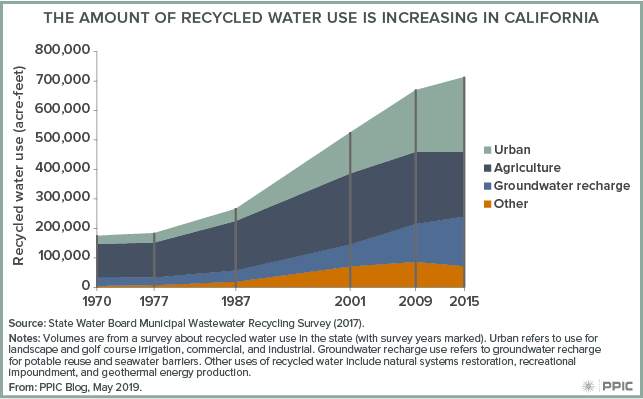
Wastewater agencies produce highly treated water that is increasingly being reused as a water supply. While it’s still only a small portion of overall water use, the use of recycled water has nearly tripled since the 1980s―and is continuing to rise as water agencies seek to meet the demands of a growing population and improve the resilience of their water supplies.

Recycled water production is closely related to water use and wastewater management. It also directly influences flows for ecosystems and downstream water users in some watersheds. As its use expands, weighing the trade-offs involved will help avoid conflict. Meeting current and future demands requires careful consideration of several issues, including the impact of water use on wastewater management, changing types of demand for recycled water, and the needs of ecosystems and downstream users.

Recycled water production is affected by reductions in water use. In other words, recycled water is not completely “drought proof.” The drought of 2012‒16 provides a clear example of this. The rapid reduction of urban indoor water use in this period resulted in a reduced quantity and quality of wastewater for most of the state’s wastewater agencies. In a survey conducted by the PPIC Water Policy Center, just over 40% of wastewater agencies that recycle wastewater reported that their ability to produce recycled water was impaired during the drought. The long-term efficiency of water use and related declines in wastewater quality may also affect recycled water production in the future. For example, as households become more water-efficient, the wastewater they discharge to sewers can have higher concentrations of salts, which are not removed in most treatment processes. Saltier water may not be suitable for outdoor irrigation of golf courses or lawns—common uses of recycled water. If this issue grows in severity, agencies may be forced to incorporate desalination into wastewater treatment, which is likely to add cost and complexity.

Demand for recycled water is growing and changing. Recycled water is increasingly being used in urban areas for public landscape irrigation, golf courses, industrial cooling, and groundwater recharge. Replenishing sources of drinking water is the biggest growth opportunity for water recyclers. New state rules allowing replenishment of groundwater and surface water storage with recycled water—and eventually the direct connection of recycled water to drinking water infrastructure—will create opportunities for recyclers to cost-effectively meet growing demands well into the future. This will require close coordination between water suppliers and wastewater agencies. Some wastewater agencies will also need to increase their treatment capacity to meet the higher water quality standards required for potable reuse.

figure - The Amount of Recycled Water Use Is Increasing in California

Expanding use of recycled water may reduce flows of treated wastewater in rivers, streams, and estuaries. Treated wastewater is an important water source for some ecosystems and downstream water users. Watersheds where wastewater makes up a significant amount of the flow that supports ecosystems and downstream users are especially vulnerable to conflict. For example, a proposal to increase the use of recycled water in Coachella Valley would decrease flows to the already shrinking and vulnerable Salton Sea. Managing recycled water so that it avoids harm to ecosystems and downstream users will require additional collaboration and thoughtful planning.

Closer coordination between wastewater agencies and water suppliers can help minimize impacts from changing patterns of water use on wastewater quantity and quality. Regional planning can also help agencies make smart recycled-water investments that take advantage of opportunities to more directly replenish drinking water supplies. New projects should be based on a careful consideration of local demands and costs, and also how well the investment fits into the overall regional supply of water for both human and environmental uses. Taking such steps now can help water managers in this growing sector make the most of this once-maligned resource.


Video: Managing Wastewater in a Changing Climate

California’s wastewater sector plays a key role in protecting public health and the environment. It is also the source of recycled water—a growing part of the water supply. But as climate change increases the risks of water scarcity and creates other new challenges, the sector is at a turning point. A recent event brought together PPIC researchers and a panel of experts to explore how wastewater management can adapt to a more volatile future.

Caitrin Chappelle, associate director of the PPIC Water Policy Center, outlined findings from a new report on climate risks to the sector and strategies needed to manage them. She noted that drought—as well as ongoing efforts to conserve water—can have unintended consequences for the sector. Less water flowing into treatment plants affects treatment processes and can harm infrastructure. Less treated water flowing out of these plants reduces supplies for downstream users, ecosystems, and recycled water uses.

Chappelle noted that cooperation is a key strategy for building resilience: “Local wastewater agencies will need to work closely with one another, with water supply agencies, and with the state to build a more resilient future.”

Identifying tradeoffs and understanding the unintended consequences of water conservation and the use of treated wastewater are key to developing good policy, noted the panel’s moderator, Kurt Schwabe, a professor at the University of California, Riverside, and an adjunct fellow at the PPIC Water Policy Center.

The three panelists—Jelena Hartman of the California State Water Board, Adam Link of the California Association of Sanitation Agencies, and Nina Hawk of the Santa Clara Valley Water District—discussed the interactions between water use and wastewater, lessons learned from the latest drought, and ways to improve coordination and information sharing with water suppliers going forward.

Hartman noted that with the 2012‒16 drought emergency behind us, “it’s a good opportunity to talk about what worked, what didn’t work” for managing future low-flow situations. “We need to plan, adapt, and be prepared, because the next drought will come,” she added.

Hawk said her agency is fully behind efficient water use but also recognizes that conservation can have impacts on wastewater management and recycled water supplies. “We really have to step back and take a planning look at it,” she said. Collaboration between water suppliers and treatment agencies is key to managing wastewater for multiple uses, she noted.

Link highlighted the difficulty in planning for future capital improvements for both sanitation and recycled water in a changing climate. “If you’re not sure how low your flows will go, how do you plan for a plant that will be useful 30 years from now?” This may require more creative planning for capital investments to ensure that new infrastructure is flexible enough for changing conditions—for example, connecting recycled water plants to groundwater and surface storage to help them weather drought.

We invite you to watch the video from the event.


Drought Watch: Regional Solutions

This is part of a continuing series on the impact of the drought.

Across California, local water agencies are scrambling to apply for new state matching grants authorized under February’s emergency drought legislation. The program aims to accelerate the use of remaining state bond funds for integrated regional water management: activities in which local agencies team up to generate mutual benefits. One example—water suppliers and stormwater agencies that work together to incorporate captured stormwater into local water supplies. Such projects can simultaneously enhance water supply reliability and the quality of water in rivers and coastal areas.

Regional integration has already led to some significant successes, most notably the enhanced ability of urban water suppliers in Southern California and the Bay Area to cope with the current drought. Successes include ramping up water conservation and recycled wastewater storage to increase supplies in storage, and building new connections between local water systems to enable emergency sharing. Outside funds are often needed to jump start these collaborations, both to encourage innovation and to enable some partners—such as stormwater agencies – to participate even if they don’t have the necessary funds.

But as we showed in our study Paying for Water in California, integrated regional water management is on the brink of fiscal failure because state bond funds are running out. Both the legislature and local water agencies have pushed the idea that bonds should continue to provide these dollars, and the major bond proposals under consideration include substantial new funds for this purpose.

But there might be a better way: adding a small statewide surcharge on water use to support regional projects. Local water agencies have often rejected this idea, arguing that if they send money to Sacramento they won’t see it again. But what if the funds go directly to the regions?

Here’s how we think this could work. The legislature (or state voters) would pass the surcharge and set broad criteria for funding eligibility. The funds would be apportioned to the state’s 12 principal hydrologic regions—the large basins that are already used to divvy up bond funds. But rather than having state agencies award the grants, this task would go to new Regional Water Commissions—regional counterparts to the California Water Commission, the state body tasked with awarding matching grants for storage projects under most bond proposals.

Though more politically tricky to pass than a bond, the statewide water surcharge would have numerous advantages. The revenues would be more reliable than bond funds. And relying on Regional Water Commissions to allocate these dollars could encourage broader collaborations than we have seen from the state-sponsored grant program, which has nearly 50 planning regions, often too small to reap the real benefits of integration. Many groundwater basins, for instance, have different boundaries than the current planning regions, and groundwater agencies could use assistance from these regional funds to support better management.

Finally, this statewide option is preferable to creating local or regional surcharges, which can be difficult to raise without approval of two-thirds of local voters. To raise $200 million annually—the amount that’s been available through bonds—a surcharge 7.5 cents/1,000 gallons on urban water bills would suffice. This would increase the average cost of tap water by just 2.8 percent, while creating a valuable incentive fund that helps local water managers enhance the quality and reliability of regional water supplies. As part of a package with a new bond devoted to areas of true statewide need, a statewide water surcharge would help ensure that our water system can support a healthy economy, society, and environment.