Commentary: How Better Wastewater Management Can Help California Adapt to Climate Change

This commentary was published on CALmatters on May 9, 2019.

Our public health relies on wastewater management to treat sewage and remove pollutants coming from our homes and businesses.

This system is fundamental to protecting our health. In California, treated wastewater also is a critical source of water for the environment, and, increasingly, a source for recycled water. Climate change is worsening water scarcity and flood risks. Advancements in engineering and technology can help prepare wastewater agencies for a changing climate. But significant shifts in policy and planning are needed to address these challenges.

Wastewater agencies must reliably remove pollutants even as the quantity and quality of the water they treat declines during droughts, and when large storms push their equipment to the breaking point.

In February, an atmospheric river storm—the type that is expected to become more common as the climate warms―inundated Healdsburg’s wastewater treatment facility and pushed more than five times the normal flow of wastewater and runoff into Santa Rosa’s treatment plant.

In a drought, reduced flows to wastewater plants can hamper agencies’ ability to comply with treatment standards, damage equipment, increase costs, and shrink revenue. Lower inflows also reduce the volumes available for recycled water, often considered a “drought-proof” supply.

The drought of 2012–16 brought all of these problems to the fore. Many wastewater agencies are now changing their operations, infrastructure, or finances in response to the challenges they experienced. Our new study recommends sector-wide changes in three areas to help build the sector’s climate resilience:

  • Maintain water quality in the face of reduced indoor water use. Short-term water conservation during droughts and longer term reductions in water use from indoor efficiency measures challenge wastewater management. All wastewater agencies should assess their vulnerability to major climate pressures, and plan for future droughts. Better coordination and information sharing with suppliers about indoor water conservation and efficiency efforts are also key.
  • Make smart recycled water investments. Coordination among wastewater and water supply agencies is needed to address the demand for recycled water. Regional planning for recycled water projects can result in investments that are more responsive to changing water use and an increasingly volatile climate, bringing financial and environmental benefits.
  • Balance conflicting objectives within watersheds. Many wastewater treatment plants discharge treated water into inland watersheds.

Meeting increased demand for recycled water may fuel conflict over the use of treated discharge to support ecosystems and downstream users. Rivers and streams are expected to experience lower flows and higher temperatures, which will heighten threats to aquatic ecosystems. Resources are needed to identify areas most at risk of conflict over the use of treated wastewater, and to develop tools to evaluate the impacts of water recycling projects on the environment and downstream water users.

The state can help wastewater managers make these adaptations, which are critical to building a more integrated and resilient water system. The State Water Board should align its policies on water use, wastewater, recycled water, and environmental protection to better manage for these multiple objectives.

Forging new partnerships to tackle the full range of climate-related risks will help wastewater agencies determine the best adaptations and improvements needed to prepare wastewater management—and California’s water system as a whole—for a more volatile future.

 

Divided Views on Charter Schools and School Choice

Nearly three decades after California started authorizing charter schools, state lawmakers have renewed the debate over their rules and regulations. Today, there is a package of bills aimed increasing charter oversight moving through the legislature, and the governor has taken steps to address related issues. As the debate continues, the PPIC Statewide Survey has taken an in-depth look at Californians’ views of charter schools and school choice.

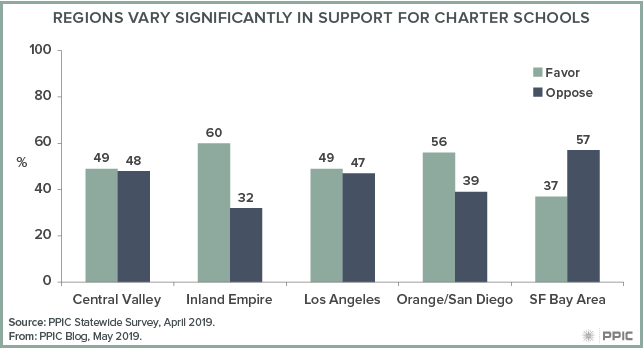
PPIC’s latest survey on K–12 education finds that Californians have mixed views on charter schools overall (49% favor, 46% oppose). Differences across regions and demographic groups are particularly notable. For example, half of Latinos (51%) and whites (50%) are in favor of charters in general, compared to fewer Asian Americans (43%) and African Americans (36%). Regionally, majorities in the Inland Empire and Orange/San Diego are in favor, while those in the Central Valley and Los Angeles are divided; a majority of San Francisco Bay Area residents are opposed.

figure 1 - Regions Vary Significantly in Support for Charter Schools

Looking more closely at charter school issues further highlights regional and racial/ethnic differences. On the question of transparency and accountability, overwhelming majorities across racial/ethnic groups say it is important for charters to operate with the same standards as traditional public schools. This includes 87% of Asian Americans, Latinos, and whites, and 72% of African Americans.

When it comes to charters taking away state funding that would otherwise be available for traditional public schools, seven in ten Los Angeles residents (71%) say they are concerned, compared to about six in ten in the Inland Empire (65%), San Francisco Bay Area (63%), and Orange/San Diego (62%); over half in the Central Valley (55%) express concern.

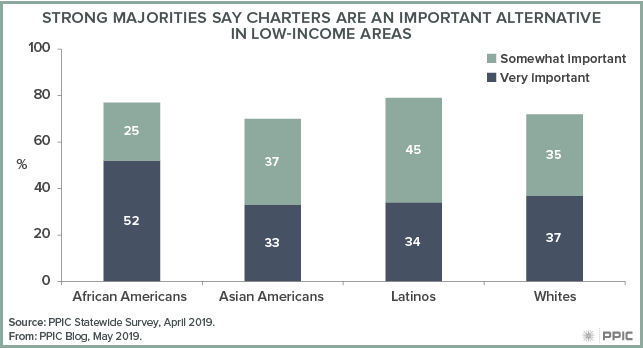
With respect to school choice, African Americans (52%) are much more likely than whites (37%), Latinos (34%), and Asian Americans (33%) to say it is very important for parents in lower-income areas to have the option of sending their children to charters instead of traditional public schools.

figure 2 - Strong Majorities Say Charters Are an Important Alternative in Low-income Areas

Earlier this year, Governor Gavin Newsom commissioned a task force to examine the impact of charter school growth on district budgets. He also signed legislation requiring the state’s 1,300-plus charter schools to follow the same transparency laws that apply to public school districts. As these policies play out, the PPIC Statewide Survey will continue to track Californians’ concerns and preferences on charter school issues.

Exploring Math Pathways under Common Core

California adopted the Common Core State Standards (CCSS) in math and English in 2010. CCSS describes what students should know in math and English by the end of each grade. These standards also prepare students to be ready for college and beyond. Nearly nine years after its adoption, awareness of and support for CCSS remain strong among Californians. What do we know so far about the reach and effectiveness of this change, particularly in math?

One of the paradigm shifts introduced by CCSS is how math is organized and taught in high schools. CCSS standards are organized into two pathways:

  • Traditional, which follows the standard sequence and includes Algebra I, Geometry, and Algebra II.
  • Integrated, which consists of Mathematics I, II, and III, with each course containing standards from all conceptual categories. For instance, Mathematics I covers topics in numbers, algebra, geometry, and statistics.

Acceleration, which gives students the opportunity to reach higher-level math such as calculus earlier, is possible in both pathways. For instance, a 9th grade student may complete 9th grade math (Algebra I or Mathematics I) and 10th grade math (Geometry or Mathematics II) concurrently. Districts can decide when and how students may accelerate.

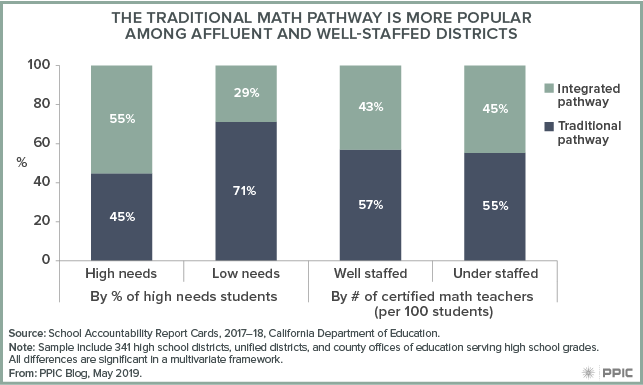
During the 2017–18 school year, 54% of districts followed the traditional pathway while 46% percent chose the integrated pathway. Significant and important differences in these choices exist across districts. Districts with more high-need students—low-income students, English learners and/or foster youth—were more likely to adopt an integrated model; districts with more certified math teachers, who are authorized to teach both pathways, were slightly more likely to choose the traditional pathway.

figure - The Traditional Math Pathway Is More Popular Among Affluent and Well-staffed Districts

Does the difference suggest that students in high-need districts may be left behind? Not necessarily. There was no significant variation based on student performance, such as the a-g completion rate. In addition, staffing, which tends to be worse in high-need districts, did not drive most of the differences in those decisions. Other factors, such as district capacity, pedagogical approach, and teaching philosophy may also be at play.

State assessment data does not seem to show any significant difference in student performance based on pathways; however, more formal evaluation is needed. So far, there have been no large scale studies that compare the effectiveness of these approaches. Doing so will require more and better data on a district’s chosen pathway (e.g., the first time these pathways were available) and student outcomes (e.g., postsecondary outcomes)—which the state currently does not collect. The governor’s proposal to create a statewide longitudinal database is a good first step toward building the capacity to evaluate one of California’s signature educational reforms.

Video: English as a Second Language in California Community Colleges

While the educational goals of students who enroll in ESL courses at California’s community colleges may vary, the economic benefits of effective ESL programs are clear: English proficiency can facilitate social and economic mobility for non-native speakers. But little is known about ESL programs across the state, or about the trajectories of ESL students. Now that a new law—Assembly Bill (AB) 705—is motivating colleges across the state to assess and reform their ESL programs, we need to better understand the ESL student population and the programs that serve them.

At an event in Sacramento earlier this week, PPIC researcher Bonnie Brooks outlined the findings of a new report on ESL in the community colleges and a panel of experts discussed AB 705’s impact on ESL in the community college system.

Kathryn Wada, who has taught ESL for 30 years at Cypress College, noted that the fact that AB 705 distinguishes ESL from developmental (or remedial) English and recognizes that ESL students are working toward proficiency in a foreign language is “huge for our field.”

AB 705 requires colleges to reform “credit” ESL programs—which offer credit-bearing courses for which students pay tuition—so that they do not deter or delay educational progress. By fall 2020, colleges must implement policies that maximize the chances that students complete a transfer-level English course within three years.

A look at the length of ESL course sequences across the system indicates that students at many colleges could, theoretically, complete transfer-level English in three years. In reality, however, most students don’t get this far. As Brooks noted, simply offering a sequence that is short enough to allow students to get through transfer-level English in three years “isn’t necessarily enough to maximize the probability of completion.”

Fortunately, many colleges are taking new approaches to ESL instruction that do increase the likelihood of completion. Courses that take an integrated approach—teaching more than one English skill at a time—and policies that allow students to move directly from ESL to transfer-level English instead of requiring them to enroll in developmental courses are likely to be key to fulfilling AB 705’s mandate. And, as Wada noted, new policies that make credits from advanced ESL courses transferable to UC and CSU moves credit ESL programs beyond the goals of AB 705: “If students are able to fulfill CSU and UC general education requirements directly with ESL courses . . . that’s huge.”

These new instructional approaches usher in a new era for ESL students. As Alice Perez, vice chancellor of academic affairs in the California Community Colleges Chancellor’s Office noted, “Many of our faculty and our institutions are set up to receive students assuming a major deficit: ‘You’re not college ready, and this placement test shows us this.’” Melissa Reeve, an English and ESL professor at Solano College, echoed Perez’s call for a “mindset shift,” citing the importance of “all of us having a belief in our students and what they are able to do, and sharing that with them in every facet of what we do.”

Immigrants Are Key to California’s Health Workforce

Governor Newsom’s proposed budget includes more than $85 million to train health care workers—a reflection of the state’s anticipated need to fill over 107,000 new health care jobs every year between 2016 and 2026. This projected increase is due to a growing and aging population, as well as greater access to care under the Affordable Care Act. California’s immigrant population will be an important source of workers in this sector.

In California, nearly one in three health care workers is foreign born, compared to one in six nationwide. This is partly because of the high share of immigrants among California’s working-age population. While immigrants make up about a quarter of all Californians, they are almost a third of working-age Californians—with even higher shares of immigrants among those with less than a high school diploma (49%) or those holding a graduate or professional degree (36%).

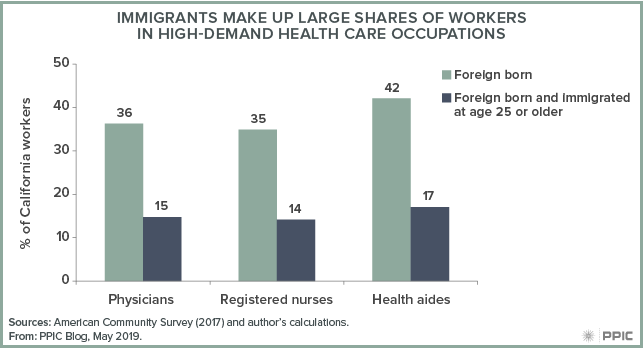
Immigrants also make up a large proportion of California workers in high-demand health care occupations, such as primary care providers (who are particularly needed in rural areas), nurses, and health aides. In 2017, 36% of the state’s physicians and 35% of registered nurses were foreign born. Forty-two percent of California’s nursing, psychiatric, and home health aides were foreign born.

figure - Immigrants Make Up Large Shares of Workers in High-demand Health Care Occupations

As California considers how to train people for these jobs, programs that account for the diversity of immigrants’ educational backgrounds will be important. Many highly skilled immigrant health workers were age 25 or older when they arrived in the country, suggesting that they may have had at least some training abroad. To help foreign-trained health professionals, some California universities already have programs to guide them through the steps necessary to enter the state’s health workforce. Training programs for support roles in health that require less than a four-year college degree are another opportunity that could encourage lower-skilled immigrants to enter the health sector.

Immigrants can also benefit the health workforce in other ways. For example, health care workers who speak languages other than English, as many immigrant workers do, can be a resource for low-income patients facing linguistic barriers to health care access. In the coming years, meeting California’s health care workforce needs will require multiple strategies—but engaging the state’s immigrant population can be a part of the solution.