Improving Equity in Mental Health Services

California has seen historic declines in the number of residents without health coverage—since 2014, the state’s uninsured rate has decreased from 17.3% to 10.3% percent among adults  younger than 65. Expansions in the Medi-Cal program account for most of this expanded coverage; since 2014 enrollment in Medi-Cal has increased more than 50% and now provides coverage to nearly one-third of Californians. However, many challenges remain to ensure that coverage translates into access, particularly in the area of mental health.

Over one million Californians use the state’s public mental health system, which includes services provided through Medi-Cal managed care plans and county mental health plans. For many patients, the system is difficult to navigate. The fragmented delivery system is part of the issue, but there are also concerns that mental health providers are unable to meet the needs of California’s diverse communities—and those needs are notable. In a recent survey, 11.2% of Latinos were identified as likely to have experienced serious psychological distress during the past year.

The disparities in access for underrepresented communities may be reflected by current utilization patterns of county mental health services. Among adult Medi-Cal enrollees, fewer Latinos and Asian/Pacific Islanders use these services than African Americans and whites.
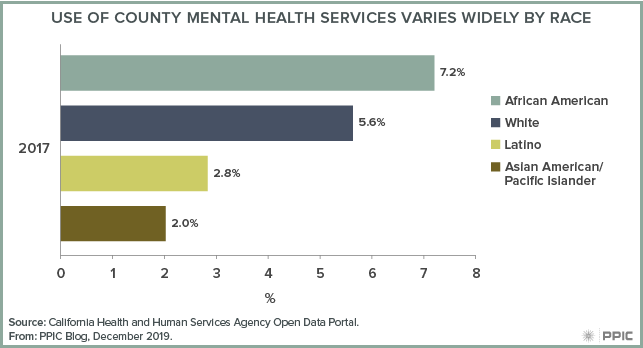
figure - Use of County Mental Health Services Varies Widely by Race

These disparities are similar nationwide—and are likely to be related to a variety of factors. One possibility is the higher share of Latinos and Asian Americans/Pacific Islanders who may experience language barriers, compared to African Americans and whites.

A primary vehicle for reducing these disparities are Cultural Competence Plans, which are intended to guide county mental health plans in meeting the cultural competence and linguistic requirements already mandated by law. Recent legislation seeking to codify these requirements for county mental health plans did not make it past the governor’s desk. But its advancement through the legislature signals growing recognition of the need for communities of color to have access to culturally and linguistically appropriate mental health services. As California’s population becomes more diverse, culturally competent care will become even more important in the coming years.

Better Data for Better California Health Policy

For over a decade, California lawmakers have tried to establish a comprehensive resource on health care costs. Yet a dearth of information still persists among consumers, purchasers, and policymakers. To address this problem, recent legislation allocated $60 million to develop a health care payments database (HPD) for the state. The California Office of Statewide Health Planning and Development (OSHPD) and a stakeholder review committee have held monthly public meetings since March 2019 to guide development.

PPIC is supporting the effort in key ways, in part by describing how an HPD can answer important questions and inform policy decisions.  At the November 21 OSHPD Healthcare Payments Data Review Committee, we presented research scenarios that highlight issues facing California policymakers:

  • How often do patients overpay for prescription drugs?
  • How does increasing consolidation of health care providers (i.e., hospitals acquiring physician practices) impact costs, quality, and patient outcomes?
  • What types of housing interventions are most effective for low-income Californians with severe mental illness?
  • How often do children transition between different types of health insurance coverage and how does it impact their use of preventive services?

We will release our detailed findings in February – including full results from our online survey of California researchers experienced with health care payments data. A sneak peek indicates that these researchers are very enthusiastic about an HPD. Nearly all 50 respondents reported they would likely submit proposals to use the database to investigate topics including: how health care policies impact health outcomes, implications of racial/ethnic disparities and the social determinants of health, as well as health care costs and usage patterns. Researchers also indicated willingness to pay user fees to access the data—an important consideration given that the HPD must be self-sustaining (i.e., not require General Fund support) once in operation.

Several other states operate health care payment databases (often called an All Payer Claims Database or APCD) that support health policy and practice, along with patient decision making. On Colorado’s database, the public can search for prices of common health care services—such as breast biopsies and ultrasounds—across different providers. It also documents how health conditions (i.e., asthma and diabetes) vary over time and across regions, types of insurance, and age groups.

For California’s HPD to be realized, the legislature must act on recommendations from OSHPD and the HPD review committee, due in July 2020. While many hurdles still remain before a California HPD is in operation, substantial investments to support current efforts signal a commitment from the state and stakeholders. By creating the database, the state gains a crucial resource to support evidence-based policymaking. Along with parallel efforts—including the development of a longitudinal database to track student and employment outcomes—California can be one step closer to having the right data to study the state’s most pressing policy issues.