Video: Press Club Focuses on Water

California’s drought has gone on long enough that many of the state’s reporters­—whether or not they cover the environment—have found they need to learn more about how water is managed in the state. The Sacramento Press Club helped close this information gap yesterday by hosting PPIC’s Water Policy Center director Ellen Hanak, who talked about the five things you need to know about water.

One of her points, that there are no silver bullets to solve our long-term water policy challenges, prompted the most conversation. While many reporters in the room may have already understood this, their questions were tinged with hope that there might be some solutions that could help make this drought go away (silver-plated bullets, perhaps?).

What about desalination, one reporter asked? The constraint, noted Hanak, is the cost. Seawater desalination is still a very expensive option for most water agencies. Using recycled wastewater (including to recharge groundwater) is a somewhat cheaper way to get “more water” for parched urban areas. But in some areas—like San Diego and some Central Coast communities—residents are already willing to pay the higher price tag for desalination to improve reliability Hanak said.

Another member of the audience asked about two proposed storage reservoirs, Temperance Flat (Fresno County) and Sites (Colusa-Glenn counties), both of which would be built off-stream in the Central Valley. “Our current system of reservoirs can collect roughly 40 million acre-feet, or about what we use in a year, statewide,” Hanak said. “Our groundwater basins can store at least three times that amount, and they can be recharged.” Hanak noted that storage investments will be needed to capture more water in wet years and make up for the shrinking snowpack. Surface reservoirs provide more flexibility, but groundwater storage is often much less costly. Operating the two types of storage in combination—and putting more drought storage into the ground—is an especially promising approach. “We need to think about managing water as a system.”

Another immutable water fact that Hanak shared is that the situation is hard but not hopeless. California has made steady progress in improving water management and systems, though much remains to be done—especially for maintaining healthy ecosystems and the wildlife they support. Water used to maintain environmental stability has become quite contentious, yet there are some promising stories, including in the Sacramento area. She described how water managers have introduced more natural flows in Putah Creek (a major stream that is part of the greater Sacramento River watershed)—using much less water than nature used to provide—with the result that native fish species are doing much better. This past year, even salmon returned after many decades’ absence.

Good reporting on the current drought, and on longer term water challenges, can help us all gain greater understanding of the highly complex world of water use in the state. We thank the Sacramento Press Club for the opportunity to help take the conversation forward.

ABOVE: PPIC’s Ellen Hanak greets Juliet Williams, Associated Press correspondent and president of the Sacramento Press Club, at the recent Press Club event. Photo: Phil Kampel Photography8.

Video: Water in Silicon Valley

Once a productive farming region, today Silicon Valley is a high-tech hub for the world, and a major driver of the state’s economy. As the valley has transitioned from fruits and nuts to bits and bytes, its water challenges have evolved—along with the approaches to dealing with them.

To explore how the region is coping with the current drought and preparing for future challenges, the PPIC Water Policy Center, with Cal Water and the Silicon Valley Leadership Group, hosted an event on April 24 with local leaders and experts. Ellen Hanak, center director, set the stage with an introductory talk on the statewide drought, opportunities for more water conservation in Silicon Valley, and regional climate-related concerns such as floods and sea level rise.

The mayor of San Jose, Sam Liccardo, brought it back to the local perspective. To achieve its 30% conservation target for 2015, he noted that the city of San Jose is taking innovative small and large steps, including a summer jobs program for youth focused on turf removal and the development of city-wide recycled water re-use system. The mayor emphasized that strong leadership at the local and statewide levels is needed to remove barriers to better-integrated and more advanced water management that can sustain the region through the coming challenges.

A panel of experts then offered wide-ranging views on the current drought, and posed a host of common-sense solutions, from increased public education to greater adoption of proven technologies such as using recycled wastewater to recharge groundwater basins. The impact of climate change on water systems, from increased temperatures to a reduced snowpack, was a major topic, with panelists agreeing that we will need to adjust to a new normal.

The participants were Angela Cheung, deputy operating officer of the Santa Clara Valley Water District; Juliet Christian-Smith, climate scientist at the Union of Concerned Scientists; and David Sedlak, co-director of the Berkeley Water Center at UC Berkeley. The panel’s moderator was Paul Rogers, an environment writer with the San Jose Mercury News and managing editor of the KQED Science Unit. As the drought continues, the PPIC Water Policy Center will be partnering with other local organizations and experts to bring similar conversations to other parts of the state.

Experts Weigh In on Drought Solutions

Along with their morning coffee, readers of Sunday’s Los Angeles Times were treated to an offering of nine bite-sized opinion pieces on solutions to help California better manage droughts. Contributors included representatives of urban and agricultural water agencies, environmental organizations, the private sector, and research institutions. The topics were equally broad. We both participated in this forum, and our two pieces highlight the importance of strategic investments in a couple of key areas: water storage and water accounting systems.

On storage, the message is that we need to think comprehensively about our water system when deciding how to invest the $2.7 billion in state bonds that voters recently authorized for new projects. People often assume that these funds will go to expanding surface reservoirs and tend to forget that storing water underground in the state’s aquifers is often more cost-effective. An especially promising approach to preparing for future droughts and adapting to our warming climate is to manage our storage network as an integrated system. This means putting more water for dry years into groundwater basins, which can free up space in surface reservoirs for summer irrigation needs and the higher flood flows likely to come with a shrinking snowpack.

On accounting, the message is that California has some serious catching up to do to better understand where, when, and how much water is used in different watersheds. This drought has exposed the tremendous challenges in managing scarce supplies because of an antiquated, incomplete, and inconsistent set of water use and water availability measurements. Updating our water accounting systems is a top priority we identified in a recent check-up on how California is faring during this drought. State officials have begun to take up this challenge. But more work is required to make this information sufficiently transparent, consistent, and integrated across the various state agencies and offices that deal with water management to facilitate allocation decisions that benefit the state’s economy, society, and environment during droughts.

Farms that Help Wildlife

When we hear that agriculture accounts for 80% of human uses of water in California, attention often turns to water intensive crops like rice and alfalfa (almonds—a water intensive but high revenue crop—have been much in the news as well). The suggestion is often made that farmers stop growing low revenue crops in order to conserve water. There are many reasons not to dictate what crops to plant. One not often discussed is that some crops that generate low revenues per unit of water may actually have high environmental value, particularly for birds and fish.

California’s freshwater landscape has been transformed, most notably in the Central Valley where less than 5% of native habitat remains. This transformation has reduced the habitat for waterfowl and shorebirds in the region. Land conversion, in conjunction with water resource development, is also the principal cause of the decline of native fishes such as salmon and steelhead.

Yet the very agricultural fields that contributed to the decline of these species may today provide the opportunity to ensure their future.

It turns out that some agricultural fields offer good habitat for both birds and fish. Farmers who flood their rice fields in the winter to help break down rice straw provide valuable wetland habitat for waterfowl and shorebirds that migrate to the Central Valley during the winter. Decades of research have helped develop practices that benefit both farmers and birds.

Researchers at UC Davis and the nonprofit California Trout have recently shown that these same rice fields can be used to rear juvenile salmon, mimicking the habitat that floodplains provided in the past. Thanks to unlimited food availability, juveniles in rice fields grow at three times the rate of those confined to river channels. They can also find their way back to rivers if given the opportunity. Their larger size increases the likelihood of survival as they pass through the Delta and head to sea.

Even alfalfa—much maligned for its high water use and low revenues—has habitat value. Swainson’s hawks—listed as threatened under the state endangered species act—and long-billed curlews make extensive use of alfalfa fields because these fields house their favorite insect and rodent prey. Alfalfa also provides nesting and foraging habitat for many other birds and has been reported to support some of the highest biodiversity among row crops.

There are many other examples of farmers providing valuable habitat for birds and fish. With modest changes in farming practices they can increase the quality and extent of this habitat. This prospect lies at the root of efforts made by the Natural Resources Conservation Service, Central Valley Joint Venture, and TNC Birdreturns, which help farmers improve the value of habitat on working lands. And projects like the Central Valley Habitat Exchange are providing incentives to farmers to set aside lands for wildlife habitat.

Increasing water scarcity and high commodity prices are creating pressure to shift to crops that generate higher revenue per unit of water used—most notably perennial crops like nuts, fruits, and grapes, which generally don’t provide good habitat. This pressure is likely to have the unwanted consequence of reducing the extent and quality of wildlife and fish habitat. Financial and other incentives may be needed to encourage farmers to plant annual crops that have environmental benefits—even if those crops are low revenue and water intensive.

Managing Tough Trade-offs in the Delta

One key source of conflict over the Sacramento–San Joaquin Delta is the competition over who gets to use the water. During droughts, this competition becomes acute, especially when it comes to decisions about how much water flows out to sea versus how much gets exported to cities and farms in the San Joaquin Valley, Southern California, and the Bay Area. New data from the 2014 water year illustrate the tough trade-offs California faces.

Those seeking more exports sometimes perceive the water flowing out of the Delta as “wasted to the sea.” But it is important to remember that these outflows, which are counted as water for the environment, serve two distinct purposes:

1) By pushing back seawater, outflows keep Delta water fresh enough for urban and farm uses.
2) Outflows also support habitat for endangered fish species.

Although the flows in the first category often help fish and wildlife as well, they would be needed to maintain water quality for people even if there were no fish or wildlife to worry about.

We estimate that 11.5 million acre-feet (maf) of surface flows were available within the Delta’s watershed in 2014—it was one of the drier years on record. This total included 9.5 maf from winter and spring rains plus 2 maf that had been stored in reservoirs from previous years. These low flows translated to greatly reduced use of surface water. Cities and farms that divert water upstream of the Delta, along with Delta farmers, used 5.4 maf—well below average. Just 1.9 maf of Delta water was exported, the lowest volume in decades. Water users made up for much of this shortfall by pumping extra groundwater.

Roughly 4.2 maf flowed to the sea last year—a near-record low, but still large relative to Delta exports. The State Water Resources Control Board estimates that the most of this outflow—3 maf, or 71%—was needed to keep Delta water fresh enough for human uses (see figure). In addition, 450,000 acre-feet of water (11%) generated by three storms could have been exported, but Delta export pumps lacked the physical capacity to capture the water.

Meanwhile, the additional 750,000 acre-feet of water that was required for fish habitat—which causes the most heated debate—was just 18 percent of total outflows (and 7% of all surface water in the watershed). Under current regulatory rules, that amount would have been higher, but the water board lowered the requirement by 400,000 acre-feet to ease hardship among people dependent on Delta exports.

Given tight water supplies, there’s little doubt that this additional water flowing from the Delta could have been used for other purposes. But some of the fish species that depend on the Delta are struggling mightily during this drought. Reallocating more water to other uses almost certainly would have caused further environmental harm, and increased the chances of stricter future regulations to protect endangered fish.

The relatively large amount of water flowing out of the Delta to manage its salinity sheds light on new approaches being taken as we enter a fourth dry year. Governor Brown’s latest executive order calls for the erection of “salinity barriers” in the western Delta. These barriers will make it possible to keep the interior Delta water fresh enough to export to farms and cities, with less flowing to the sea. The water savings could also benefit some salmon runs, because more cold water could be saved upstream for release later in the year.

But this approach will also involve new trade-offs, because reductions in Delta outflows are likely to harm delta smelt as well as salmon migrating through the Delta. This is yet another example of the tough decisions water managers are having to make during these exceptionally dry times.

FIGURE SOURCE: State Water Resources Control Board, 2015.

Californians Can Save Water—and Preserve Quality of Life

This commentary was published on Time.com on April 10, 2015.

When California Governor Jerry Brown announced a sweeping set of policies to address a fourth year of severe drought, he stood on a bare mountain meadow that most years would have been covered in five feet of snow. But the dry winter, combined with record heat, means the state has almost no snow in reserve. No snow in April is a big deal for California. Like many western states, California relies on mountain snowpack for a large share of annual water supplies – in California’s case, about a third. The snow melts into rivers and streams just as the long, dry summer rolls in.

State officials are right to be concerned that the current weather pattern is a glimpse of the future – or what some have called the “new normal.” Climate change models predict increasing temperatures (3 F to 8 F by the late 21st century) and declining snowpack in this part of the country, as well as more variability—longer droughts and more frequent floods. Indeed, this year’s record-low snowpack resembles modeling predictions for the late 21st century. This makes it prudent to improve California’s ability not only to get through this drought, but also to better handle the next one.

Many of Brown’s new policies aim to prepare California by making lasting changes in how the state uses and manages water. Most newsworthy is a first-ever statewide mandate requiring Californians to reduce water use in cities and suburbs by 25%. Last January, Brown asked Californians to voluntarily reduce water use by 20%, but they only got about halfway there. The new mandate ups the ante, and makes it likely that some communities – and some residents – will face fines if they don’t comply.

So, does this mean California is ushering in an era with fewer showers, dusty yards, and no room for newcomers, as some pundits have suggested? Not quite. On average, residential water use is still quite high in California – at around 110 gallons per person per day. And the regulations will ask for smaller reductions in places where water use is already low, like the coastal cities of Santa Cruz and San Francisco. As a point of comparison, California households still use more than twice more per person than Australians, who have a similar climate and economy.

How can people save water in ways that preserve quality of life? There’s still room for reducing indoor water use. Over the past two decades, most California communities have made great progress in this area, thanks to the installation of low-flow plumbing devices and appliances, like toilets, showerheads, and washing machines. But for buildings that haven’t yet made the switch, this is a great time to upgrade, because many utilities are offering rebates to help cover the costs.

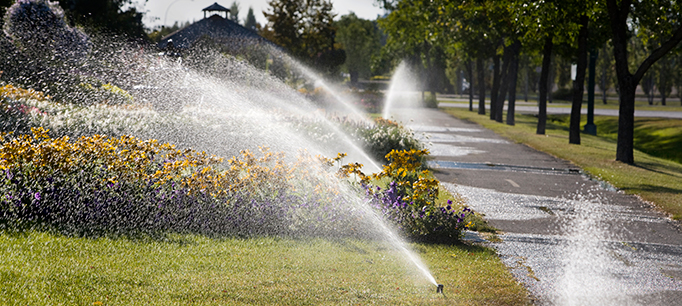
Even bigger savings can come from trimming back on outdoor watering. Most Californians don’t realize that fully half of all water use in the state’s cities and suburbs goes to landscaping, and in many of the hotter, inland communities, such as Bakersfield or Palm Springs, that share is even higher. This has happened because Californians have been accustomed to landscaping with thirsty plants like lawns that are better suited for regions where it rains in the summer. One technological innovation of the 1970s—the automatic sprinkler—compounds the problem by encouraging overwatering. People don’t think to turn it off when the weather is milder and the plants need less water.

Californians are starting to realize that it’s possible to have beautiful communities while using much less water for landscaping. This means switching out lawns and other thirsty plants for more “California friendly” plants that do well with less water, and turning to more modern irrigation systems like drip irrigation and “smart sprinklers” that don’t overwater. This doesn’t mean getting rid of all lawns, but rather keeping lawns where people use them, such as in the back yard, and replacing lawns that are just for show with beautiful, drought-tolerant plants. Here, too, it’s a good time to look for rebates, as many utilities are offering “cash for grass.” The results: a beautiful facelift for landscapes in our communities, significant water savings, and a way to be ready for the new normal.

Nine Policy Challenges for California Water

Two bills recently signed by Governor Brown—AB 91 and 92—will provide drought relief and help to enforce prescriptions for reducing water use that were outlined in the governor’s recent executive order. However most of the bills’ funds are allocated to efforts aimed at improving water management in general. Indeed, most of the funding goes to flood management.

These bills are a reminder that while drought is the crisis of the day, the state must grapple with multiple issues to put water policy on a sustainable and constructive path. These issues include improving water quality, restoring degraded ecosystems, finding new funding mechanisms, adapting to climate change, and reducing the risk of floods.

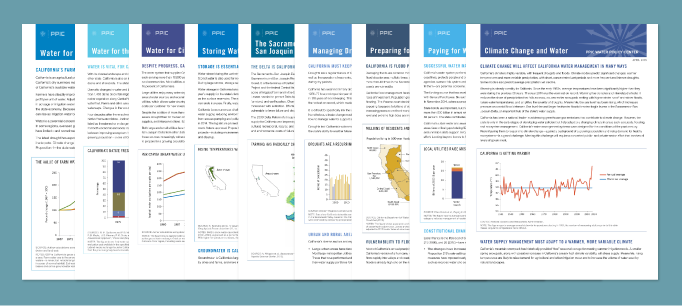
In reality, water management in California is a perpetual work-in-progress—never to be fully resolved. To help inform this process, the newly launched PPIC Water Policy Center has just published California’s Water, a collection of nine short policy briefs. The center’s research network—made up of more than 40 top experts in biology, economics, earth science, engineering, and the law—collaborated to prepare these briefs.

A common theme running through these briefs is California’s tremendous capacity to adapt to changing conditions and tackle new challenges. We hope this collection will be a useful resource for those who wish to become more familiar with California water policy and to join the conversation about solutions.

The nine topics include:

Climate Change and Water. California’s climate is changing, becoming warmer and more variable, while sea level continues to rise. The state is in the early stages of devising water policies to adapt to these changes.

Managing Droughts. The current drought is one of many in the history of the state, with more to come. Reducing harm to cities, farms, and the environment will require creative approaches to improving supply and reducing demand.

Paying for Water. Funding improvements in California’s water management systems has proven difficult, leading to funding gaps of $2-$3 billion annually. Although the recently approved state bond can help, new funding tools are needed to fill critical gaps.

Preparing for Floods. One in five California homes and more than $700 billion in structures are vulnerable to flooding. Reducing flood risk will require improving flood infrastructure while creating incentives to insure existing development against risk and keep new development out of harm’s way.

The Sacramento–San Joaquin Delta. The Delta is the fragile hub of California’s water supply system. The state will need to make strategic decisions about the future of the Delta that consider water supply reliability, ecosystem health, and the Delta economy.

Storing Water. California’s variable climate makes the state very dependent upon storage of water in surface reservoirs and groundwater basins. The state faces big choices in how to increase and manage storage capacity to adapt to a changing climate and shrinking snowpack.

Water for Cities. California’s cities have made considerable progress in managing water resources and reducing per-capita water use. Still, new efforts to reduce demand and to diversify water sources will be needed as the population grows.

Water for the Environment. Forty years after enactment of major environmental laws, California’s freshwater biodiversity is still in decline. Efficient allocation of water for the environment will be one of the biggest water challenges of the 21st century.

Water for Farms. California’s farms are the most productive in the nation, but they are increasingly vulnerable to water shortages. Major changes in groundwater and surface water management, including expanding water markets, will be needed to create a sustainable future for agriculture.

Five Things You Need to Know About Water

We marked the launch of the PPIC Water Policy Center by convening a panel of leading experts to discuss key issues in state water policy. Participants were Richard Frank, director of the California Environmental Law and Policy Center at the UC Davis law school; Matthew Rodriquez, secretary of the California Environmental Protection Agency; and Karen Ross, secretary of the California Department of Food and Agriculture. Moderating the conversation was Lois Kazakoff, deputy editorial page editor at the San Francisco Chronicle. We invite you to watch the full presentation and discussion.

Before the panel discussion, I gave a brief opening talk called “Five Things You Need to Know About Water.” Here is a summary of the five points:

Water is complicated. There are no silver bullet solutions to California’s water problems—whether it be desalination, new reservoirs, or conservation. We need to be thinking about combining a lot of different tools and strategies. This also means that there are almost always unintended consequences, even for solutions that seem like no brainers. As an example, there’s a lot of public interest—and funding—now available for increasing local drought resilience by reusing treated wastewater. However, more water reuse often means less treated wastewater gets returned to rivers and streams, where it provides important environmental benefits and supplies for downstream communities. This doesn’t mean we shouldn’t be doing these projects, but it does mean we need to be aware of the consequences and trade-offs.

We have to go after more than the low-hanging fruit. The low-hanging fruit types of solutions tend to be incremental and piecemeal in nature. This is fine for things that can change incrementally, like improving water use efficiency. But some tough problems—like meeting the co-equal goals of water supply reliability and ecosystem sustainability in the Delta—will require tough, expensive, and politically difficult solutions.

Water solutions almost always have both winners and losers. This is obvious in a case like the Delta, where it’s simply not possible to find a fix that will make everyone better off. That’s because every available option involves tradeoffs in which at least one party doesn’t fare as well, whether it’s farmers in the Delta, farmers in the San Joaquin Valley, urban residents south of the Delta, or the Delta’s native fish and wildlife. It’s also true for projects that people like to think of as win-win, such as flood protection projects that move levees back to make more room for rivers. These projects also improve wildlife habitat, but they usually cost more than traditional flood control projects. As a society, we can aim for solutions that get the most benefits per dollar spent, but we also need to consider how to soften the blow if some groups are disproportionately bearing the costs.

Crises create hardship, but also opportunity. In particular, crises create openings to achieve major reforms that might not be possible in normal times. Thanks to a string of crises—and to bold action by leaders at the local, state, and federal levels—California is now experiencing a period of extraordinary change in water policy: In 2007, in the wake of Hurricane Katrina in New Orleans, we enacted legislation that doubled the federal standard of flood protection for cities in the Central Valley. In 2009, in the third year of drought, we adopted a legislative package that required more conservation, better water use reporting, and a new governance structure for the Delta. In 2014, in the midst of a much more severe drought, we enacted historic legislation that empowers and requires local agencies to sustainably manage our threatened groundwater basins. Much work lies ahead to effectively implement all of these reforms, and more big changes will be needed in other areas, such as finding ways to fill critical funding gaps in our water system.

It’s hard work, but it’s not hopeless. We’ve been making progress in addressing some key challenges, including improving the reliability and quality of our water supplies, and preparing to weather droughts and floods. Perhaps the toughest—and most conflict-ridden—challenge we face in California water is reversing the decline of our native aquatic ecosystems, which have been failing despite several decades of well-intentioned environmental laws and investments. But even here, one can point to promising approaches. There’s the example of Putah Creek, where the reintroduction of natural, variable flow patterns—albeit with just a fraction of the water nature used to provide—has favored the return of native species. There’s also the example of the Knagg’s Ranch in the Yolo Bypass, where leaving fields flooded a little longer before planting rice is making it possible to fatten up young salmon before they make their way back to the ocean, giving them a better chance of survival. These are creative examples from the playbook of “reconciliation ecology,” a pragmatic approach to managing our ecosystems alongside continued human uses of water and land resources.

These five immutable facts about California water guide the work of our center. California needs to ground policy decisions in reliable, non-partisan, science-based diagnoses of problems and potential solutions. That’s how we—along with our research partners throughout the state—hope to contribute to a better water future.

Welcome to the PPIC Water Policy Center

California is at a crossroads in managing water. The drought has sparked significant policy activity, but much work lies ahead. With changes expected in the state’s population, economy, and climate—and pressures from aging infrastructure and a deteriorating environment—California needs to develop meaningful, lasting, forward-looking water policies.

Today, we are pleased to announce the establishment of the PPIC Water Policy Center to help meet the state’s urgent need for timely information and innovative water management solutions. The center builds on the successful model of independent, nonpartisan research and constructive engagement that defines all of PPIC’s work.

Over the last decade, PPIC laid the groundwork for the center with high-quality research on major water policy issues and productive conversations about solutions. The center represents a significant ramping up of investment in this critical area, and we thank the S. D. Bechtel, Jr. Foundation for the seed funding to launch this effort.

The PPIC Water Policy Center will focus on three critical, interrelated water management challenges facing California in the 21st century:

  • Ensuring clean and reliable water supplies. Investigating and encouraging comprehensive, integrated approaches to water quality and quantity.
  • Building healthy and resilient ecosystems. Promoting the development of healthy and sustainable ecosystems using practical approaches to watershed management.
  • Preparing for droughts and floods. Helping California adapt to an increasingly variable climate.

The PPIC Water Policy Center staff will work closely with a broad, interdisciplinary network of top researchers from around the state—and with a wide range of policymakers and stakeholders—to strengthen the bridge between research and real-world policy debates.

In conjunction with the launch of the PPIC Water Policy Center, PPIC is releasing California’s Water, a set of nine short policy briefs on the state’s most critical water management challenges and the actions needed to address them. This briefing kit is designed to inform state leaders and to raise awareness more broadly about the important water management issues facing the state.

We invite you to download California’s Water and visit our new PPIC Water Policy Center online. We also invite you to stay up to date with PPIC Water Policy Center activities:

Drought Watch: The End of the Rainy Season

This is part of a continuing series on the impact of the drought.

California’s rainy season is pretty much over. Most years, 85% of the wet season’s rain and snow has already fallen by late March. While rain often falls in April and May, it is rarely enough to make a big difference in the overall water picture, and the forecast is now quite dry.

That means California’s water managers now have a good idea how much water will be available in the state’s reservoirs, snowpack, and groundwater basins.

The news is not heartening. While parts of the north coast did fairly well, the rest of California did not. The Sierras received about half of annual average precipitation. And as the record warm temperatures of last year have persisted, the snowpack is at an all-time low (now 8% of average). As California’s struggling ski area operators know all too well, most precipitation fell as rain, rather than snow.

Statewide, reservoir storage is about half of capacity. However, the almost non-existent snowpack provides no prospect for improvement in storage this spring—something water managers count on in most years.

This fourth consecutive dry year have led to some dire, even apocalyptic predictions, including that California will run out of water within a year. While managing this drought will be difficult, even painful in some regions, the state is not going to run out of water and there is no need to panic. Rather, prudent adjustments to water scarcity that began earlier in the drought will continue and intensify. These include:

  • Increased urban conservation. Californians cut their per capita water use last year, but they can do more. In particular, there is ample room to reduce outdoor watering, which makes up roughly half of urban water use. The State Water Resources Control Board has tightened restrictions on outdoor water use, and many municipalities will increase their conservation efforts.
  • Increased water trading. Robust water markets, involving willing sellers and buyers, are an effective way to manage scarcity. The Australians found this to be helpful during their crippling Millennium Drought. California’s water market helped many farmers keep their orchards alive in 2014. This year, cities with dwindling drought reserves are also looking to buy water – as illustrated by the recent deal between Sacramento Valley rice farmers and Metropolitan Water District, Southern California’s large water wholesaler. As demand for trading increases, so will water prices.
  • Increased use of groundwater. Groundwater pumping has grown since the drought’s onset, but California’s reserves of groundwater remain large—particularly compared to surface storage. Groundwater will continue to make up shortfalls in surface water this year. Unfortunately, past failures to manage groundwater have lowered the water tables in many basins, making water more expensive to extract and often requiring drilling new, deeper wells. The new Sustainable Groundwater Management Act will eventually address this problem, but not soon enough for this drought.

In short, California is not running out of water, just cheap water. A fourth consecutive year of drought will make both water scarcity and management possibilities increasingly apparent.