The High Cost of Drought for Low-Income Californians

Californians across the state are feeling the impacts of the severe drought, now in its fourth year. Among those hit hardest are the state’s low-income residents and communities.

The worst impacts are occurring in poor rural communities. Rural residents generally rely on groundwater, from either their own wells or wells managed by small community systems. Even before the drought hit, contamination by nitrate and other pollutants was a big problem. With the drought, many wells are now going dry. These problems are now firmly on policymakers’ radar, but the solutions aren’t simple. Affordability is a major challenge, not only because of low incomes, but also because small systems don’t benefit from economies of scale. That makes infrastructure upgrades costly on a per-household basis. Costs of properly running the systems can also be quite high.

The state has recently made several changes to help these rural communities, including dedicating more funds and establishing a new Office of Sustainable Water Solutions within the State Water Resources Control Board to provide technical and financial support. The governor’s office has also proposed legislation that would authorize the board to mandate utility consolidations. As we argued in our 2014 study Paying for Water in California, physical consolidation with larger nearby systems is a good option for many small systems. In places where the distance is too great to hook these communities up, administrative consolidation can still help provide economies of scale in management and technical oversight, ensuring better long-term outcomes.

Less on the radar but also worth monitoring are the effects of the drought on the urban poor. Large metropolitan areas have generally been in much better shape during this drought, and they also are less prone to the kinds of problems witnessed in small rural systems. Urban systems benefit from economies of scale for new investments and have some ability to provide lifeline rates for lower-income households, by using revenues from the rest of their customer base.

But there are warning signs on the horizon. Urban water bills have been rising faster than inflation, making affordability a challenge for poor households in some areas. And since the 1996 enactment of Proposition 218, a voter-approved constitutional amendment, public water utilities are generally not able to increase budgets for lifeline rates without a two-thirds approval by local voters. (Privately owned utilities—like those providing electricity and telecommunications services—are exempt from this provision.) The drought raises new affordability challenges, because the extra conservation now required will lower revenues below costs for many utilities. To cover these costs, some utilities are increasing the fixed service fees on monthly bills, rather than increasing the rates charged per gallon used. Such service fees disproportionately impact lower-income households, who tend to use less water.

Now more than ever, utilities should consider the equity implications of their rate structures. And as we argued in the Paying for Water study, Californians may need to consider reforming Proposition 218. One important reason is to enable the use of lifeline rates, a tool for ensuring that poor households have access to an essential service. Finally, to durably support safe drinking water needs in rural communities, where the local funding base is inadequate, Californians should consider instituting a statewide lifeline rate system funded by a small surcharge on monthly water bills.

View slides from the presentation Water, Drought and Social Justice in Urban and Rural California.

Video: Let’s Pull Together to Solve the Groundwater Crisis

Groundwater overuse is an invisible problem that has surged with the drought. Shrinking aquifers can bring great risks for the state’s economy and well-being of groundwater-dependent communities, which is why the state stepped in to regulate its use last year. Last week, PPIC’s Water Policy Center and the California Water Institute at Fresno State co-hosted an event that brought together local experts representing agricultural, urban, and rural community perspectives. The discussion addressed the challenges of managing groundwater sustainably and implementing the new groundwater law in the San Joaquin Valley.

The event’s take-away message was clear: it’s time to stop finger-pointing and focus on cooperation. Business as usual is no longer an option when it comes to this shared resource. Local agencies and groundwater users need to come together to determine how to best manage their local resource for long-term sustainability, or risk having the state step in and do it for them. David Orth, a state water commissioner and manager of the Kings River Conservation District, said, “We have the opportunity to come up with good sustainability plans, and if we do it right, the state stays out of it. The burden is on us to succeed.”

Ellen Hanak, director of the PPIC Water Policy Center, noted that the Central Valley “is in many ways ground zero for drought impacts” on groundwater. The fact that more Californians than ever before now say the drought is the biggest issue facing the state provides opportunities for change. (View her presentation slides.)

Moderator Mark Grossi, veteran environment reporter for the Fresno Bee, has seen a shift in thinking about water in the Central Valley as well. “Forgive me for smiling, but I’ve been covering water since Governor Brown’s first term. I grew up in Bakersfield, and covered water in Kern County … Every time the subject of groundwater came up in the valley, people laughed me out of the room. Now we have the kind of drought that people have been talking about for a long, long time”— the kind of drought that has helped launch the workings of a law to manage groundwater more sustainably.

Some cities have begun tackling these issues head on. Luke Serpa, the director of public utilities for the city of Clovis, described a series of investments intended to soften the impacts of the drought, including water recycling, re-use of stormwater to recharge underground basins and other approaches to increase local supply.

Sue Ruiz, who works with local well-dependent communities, brought home the difficult realities of shrinking groundwater tables for people in the region, and the challenges of solving these problems in ways that don’t excessively burden low-income households. She described people whose wells have run dry facing 6-12 month waits for well-drillers to sink deeper wells, a sometimes slow response from the state, and too few dollars to fund long-term solutions. Poverty compounds the problem, as homeowners can’t get a loan to drill a new well if their current one is dry; without a loan, many can’t afford to pay the tens of thousands of dollars it can cost to drill.

“We’re drowning in drought,” she said.

One serious subject got a big laugh. Luke Serpa noted that his city’s mandated 36% water cut is a big hurdle, especially because it needs to happen over a short timeframe. His city’s new unofficial slogan? “If your lawn’s not dyin’, you’re not tryin’.”

View videos from past regional events:

From Droughts to Floods: Water in Silicon Valley
Water and California’s Future (Los Angeles)

Reminder: Droughts Often End with Floods

Just a year ago, Texas and Oklahoma were experiencing a crippling drought. In May, record rainfall and deadly floods swept through these recently parched states, with devastating results. It was the same story in Australia in 2010: two years of record floods followed a decade-long record-breaking drought.

There’s a reminder here for California: droughts can end with a deluge.

About one in five California residents now lives in a flood-prone area. The replacement value of buildings vulnerable to floods exceeds $575 billion. Climate change could increase these risks. Yet the amount we spend on flood management is currently just a fraction of state water spending.

Now is the time to look at improving flood responses across the state, not when rivers are overflowing. If we’re serious about reducing flood damages, we will need to adopt an “all of the above” approach to managing flood risks. The palette of solutions includes reinforcing and improving structural protections such as levees and floodwalls, encouraging residents and businesses to buy flood insurance, utilizing green approaches like wetlands, and avoiding new development on the most flood-prone lands.

The first line of defense—particularly for those in the so-called 100-year flood zone, which is prone to more frequent floods—has typically been levees. Our system of levees is in great need of improvement, and funds from a 2006 state bond have boosted investments to shore up these flood defenses. Yet we still have a large funding gap. We need to increase spending to protect our most vulnerable communities, while ensuring we get the biggest bang for our bucks with these investments. For example, setting back levees to allow rivers to have more room to flood can reduce flood damages, boost habitat benefits and even increase recharge to aquifers.

While necessary in many places, structural systems are also the most costly and environmentally damaging elements of our flood-protection system. They’re also far from infallible, particularly in light of a changing climate. Flood insurance is an underutilized tool that complements structural protections, and can help people recover more quickly. Yet too few at-risk Californians carry flood insurance. State and local agencies must find new ways to promote greater adoption of insurance. One novel approach would give local or regional flood management agencies authority to buy insurance for the community. Pooling resources this way would increase coverage and cut costs. The legislature could encourage this by creating mechanisms to recover costs through assessments or fees.

Finally, one of the best defenses against flooding is land-use planning and regulation that keeps people out of harm’s way. Many communities already discourage development in the most at-risk zones, but more needs to be done. The state doubled the protection standard for urban areas in the Central Valley in 2007. The state should consider using the higher standard major urban areas elsewhere in the state, which also face significant risk.

There is only one certainty about California’s variable climate: the drought that is hitting the state today will, at some point, give way to floods. Strengthening flood management could have big pay-offs in protecting the public health and safety and the state’s economy.

Learn more: Read our policy brief about preparing for floods.

FIGURE SOURCE: California Department of Water Resources and U.S. Army Corps of Engineers, California’s Flood Future: Recommendations for Managing the State’s Flood Risk (2013).

FIGURE NOTES: The figure shows population and structures in the 500-year floodplain—the area susceptible to floods so large that they have just a 0.2 percent chance of occurring in a given year. Levees protect much of this area from a “100-year flood,” which has a 1 percent chance of occurring in a given year. Population is adjusted to 2010 levels. Value of structures is based on the depreciated replacement value of structures and their contents in 2010 dollars.

Video: Mark Baldassare & John Myers Discuss the PPIC Survey

For the first time since the start of the PPIC Statewide Survey, Californians ranked the drought as the most important issue facing the state. And that was not the only “first” for this survey. PPIC presented it in Sacramento Thursday in a new format. Mark Baldassare—PPIC’s president, CEO, and survey director—was interviewed onstage about the findings by John Myers, senior editor of KQED’s California politics and government desk.

In addition to the drought, Baldassare and Myers covered a long list of topics that were raised in the survey, including taxes, vaccinations, marijuana, University of California tuition, distrust in government, and voter turnout. Myers also raised a theme he explored in his report on the survey for KQED: Despite an improving economy and Californians’ support for the governor’s ideas about the budget, their outlook on the direction of the state remains gloomy.

Why Farming Needs the New Groundwater Law

A groundwater deficit is growing in key agricultural areas of California. The double-whammy of the extended drought and longer-term reductions in surface water deliveries for environmental needs has pushed many farmers into using ever-more groundwater, at rates that can’t be sustained. In average years, about a third of water used by California’s farms is groundwater—and much more during droughts like this one. In some basins (especially those in major farming regions in the southern San Joaquin Valley and the Central Coast), groundwater withdrawals have long exceeded the pace of replenishment, thus shrinking our most reliable supply for times of drought.

The groundwater law enacted last fall gives local agencies the tools and authority they need to develop and implement sustainable groundwater management plans. Once agencies put these plans in place, they will have 20 years to achieve sustainability—until 2040 for the most stressed groundwater basins. The state can step in if these agencies fail to act.

Despite the seemingly generous timeline for compliance, the law’s goals will be challenging to meet. By June 2017, groundwater users in each basin need to designate a local groundwater sustainability agency that will be responsible for local oversight. And by January 2020, these agencies need to start implementing their sustainability plans. In most places, getting this preparatory work done will require significant additional technical analysis to understand how the basins’ supply and demand work. It will also require coming to agreement on how to collectively manage what has largely been considered an individual resource, with each user able to pump as much as he or she can put to beneficial use.

The drought has made it clear that the status quo is unsustainable. Declines in groundwater levels are resulting in higher energy costs to pump water from deeper depths, sinking lands, and wells going dry in some places.

The groundwater law was not widely embraced by the farm community; indeed, not a single legislator from the San Joaquin Valley voted in favor of it. Yet California farming needs to strengthen groundwater management to support the growing investments in highly valuable fruit and nut orchards and vineyards, which must be watered each year. It’s essential to manage groundwater so that it’s available during droughts, and the new law provides a pathway to do this.

Bringing basins into balance will require creative approaches to basin replenishment. Many irrigation districts are already taking critical steps in this direction. For example, agencies on the east side of the San Joaquin Valley manage surface and groundwater resources jointly to encourage groundwater basin replenishment in wet years. Some districts in the San Joaquin Valley and in the Central Coast have begun recharging basins with recycled wastewater from neighboring urban areas. Another promising approach is allowing floodwaters to spread on fields normally watered by drip irrigation.

A number of technical challenges will need to be addressed. For example, not every aquifer can be recharged, and in many areas, recharge is slow. Much of California’s water conveyance infrastructure was designed for use with surface reservoirs as the main water source, not groundwater. And over time, widespread conversions from flood to drip irrigation methods have allowed farmers to stretch limited surface water supplies, but this is also reducing opportunities for groundwater recharge. New institutional and financial arrangements will be needed to optimize groundwater storage.

Like nearly everything to do with the state’s water management, the solutions to groundwater recharge will require a deft blend of management, infrastructure and policy changes. The new law appropriately puts locals in the driver’s seat for managing a local resource. But the state must play a central role in supporting this transition, with financial and technical support. Allocating funds from Proposition 1, the water bond approved by California voters last November, will be a good start.

Learn more:
Read our policy brief about the challenges of water storage
Read our policy brief on water for farms

Drought: 10 Ways the Federal Government Can Help

For more than a year, Congress has been discussing actions that the federal government can take to help with California’s drought emergency. Federal agencies, using their existing authorities, have been providing modest amounts of help, including funding water conservation efforts, livestock disaster assistance, and supporting rural communities facing job losses from crop fallowing and drinking-water shortages. To date, however, no substantive federal legislation has been passed that addresses the drought.

Granted, the federal government cannot make it rain. But there are other things it can do to help California get through this drought and better prepare for future droughts. Along with a group of colleagues in our research network, we have compiled a list of 10 ways the feds can help. Some of these can be accomplished under existing executive authority, and some require new legislation. Here is the short list; more details can be found on the UC Davis Center for Watershed Sciences website.

Near-term opportunities for federal drought support include:

  1. Amend the Safe Drinking Water Act to allow its Revolving Funds to be used for small, local water systems that serve fewer than 15 connections (many of which are facing dry wells with the drought).
  2. Allow Central Valley Project contractors to carry over water in federal reservoirs as a hedge against future drought conditions, and to discourage potentially wasteful “use it or lose it” behavior, which can result in lower reservoir levels. During droughts, the U.S. Bureau of Reclamation should allow carry-over storage. And require the Army Corps of Engineers to use real-time forecasts of storms to reduce the risks of emptying reservoirs during the winter.
  3. Make it easier to trade water during drought emergencies.
  4. Facilitate distribution of federal cost-shares for local development of non-traditional sources of water and other drought-resiliency projects, by allowing agency federal department heads to give funds directly to states.
  5. Collaborate with California to develop a drought biodiversity management plan modeled after successful approaches used by Australia during its Millennium Drought.
  6. Expand the Central Valley Project’s ecosystem restoration fund by increasing per acre-foot fees on project water during drought and establishing a surcharge on water trades that use federal infrastructure.
  7. Speed the listing of species threatened with extinction during drought emergencies and implement recovery actions.
  8. Increase federal agency support for improved water information systems, and increase technical support, notably from the US Geological Survey and National Weather Service.
  9. Longer term: Create an Independent System Operator (ISO)—similar to the ISO that currently manages California’s electrical grid—that would merge state and federal water projects into a single, public utility.
  10. Longer term: Through legislation similar to the Coastal Zone Management Act, promote coordinated and integrated water management that addresses related issues of supply, quality, drought, flood and ecosystem challenges at a regional scale.

These 10 federal actions would help California better manage its current drought and help us prepare for inevitable future droughts.

A Dry Run for a Dry Future

During times of extreme water scarcity it is hard to find the silver lining. Yet the severity of this drought, including its record warm temperatures, is benefiting us in one way: it is a window into what droughts may look like in the future and gives us something to plan for—a target, if you will.

The state’s system of water rights laws and water supply infrastructure is built around managing periodic droughts. The design of this system reflects the climate conditions of the late 19th and early 20th centuries, as well as a much smaller population than we have today. Climate models and current observations indicate that we are facing an increasingly different future, one where warm droughts like our current one are no longer the rare exception.

It is crucial that we study our dry years closely. Like past cases, this drought has seen strong rainfall deficits. For four consecutive years (so far), the state has been dry to critically dry, with the driest calendar year on record in 2013. But recent studies have shown that while it has been unusually dry, the precipitation numbers of this drought fall within the realm of natural variability.

What is most unusual about this drought is its exceptional warmth. Statewide, three of the past four winters have been substantially warmer than the long-term average. The past two winters set records that were 4-5 degrees F above average. With this exceptional warmth, California experienced record low snowpack, since much precipitation fell as rain rather than snow and the lean snowpack melted rapidly.

The causes of this drought are being studied and debated by climatologists and oceanographers. Emerging research suggests that this drought may be linked, partially, to very warm waters in the far western tropical Pacific. Heat and moisture pumped into the atmosphere from these waters influence winds and storm tracks in the North Pacific, altering climate patterns in our region.

These teleconnections appear to have created the Ridiculously Resilient Ridge, an anomalous high pressure feature that camped over the waters off the West Coast and pushed North Pacific storms far to the north. This ridge, with its associated weak winds and unusual weather across the eastern Pacific, created The Blob: an area of very warm water stretching from the Bering Sea to Baja California. This blob has disrupted our marine ecosystems, harming fish, sea birds and marine mammals.

Onshore from all of this activity, winter storms that made it off the Pacific Ocean and into California were much fewer than normal. And those that did make it tended to be warm, reflecting conditions in the eastern Pacific, leaving us with rain instead of snow.

To date, there has been no definitive link that implicates this drought as a symptom of climate change. However, the consecutive years of dryness coupled with high temperatures strongly resemble the kind of droughts that are projected under the warmer climate during the latter half of this century. While the origins of future droughts may not be precisely the same, the on-the-ground results are likely to be.

Difficult as it is to endure, this drought provides important lessons. It is a useful and instructive test of how we manage water now—and how we will be forced to manage water in the future. As it unfolds, it tests the resiliency of California’s water infrastructure—made up of dams, aqueducts, and groundwater basins—along with our management systems and institutions. The drought is providing a preview of the warmer conditions during dry spells that will inevitably occur in future decades. As such, it is unveiling future challenges in managing the environment, including conserving our declining native biodiversity.

In short, this drought has revealed what a warmer climate future looks like. We should learn from it and plan accordingly.

“Water 101” Podcast Covers Challenges, Solutions

What do Californians need to know about our water system to be able to grasp the big management challenges we face—both in times of drought and for the longer term? Jeffrey Mount reveals all in a conversation with Joint Venture Silicon Valley CEO Russell Hancock. The wide-ranging conversation, now a free podcast, is a 45-minute entertaining crash course in the workings of watersheds, state water policy, and why we need an “all of the above” strategy to solving our water crisis.

The interview walks us through a number of key topics, but goes in-depth on one: groundwater.

“This will be the year of groundwater,” Mount said. “We’ve been treating groundwater like a non-renewable resource, like oil . . . Now as a state we’re trying to grapple with the fact that we’ve overtaxed that resource.”

By podcast’s end, you’ll be able to talk intelligently about the pores between soils (and why we need them), the costs of desalination plants, the potential for information technology solutions to help us manage our water better, and the long-distance origins of our current drought.

When asked what lasting change he would like to see as a response to the current drought, Mount said: “Droughts are pivot points: they lead to changes in technology, and they lead to changes in practice. We saw that in Australia; after the drought was over, people’s behavior changed. That is going to happen in this drought. People are using less water on a per-capita basis, and that will be the lasting part of the drought.”

We hope you’ll listen in.

Testimony: Improvements Needed in Water Information

How is the state government handling the drought? And what more could be done? A hearing convened by the Senate Natural Resources and Water subcommittee earlier this week delved into the topic, with updates by leaders from the administration on the implementation of drought actions in the urban and rural sectors and in the state’s diverse ecosystems. In a second panel, I joined several other non-governmental experts to describe additional ways forward to solve our short- and long-term water challenges.

My testimony focused on a number of policy priorities that we highlighted in a recent report on drought management. In particular, I emphasized the need for better information as a basis for better water management.

Compared to most other western states and other dry places like Australia, California’s water monitoring and accounting systems are primitive, with significant gaps in information. Without a better understanding of how much water is available in our rivers and groundwater basins, as well as who’s using what, we’re saddled with inefficiencies, inadequate transparency, and greater potential for conflict. This especially matters during droughts, when every drop counts.

On the plus side, the state has recently made some progress in improving water information. Legislation enacted in 2009 requires all surface-water users to report the volumes of water they divert and also requires local agencies to report groundwater levels. Since the drought emergency was declared in January 2014, the State Water Resources Control Board has progressively amped up water-use reporting requirements.

But more should be done to fill the gaps. This includes gathering information on groundwater use—an important component of overall water use, especially during droughts. We also need to account for the volumes of water that cities and farms discharge back into streams as treated wastewater or irrigation runoff; these discharges make up a large share of water supplies in some of our rivers and streams.

Because information is only really useful if it is well organized, the state needs to pay particular attention to developing a coherent water information management system. Currently, agencies and offices that oversee different pieces of the puzzle have different tracking systems and accounting standards, which makes it very hard to get an overall picture of what’s happening in anything close to real time. The last official estimates of water supply and water use for California date back to 2010.

Funds from the state water bond could help pay for this work. In devising our system, we should draw lessons from other states and countries that are further along in this area. And given that California is a global center for the information economy, it may make sense to tap into local “big data” expertise to help build data solutions.

There’s a saying that “You can’t manage what you don’t measure.” The drought is making it ever more important to manage our scarce water supplies for the benefit of our economy, society, and the environment. So we’d better get better at measuring it.

Watch the hearing on Cal Channel.

Video: Addressing California’s Water Challenge

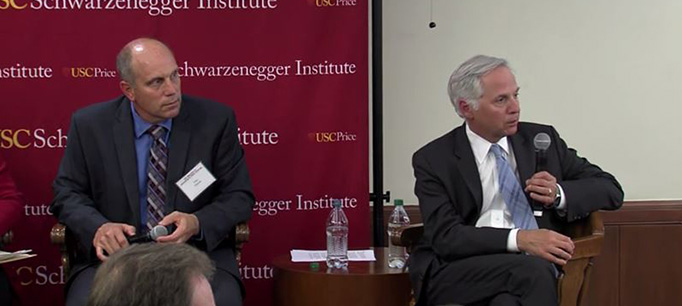
Last week the PPIC Water Policy Center partnered with the USC Schwarzenegger Institute for an important and timely discussion on the current drought and long-term solutions to California’s water challenges. The forum brought together water, business, university, and community leaders from around the state. Former governor Arnold Schwarzenegger, whose remarks opened and closed the event, emphasized the need for a big vision to tackle the drought, accompanied by strong leadership to ensure the timely implementation of creative solutions.

The event provided an opportunity to go beyond the current finger-pointing of who uses how much water, resulting in a more productive conversation about what can be done in key sectors and regions of California. In her presentation introducing key facts about the state’s big water issues, Ellen Hanak, director of the PPIC Water Policy Center, introduced two main themes that helped guide further discussions: “We’re all in this together” and “There are no silver bullets” to tackle major droughts. There was widespread agreement among speakers that a more sustainable future for water in California will benefit both our economy and environment, but we need an “all of the above” approach. We need to increase supplies, reduce demand, and modernize our approach.

More than 20 participants shared their views in a series of three panel discussions, including two members of the PPIC Water Policy Center advisory council, Tim Quinn and Lester Snow, and a member of our research network, Dan Sumner. Mark Baldassare, president and CEO of PPIC, served as moderator for a discussion on the state’s most important drought-based challenges, the role of agriculture, and solutions for addressing the drought.