Recycled Drinking Water: The Next Frontier

California is poised to become an early adopter of the direct reuse of purified wastewater as a source of drinking water. The State Water Board recently released a report for public comment that indicates it is feasible to regulate direct potable reuse to produce safe and reliable drinking water (comments are due by noon on October 25, 2016). We talked to David Sedlak—one of the 12 experts who worked on the report and a member of the PPIC Water Policy Center research network—about this potential new water source.

Public Policy Institute of California: How can treated wastewater be used?

David Sedlak: There are two main ways we reuse municipal wastewater. The first is referred to as non-potable reuse, which is the practice of taking water from conventional sewage treatment plants and subjecting it to a little more treatment before using it for landscape or agricultural irrigation or for an industrial use, like cooling towers or boilers. The second is to put it through a conventional sewage treatment plant and then through an advanced treatment plant, and reintroduce it back into the drinking water supply. This practice is referred to as potable water reuse.

We’ve spent the past three decades making lots of investments in non-potable reuse projects and in many cases, they turned out to be more expensive than we expected and less helpful in terms of preventing water shortages. In the early days of non-potable projects, we got all of the low-hanging fruit—using the water in places close to the treatment plant that needed it, such as golf courses or oil refineries. Because the users were close to the water source, the piping systems didn’t have to be very extensive. But as we tried to build more projects, the distances got longer and the projects got more expensive.

Potable water reuse holds a lot of promise because if you can make it clean enough to drink, you can use the existing water distribution system. In California, about half of the water use in cities is indoors. Hypothetically, there is a potential to recycle all the water used indoors—though you lose about 20 percent of it in the treatment process when you employ reverse osmosis membranes. So the upper boundary for potable water reuse might allow us to expand our urban water supply by about 40 percent.

PPIC: Where are we in terms of developing more potable projects?

DS: In California, all potable reuse systems built to date involve putting the wastewater through treatment, then putting it into underground aquifers until it is needed. This time spent in the natural environment serves to break the direct connection between wastewater and drinking water. This practice is called indirect potable reuse. What’s being discussed now is the possibility that we might skip that step. The reason people have become more interested in this approach is that not every city has a good groundwater aquifer near their water recycling plant. In the case of Los Angeles, for example, they would have to build an expensive pipeline to move treated water to valley aquifers. The places where direct potable reuse is getting the closest scrutiny are San Diego, Los Angeles, and San Jose.

Direct potable reuse is already happening in Texas—three projects have been built and a fourth is in the planning stages. The main impediment here in California is that the state has never written a permit for such a facility—no one ever asked for one before. The facilities in Texas got people thinking about the feasibility of doing it here.

PPIC: What factors affect the cost of this water source?

DS: Direct reuse is not necessarily more expensive than indirect potable projects. Engineers looking into direct potable reuse are considering additional treatment steps to reduce the risk that the failure of one or more steps in the process could cause a public health problem; these additional steps would increase the cost. But that is likely to be offset by the reduced costs of moving water, as it will be piped through the normal system. At this point we don’t see any major engineering challenges in direct potable reuse that we haven’t already seen in indirect reuse projects. The panel looked at various complicating aspects but none is a deal breaker at this point. So while the cost will vary from project to project, it looks like it will still be considerably less expensive than seawater desalination and many other alternative sources.

The bigger complicating factors are not engineering ones—these technologies have been pretty well tested in Texas and in the existing plants in California. It’s whether the public embraces direct potable reuse and if the state’s regulators feel comfortable permitting and endorsing it.

Learn more

Read about the State Water Board’s process on direct potable reuse (including how to comment on the report)
Read California’s Water: Water for Cities (from California’s Water briefing kit, October 2016)
Read “Water Management’s High-Tech Future” (PPIC Blog, September 3, 2015)

New Laws Strengthen State’s Water Safety Net

Governor Brown signed nearly 60 new bills this year that will influence how California goes about the business of managing water. Several of these new laws will expand and strengthen the water safety net for disadvantaged communities. A suite of bills signed in recent weeks will bring a much-needed assist for communities lacking reliable access to safe and affordable drinking water.

While the vast majority of residential water customers in California have access to safe drinking water, several hundred small communities still struggle to provide drinking water that meets basic health standards. In addition, the drought has resulted in more than 2,000 domestic wells across the state going dry and shortages in 100 small rural water systems. Small water districts serving low-income communities are not like their much larger counterparts—their rate bases are smaller, costs per household are higher, and their customers can’t afford high rates. In addition, these communities tend to have a shortage of managerial and technical expertise. These interrelated challenges constrict small districts’ ability to fund and maintain new pipelines, wells, and water treatment plants. Recognizing that there is no “one-size-fits-all” solution, the state has recently begun to experiment with regulatory, administrative, and financial tools to help solve the problem.

Consolidating small water districts into larger ones is a relatively low-cost and durable solution that can bring lower per unit costs and improved levels of service to small, disadvantaged communities. The State Water Board has exercised the authority granted last year to mandate such mergers with six consolidations in the Central Valley. The state also covers some costs for consolidations. One of the most notable examples is the voluntary merging of 1,800 water-stressed homes in unincorporated East Porterville with the larger and more resilient water system serving the nearby city of Porterville.

The suite of bills signed this year—Senate Bill (SB) 552, SB 1263, and SB 1456—builds on past progress to strengthen the water safety net in several ways.

  • Improving access to funding: SB 1456 makes it easier for water systems serving small, disadvantaged communities to use state financing for capital improvements such as drinking water treatment plants. The bill extends this benefit to professional water service providers that serve small disadvantaged communities across the state.
  • Enhancing technical and managerial capacity: Even where financial resources are available, a small water system lacking experienced managers or expert technical staff may struggle to maintain water treatment and distribution systems. SB 552 offers a remedy by allowing the State Water Board to hire a third-party administrator to manage the water system on behalf of the community. The administrator can set and collect water rates and apply for other funding to build water treatment plants and cover operations and maintenance costs. This new tool potentially offers a long-term solution for small water systems, especially when the community doesn’t have any neighboring systems to easily connect with.
  • Preventing new unsustainable systems: SB 1263 aims to prevent communities from developing unsustainable water systems in the first place. The bill authorizes the State Water Board to deny permits for new water systems if the applicants cannot demonstrate adequate capacity to produce reliable and safe drinking water for at least 20 years under a variety of hydrologic conditions. Instead, it encourages them to partner with neighboring water suppliers that can.

These new tools for addressing drinking water issues in disadvantaged communities show that the state is both conscious of the complexity of the situation and willing to experiment with new approaches. We’ll be keeping track of legislative developments related to water in future blog posts.

Learn more

Read “Drinking Water Quality: Perceptions and Challenges” (PPIC Blog, September 6, 2016)
Read “California’s Water Quality Challenges” (PPIC Water Policy Center fact sheet, October 2015)
Read “Building a Better Water Safety Net” (PPIC Blog, October 21, 2015)

Making Homes More Water Efficient

Outside water use varies dramatically in California depending on location—hot, dry places use more than cool, coastal cities, for example. But the state also has huge variation for inside water use. We talked to Dave Cogdill—CEO and president of the California Building Industry Association and a member of the PPIC Water Policy Center Advisory Council—who explains how California could save billions of gallons a year if older homes were as water efficient as newer ones.

PPIC: How water efficient is the state’s current housing stock?

Dave Cogdill: New homes are quite water efficient, but about two-thirds of the state’s homes were built prior to water-efficiency standards. Our studies show that homes built after 1980 are two times more efficient in water use than those built prior to these standards—mostly due to water-efficient fixtures that are required for new construction. We could save 300 billion gallons annually—enough to supply 2.5 to 3 million homes—if the state’s existing homes had to comply with these standards. We estimate it would cost $1,500 per home to convert older homes with water-saving plumbing fixtures such as toilets, showerheads, and faucets.

PPIC: What policy changes would help ensure California’s inside-home water use continues to be as efficient as possible for the long term?

DC: Finding ways to get people to retrofit is the big challenge. Better incentives would help. The drought-relief legislation passed in recent years included some money for these sorts of things, but nowhere near enough. We have to get more creative with incentive programs. It’s the old carrot-and-stick argument. Building standards for new homes are easier than addressing the problems with existing housing. The state has started to address issues with existing homes by requiring point-of-sale improvements for earthquake retrofits and pest inspections; maybe something like that would make sense for water-saving plumbing fixtures too. It wouldn’t add a lot to the cost of a house—and maybe the state could make it a deductible item.

PPIC: What steps can home builders take to increase water efficiency in housing?

DC: Inside the home we’re pretty much there—new homes save as much water as possible without requiring people to change their standard of living. While there’s not a lot more we can do inside the home, outside water use is a different story. The state’s model landscape ordinance was substantially revised this year to help respond to the drought. Our members have been very involved to make it as workable as possible. Massive savings are possible in outside water use, and in new developments we’ll be seeing a lot more hardscaping, drought-tolerant plants, less lawn, more efficient irrigation. There’s also an evolution toward using more recycled water and graywater in homes. By July 2018 homebuilders will be required to install “purple pipe” for recycled water to be used in landscape irrigation in those areas of California served by water recycling plants. In addition, the state has already taken steps to allow for on-site water recycling technologies. These more expensive “on-site” systems can add anywhere from $3,000 to $15,000 to the cost of a home, but they bring a substantial savings in water. Just to give you an idea of what’s possible, one on-site water recycling system we’re familiar with in El Dorado Hills recycles approximately 65 percent of the water used indoors. Given the price of water in many communities, these systems will pay for themselves over time.

Learn more

Read California’s Water: Water for Cities (from California’s Water briefing kit, April 2015)
Read “Water and Growth in the West” (PPIC Blog, February 18, 2016)
Visit the PPIC Water Policy Center’s water supply resource page

Water Marketing That Helps Nature

California urgently needs more practical, effective ways to improve conditions for struggling populations of native fish and waterbirds. A key ingredient is to add more water to rivers and wetlands at critical times of the year. Water trading is a proven way to do this—it brings necessary flexibility for environmental water managers while also reducing conflicts over the allocation of scarce supplies.

Buying water to support nature is not a novel concept in California. In fact, federal and state agencies helped jumpstart California’s water market during the 1987–92 drought by purchasing water for wildlife refuges and fish hatcheries. Today, environmental water purchases support wildlife refuges, increase flows for fish in the Sacramento–San Joaquin Delta and other watersheds, and reduce salt build-up in the Salton Sea.

Most of the water comes from irrigation supplies. Farmers are paid to release water they have in storage or to change the timing or amount of water they use on their fields. This offsets the farmers’ own costs and gives environmental managers access to water to support habitat priorities. In the early years, most environmental water deals were for a year or less. Starting in the 1990s, multiyear leases—lasting anywhere from 8 to 15 years—became more common.

Although both buyers and sellers have become more comfortable with environmental water trading, the trends suggest waning momentum for this approach. Environmental water purchases peaked in early 2000s, at around 400,000 acre-feet annually. They fell to just half that level during the latest drought. Environmental purchases fell from 30 percent to just 15 percent of all water trades—despite continued market growth.

Instead, the decline reflects a drying up of funding. In today’s dollars, roughly $620 million was spent on environmental water acquisitions from 1984 to 2014. Almost three-quarters of this sum came from state (53%) and federal (20%) taxes—mostly state general obligation bonds that are repaid with general tax revenues. Water users have provided most of the remainder. Notably, 23% is from an ecosystem restoration surcharge on water sold to Central Valley Project (CVP) contractors that is used to acquire water for wildlife refuges and some instream flows. Participants in a large water trade between the Imperial Irrigation District and San Diego are funding mitigation for the Salton Sea.

In the near term, funding constraints are likely to further reduce environmental water purchases. One large multiyear deal funded by past water bonds—a 60,000 acre-feet/year lease to support Delta flows for endangered smelt and salmon—is set to expire later this year, and no funds have been identified to continue the program.

To reverse the trends, California needs to develop more stable approaches for acquiring environmental water. One way is to permanently buy water rights, rather than just leasing them. Proposition 1, passed by voters in late 2014, sets aside $200 million for this purpose. Permanent acquisitions of water rights entail greater up-front costs, but they give environmental managers an asset they can count on.

Another way is to create a stable pool of funds, so that environmental managers can flexibly lease water when and where it’s most needed. Bonds are not the right vehicle for this. Instead, a small surcharge on water use—similar to the CVP ecosystem restoration fund—is what’s needed.

Either way, California needs to unleash the potential of water trading to improve conditions in the state’s rivers and wetlands. Australia, facing similar challenges and conflicts over the use of scarce water supplies, invested several billion dollars to permanently buy back water for the environment. This process has given the environment an equal seat at the table and taken much of the heat out of day-to-day management decisions. As a result, river and wetland species have a much better shot at thriving in a variable, drought-prone climate.

Figure source: Updated from E. Hanak and E. Stryjewski. California’s Water Market, By the Numbers: Update 2012 (PPIC, 2012).
Figure notes: Dry years are those classified as critical or dry for the Sacramento Valley. Wildlife refuges includes water purchased by the state Department of Fish and Wildlife and the federal Central Valley Project Improvement Act’s Water Acquisition Program (WAP). San Joaquin River flows, also funded through WAP, are for an experimental program to support salmon. Delta flows are for CALFED’s Environmental Water Account, continued as part of the Yuba Accord from 2008 to 2016. Other instream flows include water dedicated to the environment under section 1707 of the Water Code. Salton Sea mitigation includes water from the Imperial Irrigation District to mitigate the impacts of Colorado River water transfers to San Diego.

Learn more

Read “California’s Water Market” (PPIC Water Policy Center fact sheet, March 2016)
Read “Lessons on Sustaining the Environment During Drought” (PPIC Blog, June 23, 2016)
Read “California’s Ecosystems in Perpetual Drought” (PPIC Blog, August 30, 2016)

Drinking Water Quality: Perceptions and Challenges

Months after lead contamination in the drinking water of Flint, Michigan, gained national attention, the PPIC Statewide Survey asked if Californians think drinking water pollution is a more serious health threat in lower-income areas than in other parts of their regions. In the July survey, about 6 in 10 adults statewide said “yes,” including majorities across regions.

There is evidence to support this view. Contamination of drinking water continues to be a serious health risk for small water districts serving low-income customers, especially in rural parts of the state. Despite recent progress in building a stronger water safety net, this is a problem lacking a long-term policy solution.

As estimated in the PPIC Water Policy Center’s report Paying for Water, roughly 80,000 to 160,000 Californians live in small economically disadvantaged communities that struggle to provide safe drinking water on a consistent basis. A key part of this challenge is the dependence of many small rural water districts on groundwater that contains naturally occurring or man-made contaminants at levels unsafe for human consumption.

Cost is a key factor. Removing contaminants like arsenic or nitrate from groundwater requires large up-front expenditures, technical and managerial expertise, and the ability to cover long-term operational costs. In most water districts, these costs are borne by rate-paying customers. Small water districts serving low-income communities struggle to pay for this kind of ongoing drinking water treatment because they have higher costs per household than their much larger counterparts, and their customers can’t afford high rates.

In recent years, California has increased the amount of financial and technical assistance for improving access to safe drinking water in these communities. The state provides financial assistance through emergency spending (in response to the ongoing drought, for example), competitive grant-based awards from multiyear general obligation bonds such as Proposition 1, or low-interest loans and grants through the state revolving fund. But long-term solutions will require funding mechanisms that are more accessible, reliable, and sustainable. For example, the state General Fund or a statewide surcharge on water use could help solve this social equity issue. It will also be important to invest in solutions that are cost-effective and that communities can manage well over time. That’s an argument in favor of connecting these small systems to larger ones wherever feasible—something now under way in East Porterville and some other Central Valley communities.

The PPIC Statewide Survey finds that, while a majority of Californians see drinking water quality in lower-income areas as a serious health threat, there are wide differences among demographic and voter groups. Fewer than half of Republicans, whites, high-income Californians, or likely voters see this as a problem. On the subject of drought response, however, solid majorities across these groups (and 6 in 10 adults overall) say state and local governments are not doing enough. This eagerness for government action, coupled with policymakers’ willingness to address long-term water problems, may pave the way for solutions to drinking water contamination in vulnerable communities.

Learn more

Read “California’s Water Quality Challenges” (PPIC Water Policy Center fact sheet, October 2015)
Read “Building a Better Water Safety Net” (PPIC Blog, October 21, 2015)
Read “Flint, a Water Quality Reminder for California” (PPIC Blog, January 27, 2016)

Three Lessons on Water Accounting for California

Californians are known to take pride in the state’s many exceptional characteristics. But in at least one important area, we’d be wise to learn a thing or two from our neighbors. Not only are the Golden State’s water management challenges shared by other western states, but many of these places use more advanced practices to understand how much water is available, who has claims to it, and how much is being used.

A new report by the PPIC Water Policy Center reviewed how California compares to other dry regions—11 other western states and Australia and Spain—in integrating water information into critical management functions. We found ample room for improving the state’s systems—especially for managing groundwater overdraft, defining environmental water needs, and stimulating water trading.

These three overarching lessons, drawn from our comparison study, have particular value for California:

  • Management of groundwater can be improved by adopting common standards for evaluating its availability and use. In most regions, including California, groundwater management is locally driven. Getting users to agree on long-term goals can be difficult when local agencies that share groundwater resources use different accounting methods to assess availability and use. Recognizing the need for better coordination, Australia developed accounting standards that ensure consistency across agencies. And Texas developed “authoritative” groundwater models that serve as an accepted standard for determining allocations and settling disputes, and are used as the default for local agencies. As a result, both places improved their cooperation and coordination over shared resources, and reduced costs. Establishing a set of standards could help California facilitate basin-wide planning as the state the Sustainable Groundwater Management Act.
  • Clearly defining environmental water needs makes decision-making easier for all water users. California still needs to consistently define the quantity, timing, and quality of water for environmental uses in most watersheds throughout the state. This will not only benefit the environment but also reduce uncertainty for other water users who rely on watershed resources. For instance, Washington is defining water budgets that clarify environmental needs for each sub-basin in the state. A pragmatic path for California is to develop watershed-based environmental water budgets that integrate local watershed goals such as ecosystem health and water supply objectives.
  • A well-functioning water market stands on three legs: clarity on water claims, certainty on water use, and strong systems to manage and share information. Water trading is a key tool for shifting water from less critical uses during times of scarcity. Trading opportunities in California are limited by a lack of information. Improving our understanding of how much water is used under each water right (and how much returns to streams and aquifers) is critical for determining the volumes of water that can be traded without harming other users. Idaho and Colorado have made great strides in this area. California would also benefit from more detailed, publicly disseminated information on volumes, prices, and locations of water trade agreements. The water market in Victoria, Australia, leads the way in providing timely and accessible information on water rights, allocations, and trading.

Investing in water accounting can stretch supplies during times of scarcity, as has been demonstrated in other dry regions. Making a commitment to comprehensive, authoritative, and user-oriented water accounting now, as other states and countries have already done, will help California become more resilient to the challenges posed by future droughts and climate change.

Learn more

Read the report Accounting for California’s Water (July 2016)
Visit the PPIC Water Policy Center

Video: Improving California’s Water Accounting

Understanding California’s balance sheet for water—how much there is, who has claims to it, and what is actually being “spent”—is key to effective and sustainable water management, especially during droughts. But the state’s system of accounting is outdated and ineffective for managing some of our biggest water challenges, according to new research from the PPIC Water Policy Center.

A group of water management experts gathered to discuss the topic at a PPIC event last week.

“The drought has spotlighted weaknesses in California’s water accounting,” said PPIC researcher Alvar Escriva-Bou. These weaknesses make it harder to manage groundwater, water for the environment, surface water allocations, and water trading, he said.

Better information about groundwater use and claims is an especially urgent need. Lance Eckhart, director of basin management and resource planning for the Mojave Water Agency (which relies 100% on groundwater), said, “It’s probably going to take a generation” to bring the state’s over-drafted basins into balance. “The way you do that is by collecting good data…to quantify how much you have going in and how much is going out.” A lack of good information increases conflict over the resource, he said.

Tom Howard, executive director of the State Water Resources Control Board, noted that California has made “huge improvements” in managing information about water rights in the past six years. “But there are still a lot of blank spots” in the state’s water accounting system—for example, understanding how much water returns to the system from farms.

The drought revealed major weaknesses in how the state accounts for environmental water. Maurice Hall, associate vice president of water for the Environmental Defense Fund, said tightening the system of environmental water management through better information would allow managers to “specifically put the water where it needs to be for the fish and wildlife” and enable them to “defend the actions we are making for those wildlife.”

The issue of cost prompted a lively conversation about how we currently value water and how to fund the modernization of the system. Ellen Hanak, director of PPIC’s Water Policy Center, put the cost in context: “California annually spends $31 billion on our water system overall… And then look at the size of our economy—over $2 trillion. In the scheme of things, we ought to be able to find a little more money to do these kinds of things.”

Escriva-Bou and Hanak are coauthors of a new report that compares California’s water accounting systems to those of 11 other western states, Australia, and Spain. The authors identify gaps in California’s water information systems, and propose a dozen ways to bridge them.

Learn more

Read the report, Accounting for California’s Water (July 2016)
Visit the PPIC Water Policy Center

Commentary: California Needs Better Account of Groundwater


This commentary was published in the Sacramento Bee today, Thursday, July 21, 2016.

California’s prolonged drought has driven home the need to improve our balance sheet for water—determining how much there is, who has claims to it, and what is actually being used. New research by the PPIC Water Policy Center compared California to 11 other western states, Australia and Spain—places that also struggle with water scarcity—and found significant room for improvement.

Read the full commentary on sacbee.com.

Learn more

Read Accounting for California’s Water (July 2016)
Visit the PPIC Water Policy Center

Implementing California’s Groundwater Law

What will it take to successfully manage groundwater in California? This was the topic of a recent workshop jointly held by UC Water and the PPIC Water Policy Center. The workshop brought together researchers, policy makers, and water managers to reflect on the challenges of implementing the Sustainable Groundwater Management Act in California’s Central Valley, the state’s leading agricultural region. Here are some key takeaways.

  • Groundwater recharge should become more intentional. Farmers are the biggest users of groundwater in the Central Valley—but they also do the most to replenish it. When they apply water to their fields, crops don’t use all of it—some water seeps down and recharges underground aquifers. However, to achieve sustainable use in many aquifers, the process of recharge will have to become more deliberate and widespread in the Central Valley. UC Water experts presented research from several experimental sites across the state showing that recharge can be increased in a variety of ways. Depending on local circumstances, some possible solutions include having farmers flood their fields with excess winter runoff, setting back levees and using floodplains as infiltration grounds during flooding, and engineering recharge basins or using injection wells to direct water underground. Some of this is already happening in different parts of the valley. But scaling up recharge efforts to a magnitude large enough to bring overdrafted basins into balance will likely mean developing hundreds of additional small, decentralized projects across the valley.
  • It’s all about incentives. Recharge is a local process, but the benefits can be regional. To make recharge projects sprout in the Central Valley, incentive mechanisms will be needed to credit individuals who participate. One promising way of incentivizing farmers to recharge was presented by UC Santa Cruz researcher Andrew Fisher, who described experiences from a pilot project in the Pajaro Valley on California’s Central Coast. That project’s goal is to establish a system that provides rebates to those who recharge groundwater.
  • Accounting will be critical.California’s groundwater law requires users to establish local groundwater sustainability agencies (GSAs), which will have authority to monitor, measure, and regulate pumping and to fund recharge projects. Before passage of the law, California generally did not require monitoring of groundwater pumping or restrict its use, despite continued declines of groundwater levels in many parts of the state. As a result, there is little historical data on groundwater pumping and storage for Central Valley groundwater basins. At least some GSAs are likely to begin metering agricultural pumping, which can serve both as monitoring and enforcement. As GSAs make these important decisions, it will be important for them to strive for having widely available, transparent estimates of groundwater use and recharge volumes. Such data are critical to estimate groundwater budgets and provide a framework for water trading. For instance, crediting farmers for recharge is impossible if we don’t know how much water they pump out and how much they recharge.
  • No silver bullets. While recharge is promising, some reductions in groundwater use may also be necessary to achieve sustainability in some areas. For example, in parts of the southern Central Valley, there may not be enough extra surface water to justify building new recharge infrastructure. Many places across the valley may not have the right soil composition for recharge. Fortunately, California has extensive infrastructure to move surface water from where it is more plentiful to where it is scarce. As locals begin to implement the groundwater law and seek to reduce overdraft, water trading can help increase the efficiency and reliability of water allocation.

The workshop showed that there is a high level of interest in discussing solutions to California’s groundwater management challenges. Finding more opportunities to bring researchers and practitioners together to discuss ongoing work and identify ways to collaborate is an important step forward in the state’s path toward sustainable groundwater management.

Learn more

Read “The Coming Groundwater Revolution” (PPIC Blog, January 6, 2016)
Read our policy brief “California’s Water: Storing Water” (from California’s Water briefing kit, April 2015)
Visit the PPIC Water Policy Center

How Is California Spending the Water Bond?

Almost two years ago, California voters passed Proposition 1—a $7.5 billion water bond intended to provide significant investments in the state’s drought-challenged water systems. Today, Californians concerned about the prospects of worsening drought may wonder how the state is spending these funds, and whether they are moving out the door fast enough.

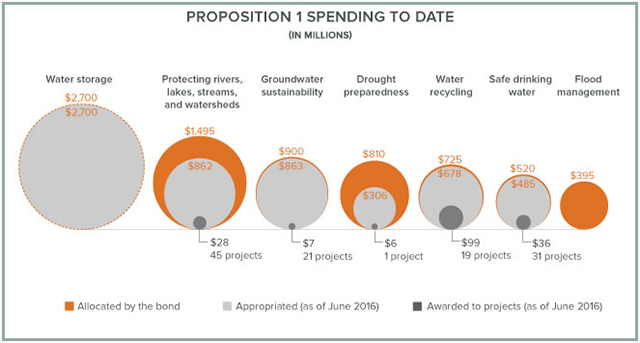
Proposition 1 has seven funding categories, with a pot of money allocated to each. The bond language preauthorized spending in the largest area—$2.7 billion for water storage projects. For the other six areas, spending must be appropriated in the state budget.

With the passage of the most recent budget, nearly 80 percent of the bond has now been appropriated. The only category with no funds appropriated is flood management, which is still spending down money from earlier bonds.

Far less of Proposition 1—just $177 million, or 2 percent—has been awarded for spending. This gap reflects the additional prep work needed to use the appropriated funds. Bond money is generally appropriated to specific state agencies, who distribute it as cost-share grants through a competitive process. To ensure accountability, agencies set up rules on how they will evaluate applications. Once these rules are publicly vetted and finalized, agencies solicit project applications and award funds.

To date, the awards have focused on addressing priorities related to urgent public health and safety issues and the drought. Thirty-one grants will help disadvantaged communities with safe drinking water and wastewater treatment projects, 19 grants will boost urban supplies with wastewater recycling projects, and 21 grants will support local efforts to better manage groundwater reserves. Another priority has been California’s ecosystems, which have been hit hard by the drought; 45 projects address water supply and habitat to support native species around the state.

No funds have been awarded yet for water storage, another key area for boosting drought resilience. This has led to some criticism that the pace of spending is too slow, but this overlooks the bond language, which laid out a two-year process for establishing funding criteria.

The water bond’s storage money can only be used for funding “public benefits” resulting from storage projects. For any given project, at least half of these benefits must be for improving ecosystem conditions. Other qualifying benefits include better flood protection, recreation opportunities, emergency supplies, and water quality. In January, the California Water Commission proposed regulations that outline how the public benefits will be judged and quantified. The public comment period has ended, and the commission is on track to finalize its regulations by the end of 2016 and start soliciting applications in 2017.

The experience so far with Proposition 1 spending highlights something Californians have already seen with past water bonds: turning bonds into projects on the ground takes time. And there can be tradeoffs between expediency and value, because spending money quickly can favor less innovative projects or those that would be relatively easy to fund without bond support. So while California shouldn’t drag its feet in funding improvements to the state’s drought-challenged water infrastructure, striving for an accountable process that leads to quality projects is likely to be worth the wait.

Figure source: Proposition 1 Bond Accountability Report; Proposition 1 Bond project search website; Wildlife Conservation Board Streamflow Enhancement Program project allocations (downloaded on June 15, 2016)

Figure note: Appropriated amounts (light grey circles) contain both appropriations and costs for issuing and tracking bonds (2% of total costs). Amounts awarded to projects are calculated by the authors compiling data for each project from the Proposition 1 project search website. We searched for projects in “all counties,” organized projects by bond spending area/chapter, and summed both total cost of projects ($571 million) and Proposition 1 contribution to that sum ($177 million). In addition to money for awarded projects, agencies have also spent some funds for grant administration, which is not included in the dark grey circles.

Learn More

Read California’s Water: Paying for Water (from California’s Water briefing kit, April 2015)