Reducing Drought Risks in Rural Communities

Disadvantaged rural communities are disproportionately exposed to drinking water risks in California. Too many experience insecure supplies and contamination of their water sources. While there are growing efforts by policymakers to address water contamination, many communities will need further help to prepare for future droughts. Improved planning efforts could help avert water shortages.

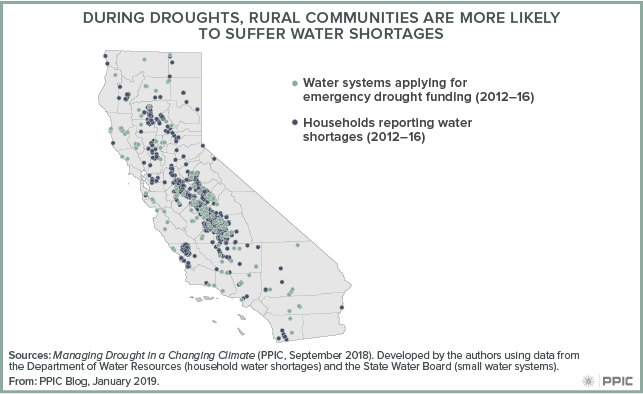
Rural residents are more vulnerable to running out of water during droughts because they are more likely to rely solely on groundwater from small community wells or domestic wells. These wells tend to be relatively shallow, so they are susceptible to running dry when pumping lowers groundwater levels. During the 2012‒16 drought, farmers and cities pumped extra groundwater to make up for surface water shortages. Thousands of wells went dry―mostly domestic drinking water wells in rural communities, especially in the San Joaquin Valley. And roughly 150 small community water systems sought emergency assistance to keep the taps flowing.

Although the state’s Sustainable Groundwater Management Act (SGMA) is expected to lead to balanced groundwater use and reduce over-pumping in the long term, California’s highly variable climate means that groundwater levels will still drop during droughts. This could result in more drinking water wells going dry. In a recent submission to the California Water Data Challenge, several colleagues from UC Davis and I found that a drought similar to the latest one could cause more than 4,000 domestic wells to go dry in the Central Valley.

A recent PPIC report on managing drought in a changing climate offers two ideas for reducing these risks:

  • Develop drinking water plans for rural communities and identify durable funding sources. Small rural systems do not have the financial capacity for drought planning and mitigation. State and local partners should use their experience from the recent drought to identify communities at highest risk, connect them to larger systems where feasible, and devise drought response programs for the others with reliable funding sources. The newly formed groundwater sustainability agencies, working with local partners such as counties and agricultural and urban dischargers, could help coordinate actions and streamline funding mechanisms.
  • Ensure groundwater sustainability plans include mitigation actions for dry drinking wells. Sustainability plans should describe preparation for groundwater drawdowns during severe drought similar to the one in 2012‒16. For instance, as groundwater sustainability agencies develop their plans, mapping drinking water wells that might be at risk for different drought scenarios and proposing mitigation actions that proactively decrease the risks are both imperative.

Studies of institutional responses to the latest drought largely find that planning for drought response and recovery paid off. Making an action plan to avoid further water-supply risks in disadvantaged rural communities―as well as identifying reliable funding mechanisms to implement it―should be top priorities for California policymakers.
Tackling Safe Drinking Water in the San Joaquin Valley

Unsafe drinking water is a significant problem in parts of California, especially in small, disadvantaged rural communities. We talked to Maria Herrera—a California water commissioner and community development manager at Self-Help Enterprises—about how to tackle this ongoing problem.

Maria HerreraPPIC: What’s behind California’s safe drinking water problem?

Maria Herrera: Too many California residents still lack access to safe drinking water. In the San Joaquin Valley, drinking water delivered by small water systems and private domestic wells is contaminated by many natural and manmade contaminates. Typical water quality issues for valley communities are contamination from nitrate, arsenic, uranium and a chemical called 1,2,3-TCP. Small community systems and private well owners often don’t have the resources to address these issues. They face a lot of challenges—for starters, they have little to no staff and lack the resources to maintain or upgrade aging infrastructure. Some rely on just one or two wells. Historically, these communities haven’t been prioritized for state funding or in planning processes.

PPIC: How should we be tackling this problem?

MH: I grew up in communities experiencing these problems and have worked on these issues for more than 10 years, and I’ve seen a big shift in visibility over safe drinking water in recent years. California has taken a number of steps to address the problem, especially with the passage of the human-right-to-water law (AB 685), which makes it state policy that every Californian should have safe and affordable drinking water. That was the biggest signal that this issue is now being prioritized. Also, Proposition 1 prioritized safe drinking water in disadvantaged communities by increasing technical assistance funding and giving communities an opportunity to hire consultants to develop shovel-ready projects and fund safe drinking water projects.

We need to continue on that path in order to make these communities less vulnerable to drought. We need to not only fund mitigation of contaminated wells and treatment plants, but also help communities develop redundant water sources, promote consolidation of small systems to larger ones, and help them with drought contingency planning. Communities need guidance and technical assistance in order to develop solutions and participate in water planning.

This year California came close to establishing a safe drinking water fund, which would have created an ongoing fund for disadvantaged communities to improve their water infrastructure and clean up contamination. A safe drinking water fund is still a priority for drinking water advocates going forward.

PPIC: How might the Sustainable Groundwater Management Act (SGMA) affect the safe drinking water effort?

MH: SGMA creates a good opportunity for people to come together and identify ways to protect and improve drinking water supplies. But achieving sustainability will bring some tough decisions and will have some impact on agriculture. We want farmers to thrive—and rural communities to have adequate water supplies. SGMA provides groundwater sustainability agencies (GSAs) an opportunity to play a very meaningful role in improving groundwater supplies. We’d like to work with GSAs and communities to develop joint solutions, improve coordination between GSAs and the agencies that work on water quality, and ensure that good information is available regarding groundwater supplies used by these communities. We’d like to encourage GSAs to look more closely at domestic wells. We’re trying to encourage them to develop more protections for vulnerable communities. Our ultimate objective is to ensure that rural communities have the information and resources they need to play a meaningful role in developing and implementing their groundwater sustainability plans.

PPIC: What gives you hope?

MH: I’m inspired by the interest of rural residents in building capacity and leadership skills to engage on water issues. There’s a new generation of young adults that know the issues, have lived in impacted communities, and are now ready to a make change in their communities by participating in water management and planning. I’m also energized by the partnerships we’ve helped establish between the communities, irrigation districts, cities, and agencies. It gives me hope that they are interested in finding common ground. And, I’m  encouraged by the attention the issue is getting at the state level—the legislature, governor, the voters have all shown interest in funding propositions and programs that will help bring safe water to these communities.

Watch a video with Maria Herrera and other panelists discussing managing drought in a changing climate.

New Laws on Drought, Forests, and Safe Drinking Water

The legislative session that just wrapped up addressed a number of water and forest management issues. Progress was made in three major areas—urban drought management, forest health, and safe drinking water.

Urban water use efficiency and drought management: Assembly Bill (AB) 1668 requires the State Water Board and the Department of Water Resources to adopt long-term efficiency standards for residential water use and efficiency metrics for commercial, industrial, and institutional water use by June 2022. The law complements Senate Bill (SB) 606, which requires urban water suppliers to develop local water use budgets by November 2023. Progress toward those objectives will be overseen by state agencies. SB 606 also strengthens local drought planning requirements and increases transparency of information about drought risks and responses. The law requires suppliers to regularly analyze the risk of a five-year severe drought and report short-term water shortage risks and responses to the state each spring. Suppliers must also revamp their drought response plans to include new elements such as descriptions of supply forecasting procedures, new ways of reporting water shortage levels, and protocols for communicating with customers during droughts. AB 1668 also includes provisions to increase drought preparedness for small rural water systems and large agricultural water suppliers.

Wildfires and forest management: SB 901 takes substantive steps toward reducing wildfire risks by increasing the pace and scale of forest health improvements. Cal Fire will have access to new, stable funding from cap-and-trade revenues—$200 million per year for five years—to pay for forest management. The law also helps lower management cost barriers for family forest owners, which occupy about one-quarter of the state’s headwater forests. It relaxes some timber harvest regulations to make it easier for these owners to reduce wildfire risk. A provision that increases the size of trees owners can harvest should expand their ability to raise funds from selling timber. The law also allows multiple landowners to work under the same timber harvest permit. Finally, SB 901 includes provisions that apply to forests managed by the US Forest Service, which make up more than half of our headwater forests. In particular, it streamlines California’s environmental permitting process for collaborative fire risk reduction projects on federal lands that are approved under the federal National Environmental Policy Act.

Safe drinking water for vulnerable communities: Drinking water received significant attention this year, as lawmakers attempted to fill the funding gap for small disadvantaged communities facing water quality and quantity problems. Proposals to tap urban water customers and agricultural fertilizer users for safe drinking water funds ultimately failed in the legislature. However, new laws signed by the governor will strengthen tools for addressing drinking water quality issues. AB 2501 increases the State Water Board’s ability to require the consolidation of vulnerable water systems with larger, more reliable systems. The new law expands the board’s authority to require the consolidation of communities served by domestic wells. AB 2501 also extends the board’s authority over support services to help communities provide safe drinking water where consolidation is not an option. Another new law, AB 2541, gives severely disadvantaged communities expanded access to the Drinking Water State Revolving Fund for water infrastructure projects. The law makes it easier for the board to provide full grant funding in addition to low-interest loans.

The governor also signed more than a dozen other bills related to water, in areas such as sewer system consolidation, on-site treatment regulations and rules for the reuse of non-potable water, and the establishment of an office within the State Water Board to help address water-rights matters.

We will keep track of updates and new proposals in 2019.

Connecting Water Systems for Safe Drinking Water

Although most Californians have safe drinking water supplies, pockets of unsafe or inadequate water remain in parts of the state. Persistent water quality challenges mostly affect smaller, economically disadvantaged rural communities. About 90% of the affected water systems distribute water to fewer than 3,300 people each; most are very small, serving fewer than 500 people. Some small communities also face water shortages because their wells went dry during the latest drought. Solutions are financially out of reach for many poor communities, which lack resources and economies of scale to pay for expensive new treatment and supply facilities.

However, the state is actively encouraging one solution: the consolidation of smaller systems into larger ones. Consolidation can occur physically, by extending service connections to these communities, or administratively, by sharing managerial resources. Both approaches can improve the reliability and quality of water in a cost-effective, long-term manner. A 2015 law gives the State Water Board authority to mandate mergers if necessary. There have been 11 mandatory consolidations since then and more are pending. Voluntary consolidations are also on the rise: since the beginning of 2017, there have been 72 mergers.

Although consolidations can reduce costs over the long run, they entail some up-front expenses. Financial assistance is available in the form of state bonds, revolving funds, and some federal programs. Proposed legislation would create a new source of funding (from a voluntary donation on water bills and fees on agricultural chemicals) that would also provide resources. Several state bonds approved over the past decade dedicate funds for this purpose, and Proposition 3 on this November’s ballot would allocate an additional $500 million for infrastructure improvements that ensure access to safe drinking water.

To receive state funding, a water system that plans to extend safe water to a disadvantaged community typically applies for grants that support planning and construction costs as well as technical assistance. The Drinking Water State Revolving Fund (DWSRF) has supported a number of successful consolidation projects, such as one in Sutter County, where four water systems—including an elementary school—had ongoing arsenic and nitrate violations. DWSRF grants, in addition to funds from Yuba City, were used to finance the connection to Yuba City’s public water system, giving 995 people access to clean and reliable drinking water.

Getting grants can be challenging. The application for planning and construction is a complex, multi-year process, and many small, disadvantaged communities lack the capacity to navigate the application process. The State Water Board, along with some local organizations and programs, are helping affected communities with this process. The State Water Board also offers financial incentives to larger water systems that voluntarily consolidate with these communities, but additional support may be needed to encourage more widespread participation in consolidation programs.

While there are sources to finance capital improvements, other important needs are currently overlooked, including support for operation and maintenance costs, protections against unaffordable water rates, and legal services for consolidation.

Drinking water vulnerabilities in disadvantaged rural communities could worsen with climate change, and more can be done to encourage and streamline the consolidation process. There is growing awareness and action around providing safe and reliable drinking water to all Californians. With dependable funding and a clear state-level action plan, this goal could be achieved in the near term.

Paying for Water’s “Fiscal Orphans”

California’s water system is generally well funded and adequately maintained, but there are a few areas that lack a steady funding source. The most prominent of these “fiscal orphans” are safe drinking water for disadvantaged rural communities, flood management, stormwater management, and water for the environment. We talked to Dean Misczynski, an expert in infrastructure financing and an adjunct fellow with the PPIC Water Policy Center, about how to create a more reliable funding stream to address these problems.

PPIC: Are there better ways to pay for California’s underfunded “fiscal orphans”?

Dean Misczynski: Water is one of the easier things in government to pay for, because you can sell it. Local water fees and local taxes pay for most spending on water in California. State voter-approved general obligation bonds also play a pretty big role. But our thinking about how to use state bond acts developed sometime around the Civil War, and we could do a better job using bonds to fund 21st-century realities.

We currently use bond acts to raise the capital needed to build projects. But funding for the operation and maintenance costs of those projects is expected to come from somewhere else―or nowhere. No sensible business thinks this way; capital funding and operations and maintenance should be part of a unified financing plan. In addition to authorizing borrowing money for specified purposes, a state bond act could easily include ongoing expenses by appropriating money from the General Fund to pay for the operation and maintenance needed to make the project work. This approach would offer a more business-like, coherent financing plan and give voters a more honest look at what the undertaking would really cost.

To be clear, the operations and maintenance budget would not be part of the borrowing authorized by the bond act, because that would be an expensive way to pay for ongoing costs. But the funding would be earmarked and committed for the long term. And note that this doesn’t call for a new tax or fee; it just requires an ongoing commitment to use some General Fund dollars to cover the ongoing costs. In this way it’s similar to the bond itself—repayment comes from the General Fund, which ultimately comes from existing taxes.

PPIC: What types of issues would this approach be especially appropriate for?

DM: It’s best in situations where there aren’t good ways to cover operations and maintenance for projects funded by the bond. If we were to take this idea seriously, we’d want to do some careful thinking to identify the most legitimate uses of this new authority and to caution against using it for unnecessary or unwise purposes.

So, for example, a relatively well-off community getting a bond-funded project wouldn’t need state money for ongoing expenses. But for a water system in a very poor community, this type of funding mechanism could be very useful. There are a number of small, disadvantaged communities in the Central Valley that can’t afford to upgrade or maintain parts of their water system and that lack safe drinking water as a result. They might be good candidates.

These types of appropriations could also pay for ongoing expenses for projects that are important and have political support, but are easy targets for cuts during the state’s inevitable next recession. Two examples that come to mind are maintaining watershed areas, and data collection and analysis to improve water management.

This approach wouldn’t just be useful in the context of water—it could help with the transportation sector, low-income housing, and other statewide challenges. And it could be used as a model for local bond funding as well.