Video: Celebrating 100 Years of Women in the California Legislature

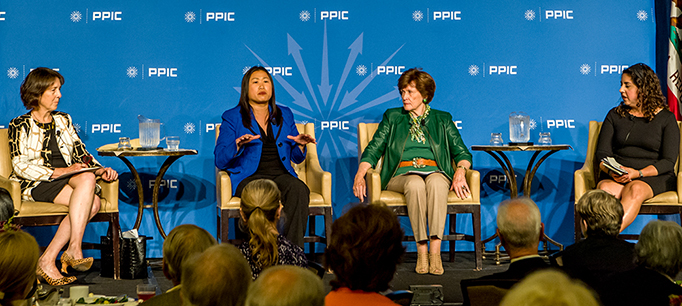
At a recent PPIC event celebrating the centennial year of women in California’s statehouse, female legislators shared stories of how they broke through the political glass ceiling.

The session opened with a conversation between Toni Atkins, the first woman and first openly LGBTQ leader of the state senate, and Mark Baldassare, president and CEO of PPIC. Their talk ranged from the professional to the personal.

Atkins listed her top legislative priorities as emergency services and disaster preparedness. It’s a “new normal” we have to grapple with, she added. Atkins also wants to continue her focus on housing and homelessness, which she called a “humanitarian crisis.”

When Baldassare asked how the #MeToo movement might change the Sacramento culture, Atkins said change “doesn’t happen overnight” but that she wants “more than anything not to lose this moment, because . . . it may not come again for some time.”

Key to Atkins’s leadership style is to listen well and value other points of view. California has a progressive bent, but in today’s political climate, “we’ve left some voices behind,” she said.

This centennial offers a reminder that women remain underrepresented in the legislature. Although they comprise more than half of California’s likely voters (53%), they make up just 23% of its legislators. A panel of lawmakers discussed that imbalance in a conversation moderated by New York Times correspondent Jennifer Medina.

Becky Morgan, a state senator from 1985 to 1993, recalled setting up the first committee on early childhood. She was also the first female legislator to wear pants on the senate floor. It wasn’t an act of protest—it was simply “a cold January morning,” Morgan said, drawing laughter from the audience.

State senator Janet Nguyen recounted her stint as the first woman to chair the Orange County Board of Supervisors and the first to lead its meetings while pregnant—which “shocked” a few supervisors, she said. Despite the daily challenge of balancing work and family, Nguyen said, “I’m not going to give up family or career. I want both!”

All the panelists agreed that gender diversity was essential to effective state leadership. State senator Nancy Skinner agreed that we need more family-friendly policies in the state, but she emphasized that women should also champion issues related to their areas of expertise—in her case, criminal justice reform and climate change. Her view on women serving in the legislature? “It’s just right,” she argued—which led to sustained applause.
The 100th Anniversary of Women in the California Legislature

The Public Policy Institute of California is hosting a public event in Sacramento to commemorate the election of the first women to the California Legislature in 1918. Today, with Toni Atkins as the first woman in the powerful position of senate president—and in the wake of the capitol’s sexual misconduct scandals—we want to offer some reflections on the status of women in California’s statehouse.

First, it’s important to point out that the legislature has far fewer women than men at a time when women have an edge over men in voting. Women now make up slightly more than half of California’s likely voters (53%). This edge persists across racial/ethnic groups: women make up more than half of African American (57%), Latino (57%), white (52%), and Asian American (51%) likely voters. Across parties, women make up 62% of Democratic likely voters, 49% of Republican likely voters, and 44% of independent likely voters.

But the predominance of women voters is not reflected in the composition of the California Legislature. After the path-breaking elections of 100 years ago, the following decades saw relatively few women serving in the assembly. And it wasn’t until 1966 that women of color won assembly seats. A decade later, the first woman was finally elected to the state senate. The top two leadership roles in the assembly and senate were filled even more slowly. No woman held the assembly Speaker position until 1995—and that was for only three months. The next woman Speaker wasn’t elected until 2008.

Legislative term limits—passed by voters in 1990—were partially conceived as a path toward increasing diversity in the statehouse. But in the nearly 30 years since—an era that has been defined by California’s increasing ethnic and racial diversity, and Democratic leanings—there has been little change. The proportion of women in the legislature has ranged from a low of 18% in the 1991–92 session to a high of 31% in the 2005–06 session; overall, the average has hovered around 25%. A slew of recent reforms such as independent legislative redistricting, the top-two primary, and additional legislative term limit reforms—as well as efforts to encourage voter registration and voting—have had little impact.

Today, the proportion of women in the California Legislature stands at 23% and is similar in both houses. However, Republicans trail Democrats in the proportion of women legislators, with 6 women among the 38 Republican members and 22 women among the 79 Democratic members.

Surprisingly, California is a laggard in this area. Although a 2018 Rutgers University report finds that 25.4% of state legislators across the US are women, California ranks just 32nd out of the 50 states, close to the next-largest state, Texas (#35, 20.4%). Compared to our western neighbors, California is well behind Arizona (#1, 40%), Nevada (#3, 38.1%), Oregon (#8, 33.3%), and Washington (#5, 37.4%).

The lack of gender diversity in the California Legislature raises serious questions about the effects of political representation. What is the impact of the gender gap on equitable and effective policymaking? What are the greatest barriers for women in political careers? Will electing more women to legislative office provide inspiration and pathways for others—and help to build a more inclusive culture? One thing is certain: California’s current gender gap has consequences for the ability to recruit and retain top talent in the legislature today.