What did the catastrophic hurricane season of 2017 tell us about how we’re managing flood risk? We talked to Nicholas Pinter—a flood and floodplains expert at the UC Davis Center for Watershed Sciences and a member of the PPIC Water Policy Center research network―about improving flood management.
 PPIC: Why did Hurricane Harvey result in so much damage to Houston?
Nicholas Pinter: Houston has had very bad land use planning—it is built on flood-prone land, and its inadequate storm drainage makes flooding worse. Combine these glaring flood-management flaws with the unprecedented rainfall that Harvey brought and you’ve got a truly epic flood disaster. Harvey’s damage is clearly a product of both human choices and the storm’s intensity.
The number and magnitude of recent extreme storms are consistent with predictions for a changing climate. There’s a nagging feeling among some of us who study flood disasters that maybe we’ve reached a sort of tipping point, with short-duration storms dumping unprecedented rainfalls. Harvey may be an example of this. And if it is happening, our window of opportunity to improve flood systems may be shrinking.
PPIC: What are your top priorities for reducing flood risk?
NP: One thing that scientists, floodplain managers, and many politicians agree on is that we must limit floodplain development. A lot of the damage from Harvey was supposed to be prevented by the National Flood Insurance Program (NFIP). But the program failed in Houston in large part due to the failure of its primary goal—to discourage development in floodplains.
With the enactment of the NFIP in 1968, the US government agreed to provide subsidized flood insurance in exchange for local controls on building in floodplains. Communities that prohibit development on their floodplains can get underwritten insurance through the program (private flood insurance options are very limited).
But enforcement of the NFIP’s floodplain rule is very mixed across the US. A good example is Illinois. For the past 25 years, that state has aggressively enforced floodplain regulations and limitations. On other end of spectrum is Texas, where they embraced development and seemed to see floodplain limitations as job killers. Differences in enforcement explain many of the documented differences in flood damages and flood resilience.
PPIC: How are we doing on flood management in California?
NP: California is doing a lot of things right, and is learning from its past mistakes. A lot of money has been invested in improving levees. California is enforcing NFIP standards and trying to limit new construction on its floodplains (though with exceptions). But the Oroville crisis was a big wake-up call. If the emergency spillway had failed—and we were within hours of it—Oroville could have been a lethal disaster similar to Katrina. All eyes are now on aging dams as well as levees.
One issue I’d like to see improvement on is flood insurance. While many other states are net recipients of NFIP, California receives something like 14 cents on every dollar it pays in premiums to the program. This appears to reflect California’s more rigorous effort to limit flood damage in its floodplains.
FEMA (the Federal Emergency Management Agency) recognizes wide differences in NFIP enforcement nationwide and has proposed a national disaster deductible to push back on states with poor enforcement and benefit those doing a good job. A second option being considered is a state-by-state rating system. And yet another option is for California to create its own flood insurance vehicle.
PPIC: Is there an argument for learning to live with flooding and rebuild after disaster strikes?
NP: A century ago the strategy was largely to live with floods. People clustered near rivers and had a tolerance for getting their feet wet occasionally. Fast forward to current times: a big leap in the density and value of infrastructure has greatly diminished that tolerance.
It’s very easy to creep forward gradually onto floodplains and much harder to back away from the flood hazard this brings. So the first and most valuable lesson is to stop creeping forward and strictly limit new floodplain development. In some cases, opportunities exist to set back levees and reconnect rivers to their floodplains. These kinds of efforts often can provide valuable, multi-layered benefits.
Read “What Recent Hurricanes Mean for Flood Insurance in California” (PPIC Blog)
Read Floods in California (PPIC fact sheet)
Watch our 3-minute video “Floods”

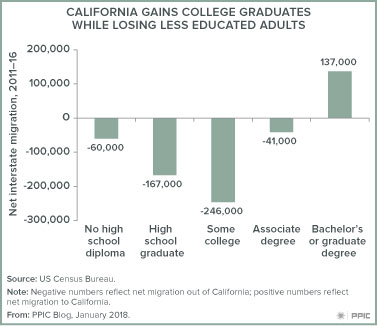 College graduates come to California from all over, but seven states send California substantially more college graduates than they get in return. Between 2011 and 2016, net gains of college graduates from New York (45,000), Illinois (32,000), New Jersey (20,000), Pennsylvania (17,000), Michigan (15,000), Florida (14,000), and Massachusetts (14,000) totaled more than 150,000. California experienced sizable net losses of college graduates to just four states: Texas (-26,000), Oregon (-20,000), Nevada (-14,000), and Arizona (-11,000).
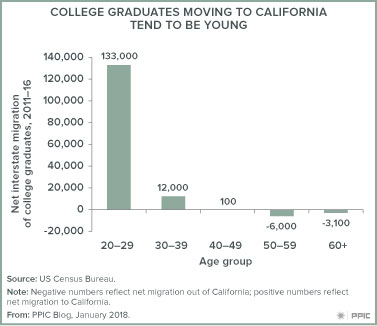 The migration of young college graduates to California is a consequence of the state’s growing demand for highly skilled and highly educated workers. But the numbers are not high enough to meet the state’s changing needs. PPIC’s research has shown that