Reducing Drought Risks in Rural Communities

Disadvantaged rural communities are disproportionately exposed to drinking water risks in California. Too many experience insecure supplies and contamination of their water sources. While there are growing efforts by policymakers to address water contamination, many communities will need further help to prepare for future droughts. Improved planning efforts could help avert water shortages.

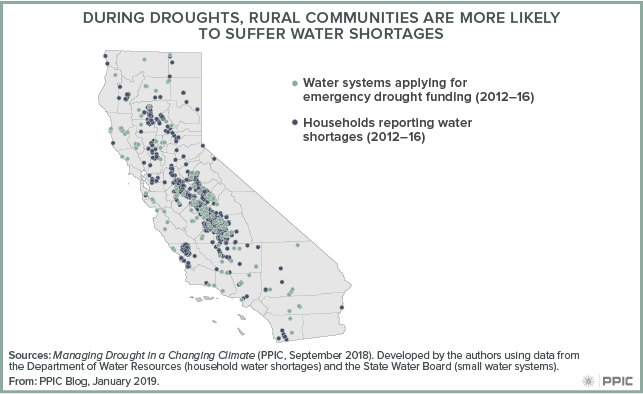
Rural residents are more vulnerable to running out of water during droughts because they are more likely to rely solely on groundwater from small community wells or domestic wells. These wells tend to be relatively shallow, so they are susceptible to running dry when pumping lowers groundwater levels. During the 2012‒16 drought, farmers and cities pumped extra groundwater to make up for surface water shortages. Thousands of wells went dry―mostly domestic drinking water wells in rural communities, especially in the San Joaquin Valley. And roughly 150 small community water systems sought emergency assistance to keep the taps flowing.

Although the state’s Sustainable Groundwater Management Act (SGMA) is expected to lead to balanced groundwater use and reduce over-pumping in the long term, California’s highly variable climate means that groundwater levels will still drop during droughts. This could result in more drinking water wells going dry. In a recent submission to the California Water Data Challenge, several colleagues from UC Davis and I found that a drought similar to the latest one could cause more than 4,000 domestic wells to go dry in the Central Valley.

A recent PPIC report on managing drought in a changing climate offers two ideas for reducing these risks:

  • Develop drinking water plans for rural communities and identify durable funding sources. Small rural systems do not have the financial capacity for drought planning and mitigation. State and local partners should use their experience from the recent drought to identify communities at highest risk, connect them to larger systems where feasible, and devise drought response programs for the others with reliable funding sources. The newly formed groundwater sustainability agencies, working with local partners such as counties and agricultural and urban dischargers, could help coordinate actions and streamline funding mechanisms.
  • Ensure groundwater sustainability plans include mitigation actions for dry drinking wells. Sustainability plans should describe preparation for groundwater drawdowns during severe drought similar to the one in 2012‒16. For instance, as groundwater sustainability agencies develop their plans, mapping drinking water wells that might be at risk for different drought scenarios and proposing mitigation actions that proactively decrease the risks are both imperative.

Studies of institutional responses to the latest drought largely find that planning for drought response and recovery paid off. Making an action plan to avoid further water-supply risks in disadvantaged rural communities―as well as identifying reliable funding mechanisms to implement it―should be top priorities for California policymakers.
2020 Census: Counting Orange and San Diego Counties

The decennial census plays an essential role in American democracy. Our series of blog posts examines what’s at stake for California and the challenges facing the 2020 Census, including communities that are at risk of being undercounted.  

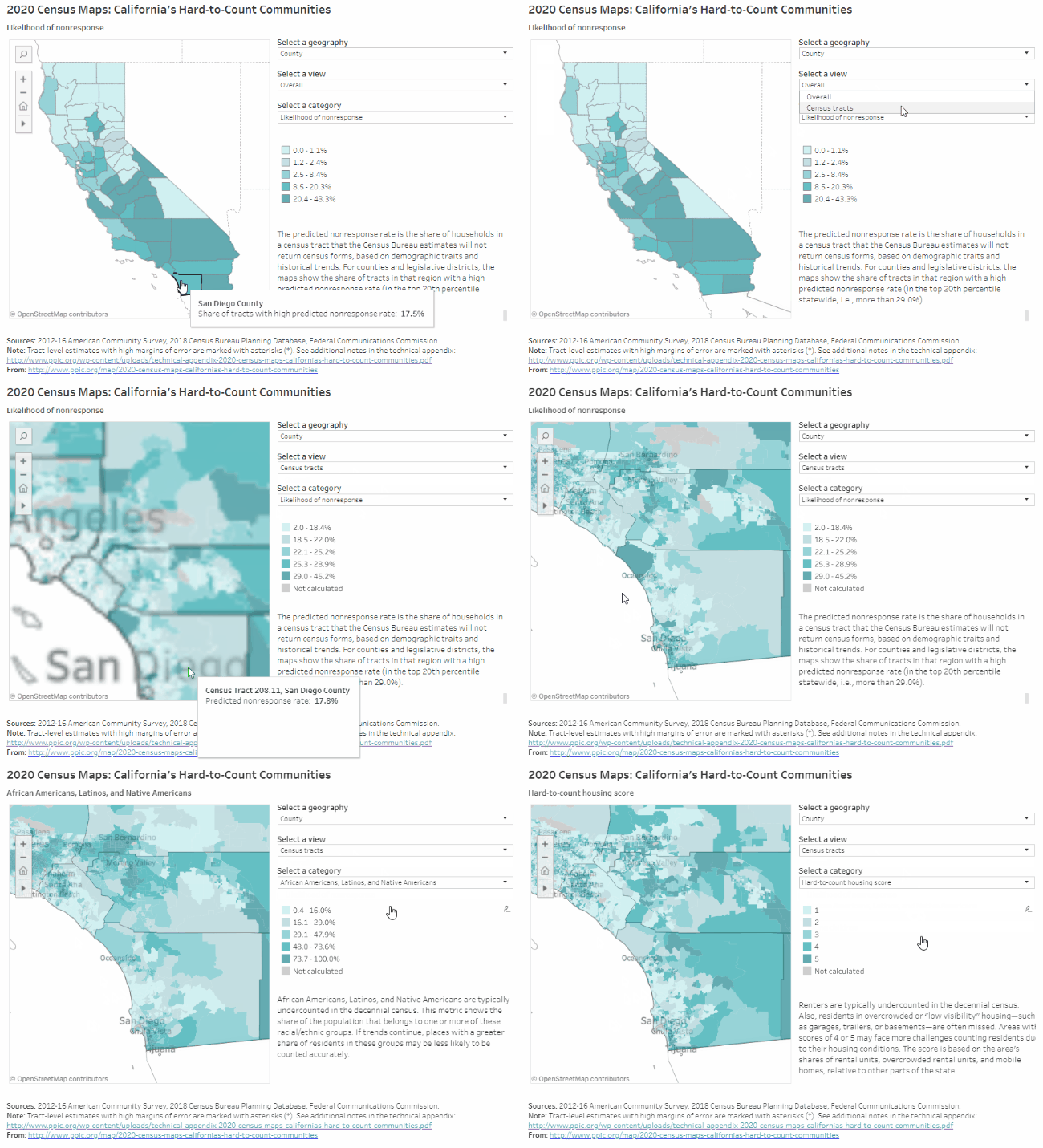
PPIC’s interactive census maps are an important tool for Californians working to ensure an accurate census count. Using estimates from the Census Bureau and the Federal Communications Commission, they highlight hard-to-count communities across the state and pinpoint reasons why certain areas may be hard to reach.

More than 6.5 million Californians live in Orange and San Diego Counties. In Orange County, the hardest-to-reach neighborhoods are found in Anaheim, Buena Park, Santa Ana, and Tustin. In San Diego County, the hardest-to-count areas include parts of Oceanside and Escondido in the northwest and, in the southwest, pockets of the cities of San Diego and Chula Vista. Altogether, San Diego County has a higher share of these very hard-to-count areas (18% of census tracts) than Orange County (11%), according to Census Bureau estimates that draw on demographic characteristics (e.g., race/ethnicity, age, citizenship, and housing conditions) and historical trends. Both counties have higher shares of these areas than 60% of counties, statewide. Households in these very hard-to-count areas are the least likely to respond initially to census forms and are therefore at risk of being undercounted.

Some highlights:

  • Undercounting hard-to-reach areas could affect political representation in the region. Since the 2020 Census will be used to redraw legislative district lines, political representation could shift away from certain neighborhoods if they are undercounted relative to other areas. For example, in Assembly District 80 (Gonzalez Fletcher), which covers southern parts of the cities of San Diego and Chula Vista, as well as a stretch of the southern border with Mexico, 52% of households are predicted to not respond initially to the census—compared to 19% in the surrounding districts.
  • Knowledge of local population trends can help guide effective outreach. Some neighborhoods in the region have higher concentrations of African Americans, Latinos, or Native Americans—populations that have historically been undercounted in the census. Latinos make up the large majority of residents around Anaheim and Santa Ana in Orange County, as well as in parts of the cities of San Diego and Chula Vista in San Diego County. In some of these same neighborhoods, more than a quarter of residents are noncitizens, who may be less likely to respond in 2020 due to the planned addition of a citizenship question. Moreover, in central and eastern parts of San Diego County, working with tribal governments to reach Native Americans will be necessary to count all residents.
  • Housing conditions may present challenges to an accurate count, particularly in urban areas. Renters and people living in overcrowded conditions or mobile homes can be harder to count accurately. Hard-to-count housing in the region is concentrated in urban parts of Orange County and in urban and eastern San Diego County. For example, in several neighborhoods in Anaheim, Stanton, and Santa Ana in Orange County, more a quarter of rentals are overcrowded. The same is true for many neighborhoods in the southwest corner of San Diego County, which also often have high shares of mobile homes. San Diego County has hard-to-count housing in inland areas as well, including in Bostonia, El Cajon, and several tribal lands.
  • The region has small pockets of relatively low internet access. The Census Bureau plans to collect most responses online in 2020—a change from previous practice. Though urban areas generally have better internet access than rural areas do, a number of neighborhoods in the cities of San Diego and Chula Vista actually have fewer high-speed residential internet connections than the surrounding suburbs. Central and eastern San Diego County also have relatively low internet connectivity. In these places, it may be harder to collect responses online, and participation will rely more heavily on paper forms, in-person census takers, or internet provided by local institutions.

We hope these maps serve as a starting point to help local, regional, and state leaders think about which activities, resources, and partnerships—including language assistance, awareness raising, and community outreach—might be most effective for accurately counting different parts of California. Stay tuned for future posts that examine hard-to-count communities in other regions of the state.

Making Career Education Affordable in California

Secretary of Education Betsy DeVos recently announced plans to eliminate rules put in place during the Obama administration that require career-education colleges to show that the credentials they award lead to gainful employment. In California, these rules have helped shift enrollment from expensive for-profit institutions to public community colleges, which offer career education programs at much lower cost. Indeed, California’s community college system is one of the most affordable higher education institutions in the country.

Many are concerned that eliminating gainful employment rules will lead to a loss of accountability and even a resurgence of enrollment in for-profit colleges. Some of those colleges have engaged in predatory recruiting practices, and many have high dropout rates and exorbitant student debt. In California, there are also concerns about a reversal of recent gains in affordable access to higher education—particularly among groups that have historically been underserved.

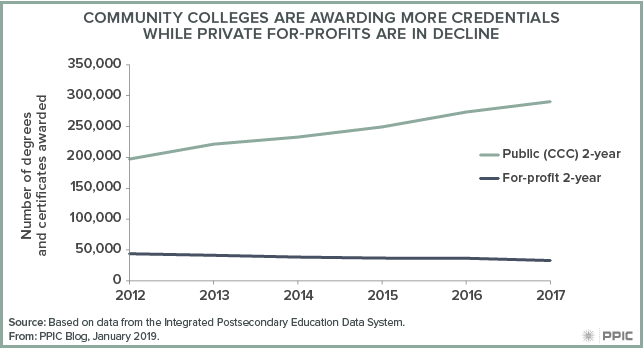
Partly because of the information provided by the gainful employment rules, career education students in California have been increasingly seeking degrees and certificates at the state’s large public community college system rather than at for-profit colleges. Between 2012 and 2017, the number of associate degrees and certificates conferred by for-profit institutions dropped by 25%. In comparison, the state’s community colleges saw an increase of 47%; in 2017, the number of degrees and certificates they awarded was more than eight times the number awarded by for-profit colleges.

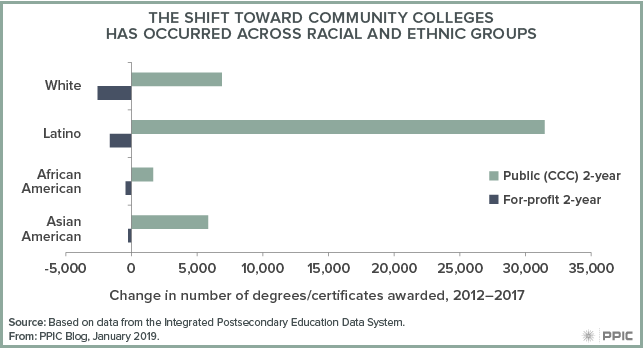
Many for-profit institutions have targeted workers looking to get into in-demand fields such as health or family and consumer sciences. These for-profits have marketed options that lead to credentials—known as short-term certificates—that can be earned in less than one year. In 2012, private for-profit colleges awarded almost 21,000 short-term certificates compared to 38,000 awarded at the community colleges. But by 2017 the number of short-term certificates awarded had declined to fewer than 7,000 at for-profit colleges and risen to more than 55,000 at the community colleges. Many of the students who have shifted to the community colleges in recent years are from historically underserved backgrounds (e.g., African American, Latino, older, and low-income students). These students now have opportunities for career education without the hefty price tag attached to programs at for-profit colleges.

The elimination of federal gainful employment rules could have a negative impact on affordable access to career education. However, efforts by California’s community colleges to attract students who might be drawn to for-profit institutions will continue. So too will state rules that make institutions with low graduation rates and high loan default rates ineligible for Cal Grants. These state-level initiatives might not be able to prevent a resurgence of exploitative for-profits, but they could make a difference for many Californians.

PPIC Turns 25

Times were tumultuous in the California of the 1990s: recession, strife over police-community relations, a voter revolt that ushered in term limits, contentious immigration debates.

There was an urgent need to address these and other issues that affected every Californian. But government had few resources to research the facts and perform the analysis necessary to help leaders to make informed decisions. PPIC was born of this need. Twenty-five years later, the necessity of nonpartisan, fact-based research has never been greater.

PPIC was founded by three exceptional leaders: Roger W. Heyns, former chancellor of University of California, Berkeley; Arjay Miller, former president of Ford Motor Company and former dean of Stanford Business School; and William R. Hewlett, co-founder of Hewlett-Packard Company. These visionaries wanted to help California’s leaders better understand policy issues through objective, evidence-based research. An endowment by Hewlett made their vision of a nonpartisan, nonprofit think tank a reality.

In 1994, the year PPIC was founded, a major earthquake shook Northridge; Orange County became the largest municipality in US history to file for bankruptcy; and California voters passed Proposition 187, which would have banned undocumented immigrants from using public services. The proposition was later declared unconstitutional, but the issues it raised and the backlash it created have powerfully influenced politics and policy ever since.

The issues that surfaced in the ’90s were complex, challenging—and are still with us, even though the state’s demographics, economy, and political climate have changed. PPIC has grown and evolved because it was built to be relevant and resilient. As the state has dealt with a gubernatorial recall, a major recession, and a lengthy drought, our work has evolved to meet its changing needs.

During the recent drought, we created the PPIC Water Policy Center to help spur innovative water management solutions. After our research demonstrated that California is not producing enough college graduates to meet the needs of our future economy, we founded the PPIC Higher Education Center. Our work there is focused on finding practical solutions that enhance educational opportunities for all Californians.

We do not do this work alone. PPIC has developed an extensive network of advisors and other engaged Californians to ensure our relevance, expand our reach, and deepen our impact. Our colleagues in local, state, and federal government often put our research into practice. Our board of directors and statewide leadership council provide us with valuable insights, and members of the business and nonprofit communities serve as our ambassadors.

In this year of transition, PPIC will be an essential resource for new leaders—the governor, legislators, members of Congress, and others who care deeply about public policy. We will offer analysis and advice on a number of key topics. Through the PPIC Statewide Survey, our leaders will regularly have the opportunity to find out what the public thinks of new policies and proposals.

In our Speaker Series on California’s Future, we plan to draw on the vast experience of past leaders by inviting all living former governors to share the stage. They will talk about lessons they have learned and offer their thoughts about the state’s future.

PPIC’s first 25 years have been exciting, rewarding, and challenging. We expect no less of the next 25—and we invite you to join us by keeping up to date with our activities and offering your support.