Drinking Water Quality: Perceptions and Challenges

Months after lead contamination in the drinking water of Flint, Michigan, gained national attention, the PPIC Statewide Survey asked if Californians think drinking water pollution is a more serious health threat in lower-income areas than in other parts of their regions. In the July survey, about 6 in 10 adults statewide said “yes,” including majorities across regions.

There is evidence to support this view. Contamination of drinking water continues to be a serious health risk for small water districts serving low-income customers, especially in rural parts of the state. Despite recent progress in building a stronger water safety net, this is a problem lacking a long-term policy solution.

As estimated in the PPIC Water Policy Center’s report Paying for Water, roughly 80,000 to 160,000 Californians live in small economically disadvantaged communities that struggle to provide safe drinking water on a consistent basis. A key part of this challenge is the dependence of many small rural water districts on groundwater that contains naturally occurring or man-made contaminants at levels unsafe for human consumption.

Cost is a key factor. Removing contaminants like arsenic or nitrate from groundwater requires large up-front expenditures, technical and managerial expertise, and the ability to cover long-term operational costs. In most water districts, these costs are borne by rate-paying customers. Small water districts serving low-income communities struggle to pay for this kind of ongoing drinking water treatment because they have higher costs per household than their much larger counterparts, and their customers can’t afford high rates.

In recent years, California has increased the amount of financial and technical assistance for improving access to safe drinking water in these communities. The state provides financial assistance through emergency spending (in response to the ongoing drought, for example), competitive grant-based awards from multiyear general obligation bonds such as Proposition 1, or low-interest loans and grants through the state revolving fund. But long-term solutions will require funding mechanisms that are more accessible, reliable, and sustainable. For example, the state General Fund or a statewide surcharge on water use could help solve this social equity issue. It will also be important to invest in solutions that are cost-effective and that communities can manage well over time. That’s an argument in favor of connecting these small systems to larger ones wherever feasible—something now under way in East Porterville and some other Central Valley communities.

The PPIC Statewide Survey finds that, while a majority of Californians see drinking water quality in lower-income areas as a serious health threat, there are wide differences among demographic and voter groups. Fewer than half of Republicans, whites, high-income Californians, or likely voters see this as a problem. On the subject of drought response, however, solid majorities across these groups (and 6 in 10 adults overall) say state and local governments are not doing enough. This eagerness for government action, coupled with policymakers’ willingness to address long-term water problems, may pave the way for solutions to drinking water contamination in vulnerable communities.

Learn more

Read “California’s Water Quality Challenges” (PPIC Water Policy Center fact sheet, October 2015)
Read “Building a Better Water Safety Net” (PPIC Blog, October 21, 2015)
Read “Flint, a Water Quality Reminder for California” (PPIC Blog, January 27, 2016)
California’s Ecosystems in Perpetual Drought

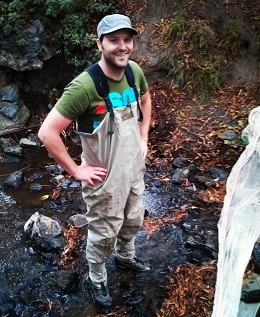
Freshwater species—especially fish—are in trouble, and it’s not just the latest drought that put them there. We talked to Ted Grantham, a river scientist at UC Berkeley and a member of the PPIC Water Policy Center’s research network, about the status of the state’s freshwater ecosystems.

PPIC: Drought has really hurt populations of native fishes. Aren’t these fishes adapted to drought?

Ted Grantham: California’s native fish have been in steady decline for at least 50 years—in part due to dams, habitat degradation, and the introduction of non-native species. Drought is an added stressor. California has a highly variable climate, with dramatic changes in rainfall and stream flow from year to year. Native fishes have developed several strategies to cope, but key to their long-term survival is their ability to recover from drought during wet years. It’s a “boom and bust” ecosystem. The problem is that we capture and divert a significant portion of available water in wet years, making it harder for the fishes to recover. Since 1975 the state has had about 15 years that were above-normal or wet years. But in the Delta, for example, the ecosystem only experienced about half that many wet years because of water diversions. During this same period, California has had fewer than five extreme dry years, but the Delta experienced about 20 from the ecosystem’s perspective. Essentially, our freshwater ecosystems are now experiencing a perpetual drought. The boom and bust ecology has lost its boom.

PPIC: A number of California fish populations hit new lows in this drought. What can we do to prevent extinctions?

TG: There are at least three strategies that would help us better manage our native freshwater fishes. First, we need to better define the amount of water needed to sustain healthy fish populations. The ability to protect flows for ecosystem benefits also depends on an accurate accounting system for tracking water availability and use; we have a long way to go on this. And we need to recognize that not all streams are created equal—some streams are disproportionately important for supporting biological diversity. Currently, the state doesn’t have a plan to identify and protect those areas. We need to be more strategic in conserving the places that matter most.

PPIC: What kinds of problems will climate change pose for California’s ecosystems, and what can we do about it?

TG: For many of our native fish species—especially salmon—California is the southern extent of their natural range. So we’re already at the limits of their tolerance for warm temperatures. As the climate gets warmer, life will be increasingly difficult for these species. We’re already seeing that species dependent on cold water are responding to climate warming by moving to cooler streams, such as those at higher elevations. The problem is we’ve constructed so many dams on our rivers that fish might not be able to migrate to these preferred locations—the dams act as barriers to fish movements. California has at least 1,400 large dams and thousands of smaller ones. We need to start identifying critical barriers to fish movement and take a closer look to determine if modifying these structures—or in some cases removing dams—is a feasible strategy to restore connectivity in our rivers and streams.

The second adaption strategy is protecting “climate refugia”—areas naturally buffered from climate change—to support cold-water species. Some rivers and streams appear to be more resilient to climate change and provide sustained, cool flows despite warming air temperatures—because they are fed by groundwater springs or have a northern exposure, for example. Identifying and protecting these kinds of refugia could help minimize the loss of species in a warmer future.

I am actually optimistic about the future. Although the drought has severely affected California’s freshwater ecosystems, it also has raised awareness about the need to improve water management and better prepare for climate change. We’ve begun to address longstanding problems, such as poor groundwater management. We’re also starting to realize that the health of our ecosystems is tied to the reliability and quality of our water supply, which is leading to creative and more integrated solutions that balance human and ecosystem needs.

Learn more

Read “How Much Water Does Nature Need?” (PPIC blog, June 29, 2016)
Read “Lessons on Sustaining the Environment During Drought” (PPIC blog, June 23, 2016)
Visit the PPIC Water Policy Center’s ecosystems resource page

Three Lessons on Water Accounting for California

Californians are known to take pride in the state’s many exceptional characteristics. But in at least one important area, we’d be wise to learn a thing or two from our neighbors. Not only are the Golden State’s water management challenges shared by other western states, but many of these places use more advanced practices to understand how much water is available, who has claims to it, and how much is being used.

A new report by the PPIC Water Policy Center reviewed how California compares to other dry regions—11 other western states and Australia and Spain—in integrating water information into critical management functions. We found ample room for improving the state’s systems—especially for managing groundwater overdraft, defining environmental water needs, and stimulating water trading.

These three overarching lessons, drawn from our comparison study, have particular value for California:

  • Management of groundwater can be improved by adopting common standards for evaluating its availability and use. In most regions, including California, groundwater management is locally driven. Getting users to agree on long-term goals can be difficult when local agencies that share groundwater resources use different accounting methods to assess availability and use. Recognizing the need for better coordination, Australia developed accounting standards that ensure consistency across agencies. And Texas developed “authoritative” groundwater models that serve as an accepted standard for determining allocations and settling disputes, and are used as the default for local agencies. As a result, both places improved their cooperation and coordination over shared resources, and reduced costs. Establishing a set of standards could help California facilitate basin-wide planning as the state the Sustainable Groundwater Management Act.
  • Clearly defining environmental water needs makes decision-making easier for all water users. California still needs to consistently define the quantity, timing, and quality of water for environmental uses in most watersheds throughout the state. This will not only benefit the environment but also reduce uncertainty for other water users who rely on watershed resources. For instance, Washington is defining water budgets that clarify environmental needs for each sub-basin in the state. A pragmatic path for California is to develop watershed-based environmental water budgets that integrate local watershed goals such as ecosystem health and water supply objectives.
  • A well-functioning water market stands on three legs: clarity on water claims, certainty on water use, and strong systems to manage and share information. Water trading is a key tool for shifting water from less critical uses during times of scarcity. Trading opportunities in California are limited by a lack of information. Improving our understanding of how much water is used under each water right (and how much returns to streams and aquifers) is critical for determining the volumes of water that can be traded without harming other users. Idaho and Colorado have made great strides in this area. California would also benefit from more detailed, publicly disseminated information on volumes, prices, and locations of water trade agreements. The water market in Victoria, Australia, leads the way in providing timely and accessible information on water rights, allocations, and trading.

Investing in water accounting can stretch supplies during times of scarcity, as has been demonstrated in other dry regions. Making a commitment to comprehensive, authoritative, and user-oriented water accounting now, as other states and countries have already done, will help California become more resilient to the challenges posed by future droughts and climate change.

Learn more

Read the report Accounting for California’s Water (July 2016)
Visit the PPIC Water Policy Center

Video: Assessing California’s Global Warming Law

Ten years ago, California enacted a law to combat global warming that set an ambitious goal: reducing greenhouse gas emissions to 1990 levels by 2020. Today, the state is poised to reach this target, and policymakers are discussing aiming for a new one.

Each year since the law—AB 32—took effect, the PPIC Statewide Survey has examined Californians’ views on climate change and the state’s actions to address it. The survey has consistently found that most Californians believe that the effects of global warming have begun and that majorities support the state taking action to address it.

But a partisan split has emerged since the law took effect. AB 32’s goals no longer have the bipartisan support they did in 2006. Today, Democrats and independents are much more likely than Republicans to support the goals of AB 32. This divide is reflected in a number of findings in the 2016 Californians and the Environment Survey.

Research associate David Kordus presented the survey at a briefing in Sacramento last week.

Video: Improving California’s Water Accounting

Understanding California’s balance sheet for water—how much there is, who has claims to it, and what is actually being “spent”—is key to effective and sustainable water management, especially during droughts. But the state’s system of accounting is outdated and ineffective for managing some of our biggest water challenges, according to new research from the PPIC Water Policy Center.

A group of water management experts gathered to discuss the topic at a PPIC event last week.

“The drought has spotlighted weaknesses in California’s water accounting,” said PPIC researcher Alvar Escriva-Bou. These weaknesses make it harder to manage groundwater, water for the environment, surface water allocations, and water trading, he said.

Better information about groundwater use and claims is an especially urgent need. Lance Eckhart, director of basin management and resource planning for the Mojave Water Agency (which relies 100% on groundwater), said, “It’s probably going to take a generation” to bring the state’s over-drafted basins into balance. “The way you do that is by collecting good data…to quantify how much you have going in and how much is going out.” A lack of good information increases conflict over the resource, he said.

Tom Howard, executive director of the State Water Resources Control Board, noted that California has made “huge improvements” in managing information about water rights in the past six years. “But there are still a lot of blank spots” in the state’s water accounting system—for example, understanding how much water returns to the system from farms.

The drought revealed major weaknesses in how the state accounts for environmental water. Maurice Hall, associate vice president of water for the Environmental Defense Fund, said tightening the system of environmental water management through better information would allow managers to “specifically put the water where it needs to be for the fish and wildlife” and enable them to “defend the actions we are making for those wildlife.”

The issue of cost prompted a lively conversation about how we currently value water and how to fund the modernization of the system. Ellen Hanak, director of PPIC’s Water Policy Center, put the cost in context: “California annually spends $31 billion on our water system overall… And then look at the size of our economy—over $2 trillion. In the scheme of things, we ought to be able to find a little more money to do these kinds of things.”

Escriva-Bou and Hanak are coauthors of a new report that compares California’s water accounting systems to those of 11 other western states, Australia, and Spain. The authors identify gaps in California’s water information systems, and propose a dozen ways to bridge them.

Learn more

Read the report, Accounting for California’s Water (July 2016)
Visit the PPIC Water Policy Center

Commentary: California Needs Better Account of Groundwater


This commentary was published in the Sacramento Bee today, Thursday, July 21, 2016.

California’s prolonged drought has driven home the need to improve our balance sheet for water—determining how much there is, who has claims to it, and what is actually being used. New research by the PPIC Water Policy Center compared California to 11 other western states, Australia and Spain—places that also struggle with water scarcity—and found significant room for improvement.

Read the full commentary on sacbee.com.

Learn more

Read Accounting for California’s Water (July 2016)
Visit the PPIC Water Policy Center

How Much Water Does Nature Need?

California’s water-dependent ecosystems are stressed even in normal times, and the latest drought has made matters worse. We talked to Mike Sweeney—the executive director of the Nature Conservancy’s California chapter and a member of the PPIC Water Policy Center’s advisory board—about the troubled condition of our natural environment and how to improve it.

PPIC: How much water does nature need?

Mike Sweeney: In most places, the answer is “more than it’s getting now.” But it’s as much about timing and temperature as it is about quantity. Research shows that taking more than 20% of a river’s natural flow at any given time can negatively impact the river’s function and ecosystem. Today, our rivers receive about half of their historic natural flow. Clearly, we have a problem.

That said, there isn’t a simple answer to the question, “How much water does nature need?” Nature’s needs are dynamic, not static. Many species need surges of water at precise times and places. We’ve heavily engineered our water system to store water during wet periods and to move it to where people need it. This changed not only how much water flows through our river basins but also when it flows, often undermining conditions most favorable to native species.

We need to get specific about when and where nature needs water and build solutions that address these needs. That can include things like leasing water at key times of year from other water users or managing a dam so that water flows when it is needed and in the right amounts—rather than at a set volume all the time, which is often the current practice.

PPIC: What kinds of solutions might help resolve the conflict over water for the environment?

MS: Fish are in trouble: 88% of the state’s native fish species are already extinct, threatened, or endangered and at risk of extinction. But these days, farmers are often at odds with the people trying to protect nature, whether that’s in the Central Valley or up north along the Shasta River. Farmers are frustrated because regulators cut back their access to water.

What if we create solutions that work for both? There are ways to meet the needs of farmers and fish. Farmers can be part of the solution by helping to find ways to change the timing of water use—such as storing water in the winter for agricultural use during summer, rather than tapping rivers and streams when fish need it most. We need to get smarter about managing the wet times and dry times to provide water for both farms and fish.

PPIC: If you could change one thing about how California water is managed, what would it be?

MS: In California, we don’t do a good job of measuring how much water is flowing in our rivers and streams. That makes it hard to know how much really needs to be there for nature and when you should cut back water use on farms and ranches to provide water for fish. So the most important thing to change is to proactively manage water to meet nature’s needs using the best, state-of-the-art information we can get. To do that, we have to measure water in real time so that we have accurate data about where water is flowing. This would make it far easier to optimize water for cities, farms, and nature.

Learn more

Read “California’s Environment Needs a Water Budget” (PPIC blog, December 14, 2015) 

Read “Lessons on Sustaining the Environment During Drought” (PPIC blog, June 23, 2016)
Visit the PPIC Water Policy Center’s ecosystems resource page

Lessons on Sustaining the Environment During Drought

California and Victoria, Australia, are both drought-prone states that face major challenges in managing freshwater-dependent ecosystems and native species during dry times. Both states have experienced intense controversy over balancing water for environmental needs and agricultural and urban uses. But while California’s environment has suffered greatly during its latest drought—with many species pushed to the brink of extinction—Victoria avoided serious biological losses during an even longer drought. Equally important, Victoria enacted a suite of policy changes that improved water management for all sectors, not just the environment, and reduced conflict.

A new report by the PPIC Water Policy Center examines how Victoria allocates water for the environment during times of extreme scarcity. We identify four key lessons from Victoria’s experience that could improve how California manages water for the environment during drought. These include:

  • Plan for drought rather than simply react to it: Victoria adopted planning processes that make it easier to set priorities for managing species during times of extreme scarcity, help build species’ resilience during normal and wet years, and promote recovery of populations when drought ends. Extensive community involvement in these plans has improved the public’s understanding of environmental water management actions, resulting in reduced tensions. California lacks environmental drought plans, relying instead on decision making during an emergency, rather than before.
  • Strengthen state and federal partnerships: Victoria’s success in managing drought relied on strong support from the Australian federal government. Although federal-state coordination in the West has improved during the current drought, the federal government—despite its key responsibilities in regulating and providing water resources—has not played a significant role in anticipating or reducing the effects of drought on California’s environment.
  • Recognize a water right for the environment: Victoria granted the environment a water right with equal priority to urban and agricultural uses. Environmental water managers are provided with resources to build and manage an extensive water portfolio, and participate in a robust, well-managed water market. Although California has some water rights allocated to the environment, volumes are relatively small and cannot be flexibly managed. Efforts to acquire significant permanent supplies for environmental uses have been limited by a lack of funding.
  • Treat environmental water as equal to other uses: In Australia, the environment has an equal “seat at the table” in water negotiations and the opportunity to be a partner in constructing water management solutions. This enables a more flexible, ecosystem-based approach to managing environmental water. In California, the highest environmental priority is avoiding extinction of native species protected by state and federal endangered species acts. This creates the perception that the environment is a constraint rather than an integrated priority in water management.

California has made some important advances in environmental water management during the current drought, including enacting historic legislation to reform groundwater management, developing new standards for environmental flows in a few basins, and allocating bond funds to purchase water rights for the environment. But much more needs to be done to improve drought resilience and to reduce conflict over environmental water allocations in future droughts. The Victorian experience shows that better planning and the right tools can reduce uncertainty for all parties and increase flexibility for environmental management. It’s a model worth exploring here in California.

Learn more

Read “California’s Environment Needs a Water Budget” (PPIC blog, December 14, 2015)
Read a summary of policy recommendations from Improving the Federal Response to Western Drought (February 2016)
Visit the PPIC Water Policy Center’s drought resource page

How Is California Spending the Water Bond?

Almost two years ago, California voters passed Proposition 1—a $7.5 billion water bond intended to provide significant investments in the state’s drought-challenged water systems. Today, Californians concerned about the prospects of worsening drought may wonder how the state is spending these funds, and whether they are moving out the door fast enough.

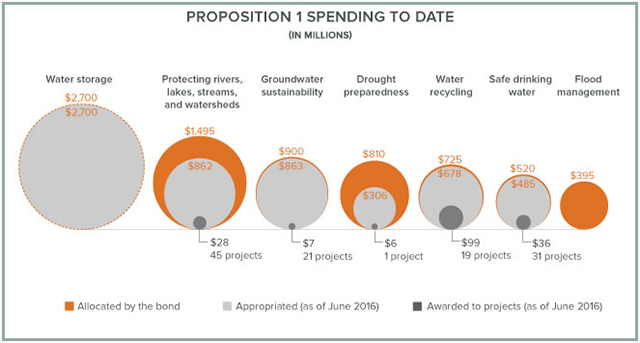
Proposition 1 has seven funding categories, with a pot of money allocated to each. The bond language preauthorized spending in the largest area—$2.7 billion for water storage projects. For the other six areas, spending must be appropriated in the state budget.

With the passage of the most recent budget, nearly 80 percent of the bond has now been appropriated. The only category with no funds appropriated is flood management, which is still spending down money from earlier bonds.

Far less of Proposition 1—just $177 million, or 2 percent—has been awarded for spending. This gap reflects the additional prep work needed to use the appropriated funds. Bond money is generally appropriated to specific state agencies, who distribute it as cost-share grants through a competitive process. To ensure accountability, agencies set up rules on how they will evaluate applications. Once these rules are publicly vetted and finalized, agencies solicit project applications and award funds.

To date, the awards have focused on addressing priorities related to urgent public health and safety issues and the drought. Thirty-one grants will help disadvantaged communities with safe drinking water and wastewater treatment projects, 19 grants will boost urban supplies with wastewater recycling projects, and 21 grants will support local efforts to better manage groundwater reserves. Another priority has been California’s ecosystems, which have been hit hard by the drought; 45 projects address water supply and habitat to support native species around the state.

No funds have been awarded yet for water storage, another key area for boosting drought resilience. This has led to some criticism that the pace of spending is too slow, but this overlooks the bond language, which laid out a two-year process for establishing funding criteria.

The water bond’s storage money can only be used for funding “public benefits” resulting from storage projects. For any given project, at least half of these benefits must be for improving ecosystem conditions. Other qualifying benefits include better flood protection, recreation opportunities, emergency supplies, and water quality. In January, the California Water Commission proposed regulations that outline how the public benefits will be judged and quantified. The public comment period has ended, and the commission is on track to finalize its regulations by the end of 2016 and start soliciting applications in 2017.

The experience so far with Proposition 1 spending highlights something Californians have already seen with past water bonds: turning bonds into projects on the ground takes time. And there can be tradeoffs between expediency and value, because spending money quickly can favor less innovative projects or those that would be relatively easy to fund without bond support. So while California shouldn’t drag its feet in funding improvements to the state’s drought-challenged water infrastructure, striving for an accountable process that leads to quality projects is likely to be worth the wait.

Figure source: Proposition 1 Bond Accountability Report; Proposition 1 Bond project search website; Wildlife Conservation Board Streamflow Enhancement Program project allocations (downloaded on June 15, 2016)

Figure note: Appropriated amounts (light grey circles) contain both appropriations and costs for issuing and tracking bonds (2% of total costs). Amounts awarded to projects are calculated by the authors compiling data for each project from the Proposition 1 project search website. We searched for projects in “all counties,” organized projects by bond spending area/chapter, and summed both total cost of projects ($571 million) and Proposition 1 contribution to that sum ($177 million). In addition to money for awarded projects, agencies have also spent some funds for grant administration, which is not included in the dark grey circles.

Learn More

Read California’s Water: Paying for Water (from California’s Water briefing kit, April 2015)

A Changing State of Water Conservation

The California State Water Board is charged with balancing all water needs across the state—an especially difficult task when there’s less water to go around. We talked to Fran Spivy-Weber, the board’s vice chair (and chair of the PPIC Water Policy Center’s advisory council), about water conservation and lessons from the drought.

PPIC: What expectations do you have for statewide water use in light of recent changes to the state’s approach to urban water conservation, which replaced the 25% mandate with locally set standards?

Fran Spivy-Weber: I think there will be a bit of an uptick in water use in the short term, but I’m not expecting water use to go up to where it was. My experience after previous droughts shows that after all the work to educate people and change plumbing fixtures and appliances, water use stays pretty flat. Meanwhile, the board is working with the Department of Water Resources to develop long-term water use targets—for indoor and outdoor urban uses—as well as targets for reductions in leakage from pipes. We plan to work on these targets into early fall, and will be getting public input during that time. By the end of the year these targets should be pretty final, and the governor can put them into legislation and agency practice next year. These targets will give everyone something to aim for.

PPIC: What is the most important lesson for California from the latest drought?

FSW: I think it’s to share data about water use with the press and public. We’ve seen strong leadership on water conservation by individuals around the state—most changes were done not because people were told to do so but because they could see there was a limited amount of water available and they wanted to do their part. We also learned that water rates do matter. Water agencies that have drought surcharges did OK, those that did not are suffering. It can be politically difficult to change rates, but when people buy less water during droughts, water agencies with flat rates suffer. People mostly care about having enough water when they turn on the tap; they care very little about how much water their appliances use. The energy sector in California has completely separated the costs of delivery from the service of providing their commodity. The water sector needs to do this too.

PPIC: What is the state doing to encourage innovations in water supply?

FSW: The board’s biggest action was to approve loans for recycled water, and it clearly helped. We’re now identifying how much recycled water is actually being served—we’ll know by the end of summer. The state’s goal is 1 million acre-feet by 2020, 2 million by 2030. On technological innovations in water, the governor’s office is taking the lead. A number of the state’s universities are also pursuing these kind of innovations. Over the next 10 years the way in which water is delivered will likely change dramatically. Water will be reused a lot more, and storm water will be captured in more places. Water agencies tend to be the most conservative agencies—their engineers have to know that when they undertake something new it will provide safe, clean water and meet customers’ needs—so they’re often not eager to take on new technologies. But with the drought and climate change, and an increasing cost of water, they’re starting to think about it more.

PPIC: How much more room do we have to improve urban water efficiency?

FSW: There is much more room for improvement. While a number of communities are achieving 55 gallons of indoor water use per capita per day or even less—particularly in new houses—most people in the state live in older housing, with old, water-wasting fixtures. This will change in the next few years. Outdoor landscaping is changing, and we haven’t seen the end of it—many people pulled out lawns to save water, but now many more are beginning to realize they don’t want lawns that take a lot of maintenance and water.

Learn more

Read “Water Management’s High-Tech Future” (PPIC Blog, September 3, 2015)
Visit the State Water Board’s drought information page
Visit the PPIC Water Policy Center’s water supply resource page