Working with California Tribes on Upper Watershed Restoration

“Fish are very important to me, to my family, my culture.”

“It’s surprising how much you rely on traditional foods if you’re in a community like we are. You don’t necessarily realize it until you don’t have it . . . especially salmon.”

“If the water quality got better, rivers and creeks would be much better and it would bring back the fish.”

These are the voices of youth from the Karuk tribe in the Klamath River watershed, as heard in a new video that explores the connections between ecosystem health and tribal well-being. Healthy local waterways and the traditional foods they support are considered irreplaceable by indigenous peoples. A new program is seeking to tap into tribal understanding of natural resources to ensure their voices are being heard and to provide a more expansive approach to how state and tribal programs can align in the management of rivers, fisheries, and forests.

As part of this effort, the state is participating in a series of “forest gatherings,” which bring people working on natural resource issues to local watersheds in events hosted by a tribe from that place. “Place matters,” said Debbie Franco, community and rural affairs advisor in the Governor’s Office of Planning and Research. “Gathering in a watershed with tribal people who have been managing that place for thousands of years is a way to more deeply understand their perspective that forests, fish, water, and food are by nature integrated and connected.”

The gatherings are an opportunity for those in attendance to explore questions such as: How can the traditional land management practices of indigenous peoples inform how we can work better together in managing the land? What ecological ideal should we strive for? How do we connect the work of indigenous peoples with statewide policy discussions?

Each gathering is designed by a team with members from local NGOs, county and US Forest Service representatives, state representatives, and the host tribe. Invitees have included academics, policy experts, local governments, indigenous people, logging interests, and regional and state agencies.

“The idea is to find the people whose relationships are necessary to do good upper watershed management and to bring them together to build relationships and create a voluntary learning environment,” said Franco.

In addition to sharing ideas, participants may find themselves physically connecting with the watershed. An upper watershed gathering this August, for example, had participants rafting the Klamath River with a tribal person and stopping at a tributary along the way to help create better environmental conditions for spawning salmon.

Franco noted that indigenous knowledge can bring new solutions to problems facing watersheds today. “It goes well beyond what we know from our 150 years here. These forest gatherings are bringing more people to the understanding that the answers to our water challenges lie in the connections between us and our natural systems.”
New Federal Policies Will Help Manage Wildfire Risk

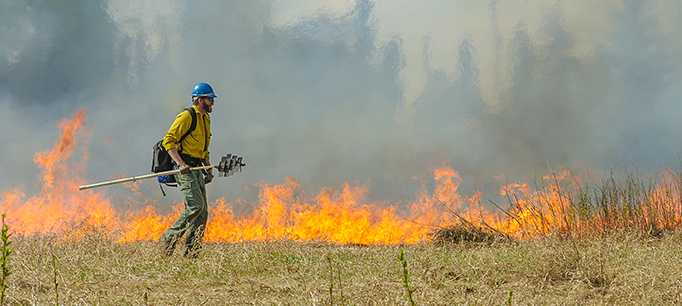
California’s headwater forests have experienced a long-term decline in health and have suffered unprecedented tree death and severe wildfires as a result. About half the Sierra Nevada and southern Cascade forests are owned and managed by the US Forest Service (USFS). HR 1625, the federal budget bill enacted in March of this year, contains four new reforms that will make it easier for the USFS to ramp up management efforts and reduce wildfire risk in this region:

  1. Protecting funds dedicated to forest management and restoration. The Forest Service’s fire suppression activities have traditionally been funded from the same pot of money that pays for management to reduce hazardous fuels, like prescribed burning and mechanical thinning. The rising costs of wildfire suppression thus draws resources away from management actions. This fiscal practice, sometimes known as “fire borrowing,” creates a vicious cycle. With low levels of management, fuels continue to build up, increasing the likelihood and intensity of future fires—and the cost of suppressing them. The reform freezes USFS expenditures on wildfire suppression at 2015 levels and creates a new source of wildfire suppression funds that is independent from funds for forest management and restoration. This change becomes effective in fiscal year 2020.
  2. Expediting small-scale forest management projects. Currently, the USFS can streamline environmental review for certain types of small-scale projects that don’t pose a significant environmental threat, such as restoring burned areas, stopping insect infestation, and performing some commercial harvesting. This reform expands USFS authority to streamline approval for small, proactive fuel-management projects that improve forests’ resilience to drought, pest, and wildfires. USFS Region 5 (serving California, Hawaii, and the Pacific Islands) is evaluating opportunities to use this new streamlining tool in 2019.
  3. Improving tools for collaboration between the Forest Service and local parties. USFS’s stewardship projects allow businesses, local governments, and nonprofits to play a larger role in carrying out forest management projects on USFS lands. This harnesses additional resources to promote forest health on these lands. The new policy doubles the maximum duration of stewardship projects to 20 years, which could encourage larger projects and more substantial investments in supportive infrastructure, such as roads, sawmills, and biomass energy generators.
  4. Improving tools for collaboration between the Forest Service and states. This reform expands the management work that states may perform on USFS lands under the Good Neighbor Authority (GNA). The GNA can be helpful when private or local government landowners share a boundary with federal forests. The new policy expands the use of GNA programs to include road rehabilitation and repair projects that can improve access to forests in need of management. The USFS expects this will encourage partnerships with state agencies such as Caltrans and California State Parks, which regularly repair roads in the vicinity of national forests.

This new suite of policies signals a growing prioritization of forest management and provides concrete steps to increase the pace and scale of active management. The changes will allow USFS to develop stronger partnerships with other forest landowners and stakeholders, and could help lead to healthier headwater forests in California.

Testimony: Managing California’s Headwater Forests

Van Butsic, a forestry expert with UC Berkeley’s cooperative extension and a member of the PPIC Water Policy Center’s research network, testified before the Little Hoover Commission in Sacramento today (August 24, 2017).


The hearing focused on California forest management and was held in response to the sharp increase in the number of trees dying in headwater forests. Butsic drew his prepared remarks from the PPIC policy brief California’s Water: Protecting Headwaters. Here is a summary.

The committee asked Butsic to explain the risks to the state’s forested upper watersheds and ways to improve forest health. He described a number of risks, including:

  • Policies aimed at extinguishing fires as quickly as possible—combined with reduced timber harvesting—have resulted in exceptionally dense vegetation in many California forests, increasing the risk of extreme wildfires;
  • The expansion of rural communities into wildland areas has complicated efforts to manage fire risk, and;
  • Stress from drought and a changing climate.

Butsic said California stands to lose timber production, wildlife habitat, recreational opportunities, and water supply if this natural infrastructure continues to decline. He noted that the bulk of forestry funding is spent on putting out fires rather than managing forests for long-term resilience.

Butsic explained that to improve health of headwater forests, California must increase the pace and scale of management tools such as fire and forest thinning. This will require management, regulatory, and legal reforms. He described ongoing research being undertaken by PPIC into ways to improve forest management. And he noted that due to a diverse mix of land ownership in the headwaters area, collaborative approaches will be critical.

Learn more
PPIC is preparing a report on California’s headwater forests. Register to attend the related event, Improving the Health of California’s Headwater Forests.

California’s Changing Headwaters

Much of the state’s water supply originates in forested headwaters high in the mountains. Yufang Jin is a UC Davis professor specializing in ecosystem change and remote sensing (gathering aerial images of the earth). She is also a member of the PPIC Water Policy Center’s research network. She talked to us about how a warming climate and extreme wildfires are changing these crucial ecosystems.

PPIC: How are large wildfires changing our watersheds?

Yufang Jin: We’re seeing intensifying wildfires in California, especially in the headwater regions where our rivers originate. More intense fires have significantly changed the composition and structure of forest ecosystems, affecting both water quality and quantity—though not always for the worse. For example, large fires can significantly reduce the amount of vegetation covering the land, which reduces the amount of water consumed by plants. Burned areas also have much less water circulating in the soil. Both of these post-fire processes have a positive impact on streamflow, as more water works its way into the water table and streams. But the loss of groundcover plants from intense fires also increases surface erosion, which can cause landslides in the rainy season. Ashes and sediments flowing into streams harm water quality.

PPIC: What are catastrophic fires teaching us about managing forests, wildfires, and water in California?

YJ: They’re pushing us to use management strategies that recognize the relationships between forests, fires, and water supply. In the past most forest management focused on wildfire suppression. There’s now recognition that solely focusing on suppression led to unnaturally dense forests, which in turn led to larger and catastrophic fires. So now there’s a growing effort to use forest thinning and prescribed fires to reduce fire hazards. Some pilot projects indicate that allowing natural fire to thin forests can lead to increases in water quantity in the watershed as well. A lot of federal and state agencies are now emphasizing watershed restoration strategies that bring multiple benefits. They are paying more attention to approaches that reduce fire hazards and may also increase water yields.

PPIC: How will climate change affect the severity of wildfires in California?

YJ: All climate models predict that the warming trend will continue in coming decades, and will often be accompanied by drier conditions. There is consensus that with these conditions, we can expect more severe wildfires across California and in the West more generally. One of our recent studies showed that the average area burned in Southern California could increase 70 percent by mid-century. Another effect of climate change is that forests in the western US will become more vulnerable to drought stress, making them more prone to diseases and beetles, leading to greater tree mortality and more fires.

PPIC: What kinds of technological advances can help us improve watershed management in the state?

YJ: There are two technologies that can provide more informed water management. One is obtaining images from satellites with remote sensors to learn about ecological and hydrological conditions on the ground. The other is using big data analytics and cloud computing, which can help us interpret the huge amount of data you get from remote sensors and translate it into information that farmers and water managers can use and act upon.

Basically, remote sensors can be used to monitor factors like water temperatures, the range of particular plant types, or the amount of water being released from plants. You can observe relatively large areas over time in a cost-effective way. For example, remote sensors can help detect algal blooms and invasive aquatic species throughout the watershed. Water managers can use remote sensing to estimate how much water is being used by crops or by natural vegetation, and how that water use changes from season to season or year to year. It can also help figure out how ecosystems will respond to a changing climate or how changing land use can affect water use. For fire management, remote sensing can track when and where fires occur, how effective fuel treatment projects are in reducing fire severity, and how vegetation recovers after fires.

While there are no simple technological solutions for managing the effect of a changing climate, having tools like these will make it much easier to get the quantitative information that we need to develop adaptive forest and watershed management strategies.

Learn more

Read California’s Water: Protecting Headwaters (from California’s Water briefing kit, October 2016)
Read “Managing Wildfires Requires New Strategies” (PPIC Blog, September 23, 2015)
Visit the PPIC Water Policy Center’s drought resource page