While most of California’s likely voters are satisfied with the way the initiative process is working in California, an overwhelming majority also think that the wording for citizens’ initiatives is often too complicated and confusing for voters to understand what happens if the initiative passes. This may be the case with Proposition 10, as our September survey findings suggest.
When read the ballot title and label of Proposition 10—which would expand the authority of local governments to enact rent control—about half of likely voters say they would vote no (48%) while far fewer (36%) would vote yes. However, when asked a general question about rent control by local governments, half of likely voters say it is a “good thing” (52%) while fewer (41%) say it is a “bad thing.” This translates to a 16-point gap between support for Prop 10 and support for the concept of rent control.
This gap widens when we dig a little deeper. For example, we find double digit differences in support for Prop 10 and for rent control in general across parties (Democrats 23 points, independents 14 points, Republicans 12 points).
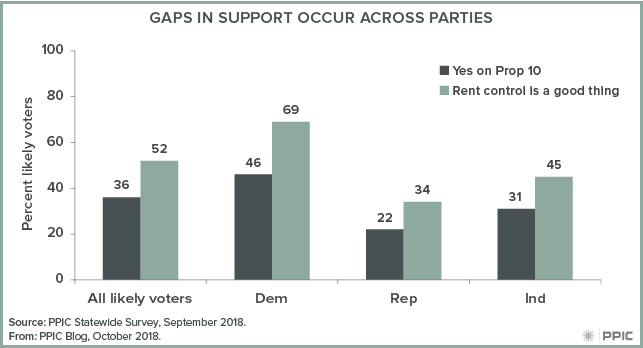
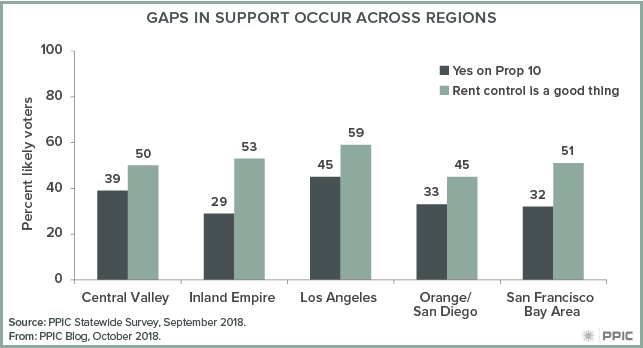
Support for Prop 10 and for rent control in general varies across regions, but the gap in support remains.
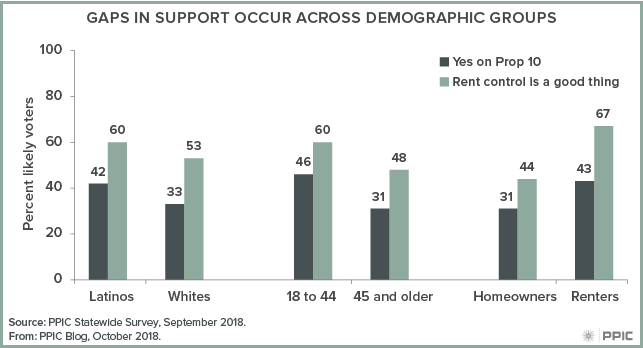
Gaps in support also occur across demographic groups: likely voters who are white (20 points) and Latino (18 points), those age 18 to 44 (14 points) and those age 45 and older (17 points), those making less than $80,000 annually (19 points) and those making $80,000 or more (14 points). Support for Proposition 10 is also lower than the share saying rent control is a good thing among renters (24 points) and homeowners (13 points).
It’s not entirely clear why these differences exist or why they are so pervasive. Perhaps the wording of Proposition 10 is having an impact. The ballot title and label—which are read to our survey participants—describe repealing the current state law that restricts the scope of rent-control policies. (This is the 1995 Costa-Hawkins Rental Housing Act.) It also mentions the potential net reduction of tens of millions of dollars in state and local revenues.
Proposition 10 Ballot Language
Proposition 10 is called the “Expands Local Governments’ Authority to Enact Rent Control on Residential Property. Initiative Statute.” It repeals state law that currently restricts the scope of rent-control policies that cities and other local jurisdictions may impose on residential property. The fiscal impact is potential net reduction in state and local revenues of tens of millions of dollars per year in the long term. Depending on actions by local communities, revenue losses could be less or considerably more. If the election were held today, would you vote yes or no on Proposition 10?
Is this a case of confusing ballot language? Or are voters simply not interested in this particular approach to rent control? As Californians learn more about the propositions during the run up to November it will be interesting to see the impact on Proposition 10. Stay tuned to the PPIC Statewide Survey for timely coverage of this year’s election.