
 Six years ago, a California ballot initiative to legalize marijuana for recreational use fell short of a majority—46.5% voted yes. This November, Californians will vote on Proposition 64, another marijuana legalization initiative. Since the 2010 election, four other states and the District of Columbia have legalized marijuana for recreational use, and, in California, the PPIC Statewide Survey series has found increased support for legalization among likely voters and within some key groups.
In our September survey, after hearing the Proposition 64 ballot title and label, 60% of California likely voters said they would vote yes. That includes strong majorities of Democrats and independents and nearly half of Republicans.
- Support has increased among likely voters. In response to a separate, more general question, a similar share (61%) of likely voters said that they think marijuana use should be legal. That’s a 10 point increase in support for legalization in general since September 2010, when about half of likely voters said they were in favor.
- The partisan divide has narrowed. We have consistently found support for legalization in general to be lower among Republican likely voters than among Democrats or independents, but the gap is somewhat narrower today than it was in 2010. Then as now, at least 60% of Democratic and independent likely voters supported legalization. Among Republicans, though, support has increased from 32% in September 2010 to 45% in September of this year.
- Support has grown among older Californians. Today, nearly three-fourths of California likely voters under age 35 favor legalization, and they are more likely than older Californians to do so—a pattern that has held since 2010. But support for marijuana legalization has increased among older Californians over the past six years. Today, nearly two-thirds of likely voters age 35 to 54 support legalization, compared to about half in 2010. A slight majority of likely voters age 55 and over are in favor today, while fewer than half favored it in 2010.
As with any election outcome, much will depend on who turns out to vote. Based on past election cycles, we can expect a larger—and younger—electorate in this presidential election year than we saw in the midterm election year of 2010. It remains to be seen, though, if Californians’ changing attitudes toward marijuana legalization will be reflected in the vote on Proposition 64.
Read the September PPIC Statewide Survey
Visit the PPIC Statewide Survey website

 What struck me as most significant about the
 This September, the Democratic-Republican registration gap swelled to 18 points (45% to 27%). In a departure from recent trends, Democratic registration saw larger gains than independent registration over the past four years. Moreover, comparing the
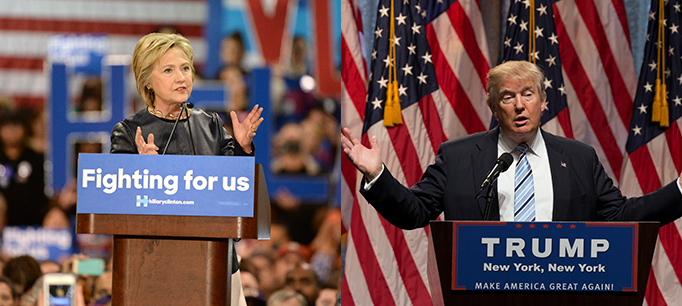
 Unlike 2012—when satisfaction with the choice of candidates increased as the election approached—satisfaction has been declining. This is not a view unique to California.
 Who are these unsatisfied supporters? Notably, 30% of unsatisfied Clinton supporters are between 18 and 34 years old.



 Today, the state is prepared to meet the reduction targets set forth in AB 32. As policymakers debate how to further reduce emissions,
 What’s changed since 2006? In California, Republican Governor Arnold Schwarzenegger has been replaced by Democratic Governor Jerry Brown, who has been a vocal leader on climate change and made the issue a major component of his agenda. At the national level, there is a contentious debate about global warming, as well as a growing partisan and ideological divide.


 Both measures hold promise for raising significant funds and represent an alternative source of revenue in a state that is heavily dependent upon personal income taxes. Together, they could bring in more than $2 billion in state revenue. This would be significantly more than the state’s other sin tax on alcohol, which raised about $350 million in 2014.
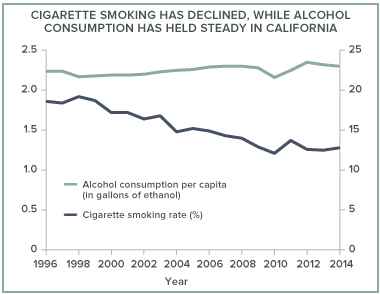 Nationally, California had the second-lowest cigarette smoking rate in 2014 (after Utah). But it’s worth noting that e-cigarette use nearly doubled among California adults from 1.8% in 2012 to 3.5% in 2013, complicating estimates of future revenue. If passed, the tax would also apply to e-cigarettes. If Californians use e-cigarettes as a substitute for cigarettes, then the measure will also capture revenue due to increased e-cigarette use. As we noted in our recent report, the additional revenue generated by taxing marijuana could be as much as $1 billion a year for the state. In the first full year after legalizing recreational marijuana, Colorado raised just over $120 million in state revenue, and Washington collected slightly less than $130 million. Given California’s larger population, the $1 billion figure is in the right ballpark. But since much is still unknown about the marijuana market, any estimate should be treated with caution.
 The proposed taxes would be comparable to those currently in place in other states. If the tobacco tax passes, it would boost per capita revenue from $21 per resident to $50 per resident. This would still be below the national average of $57 per resident, though it would be much closer. For marijuana, the estimate of $1 billion in revenue would translate to about $26 per resident. Though there isn’t a national reference point for marijuana taxes, this number would be higher than the per capita amounts raised in Colorado and Washington. Interestingly, California’s alcohol tax revenue is less than most other states. On a per capita basis, California ranks 40th of the 50 states in alcohol revenue collected. In 2014, California collected only $9 per resident in alcohol taxes compared to the rest of the country, which raised $21 per resident. Doubling this rate—which would still be below the national average—could add another $350 million to state revenues.