Linking Land Use and Water Decisions

In nature, water and land are intimately entwined. But in the human landscape, we’ve created divides. Communities across the state separate water and land use, and this can lead to inconsistency, inefficiency, and conflict. The Governor’s Office of Planning and Research (OPR) recently convened a series of workshops in rural California on aligning land and water planning for long-term sustainability. Debbie Franco is OPR’s community and rural affairs advisor and local drought liaison, and a member of the PPIC Water Policy Center’s advisory council. We talked to her about this ongoing process.

PPIC: What was the purpose of these workshops, and what common themes did you hear?

Debbie Franco: We’re seeking ways to ensure that water and land use decisions are informed by each other and ultimately are driving toward the same goal. As a first step, we organized six regional workshops in rural parts of the state to talk to folks working in water and land-use planning, with the goal of better understanding how locals see optimum alignment, where there are gaps or barriers, and opportunities to close the gaps and overcome the barriers. We logged more than a hundred ideas, and now we’re working to figure out what actions would move us toward more resilient water and land systems.

Themes that emerged included:

  • The need for strong political leadership, supported by mechanisms to help leaders balance competing priorities and to achieve equity across our various water divides;
  • Institutional drivers that lead to good choices for water and land management—such as eliminating the pressure small local governments feel to embrace development as a way to fund community services;
  • The value of using common data and metrics across land use and water planning, and focusing on measurable outcomes.

PPIC: What are the most pressing issues you heard about?

DF: The biggest idea that came up over and over was the need to have watershed-scale water accounting. The idea needs a lot more discussion and research, but basically, such a process might for example document how much water everyone gets, what water rights pertain, and where you have lands with high potential for stormwater capture or groundwater recharge. You might end up with a watershed map showing lands with high potential for storing water, where everyone benefits from ensuring they are used for that purpose. Sharing such information with land use authorities could lead to better analysis of land options for new developments. We heard from participants that California’s “show me the water” requirements and environmental review process under CEQA (the California Environmental Quality Act) happen too late, when proposed developments are far along in the planning process. If developers got water information to inform site selection, it could make it easier for them and result in water benefits, too. Some jurisdictions are already taking this approach.

Several regions discussed the potential for marijuana to be legalized, and the crop possibly shifting from the forests to conventional farmlands. There’s a huge opportunity to be forward-thinking on solving water issues that might arise from this shift.

Every workshop included a discussion about how under-resourced local government planning is. There are so many barriers—no dedicated funding source for this kind of planning, out-of-date general plans, plans trapped in litigation for years. We need sufficient resources for local governments to do good planning.

Learn more

More on this topic: “Video: Water and Growth in the West” (PPIC Blog, February 18, 2016)
Read the California Water Action Plan, which was a motivation for these meetings
Visit the PPIC Water Policy Center

Video: Senator Dianne Feinstein in Conversation

Underscoring her role in three contentious policy issues, California’s senior senator spoke to a Sacramento audience last week about filling the vacancy on the US Supreme Court, the dispute between Apple and the FBI, and drought relief.

Senator Dianne Feinstein urged speedy consideration of a nominee to replace the late Antonin Scalia on the court, saying that Senate can consider and confirm a new justice within 69 days—the average time for the process has taken in the past. She acknowledged that it would not be easy.

“I wish we could go back to the days when I first went to the Senate when the belief was that every president deserves his nominations,” she told Mark Baldassare, PPIC president and CEO, at the PPIC event.

Asked about the Apple controversy, she called on the company to reconsider its position and cooperate with the FBI to access data on a phone used by one of the San Bernardino killers. “Apple is not above the laws of the United States,” she said.

She said her position on the Senate Intelligence Committee—which occupies most of her time—gives her a perspective not shared by many on the dangers posed by terrorists.

Feinstein also detailed some of the provisions in her drought-relief bill, which would fund recycling, desalination, and water storage projects, as well as ease water trading.

She closed by describing her leadership style, saying she tries to “use the time to get things done. If I can’t do them through legislation, I’ll do them another way.”

Video: Water and Growth in the West

When water supplies are tight—as during the latest drought—discussions often turn to the question of whether state and local governments should be limiting growth. How western states are managing this issue—and areas where improvement is needed—was the topic of my presentation at a recent conference on sustaining western water. The event, which also featured presentations from three members of the PPIC Water Policy Center’s research network, was sponsored by the Renewable Natural Resources Foundation.

Most western states have laws to ensure adequate water supply for new developments. These laws generally require that developers—or the city and county governments that approve new construction on their behalf—ensure the availability of long-term supplies before the projects can go forward. In rural areas, the concern is often to prevent individual consumers from being sold a “dry lot,” lacking basic services. In larger communities, the concern is more often about making sure that new projects don’t reduce the reliability of community-wide supplies, ultimately requiring costly new investments for existing residents. California’s law falls somewhere in the middle of the spectrum. We require new developments of 500 or more units to demonstrate at least 20 years of water supply availability. (Arizona’s law requires 100 years of supply in major metropolitan areas; Colorado usually leaves this decision up to local utilities.)

Our research has found that these laws are working fairly well in cities and suburbs, where utilities can provide good oversight and draw on multiple tools to ensure water availability. For instance, in California, utilities generally require supplies well beyond the 20-year requirement of state law. Investments in conservation, recycled wastewater, new storage, and water trading have all enabled communities to accommodate growth.

Things are more likely to fall through the cracks in smaller rural communities. As California has seen during the latest drought, some well-dependent rural homes are facing water supply shortages; many also have inadequate sanitation and other services.

Western states also need to devote more attention to agricultural land use. On average, farms use 85 percent of total business and residential water use in the West, so farming needs to be part of any equation addressing water scarcity. Pressing issues right now include making sure there’s enough water to support long term investments in tree and vine crops, which now account for more than 40 percent of crop acreage in the water-scarce San Joaquin Valley. And as we move to implement the new Sustainable Groundwater Management Act, there’s great interest in making sure that communities manage both urban and farm development in ways that protect lands with high potential for groundwater recharge. This means not paving over these lands in cities and managing farmlands so that these fields can be flooded during winter and early spring.

Learn more

Watch these video presentations from other PPIC Water Policy Center researchers who spoke at the conference:

About the PPIC Water Policy Center

Video: Reforming Federal Drought Management

The federal government is a key partner in just about every aspect of western water management. It’s the West’s largest landowner, chief environmental regulator, major supplier of irrigation water and hydropower, key provider of water information, and an important source of water-related funding. The vast scale of its involvement has brought big challenges to how it manages the drought that has affected the entire 11-state region in recent years.

The fed’s role in managing droughts in the West was the topic of a seminar in Washington, DC, last week, a joint effort of Resources for the Future and the PPIC Water Policy Center. Along with a panel of prominent national experts, we discussed how to improve policies and practices to build drought resilience at the federal level, with a focus on pragmatic changes that are doable in the near term. I introduced recommendations from our new report, Improving the Federal Response to Drought: Five Areas for Reform, to help structure the conversation.

A panel discussion followed, with my colleague Jeffrey Mount moderating. He asked panelist Ann Mills, deputy under secretary for natural resources and environment at the US Department of Agriculture, about how USDA’s vast array of programs could be better coordinated for drought.

Noting that there are 15 agencies just within the department that have some influence on water management, Mills said, “We’ve started to create USDA water teams at the senior policy level … to make sure we’re coordinating our work as effectively as possible. There are real challenges in breaking down silos in the USDA and the federal family.” Mills noted that USDA is also seeking to improve its data and make it actionable and more available to customers. “And we’re building on the really great work that’s already happening on the ground,” she said.

Panelist Mark Kramer of The Nature Conservancy was asked about the lack of a “drought plan” for the environment during the latest drought, which might have reduced the crisis now facing some species.

“The pressure to squeeze more water out of the system is enormous,” Kramer said. Water has been framed as an “either-or” proposition—either it goes to the environment or to human uses. But, he noted, it can be managed in ways that address environmental needs without harming other users. The Nature Conservancy has been working on pilot projects that help farmers put water “when and where it’s needed”—for example, to create temporary wetlands for birds during drought. To scale up these efforts, some agencies may need more funding and other tools.

These are tough, multidimensional problems, and solving them will require a heavy lift. But increasingly, people in the West realize we can’t continue with “business-as-usual” water management. Tom Iseman, deputy assistant secretary for water and science at the US Bureau of Reclamation, noted that westerners are already experiencing the impacts of hotter, longer droughts, and realizing some things will need to change. “We’re trying to get ahead of these problems, to promote long-term drought resilience.”

Learn more

Read a summary of policy recommendations from Improving the Federal Response to Western Drought (February 2016)
Read “There’s Always Drought Somewhere in the West” (PPIC blog, February 4, 2016)

There’s Always Drought Somewhere in the West

Thanks to the January rains, hopes for an end to the latest drought are rising along with reservoir levels. But the reality is, drought is occurring somewhere in the West practically all the time.

Over the past decade, except for a few brief wet periods, more than a quarter of western lands have been in drought. Since 2012, more than half of the West has been hit, with large areas facing extremely dry conditions.

To get a better sense of how drought conditions vary across the region over time, we created a time-lapse animation using the maps released weekly by the US Drought Monitor.

The 10-year span shows strong regional differences. Droughts in California and the Pacific Northwest tend to develop and end relatively quickly. In contrast, parts of the Colorado Basin have been dry for much of the past decade or longer—a situation that is proving difficult to manage.

The rain and snow we’ve experienced already in this wet season have made modest dents in the latest drought. And there’s been a pronounced turnaround in the Pacific Northwest, where unusually severe storms have moved much of the region out of drought.

California’s above-average snowpack in is encouraging, and it seems that the outlook for 2016 is improving. But these graphics remind us that droughts never truly leave the West. As we highlight in our recent report, Improving the Federal Response to Western Drought, California—like its western neighbors—must continue to strengthen its water management to better cope with ongoing drought and prepare for the next.

State Water Market Needs Reform

Water trading is an important tool for managing water scarcity. It enables water right-holders to voluntarily shift water—permanently or temporarily—to those who need it, making better use of existing supplies. Despite potential benefits, the approval process for trading water in California continues to be lengthy, cumbersome, and lacking in transparency. This is an especially big concern during droughts, when speed is important.

In California, water trading takes the form of short-term leases, long-term leases, and permanent sales. The figure below shows statewide estimates of volumes of water traded in recent decades, including the first three years of the latest drought.
Since the onset of the latest drought, total volumes traded appear to have tapered off, despite strong demand. Farmers facing scarcity have been willing to pay record-high water prices for their high-value crops. Prior to this drought, an acre-foot of water typically sold for less than $500, and sometimes less than $100. In the spring of 2014, a Kern County water district auctioned 12,000 acre-feet of stored groundwater to local users and got bids for more than 60,000 acre-feet at a price of $650 per acre-foot or more. In the summer of 2015, some San Joaquin Valley farmers were reported to have leased water for as much as $2,000 per acre-foot—more than most cities pay for municipal supplies.

But the slow approval process, along with tight supply conditions, limited volumes available for sale. While senior water-rights holders normally have more reliable and ample water supplies, the past several years have been so dry that the state decided to cut their water allocations for the first time since 1977. The cuts rippled throughout the market. For instance, the Metropolitan Water District of Southern California had planned to purchase around 100,000 acre-feet from Sacramento Valley rice growers, but that deal was contingent on the growers getting a full allocation. When the growers’ allocation was cut by half, the deal was significantly scaled back.

The drought has placed markets at the center of a conversation about ways to manage droughts and lessen the costs of scarcity. Many point to the example of Australia, which significantly expanded water rights trading in the midst of drought. Buyers and sellers register their shares with the help of brokers—often using online trading platforms—and trades are approved within a matter of hours or days, not the weeks and months that are the norm in California.

To reach Australia’s level of fast-paced trading, California would need to address many challenges. Clarifying and simplifying the review process for transfers is one priority. This will require improving information about water availability and how much can be safely traded without harming the environment or other legal water users. In addition, California will need to address infrastructure weaknesses that restrict moving water between buyers and sellers in some places.

Making these changes will require the cooperation of water users and state, federal, and local agencies. It won’t happen overnight, but we need to get started. Strengthening California’s water market will be key to effectively managing future droughts, a regular feature of our climate.

Chart source: Updated from E. Hanak and E. Stryjewski. California’s Water Market, By the Numbers: Update 2012 (PPIC, 2012).

Chart notes: The figure shows water traded between entities that are not members of the same water district or wholesale agency. It excludes volumes committed under long-term lease and permanent-sale contracts that were not physically transferred. Dry years are those classified as critical or dry for the Sacramento Valley

Learn more
Read our report What If California’s Drought Continues? (August 2015)
Read our report Allocating California’s Water: Directions for Reform (November 2015)

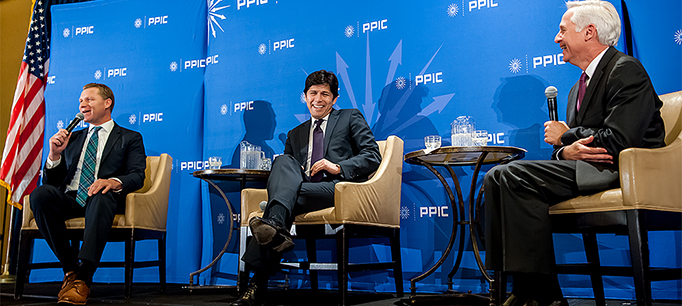
Video: A Conversation with Legislative Leadership

At a PPIC event last week, Kevin de León, senate leader pro tem, and Chad Mayes, the Assembly Republican leader, were asked to name the top three issues the legislature should work on with the governor. Though the leaders come from different sides of the aisle, the list of issues they named before a large Sacramento audience had a lot in common. De León’s priorities began with income inequality between the coastal and inland regions, a “tale of two states.” He also listed water and making targeted investments, particularly in higher education. He went on to list a fourth issue: climate change.

Mayes named water and a lack of water infrastructure, and the many Californians left behind in the state’s economic recovery. His third issue was transportation, the focus of an ongoing special legislative session.

“Everywhere that I go in California,” he said, “I’m stuck in traffic. So we know there’s a problem.”

The leaders’ top issues dovetail with findings from the latest PPIC Statewide Survey in which Californians identify water and the economy as the most important issues for the legislature and governor to work on in 2016. 

Though De León and Mayes named similar priorities, there was much less agreement on solutions. But the two maintained a collaborative tone throughout their conversation, denounced what Mayes termed “demagoguery on the national stage,” and repeated their commitment to working together productively.

De León said the legislature can avoid being mired in bitter national political debates if leaders continue to work cooperatively to “get some real tangible victories for Californians.”

“We’re doing things very differently in the state of California,” he said.

A Strong Start for PPIC’s Water Policy Center

Nine months ago—serendipitously, just one day after Governor Brown announced a state of emergency in response to the drought—the PPIC Water Policy Center was launched with the goal of spurring water management innovations to support a healthy economy, environment, and society. Today, cities throughout the state remain focused on water conservation while simultaneously bracing for El Niño floods (it will take more than one wet year to recover from the drought).Through it all, our center—with its network of more than 40 researchers—has been contributing to important water policy debates with new research, publications, and public outreach.

In our first nine months, the Water Policy Center waded quickly into the depths of California’s most pressing water issues, starting with the ongoing drought. Our first major report, What If California’s Drought Continues?, documented the drought’s effects on different sectors and suggestions to improve drought response in the most urgent problem areas—particularly water for rural communities and the environment.

We also reviewed the performance of the state’s water market and water rights systems in response to drought. Allocating California’s Water: Directions for Reform describes ways to improve these systems’ efficiency and transparency, as well as their responsiveness to the environment and public health. We briefed the governor’s office, the State Water Board, California Environmental Protection Agency, and the legislature on the findings. The report generated a spirited conversation in the media and with decision makers about the need to reform water rights to improve water management across the state.

In addition to these major research efforts, we’ve been hard at work interpreting key water issues in “short form” as well. You can get quickly up to speed on key topics through our water blog (sign up for it here) and our growing library of fact sheets, which cover topics such as California’s water quality challenges and reforming groundwater management. Our briefing kit outlines nine pressing water issues facing the state. Our YouTube page hosts our videos on a range of key topics and events.

Another very important aspect of our work is public outreach. In its inaugural year, the Water Policy Center sponsored four regional outreach meetings in Fresno, Monterey, Los Angeles, and San Jose on locally important topics. We testified at hearings held by the state assembly and senate, and had numerous meetings with state, federal, and local water officials and key stakeholders. We gave many talks around the state and in other western states, including at a “Climate One” panel in San Francisco; a forum for environmental educators in San Diego; and meetings of Water Education for Latino Leaders, the Association of California Water Agencies, and the Western Growers Association, among others.

Looking ahead, we’re working on a number of exciting new projects, ranging from improving the federal response to western drought, to strengthening California’s water accounting and information systems, to applying lessons from Australia’s experience with environmental drought planning and management. We are beginning a three-year project funded by the US Environmental Protection Agency to examine the response by federal, state, and local institutions to drought, and develop recommendations to improve long-term drought management.

California’s water landscape is unpredictable and challenging—yet ripe for reforms that will help the state prepare for a changing climate and a growing population and economy. We’re already seeing progress on some of California’s toughest problems, from groundwater management to addressing water security in rural communities. We at the Water Policy Center are looking forward to tackling the state’s most pressing water challenges in the coming year—and to hearing your perspectives on these critical issues.

The Coming Groundwater Revolution

Pumping extra groundwater has gotten many California farmers through this drought, and if managed well, it can help the state weather future dry periods. Groundwater is our most important drought reserve, but overuse is a serious problem in some regions. We talked to Thomas Harter—a groundwater expert at UC Davis and a member of the PPIC Water Policy Center’s research network—about managing groundwater for the long term.

PPIC: What are some of the biggest challenges for California’s groundwater management?

Thomas Harter: Farmers are facing a lot of change. They have to address new laws on groundwater use and water quality. The agricultural community uses by far the most groundwater but has never been asked to actively manage and protect it. It’s a fundamentally new world, and it will take time for the industry to adjust.

The first step for farmers is to understand their groundwater resources. They’ll need to learn what drives their basin’s “water budget.” The state’s new groundwater law requires locals to form groundwater sustainability agencies and develop sustainability plans, and it will be important for farmers and rural communities to actively engage in that process. Locals have a lot of information and ideas that regulators in Sacramento may never come up with, so working on this issue together is key.

In areas with significant overuse, the first challenge will be to increase local recharge of groundwater. To the degree that regions can’t balance their groundwater budgets through recharge or by using more surface water, the toughest challenge will be to reduce groundwater use while minimizing the economic effects.

In Northern California, the most challenging piece is understanding how pumping affects groundwater flowing to rivers and streams. That’s a challenge for state and local agencies, consultants and scientists alike.

PPIC: What is the link between improving groundwater quality and quantity?

TH: Farmlands make up the largest landscape overlying our groundwater basins. Finding creative ways to use that landscape to put clean water underground—while also reducing groundwater pollution—are what we should focus on.

Farmers hold the key to maintaining water quality through their management practices. Excess fertilizers and pesticides can leach into groundwater. Pollution can be reduced through practices such as being very water efficient with crops that require lots of chemicals or, alternatively, by replacing fertilizer-hungry crops with crops that fix their own nitrogen or use little.

PPIC: What are some approaches to help us get to groundwater sustainability?

TH: Setting back levees allows some of the floodplain to act as a recharge area. Levee setbacks on the Cosumnes River raised the water table in just one storm last winter. Another option is to recharge groundwater during times when there is excess runoff. In parts of the Central Valley we’re looking at what crops can take flooding to increase recharge. Vineyards and alfalfa are promising candidates because they use very little fertilizer and pesticides. We’re also considering setting aside dedicated recharge basins. For example, farmers might be paid to fallow land short-term to allow groundwater recharge. We’re just beginning to find out how some of these solutions will work, what changes to infrastructure we’ll need to implement them, which are economically and agronomically feasible, and under what conditions they can be done.

Learn More

Read Harter’s article “Groundwater: The Crucial Challenge” (Capitol Weekly, November 20, 2015)
Read Reforming California’s Groundwater Management (PPIC fact sheet)
Read “Getting to Groundwater Sustainability” (PPIC blog, June 16, 2015)
Read Harter’s analysis “California’s Agricultural Regions Gear Up to Actively Manage Groundwater Use and Protection” (California Agriculture, September 2015).

A Pragmatic Reason to Protect Freshwater Fish

California’s freshwater fish are in trouble. The causes are many and include the way we manage water and land as well as this unusually warm drought. The decline of these fishes can lead to broader consequences, particularly if they are declared threatened or endangered under the federal Endangered Species Act (ESA).

There are pragmatic reasons to avoid this outcome. Listings under the ESA lead to “emergency room” actions to prevent extinctions, often reducing flexibility for water management and bringing significant economic consequences. Of the 30 California freshwater fishes now designated as threatened or endangered, 14 have affected local and regional water supply management. Three—delta smelt, winter-run Chinook, and spring-run Chinook—are a dominant constraint on the Brown administration’s proposal for new water conveyance in the Delta (California WaterFix).

To illustrate the scope of the problem, here are some examples of fish that are in decline but are not yet federally listed. If listed, the measures needed to protect them will have significant effects on the water supply:

  • Central Valley late-fall- and fall-run Chinook salmon. These are the last unlisted salmon runs in the Central Valley. Both—particularly the late fall-run—may be future candidates for listing. Fall-run Chinook are the basis of the state’s salmon fishing industry. Federal listing would add new restrictions, ensuring year-round constraints on water supply operations in the Central Valley and the Delta.
  • Upper Klamath–Trinity fall- and spring-run Chinook salmon. Both runs are increasingly at risk within the Klamath Basin, with the potential to complicate efforts to complete the Klamath Basin Restoration Agreement, the California Department of Fish and Wildlife’s effort to improve habitat on Klamath River tributaries such as the Scott and Shasta Rivers, and operations of the Central Valley Project, which diverts water from the Trinity River to the Sacramento River.
  • North Coast steelhead. Two populations of steelhead—Northern California and Klamath Mountains Province—have been in decline at least partly from the effects of dams. The expansion of marijuana farms and the drought have increased stress on these populations. Federal listing would complicate recently launched efforts of the California Department of Food and Agriculture and the State Water Board to license medical marijuana farms and better manage water resources in this region.

Improving the way California manages water for environmental purposes is key to preventing new ESA listings. The development of environmental water budgets would create an opportunity to more flexibly and effectively manage the aquatic environment. The details of this proposal are contained in the PPIC Water Policy Center report Allocating California’s Water: Directions for Reform.

Although establishing environmental water budgets would often require setting aside more water than we do now to protect at-risk species, this approach is likely to be more flexible and less disruptive than regulations arising from ESA listings. California needs new tools, such as environmental water budgets and the willingness to take proactive steps to keep species out of the emergency room.

SOURCE: US Fish & Wildlife, ECOS Database Species Search.

Learn More

Read the report Fish Species of Special Concern (Moyle et al., July 2015)