How “Weather Whiplash” Could Change California

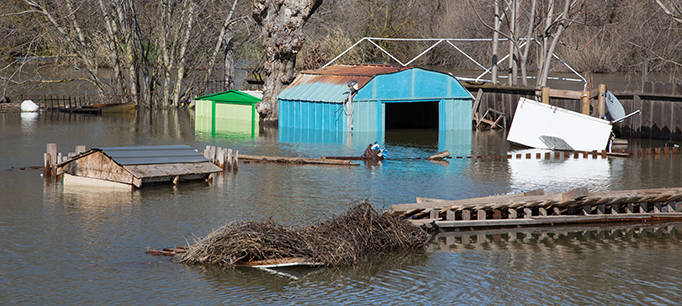
First came the drought, then the floods: California has long bounced between the two weather extremes―most recently when the latest drought segued into 2017’s record-breaking rain and snow. Such “weather whiplash” could become much more common as the climate changes, according to a new study. We talked to Daniel Swain, a climate scientist at UCLA—and the study’s lead author—about what to expect.
PPIC: California already has a highly variable climate. How will this be different?

Daniel Swain: There will be much bigger swings between wet and dry years. We project a 25–100% increase in extreme swings in this century. On top of that we’ll probably see some changes in seasonality. While it will still be dry in summer and wet in winter, spring is likely to become considerably drier in most of the state, especially in the south. This will have big consequences for things like the snowpack and wildfire risk.

California’s human and natural systems can usually withstand the kind of variations we’ve seen in the past. But as the frequency and intensity of these swings increases, it could push some species to the edge. For example, the warming climate is already stressing our forests faster than they can adapt—we’re seeing a dramatic example of this right now with widespread Sierra Nevada tree mortality. And warming temperatures are making it difficult to manage for salmon and other fishes that rely on cold water.

It could be equally hard for the state’s water system to adapt to the bigger floods. Our big dams were designed to capture smaller floods than what we expect in the future. We can make some changes on the margins, but these structures were built for a climate that we no longer have.

PPIC: What is the most surprising thing about your findings?  

DS: We were surprised by how much the risk for really severe flood events increases. We project a 300–400% increase in the likelihood of events similar to California’s 1862 Great Flood, which brought weeks of unrelenting rain and inundated much of the Central Valley. We found that it’s more likely than not that an event comparable to the 1862 flood will occur in the next 40–50 years. Keep in mind that there’s no modern precedent for this—it would exceed all previous tests of our flood management infrastructure.

It’s important to remember that we based our study on fairly pessimistic assumptions. If the world greatly reduces greenhouse gas emissions, California could see a smaller increase in extreme flood risk. But social and political factors will ultimately determine how much we reduce emissions in coming decades, so uncertainty remains.

PPIC: What is the key takeaway for water managers?

DS: We need to think about managing droughts and floods simultaneously, because some adaptations to help manage drought could make it harder to manage floods and vice versa. For example, increasing water stored behind California’s big dams gives us a nice buffer against a couple years of drought. But this saved water can become a liability because it reduces the reservoir space available to capture flood water. A higher risk of big floods necessitates bigger safety margins, which means storing less water behind dams for dry times.

One way to help manage this trade-off is to increase the use of natural floodplains to take up some of the water from big storm events. For example, Sacramento’s Yolo Bypass is intentionally inundated to protect the city from big floods. Another approach is to capture the water released from dams to make space for floods and store it underground. And when floods inevitably come, use flood waters to recharge groundwater.

Are California’s Cities Ready for the Next Drought?

California’s urban areas—where more than 90% of residents live—managed the last drought quite well. How well prepared are cities and suburbs to weather the next long dry spell? Here are two things to know about urban drought preparedness.

Are we backsliding too much on water conservation?

While it’s true that urban water use is not as low as it was at the height of the latest drought in 2015, it is still much lower than in 2013, before Californians were asked to significantly limit their water use. This winter, some media stories highlighted unfavorable month-to-month comparisons—for example, water use in December 2017 was about the same as in December 2013. But what’s lost in this message is that water use in California is normally much lower in winter months, when very little is going to outdoor landscaping. When we smooth out the seasonal differences, water use in 2017 was roughly 13% lower than in 2013—and it has stayed down across all regions of the state (see figure).

During droughts people save water in all kinds of ways, but especially by reducing landscape watering, which in normal years accounts for about half of all urban water use. During the latest drought this saved a lot of water, but it also entailed costs—gardens and trees died and urban landscapes suffered.

Another thing to remember is that the large reduction in urban water use in 2015 and early 2016 was the consequence of state-imposed mandatory rationing. It’s normal for water use to rebound somewhat when rationing is lifted. This also happened after other recent droughts. Generally, though, Californians have been reducing their water use for the past several decades.

What should cities be doing now to prepare for the next drought?

With California’s variable climate, it’s always prudent to be prepared, because the next drought can be just around the corner. Even though urban water utilities have done a good job preparing for past droughts, they can’t rest on their laurels. For example, as cities and suburbs become increasingly efficient with water over the long term, this affects their ability to tighten their belts during droughts. There’s less of a cushion and fewer easy steps that can be done quickly. Utilities will need to address this trade-off by ensuring that some portion of the long-term water savings is reserved in storage for times of drought emergency.

Urban utilities also need to be better fiscally prepared for times when they sell less water. This was a real weakness during the latest drought. The dilemma is that up to 80% of the costs of supplying water to businesses and households don’t change with the amount of water people buy. Utilities still have to maintain their systems, but most of their revenues are based on the number of gallons sold. When you start asking everyone to conserve, you can quickly end up in the red. We recommend that as soon as a utility knows it will have to ask for drought savings, it should inform its customers about how that could affect rates. Some communities have drought surcharges, which work well. The key is to have a plan, communicate in advance, and engage the public in understanding the issue of balancing revenues and costs.

3 Things to Know about California Droughts

The erratic weather in recent months—a dry winter followed by “atmospheric rivers” that packed a punch in March and April, capped by a poor report on the state’s snowpack—hasn’t exactly offered a clear picture for drought watchers. In fact, there is no universal definition of when a drought begins or ends. Here are three things about droughts that every Californian should know.

Rain, snow, and water in storage are the conditions that define a drought in California.

Technically speaking, a drought is simply having less precipitation than normal. But California’s climate is so variable—indeed, it’s the most variable in the nation—that our “normal” is often either very wet or very dry. We also have an annual, seasonal “drought” from late spring through early fall.

To cope with this variability, we’ve developed a massive storage system and conveyance networks to move water to places where it is scarce and demand is high. Thanks to this elaborate water system, California can face one or two much drier-than-normal years without major disruptions.

California’s mountain snowpack has historically provided “free” seasonal storage for meeting summer irrigation needs. About a third of the state’s annual water supply is stored as snow in the Sierra headwaters. Large reservoirs across the state capture melting snow and release it during our dry summers. Experts have recently begun referring to a new type of drought—“snow drought”—to define years when reduced overall precipitation coincides with unusually warm winters. The winter of 2015 was a good example, with the all-time lowest snowpack in recorded history. Unfortunately, this is becoming more frequent due to the warming climate, and it has big implications for water management because our current system isn’t designed for this shift from snow to rain.

Accounting for these conditions, most of California is not expected to be in a drought this year. Precipitation levels have been low—somewhere between “dry” and “below normal”—and the snowpack is about half of average, but the large reservoirs are still in good shape after the 2017 deluge.

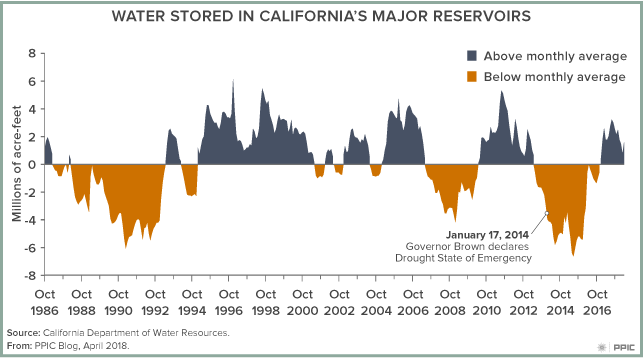
But this might change relatively quickly. As the figure shows, during successive dry years we rapidly draw down storage in reservoirs. By year two or three of a drought, reservoir releases are cut back and water scarcity becomes a problem, particularly in many agricultural regions. Groundwater helps reduce the impacts of drought, but it isn’t sufficient for extended droughts, and significant cutbacks in water use are required.

Drought vulnerability varies across the state.

California suffers a statewide drought only rarely, and the impacts of drought vary. Southern California is a relatively dry region, but it imports half of its water from Northern California and the Colorado River basin, both of which provide more reliable supplies. The central coast, which is not well connected to the statewide water system, relies much more on local precipitation and storage, which means it has a higher vulnerability to drought than other regions. In many areas, groundwater helps offset the loss of surface water during droughts. But long-term overreliance on groundwater—especially in the San Joaquin Valley—has led to negative effects, including dry wells, sinking lands, increased costs of groundwater pumping, and reduced supplies for future droughts.

Planning and preparing for drought can make a big difference. Our research has found that California’s cities and suburbs are the most drought-resilient areas of the state, thanks to significant local and regional investments in diversified water supplies.

Drought is not our only—or biggest—water problem.

Droughts worsen many of California’s water problems and heighten awareness of a number of other issues. But drought is not the underlying cause of critical, chronic problems facing California, such as difficulties accessing safe drinking water, our aquatic ecosystem crisis, or the unsustainable use of groundwater. Perhaps we put too much emphasis on drought―which is, after all, a natural feature of the state’s climate―and not enough on other critical issues.

A Bottom-Up Approach to Groundwater Sustainability

California’s Sustainable Groundwater Management Act (SGMA) requires communities with ongoing groundwater deficits to bring their aquifers into balance in the coming years. This will be a difficult and complex process, but it’s also an opportunity to devise workable solutions at the community level. We talked to Eric Averett of the Rosedale–Rio Bravo Water Storage District about groundwater management innovations being tried in his Kern County district and lessons learned that might have wider application.

PPIC: What are the priority areas for addressing groundwater sustainability in your district?
Eric Averett: The most challenging area is managing and mitigating impacts associated with demand reduction. Rather than mandating that individual landowners reduce demand, our district has pursued a path that we think gives individuals greater flexibility. The idea is that every acre will be assigned a water budget based on what the district can provide or considers sustainable. If a landowner uses more than that amount, it triggers a water charge. The district will use those funds to develop water supply programs or purchase land from willing sellers to retire it from production. Either way, this system doesn’t take anything away from landowners’ ability to manage their own water, it just gives them more options.

Another important area we’re looking at is water trading within our district’s boundaries. We’ve implemented a pilot study that empowers landowners to act as buyers or sellers in managing their water resources. We think water trading will be an essential tool to getting aquifers into balance and maximizing the value of the resource. For example, during a drought, a small grower with row crops may find greater value in fallowing a field and selling the water. At the same time, a grower who may be short of water and facing the loss of a permanent crop may enter the market as a buyer. If we don’t find a way to create these buy/sell opportunities, we strand the asset.

A third area we’re working on is creating individual groundwater bank accounts for landowners. We have a number of landowners who’ve committed to make their land available for recharge in exchange for a portion of the recharged water being credited to their account. Alternatively, some landowners have acquired a source of water and asked the district to use it for recharge on their behalf. Both types of programs were tested successfully in 2017, and we look forward to expanding the concept.   Ultimately, we’re looking at ways the district can assist landowners in becoming sustainable and mitigating SGMA impacts.

PPIC: How are you handling the issue of dry wells?

EA:  During the most recent drought, we experienced a number of wells that went dry. Kern County’s groundwater levels can be very dynamic, in part because of the groundwater banking projects within the region. These projects pump out large volumes of water during droughts, causing the water table to drop a lot and fairly quickly. We’ve developed a unique mitigation program in partnership with the banking projects. We utilize a groundwater model to evaluate the well in question. If it’s determined that the well’s failure was due to water level impacts from the banking projects, we mitigate the impacts. Within 24 hours of the well going dry they’re connected into a temporary water supply. To date, we’ve spent more than $1 million replacing and repairing wells, or connecting people with dry wells to local service providers. The proof of success is that not one landowner has pursued legal remedies, and all have been satisfied with the results. We think it’s a good template for others to try and may be a model going into the groundwater sustainability planning process.

PPIC: What’s the big lesson from your district’s efforts?

EA In all of these areas, our goal is to have the district be a resource for sustainability, not a regulator. Each landowner is unique: some have thousands of acres, and the impacts on them may not be as great as for someone with a small parcel. A lot of smaller landowners may be unable to manage the fixed costs that will arise from implementing SGMA. We wanted to address the diversity in our district and not disadvantage any one user.

We’re emphasizing approaches that let growers decide what’s best for them—whether it’s helping them put unused water into a market or compensating them for using their land for recharge. Everyone in the district will have to live with the water budget we come up with, but we want to provide as many tools and options to get to sustainability as we can.

Building Community to Support Healthy Forests

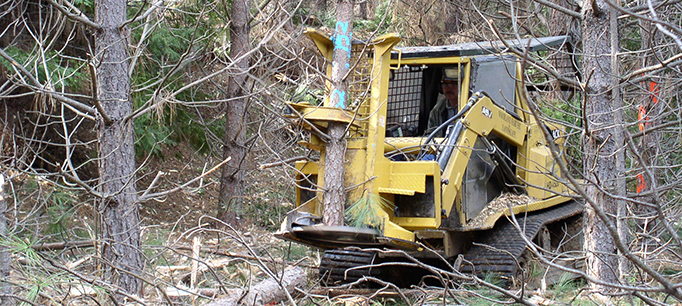
California’s mountainous headwater forests are in crisis, and an all-hands-on-deck approach is needed to improve their health. A combination of factors—dense forests with too many small trees, abundant ground fuels, and large patches of dead trees―leaves them increasingly vulnerable to severe wildfire. The best way to address the impacts of tree mortality and improve forest health is with strategic use of fire and mechanical thinning.

A big challenge to increasing the pace and scale of forest management is the patchwork nature of California’s headwaters. Implementing forest management is particularly challenging for many people who own family forests (parcels less than 5,000 acres in size), which make up about a quarter of the Sierra Nevada headwater forests. The high cost of forestry work on these small land holdings is a major barrier for many owners.

Resource conservation districts (RCDs) are one of several locally governed entities that can play an important role in helping landowners improve forest health. RCDs are authorized by the state to perform a variety of resource and land management functions, including forest stewardship, fuels management, and watershed planning and management. There are about 20 RCDs covering most of the Sierra Nevada headwater region. RCDs are well versed in local resource management issues and often are more trusted by local landowners than state or federal agencies.

RCDs can organize forest management projects across multiple private properties. For example, in 2017 the Placer County RCD used grant funding to pay for dead tree removal on family-owned forest properties in the rural community of Foresthill—an area that was hit hard by tree loss caused by drought and pests. RCDs could also assist groups of forest owners in identifying common management needs and pooling private resources to pay for on-going management.

RCDs are well placed to facilitate relationships between forest owners and other potential partners in management projects. For example, the Sierra RCD in Fresno County is implementing a district-wide carbon management program that makes use of dead trees from the massive tree die-off. With the help of the California Association of Resource Conservation Districts and the Governor’s Office of Planning and Research, the Sierra RCD is working with CAL FIRE and the US Forest Service to process these dead trees into a charcoal-like product called “biochar,” which can be used to increase soil health on nearby agricultural lands in the Central Valley.

Steve Haze, the district manager of the Sierra RCD, says these kinds of strategic partnerships can help “carve out a niche and add value to the effort” of removing large numbers of dead trees. Many RCDs are in a unique position to find overlapping interests and turn them into projects with multiple benefits in their districts.

While many RCDs may be keen to take on new roles and responsibilities to meet their local forest management needs, establishing long-term funding to support these efforts is a major challenge.  Less than 15 of the state’s 99 RCDs have adequate funding through local property taxes; the rest are supported by less-stable sources such as grants or appropriations from county governments. Finding durable funding sources for headwater RCDs could help spur long-term forest management work that would bring benefits to entire watersheds.

Learn more
Read Improving the Health of California’s Headwater Forests (PPIC, 2017)
Read California’s Water: Protecting Headwaters (from the California’s Water briefing kit)
Visit the PPIC Water Policy Center’s drought resource page


A Look Back at the Year in Water Policy

A year of extreme events—from heavy rains that strained dams to high heat and massive wildfires—revealed the many ways California’s variable climate can impact water management. In 2017 the PPIC Water Policy Center explored how the state is managing such extremes and suggested improvements to help us prepare for an even more volatile future climate. Here are a few highlights.
  • Our evaluation of California’s urban water systems revealed that they have become adept at drought management thanks to diversified supplies, cooperation with neighbors, and programs to manage demand. But the state’s conservation mandate in 2015 opened a debate on how to manage water scarcity. We reviewed evolving state and local roles in urban drought management and described areas for improved cooperation to strengthen resilience.
  • Five dry years took a toll on groundwater, a critical drought reserve. Some farm areas saw steep declines in local aquifers. Our assessment of water stress in the San Joaquin Valley—California’s largest agricultural region and “ground zero” for groundwater concerns—summarizes sustainable management solutions. Our survey of groundwater recharge practices by valley water suppliers sheds light on what more can be done to advance recharge efforts.
  • The state’s headwater forests are in poor health and at increased risk of severe wildfire. Our review of current management practices explains steps needed to shift the emphasis from fire suppression to forest management and how to pay for these improvements.
  • The way California manages water for the environment is focused on responding to crises rather than building capacity to weather future dry spells. We undertook an in-depth evaluation of how to improve conditions for native fish and reduce conflict over water for the environment. We also proposed a better way to account for environmental water, with an example from the Sacramento–San Joaquin Delta.

The PPIC Water Policy Center’s efforts were collaborative in nature—involving research teams from across California and conversations with policy makers, water managers, and other stakeholders—and we broadened the conversations through a series of public events.

This year will bring major decisions on funding for safe drinking water, investing in water storage, sharing scarcity on the Colorado River, and conveying water through the Delta. To help inform the debate on these and other complex issues, we created a policy brief that summarizes problem areas and priorities for action. This brief was released in conjunction with our second annual water conference, which brought together leaders from across the state to discuss the ways forward.

Looking ahead, the water team is working on the potential effect of climate change on future droughts, pathways to water sustainability in the San Joaquin Valley, and the impact of drought on water quality and wastewater management.

The mostly dry December has left many wondering what 2018 will bring. But one thing is certain: we’re thankful for the opportunity to promote creative and collaborative solutions to California’s most difficult and pressing water challenges. And we are thankful for your support of this important work.

With best wishes for 2018,

Ellen Hanak

P.S. If you’re not yet receiving our weekly blog post by email, you can sign up here. And if you’d like to support the center’s work, learn more here.

Commentary: California Should Plan as if Drought Has Returned

This commentary was published in the Sacramento Bee on December 20, 2017.

The unusually warm, dry start to this winter—along with intense wildfires in southern California—has many Californians experiencing “drought deja vu.” Despite this uneasy feeling, we are not in drought. But it might be prudent to act as if this is the beginning of the next one. Here are some short-term priority areas for drought planning that we think can help the state prepare.

Read the full commentary on sacbee.com.

How California’s Water Bond Is Being Spent

California has many unmet needs in its water system—most notably in the areas of flood protection, safe drinking water, stormwater treatment, and ecosystem support. While dedicated funding over the long term has been hard to come by, water bonds have helped fill some gaps in these areas. Looking at how the 2014 water bond is being spent can give us some insights into how bonds are turned into projects on the ground. This is particularly important as three new bond proposals are floated for 2018.

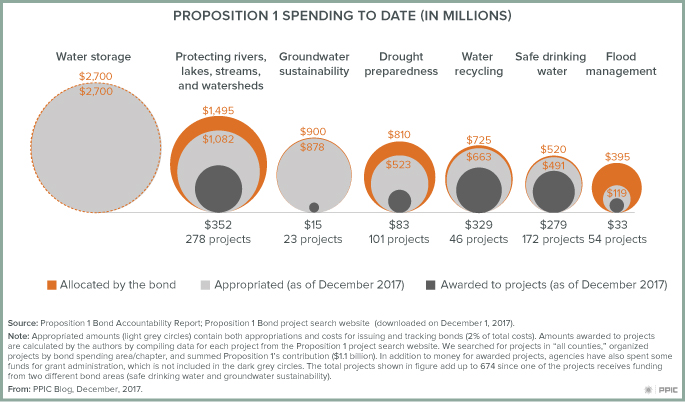
The state’s 2014 bond, Proposition 1, provides $7.5 billion in funding. The money is broken into seven funding categories. The bond language preauthorized $2.7 billion for water storage projects. For the other six areas, spending must be appropriated in the state budget. Once the funds are appropriated in the budget, the state agencies distribute them to selected projects.

With the 2017–18 budget, the legislature has now appropriated more than 86% of Proposition 1 funds. The largest new appropriation is more than $200 million for “Integrated Regional Water Management,” a grant program for collaborative regional projects to address complex water management challenges. In addition, more than $111 million was appropriated for flood management, reflecting statewide concerns about dam and levee infrastructure after the Oroville dam incident.

Of the Proposition 1 money appropriated, approximately $1.1 billion has been awarded for spending. That is roughly a billion dollars since June 2016. The number of projects has spiked since then as well, from 117 to 673. Even with this large increase in spending, only 14% of the bond has been awarded so far. This pace of water bond spending—about $785 million per year—is on par with patterns observed since the early 2000s.

Ecosystems in decline and disadvantaged communities that lack access to safe drinking water—problems made worse by the latest drought—lead the way in number of projects awarded, with 278 and 172 grants, respectively. Fifty-four grants have been awarded for the maintenance of Delta levees. Another 101 grants will foster regional drought preparedness. And 46 grants will be used for urban wastewater recycling projects.

The largest pot of money—$2.7 billion for water storage—is expected to be awarded in June 2018. In total, 12 projects—seven for surface water storage and five for projects that focus on storing more water underground—are competing for some portion of the money. The California Water Commission is now reviewing proposals. The winning bids will only receive funding for “public benefits” resulting from the new storage. At least half of these benefits must be for improving ecosystem conditions. Other qualifying benefits include flood protection, recreation, emergency water supplies, and water quality improvements.

About $900 million is allocated for groundwater sustainability—an area in which there is a growing need for funding to implement the 2014 Sustainable Groundwater Management Act. Of this total, $100 million is allocated to help the more than 250 newly formed Groundwater Sustainability Agencies (GSAs) develop their plans. The Department of Water Resources is now receiving proposals for these grants.

Looking beyond Proposition 1, three other water bonds have been proposed for the ballot in 2018. The $4 billion California Parks, Environment, and Water Bond was approved by the legislature, signed by the governor in September, and will appear on the June 2018 ballot. This bond would distribute a third of its revenue to park improvements, and the rest to environmental restoration and water and flood infrastructure. Specific areas include Salton Sea restoration, ecosystem improvements in the Sacramento and San Joaquin River watersheds, groundwater recharge, and safe drinking water.

Two other bonds—which would be put on the November 2018 ballot through the initiative process—are still under consideration. A bond proposal from Gerald Meral, a former state water official, would authorize $8.9 billion for various water supply and water quality projects, including water infrastructure improvements, safe drinking water projects, habitat protection, groundwater replenishment, and dam repairs. And a $7.99 billion bond proposed by environmental lawyer Joseph Caves would award half of its funds to drinking water safety improvements, and the rest to ecosystem restoration, and state and local park projects.

Clearly, bonds are an important source of one-time funding for some of the problems dogging the state’s water system. But state bonds only make up about 2% of total annual spending in California’s water sector. California must look beyond bonds to fill persistent funding gaps.

Learn more
Read our June 2016 blog post, “How is California Spending the Water Bond?”
Read California’s Water: Paying for Water (from California’s Water briefing kit)

The Unintended Consequences of Indoor Water Conservation

High rates of water conservation helped California manage limited supplies during the 2012–16 drought. But conservation can have a downside. New research shows that indoor water conservation can reduce the quality and quantity of wastewater, making it harder for local agencies to use treated wastewater to augment their water supply.

We talked to two members of the research team about their findings: David Jassby, associate professor of civil and environmental engineering at UCLA; and Kurt Schwabe, professor of environmental economics and policy at UC Riverside and an adjunct fellow at the PPIC Water Policy Center.

Jassby summarized the problem: “In general, as people conserve water inside their homes, the concentration of contaminants in the wastewater goes up—organic matter, nitrogen, detergents, and more. All of these things have to be treated.”

Schwabe noted that in the past, recycled water was mostly used for irrigating nearby cropland and median strips—not drinking. But as treatment processes have improved and demand for water increased, recycled water has become an integral part of the drinking water supply in some areas, where it is used to replenish groundwater basins. In many communities, treated wastewater is discharged into rivers and streams and used by downstream entities that treat the water again.

Salinity is a particular challenge. “Most wastewater treatment plants can treat higher levels of nutrients, but they’re not designed to treat higher levels of salinity,” Schwabe said. “What this means is the water that is discharged into streams or to farms or into aquifers for groundwater recharge will be saltier, which reduces water quality and crop yields.”

Schwabe noted that while utilities can employ technical fixes to address drought-related wastewater quality issues, this doesn’t address the problem of quantity. Indoor conservation results in less treated water flowing into streams or available for reuse.

On average, only about 10% of municipal wastewater is reused in the US. Israel reuses 85–90% of its wastewater—perhaps the highest rate in the world, Schwabe said. California is adopting new rules on “direct potable reuse” of treated wastewater, which would enable cities to add treated wastewater directly into their water supply.

“Farmers in some parts of California are becoming increasingly reliant on treated municipal wastewater from neighboring urban areas. This is an effective strategy for dealing with water scarcity. But it also reveals that conservation—another effective drought strategy—might in some instances work at odds with wastewater reuse.”

Urban areas are also affected. For example, recycled wastewater is a significant portion of stream flow in the Santa Ana River in Southern California. Indoor conservation reduces water supply for communities in downstream reaches of the river.

Does this mean that people abandon conservation? The researchers say no. “Our results are intended to illustrate how different drought mitigation actions are related so agencies can plan, communicate, and coordinate in the most informed and cost-effective manner possible,” said Schwabe. “Conservation mandates that don’t recognize these linkages can have significant and negative consequences on the effort to reuse wastewater.”

Jassby noted that the place conservation happens is key: “When people are asked to conserve water, they should be encouraged to conserve water outside the home.”

More broadly, having water supply and wastewater treatment agencies cooperate in how they manage their systems can also help, Schwabe said.

Commentary: A New Approach to Protecting Rivers

This commentary was published in the Sacramento Bee on November 20, 2017.

California’s native freshwater fish—salmon, steelhead, sturgeon and others—continue to decline, and regulations to reverse this trend have fanned controversy. A new approach to environmental stewardship is needed. We should start by granting the environment a water right, as detailed in a new report by the PPIC Water Policy Center.

Read the full commentary on sacbee.com.