A Water Budget for the Environment

California’s freshwater ecosystems—and many native species that rely on them—are in decline and becoming increasingly vulnerable to drought. Allocating water to these ecosystems is contentious because it often conflicts with urban and agricultural uses. There may be a way to meet environmental needs that reduces conflict.

My recent presentation before the Delta Science Program outlined an alternative approach to managing water for the environment that is detailed in a 2017 PPIC report. 

Currently, state and federal regulators rely heavily on minimum flow and water quality standards to protect the environment. These flows are often set to meet the needs of one or more endangered species. This approach has failed to reverse the decline in native species and their ecosystems for many reasons—simply bumping up minimum flows is unlikely to improve conditions.

Instead, our report recommends establishing ecosystem water budgets. These budgets would specify a volume of water to be made available to support a range of ecosystem functions to which native species are adapted. The amounts would vary in accordance with the type of water year (e.g., wet, average, dry) but each amount would be fixed for a number of years. The volume to start with would be the water currently allocated to meet minimum flow and water quality standards. Mechanisms would be needed to increase this volume where necessary through purchases or leases.

To be effective, the budget should be flexibly managed, much like a water right—preferably by an ecosystem trustee vested with the authority to trade and store water. These budgets would focus on improving overall ecosystem conditions rather than protecting individual species.

Ecosystem water budgets are a better approach for three reasons. First, the flexible allocation of water allows environmental managers to use water more efficiently by responding to changing conditions (such as droughts, storms, and heatwaves) and delivering water to habitat in areas that are likely to have the highest ecological benefit.

Second, having a budget that can be flexibly managed makes the environment a partner in water management, not just a constraint. The ecosystem trustee would sit at the table with water managers and participate in the trading, storage, and planning that goes on in a watershed.

Finally, a budget with a set term makes the amount of water that will be allocated to the environment clear to all water users. This addresses one of the most common complaints about environmental water management: urban and agricultural users face uncertainty over regulatory actions that transfer water from economic to environmental uses.

Ecosystem water budgets would be an advance over traditional minimum flow and water quality standards, but they are unlikely to succeed without major improvements in both ecosystem planning and water accounting. Robust, watershed-scale plans are needed to set budget objectives and priorities for action. We recommend annual watering plans—vetted with local stakeholders—that preview actions to be taken every year, depending on hydrologic conditions. Equally important, California must improve accounting for water use and availability, because it’s not possible to manage what you don’t measure.

The current approach to freshwater ecosystem management is not working for anyone. The three reforms described here—ecosystem water budgets, ecosystem plans, and improved accounting—are likely to produce better outcomes for native species and result in more efficient use of environmental water. They also have the potential to increase certainty about environmental water allocation and reduce controversy. Making the environment a partner in water management is a novel, effective way to address one of the big challenges in California water.

Groundwater Management is Key to Adapting to Climate Change

California relies heavily on groundwater for its water supply, particularly during drought.  Climate change is increasing drought intensity, making groundwater―with its immense potential for low-cost storage―an ever more important water source. Sustainable groundwater management will be vital to adapting to a warmer future and should be a top policy priority for the next administration.

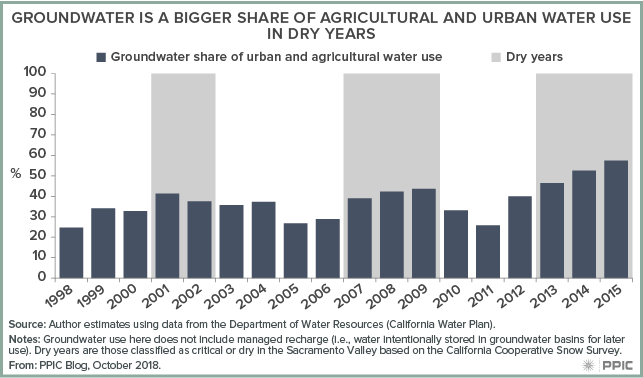
In non-drought years, groundwater supplies approximately one-third of urban and agricultural water use in California, but its share rises during droughts, when snow and surface water are scarce. In severe drought years, it provides more than half of urban and agricultural water use.

A recent report by the PPIC Water Policy Center and a large team of experts highlighted the impacts of climate change on water supply and ecosystem management during drought. As winter precipitation shifts from snow to rain in a warming climate, a key issue will be adapting the management of the state’s water storage system. A more volatile climate and changes in precipitation could shift the use of large multipurpose reservoirs from water storage to protection against flood risk, thus reducing the water available from reservoirs in some years―and making groundwater storage even more important.

In some regions, including the San Joaquin Valley, groundwater overdraft—taking more water out of aquifers than is put back—has been going on for decades. This has increased the cost of groundwater pumping, dried up wells in many rural areas, and caused land to sink, damaging infrastructure.

But the greatest long-term impact of unsustainable groundwater use is the loss of stored water that can be economically pumped during dry periods. This makes the state increasingly vulnerable to drought in a changing climate.

The 2014 Sustainable Groundwater Management Act (SGMA) requires water users and other stakeholders to self-organize into groundwater sustainability agencies (GSAs) and prepare and implement plans to achieve sustainability in the next 20 years. Done well, these efforts will restore the capacity of the state’s groundwater basins to supply water during drought.

GSAs have begun the hard work of developing their sustainability plans—due in January 2020 for critically overdrafted basins and two years later for the rest. The Department of Water Resources is providing technical and planning assistance, and the State Water Board―which has ultimate authority over these plans―is offering policy and legal guidance where it can.

Making SGMA a success will require additional action in the following four areas:

  • Advance planning. At the top of the list is expanding state and regional support for groundwater sustainability plans. Factoring in the predicted effects of climate change and developing robust water accounting and regional strategies for managing scarcity will be key.
  • Modernizing the water grid. A major priority for helping groundwater basins achieve sustainability is to upgrade and modernize the state’s water “grid”―the network of reservoirs, canals, rivers, and groundwater basins that store and convey water. Improving the grid’s capacity to move surface water into groundwater storage during wet periods is essential.
  • Updating water allocation rules. For the improved grid capacity to function well, the state will need to make it easier to recharge, trade, and bank groundwater.
  • Finding the money. Finding the money for groundwater sustainability programs will be crucial. The best solutions focus on expanding funding from local water bills and taxes—which currently fund roughly 85% of water management expenditures—and using state general obligation bonds to fund projects with clearly defined public benefits.

Achieving sustainable groundwater management is one of the most important things California can do to prepare for a warming climate. Getting there will require a suite of actions―including some reforms beyond those called for under SGMA. Better planning, modernizing the grid, streamlining water allocation, and finding program funding can help us manage this critical water supply.

New Laws on Drought, Forests, and Safe Drinking Water

The legislative session that just wrapped up addressed a number of water and forest management issues. Progress was made in three major areas—urban drought management, forest health, and safe drinking water.

Urban water use efficiency and drought management: Assembly Bill (AB) 1668 requires the State Water Board and the Department of Water Resources to adopt long-term efficiency standards for residential water use and efficiency metrics for commercial, industrial, and institutional water use by June 2022. The law complements Senate Bill (SB) 606, which requires urban water suppliers to develop local water use budgets by November 2023. Progress toward those objectives will be overseen by state agencies. SB 606 also strengthens local drought planning requirements and increases transparency of information about drought risks and responses. The law requires suppliers to regularly analyze the risk of a five-year severe drought and report short-term water shortage risks and responses to the state each spring. Suppliers must also revamp their drought response plans to include new elements such as descriptions of supply forecasting procedures, new ways of reporting water shortage levels, and protocols for communicating with customers during droughts. AB 1668 also includes provisions to increase drought preparedness for small rural water systems and large agricultural water suppliers.

Wildfires and forest management: SB 901 takes substantive steps toward reducing wildfire risks by increasing the pace and scale of forest health improvements. Cal Fire will have access to new, stable funding from cap-and-trade revenues—$200 million per year for five years—to pay for forest management. The law also helps lower management cost barriers for family forest owners, which occupy about one-quarter of the state’s headwater forests. It relaxes some timber harvest regulations to make it easier for these owners to reduce wildfire risk. A provision that increases the size of trees owners can harvest should expand their ability to raise funds from selling timber. The law also allows multiple landowners to work under the same timber harvest permit. Finally, SB 901 includes provisions that apply to forests managed by the US Forest Service, which make up more than half of our headwater forests. In particular, it streamlines California’s environmental permitting process for collaborative fire risk reduction projects on federal lands that are approved under the federal National Environmental Policy Act.

Safe drinking water for vulnerable communities: Drinking water received significant attention this year, as lawmakers attempted to fill the funding gap for small disadvantaged communities facing water quality and quantity problems. Proposals to tap urban water customers and agricultural fertilizer users for safe drinking water funds ultimately failed in the legislature. However, new laws signed by the governor will strengthen tools for addressing drinking water quality issues. AB 2501 increases the State Water Board’s ability to require the consolidation of vulnerable water systems with larger, more reliable systems. The new law expands the board’s authority to require the consolidation of communities served by domestic wells. AB 2501 also extends the board’s authority over support services to help communities provide safe drinking water where consolidation is not an option. Another new law, AB 2541, gives severely disadvantaged communities expanded access to the Drinking Water State Revolving Fund for water infrastructure projects. The law makes it easier for the board to provide full grant funding in addition to low-interest loans.

The governor also signed more than a dozen other bills related to water, in areas such as sewer system consolidation, on-site treatment regulations and rules for the reuse of non-potable water, and the establishment of an office within the State Water Board to help address water-rights matters.

We will keep track of updates and new proposals in 2019.

Groundwater and the Colorado River

Like so many rivers, the Colorado is closely linked to groundwater. A US Geological Survey study found that more than half of the streamflow in the upper Colorado Basin originates as groundwater.  We talked to Doug Kenney—director of the Western Water Policy Program at the University of Colorado and a member of the PPIC Water Policy Center research network―about managing groundwater in the basin. Kenney organized a conference in June that covered these issues in depth.

PPIC: What is the status of the basin’s groundwater?

Doug Kenney: That’s difficult to answer, in part because there’s a lack of good information on groundwater in many areas. Also, there is no one groundwater source—the Colorado Basin has multiple aquifers, with different types of connections to surface waters and different uses for the water. Some aquifers provide potable water, while others are too salty or polluted to use for drinking. We have a number of huge aquifers, and some very tiny ones.

Some places have a very tight physical connection between groundwater and rivers. In those areas, if you drill a lot of wells and the water table drops, streams can dry up. The connection goes the other way as well—when there’s a lot of water flowing in streams, some seeps into aquifers. In other places, there may not be a physical connection but groundwater use impacts overall water management. The key is that if you manage groundwater poorly, surface water will ultimately suffer―and vice versa.

PPIC: What are the big challenges for managing groundwater in the basin?

DK: While it’s hard to generalize, the trend is increased pressure on groundwater, just as with the basin’s surface water. In some aquifers, depletion is a really acute problem. The management challenge is that with so many differing circumstances, you need a unique approach for each one. Each state in the basin has come up with its own groundwater laws and policies, but each state also recognizes that managing groundwater at the state level is too broad―you still need solutions tailored to local conditions.

Managing groundwater is just inherently difficult—you can’t see it and it’s hard to measure. And there’s a time lag: bad groundwater management today often creates slow-moving problems that might not be felt for many years. In those cases, there’s no constituency to protest groundwater mismanagement because those constituents haven’t been born yet. With surface water, if someone is using water in a way that harms another user, that user will draw attention to the problem.

The Colorado River is governed by a compact between states, and there’s a body of law to help manage its surface waters. But the river’s compact doesn’t deal with groundwater, and it’s always been left out of the discussion. You can get away with that for a while, but once it affects surface-water allocations, that’s where agreements start to fall apart—as has happened on the Rio Grande, the Arkansas, and the Republican Rivers. These are just three examples where the Supreme Court had to get involved. I worry that’s going to be the future for the Colorado too.

PPIC: What strategies hold promise for improving groundwater management in the future?

DK: I’d say 80% of good groundwater management is just making the effort. It will always be a difficult endeavor, but you have to try.

In many respects, groundwater management has become more innovative than for surface water. For example, there are more experiments with market-based approaches in groundwater. In places as diverse as the Diamond Valley in Nevada and in the San Luis Valley in Colorado, new incentive structures are being tried to reward people for not depleting the aquifer. In both places, prospects for maintaining the agricultural economy are much better than before; people have had to innovate or die. In surface water, it’s more about clarifying who has what rights to water and enforcing them—there’s not as much innovation. But in groundwater people are trying creative things and it’s encouraging.

What Motivates People to Use Less Water?

During a drought, households can be inundated by messages to conserve water. We talked to Katrina Jessoe—an economist at UC Davis and a member of the PPIC Water Policy Center’s research network―about new research on what motivates people to conserve water.

PPIC: Talk about your recent research on water conservation messaging. What did you learn?

Katrina Jessoe: We partnered with a municipally owned water and electric utility to see how people would respond to additional water conservation messaging during summer 2015―at the height of the latest drought. These households were already receiving statewide and utility messages and incentives to conserve water. Our focus was to gauge if social comparisons would lead to additional conservation.

The utilities sent bi-monthly home water reports to a random sample of households. These reports compared a household’s water use to that of neighbors, gave recommendations on how to conserve water, and provided information on particular conservation programs being used by that utility.

We looked at how people responded and found that households that got these reports saved more water than those that didn’t. The reports prompted a reduction in water use of 3 to 4.5%, on top of water savings already prompted by other conservation programs. Interestingly, these water reports led to reduced electricity use as well—participating households used 1.3% to 2.3% less electricity that summer.

Similar home energy reports, which are being deployed throughout the US, are typically cited as leading to 1.3% to 2.5% reduction in energy use. These home water reports reduced electricity use by similar amounts as the energy reports while also reducing water use—even though electricity use wasn’t the target.

We were also able to see that people reduced their electricity use during peak hours—which is when electricity is most expensive and less likely to be produced from clean energy sources like renewables. This has ramifications for greenhouse gas emissions and the cost of providing energy. So this program was providing more bang for the buck than just water conservation.

Why should policy makers care? If you think about this from a cost effectiveness angle, saving water alone may not justify these kinds of interventions. But with the additional electricity savings, it increases the net benefit of these reports by almost two-thirds. We talk a lot about the water-energy nexus, but typically it’s about “embedded” energy savings—if you reduce water use by a gallon, what is the energy savings from treating and moving that water. This research documents the end-use savings in electricity from a water conservation instrument.

PPIC: What other tools show promise for encourage conservation?

KJ: We’ve looked at the City of Modesto, which moved from a flat fee type of billing to charging per unit of water. The utility took a unique approach to rolling out its pricing change. About every six months the utility switches a number of households to the new volumetric pricing system. Households receive a letter informing them when they will be switched to volumetric prices. For two billing periods they also receive a hypothetical bill informing them what their bills would be under the new system, though they continue to pay a flat rate for water.

We find that households reduce water use in response to both the actual price change and the earlier message with the hypothetical price change. The reduction in water use persists for more than two years after the switch to volumetric pricing. While still preliminary, these results highlight that when customers are informed about price changes, they respond to them. This suggests that price may be an effective tool to manage water use, if customers are well informed about the change.

Video: Managing Drought in a Changing Climate

As San Francisco began welcoming visitors arriving for this week’s Global Action Climate Summit, the PPIC Water Policy Center hosted an event on the impact of climate change on California’s water system.

The Monday event brought together a panel of experts to discuss reforms that could improve resilience and galvanize action to prepare for future droughts. The panelists were Maria Herrera, who works on water issues for Self-Help Enterprises and is a member of the California Water Commission; Felicia Marcus, chair of the State Water Board; Cannon Michael, president of Bowles Farming Company; and Tim Ramirez, a member of the Central Valley Flood Protection Board. The panel was moderated by Greg Dalton, founder and host of Climate One.

Ellen Hanak, director of the center, kicked off the evening with a summary of new research by PPIC on managing drought in a changing climate. After noting that California is already seeing changes from a warming climate, she said that “a lot of things we’re recommending are going to be very important and very useful as soon as we can do them.” She reviewed the report’s four main suggested areas of reform: plan ahead, modernize the water grid, update water allocation rules, and find the money to pay for these reforms. “It’s a plan that would be great for the next governor,” she said.

Dalton launched the panel discussion with a question about the need to modernize the state’s water grid—the network of above- and below-ground storage and conveyance systems that connects most water uses in the state. Ramirez said that the conveyance system needs updating because it is “totally insufficient for the precipitation we have now.” For example, the San Joaquin River system “was plumbed for snowmelt―very predictable, slow runoff―but that’s not what happens anymore.” He discussed the need for expanded floodplain capacity to help absorb floods.

Marcus said, “The answer is to maximize every drop—figuring out how every molecule of water … can be used over and over again and used for multiple things.” She said improved information and modernizing our thinking about infrastructure are steps toward achieving this goal.

Herrera noted that disadvantaged rural communities, which are most likely to face drought-related water shortages, find it difficult to engage in discussions about the water system. She called for ensuring that local communities are included in decision making about water grid upgrades, and added that they should have a say in “where to place storage, how water that is stored gets used and allocated, and for what benefits.”

Other topics of discussion included addressing growing wildfire risk; ensuring safe, reliable drinking water for the most vulnerable communities; advice for the next governor on managing climate volatility (Marcus: “the key is to pick up the baton and run with it.… [Water] is an issue on which leadership can make a difference on so many things”), and ways to reduce conflict over water.

Cannon Michael seconded the need for leadership to tackle climate change—and urged all Californians to heed that call. “We need to think about the California we have, what an amazing state this is, and lead from that. We’ve got to push past the voices that are trying to drag us apart, and work on solutions from the middle. We can solve any problem that we all put our minds together on.”

Make California’s Water Grid Climate-Ready

Next week people from around the globe will gather at the Global Climate Action Summit in San Francisco to explore solutions to climate change. California has long played a leadership role in reducing climate emissions. But the state has a crucial weakness in its climate readiness: its vast water system. Modernizing California’s “water grid”―the linked network of above- and below-ground storage and conveyance systems that connects most water use in the state―can help reduce the costs and impacts of a changing climate.

The PPIC Water Policy Center put together a team of experts in climate science, hydrology, ecology, engineering, economics, and law to review the weak points in California’s water system and recommend actions to build the system’s climate resilience. The focus of the work was on managing water scarcity, using lessons learned from California’s most recent drought.

We found that five climate pressures will seriously impact the state’s water system: warming temperatures, shrinking snowpack, shorter and more intense wet seasons, more volatile precipitation patterns, and rising seas.

During drought, California relies heavily on its water grid to manage supplies. This system will become even more important for managing more intense droughts of the future. Yet elements of this grid are in trouble, and climate pressures will make it harder to manage competing demands—particularly the need to store more water for drought while also capturing high flows to reduce flood risk, while also protecting freshwater ecosystems.

California’s climate is changing and drought intensity is increasing. Adapting to and preparing for change will require a more robust, better-integrated water grid. This should be a top priority for the next governor.

To make the grid climate-ready, the new administration should undertake a thorough assessment of weaknesses in the state’s storage and conveyance system—including important canals and aqueducts that help recharge groundwater, deliver surface water, and manage floods―and launch a major upgrade of this network.

The state’s many underground basins have a much large capacity for storage than surface reservoirs and will become much more important as a drought reserve. Strategic investments are needed to help California store water more effectively and take better advantage of opportunities to trade and share it—an important way to reduce the social, economic, and environmental costs of using less.

Adapting to a more volatile climate—including more intense winter storms—will also require more operational flexibility to enable storage and conveyance facilities to work together as an integrated water supply and flood management system. Investments will be needed to update hydrological assumptions for reservoirs, and improve water accounting in all sectors, including groundwater recharge and use.

This water infrastructure revolution won’t just be technically challenging: it will also require finding reliable funding to pay for necessary investments. Californians will need to look beyond general obligation bonds and develop long-term funding sources to adapt the water grid to a changing climate.

Strong leadership from state and local institutions has guided the development of the water system that California relies on today. Despite its many problems, this system has mostly served the state well, even in the face of occasional severe drought. Leadership—an essential ingredient for continued progress in water management—is a key requirement to prepare for droughts of the future.

Voters Favor New Water Bond. What Are They Missing?

One of the most surprising findings in the July PPIC survey is the strong support for an $8.9 billion state water bond among California likely voters (58%). Support for the bond―Proposition 3 on the November ballot―comes close on the heels of California voters passing a $4.1 billion state water and parks bond in June. What’s going on?

Majorities of California likely voters across partisan and demographic groups and the state’s regions say that water supply is a big problem in their part of California. Water supply and drought were the number one environmental problem named by likely voters in the survey (24%). Since Governor Brown took office in 2011, water supply and drought have been among the top environmental issues named by likely voters, and since 2014, together they have been named the most important environmental issue facing the state.

Majorities of likely voters across demographic groups and regions―including most Democrats (72%), nearly half of independents (48%), and four in ten Republicans (43%) and self-described conservatives (46%)―support Proposition 3.

PPIC surveys in the past five years show that support for state water bonds has remained high since the severe drought of 2012–16; voters are anxious about its return in light of other signs of climate change. Since 2014, at least half of California likely voters have said they would vote yes on various state water bonds. Moreover, an earlier PPIC survey found that most likely voters prefer bonds (44%) over fees (25%) and taxes (13%) as the means to fund water infrastructure projects.

What are the voters missing?

State bonds are important, but they actually play a relatively minor role in funding California’s water. Bonds provide at most $1 billion of the more than $30 billion in annual water-related spending. Local revenue—from water and sewer bills to taxes—provides the lion’s share. In addition, bonds are not a reliable long-term funding source, and they generally don’t cover operating and maintenance costs. State bonds don’t directly raise fees or taxes—which may make them more popular with voters than these alternatives. But they are not free. Every year bonds are repaid with significant interest from the state General Fund, which can reduce funding available for other important budget areas, such as education and health and human services.

California faces critical water funding gaps—totaling about $2–$3 billion annually—across several essential areas: safe drinking water in small, disadvantaged communities; flood protection; control of stormwater and other polluted runoff; and management of freshwater ecosystems and headwater forests. Limited financial capacity of low-income communities, legal constraints on local funding, a shrinking federal contribution, and unreliable state support contribute to the shortfall. There have been efforts to fill the gaps in other ways—especially for safe drinking water—but new sources of funding such as a surcharge on water bills haven’t enjoyed the same broad support as state bonds.

In California’s $2.7 trillion economy, filling the gaps for water’s “fiscal orphans” should be manageable. But this will require a focused effort and leadership at all levels. Bonds can help, but they can’t do it alone. Looking beyond bonds to find more durable ways to pay for essential water services—including with new fees and taxes―must be a top priority going forward.

A Balancing Act for the Colorado River

The Colorado River―a critically important water supply for seven western states, including California―has been in drought for nearly two decades. We talked to Bonnie Colby, a professor of natural resource economics at the University of Arizona and a member of the PPIC Water Policy Center research network, about conditions in the basin and next steps for improving shared management of the river.

PPIC: What concerns you most about the river’s condition?
Bonnie Colby: We’re in a more difficult situation than in previous droughts because the major reservoirs—Powell and Mead—are so low. It’s unprecedented in my 35 years of working on water. Low reservoir levels increase the potential for conflict and make it harder to balance supply and demand. But our collective capacity to address these kinds of conflicts is growing as well.

Regionally, groundwater levels are falling dramatically from increased pumping during drought. That strategy brings hazards over time because river flows and groundwater are intricately connected, and overdrafting groundwater reduces water flowing into rivers. California is now working on groundwater sustainability, which is promising. Arizona has done a great job managing groundwater in heavily pumped areas (known as “active management areas”), but there are other places where groundwater use is not regulated to manage overdraft.

PPIC: What are your biggest concerns about current efforts to manage the river?

BC: There’s a fundamental conflict over who’s going to cut back on water use. Cities and environmental groups hope irrigated agriculture will use various proven strategies to free up more water for cities and the environment, giving up use of some of its water for fair payment. Some farmers are willing to cut back for a few years, but many are reluctant to do that indefinitely. No one can be sure whether this drought will extend for years or decades. The overall drying trend in the basin should alert us that the future will not merely repeat past drought patterns. Once we start reducing crop water use year after year in farming regions, it’s hard to maintain the agricultural economy and related infrastructure.

Delays in the “drought contingency plan” process are another concern. These plans lay out commitments by the states regarding specific steps to cut water use and help maintain reservoir levels during drought. Water conflict is a very hard puzzle to solve. It’s difficult to decide which groups will bear the economic pain and impact to their quality of life. If there are cutbacks for multiple years in a row, how drastically should cities be asked to reduce water use? How should we deal with water for golf courses, for farms? Until the states can finalize drought contingency plans, we can’t finalize a number of important policy agreements—for example, new agreements with Mexico over sharing the river’s waters.

PPIC: What are some positive things about the state of the basin?

BC: The state of Colorado has shown a lot of leadership in making arrangements with farmers to use less water without causing significant economic disruption. These on-farm collaborative arrangements are where the basin can make substantial progress. If we put farmers’ and irrigation district managers’ knowledge and experience to use through voluntary collaborative programs, we should be able to reduce farm water 5% while only seeing a 1% drop in farm income, with only minor effects on food and fiber production. Farmers won’t, and shouldn’t have to, do this at their own expense―compensation for farm income losses is necessary.

On another hopeful note, we’ve seen the conversation start to shift so that more people in the region see the river as a connected system, from its headwaters in Wyoming and Colorado to its estuary in Mexico’s Sea of Cortez. There’s more understanding about the importance of changes in snowpack patterns, long-term water scarcity, and other key issues. A better informed constituency is a very good thing for tackling basin-wide challenges.

New Federal Policies Will Help Manage Wildfire Risk

California’s headwater forests have experienced a long-term decline in health and have suffered unprecedented tree death and severe wildfires as a result. About half the Sierra Nevada and southern Cascade forests are owned and managed by the US Forest Service (USFS). HR 1625, the federal budget bill enacted in March of this year, contains four new reforms that will make it easier for the USFS to ramp up management efforts and reduce wildfire risk in this region:

  1. Protecting funds dedicated to forest management and restoration. The Forest Service’s fire suppression activities have traditionally been funded from the same pot of money that pays for management to reduce hazardous fuels, like prescribed burning and mechanical thinning. The rising costs of wildfire suppression thus draws resources away from management actions. This fiscal practice, sometimes known as “fire borrowing,” creates a vicious cycle. With low levels of management, fuels continue to build up, increasing the likelihood and intensity of future fires—and the cost of suppressing them. The reform freezes USFS expenditures on wildfire suppression at 2015 levels and creates a new source of wildfire suppression funds that is independent from funds for forest management and restoration. This change becomes effective in fiscal year 2020.
  2. Expediting small-scale forest management projects. Currently, the USFS can streamline environmental review for certain types of small-scale projects that don’t pose a significant environmental threat, such as restoring burned areas, stopping insect infestation, and performing some commercial harvesting. This reform expands USFS authority to streamline approval for small, proactive fuel-management projects that improve forests’ resilience to drought, pest, and wildfires. USFS Region 5 (serving California, Hawaii, and the Pacific Islands) is evaluating opportunities to use this new streamlining tool in 2019.
  3. Improving tools for collaboration between the Forest Service and local parties. USFS’s stewardship projects allow businesses, local governments, and nonprofits to play a larger role in carrying out forest management projects on USFS lands. This harnesses additional resources to promote forest health on these lands. The new policy doubles the maximum duration of stewardship projects to 20 years, which could encourage larger projects and more substantial investments in supportive infrastructure, such as roads, sawmills, and biomass energy generators.
  4. Improving tools for collaboration between the Forest Service and states. This reform expands the management work that states may perform on USFS lands under the Good Neighbor Authority (GNA). The GNA can be helpful when private or local government landowners share a boundary with federal forests. The new policy expands the use of GNA programs to include road rehabilitation and repair projects that can improve access to forests in need of management. The USFS expects this will encourage partnerships with state agencies such as Caltrans and California State Parks, which regularly repair roads in the vicinity of national forests.

This new suite of policies signals a growing prioritization of forest management and provides concrete steps to increase the pace and scale of active management. The changes will allow USFS to develop stronger partnerships with other forest landowners and stakeholders, and could help lead to healthier headwater forests in California.