Testimony: Water Supply and Quality Challenges in the San Joaquin Valley

Ellen Hanak, director of the PPIC Water Policy Center, testified today (April 30, 2019) before the Assembly Subcommittee on Water, Parks and Wildlife, at a hearing on balancing water needs into the future in the San Joaquin Valley. Here are her prepared remarks. View her presentation.

The San Joaquin Valley produces more than half of California’s agricultural output. Irrigated farming is the region’s main economic driver and predomi­nant water user. The region is also ground zero for many of the state’s most difficult water management problems―including long-term depletion of groundwater reserves, lack of safe drinking water in many rural communities, and accumulation of a variety of groundwater contaminants.

Over the past three years, the PPIC Water Policy Center has worked with an interdisciplinary team of researchers from Fresno State, Point Blue Conservation Science, UC Davis, and UC Merced to examine these challenges and identify promising solutions. Today, I’ll provide you with some highlights from our latest report, Water and the Future of the San Joaquin Valley, including areas where the California Legislature can be most helpful in facilitating progress. Two of my coauthors on this study—Sarge Green from Fresno State and Thomas Harter from UC Davis—are also here to answer your questions.

I’ll touch on four priority areas for action: balancing water supplies and demands; ensuring safe and reliable drinking water supplies; managing groundwater quality for the long-term; and fostering beneficial water and land use transitions.

Balancing water supplies and demands

Chronic groundwater overdraft—pumping in excess of the amount that is replenished—averages nearly 2 million acre-feet per year in the San Joaquin Valley, or roughly 11 percent of the region’s net water use. The consequences include dry wells, sinking lands, damaged infrastructure, and reduced reserves to cope with future droughts.

In light of these problems, the valley is on a fast track to implement the Sustainable Groundwater Management Act (SGMA), which requires groundwater users to bring water supplies and demands into balance by the 2040s. The first local sustainability plans must be finalized and launched in early 2020.  Although attaining balance will benefit the valley’s economy over the long-term, it will entail some near-term costs.

To end overdraft, local groundwater sustainability agencies (GSAs) will have to augment supplies, reduce demands, or use some combination of these approaches. We estimate that about a quarter of the historical deficit can be filled with new supplies at prices farmers can afford.  The balance will likely need to be met by managing farm water demand—with the idling of at least 500,000 acres of irrigated cropland (about 10% of current acreage).

On the supply side, the most promising options are to capture and store more local runoff in groundwater basins, and to increase water imports by managing the system differently. On the demand side, increasing water trading—both within and across groundwater basins—can significantly mitigate the economic impacts of reducing water use, by allowing farmers to maintain the crops that generate the most revenue, GDP, and jobs. Reducing overdraft gradually between now and 2040—the “glide path” approach to implementing SGMA—can also lessen the costs of adjustment by giving farmers more time to adapt.

Priority actions to facilitate the adoption of an optimal supply and demand portfolio approach include:

  • Assessing which new infrastructure investments—including conveyance—are warranted to support more recharge and water trading.
  • Incentivizing recharge on farmland—one of the most cost-effective ways to store water.
  • Developing transparent and equitable local water trading rules, including for groundwater.
  • Clarifying how much additional high winter and spring runoff is available for recharge.
  • Facilitating state and federal approvals for water trading and groundwater banking projects.
  • Coordinating both within and across groundwater basins to maximize benefits.

Although local and regional water users and agencies will need to take the lead on many of these actions, both the state and federal governments can play vital roles. The state can be especially helpful in clarifying how much water is available for recharge, facilitating approvals for water trading and groundwater banking projects, and working with local partners to assess infrastructure needs.

Ensuring safe and reliable drinking water

The valley’s most urgent water issue is addressing chronic problems of unsafe and unreliable drinking water in rural communities, most of which rely on groundwater. The region is a hot spot for unsafe drinking water. With just 10 percent of the state’s population, it is home to more than half of all community water systems that have persistently contaminated tap water. Contamination is also a problem for very small water systems that are regulated by counties and for homes served by domestic wells. Some groundwater contaminants—such as arsenic and uranium—occur naturally. Others are caused by human activity. For instance, agriculture is the primary source of nitrate, a serious contaminant that is widely present in shallow wells.

The region is also a hot spot for unreliable drinking water supplies in communities that depend on shallow wells. During the latest drought, roughly half of the 150 small water systems that sought emergency assistance from the state were in the valley, as were nearly 80 percent of all residents who reported dry domestic wells. Without concerted action, this vulnerability will persist. Several thousand additional drinking water wells are vulnerable if groundwater levels fall another 30 feet—something that could easily happen during the next drought, or if local groundwater sustainability plans allow continued overdraft under a glide path approach and fail to mitigate the problem.

In recent years, various legal and administrative changes have helped address the drinking water crisis. But there is still an urgent need to build a robust, comprehensive framework for tackling it. Affected communities will require technical, financial, and managerial assistance. Here are some top priorities:

  • Consolidating or aggregating systems to provide economies of scale to small water systems.
  • Providing technical support.
  • Planning for shortages and developing rapid response procedures to mitigate dry wells.
  • Ensuring funding support for both capital investments and ongoing operations and maintenance.

A variety of local parties—including counties, urban water suppliers, irrigation districts, groundwater sustainability agencies, pollution dischargers, and NGOs—will need to play a major role in helping to address this problem. But the state must take leadership in developing funding solutions and ensuring there’s a comprehensive plan for addressing both quality and supply vulnerabilities in a timely manner.

Managing groundwater quality for the long-term

Valley farmers and other dischargers of contaminants must also meet new requirements for protecting groundwater and soils from the long-term buildup of nitrate and salts. California has been a national leader in seeking to address these problems, with a suite of new regulations adopted over the past decade. The Salt and Nitrate Control Program (SNCP)—adopted by the Central Valley Regional Water Quality Control Board in 2018 and pending approval by the State Water Board—provides an umbrella framework for addressing these challenges. SGMA also requires GSAs to protect water quality while balancing groundwater supplies and demands.

Nitrate in drinking water wells, which originates primarily from inorganic nitrogen fertilizer and manure used in farming, poses significant public health risks. Dairies face special challenges in managing manure efficiently, and solutions have remained elusive.

Salinity is a growing threat to local agricultural productivity. Roughly 250,000 acres of cropland have already been retired due to salinity in soils, and another 1.5 million acres are considered impaired.

But managing for these contaminants is costly. The SCNP seeks to find a balance between protecting water and land resources for the long run and maintaining the viability of agricultural production in the present, while also ensuring safe drinking water solutions.

Here are some top priorities for action:

  • Coordinating water quality and quantity management. This will be especially important for managing groundwater recharge, which under some circumstances can accelerate the migration of chemicals in the soil (especially nitrate) into the aquifer and impair drinking water quality, at least for a time.
  • Implementing new technologies to manage pollutants. This will be especially important for dairies, which need to remove excess manure and transform it for other uses.
  • Providing regulatory flexibility. This includes flexibility to allow some continued loading of nitrogen and salt as long as impacts on drinking water supplies are mitigated, as proposed under the SNCP.

While local water managers, farmers, and the agricultural industry will need to take the lead in addressing these issues on the ground, the state can play a major role in providing effective and responsible regulatory flexibility, and in supporting research and development (R&D).

Fostering beneficial water and land use transitions

Finally, the valley will need to plan for and manage the changing landscape as some cropland is idled—both to avoid negative consequences from dust, pests, and weeds, and to get the most value from these lands in other uses. Pursuing approaches that seek multiple benefits on this land can support the regional economy, public health, and the environment. There are numerous stewardship options: healthy soils, habitat, wildlife-friendly solar, recharge, flood protection, and recreation.

There are already some models of how this can work. For instance, the Kern Water Bank provides thousands of acres of upland habitat for San Joaquin desert species and abundant intermittent wetlands, while also serving as a major groundwater storage site. But to date, there is no serious planning effort to see how lands coming out of production might be used most productively, and how to provide the right incentives to realize this potential.

Here are some top priorities for action:

  • Initiating broad-based, inclusive planning. For many issues—ranging from determining the best areas for habitat investments to coordinating recharge and managing salinity—taking a valley-wide perspective will be key.
  • Implementing flexible regulatory approaches to make it easier to implement multi-benefit restoration projects.
  • Providing incentives and funding to support activities on the ground.
  • Boosting technical support and R&D.

Again, local and regional parties will need to take the lead on many aspects of this work. But state and federal agencies can facilitate good outcomes by providing regulatory flexibility, financial incentives, and support for technical assistance and R&D.

How can the Legislature be most helpful now?

The valley is at a pivotal moment, and there are many ways in which the state can assist the region’s residents implement efficient, equitable, and sustainable solutions to their water-related challenges. Here are some final thoughts on how the Legislature can be most helpful in the near-term:

First, ensure a robust, comprehensive framework for safe and reliable drinking water solutions. This is an urgent public health issue and needs urgent attention. The framework should include reliable funding, as well as a sound, timely approach to providing technical and managerial solutions on the ground.

Second, support the building blocks for the region’s transition to groundwater sustainability. Planning for sustainable groundwater management is well underway, but this transition won’t happen overnight. Early actions to promote forward momentum will be especially valuable in the next few years.

To create the preconditions for success, the state should accelerate its own efforts to provide regulatory clarity, consistency, and flexibility. Key areas include how much water is available for recharge, how to recharge in ways that are acceptable from a water quality perspective, and how to implement broad-based, multi-benefit restoration projects that put land coming out of production to best use.

Support for local and regional initiatives can also make a difference. Key areas include assistance with the assessment of smart infrastructure investments, pilot efforts to implement innovative approaches on the ground, technical support and R&D for water quality and land stewardship solutions, and broad-based planning to develop regional approaches for multi-benefit management of water and land.

California has long been a model for others in the management of natural resources. Many are now looking to see how we tackle the tough challenges of providing safe drinking water to all residents and managing our groundwater resources sustainably for the long term. The San Joaquin Valley is on the front line for addressing both of these challenges. The region’s farmers and residents have a history of creatively adapting to difficult and changing conditions, and constructive solutions are in reach. The state can provide vital support to help ensure success.

Video: Managing Wastewater in a Changing Climate

California’s wastewater sector plays a key role in protecting public health and the environment. It is also the source of recycled water—a growing part of the water supply. But as climate change increases the risks of water scarcity and creates other new challenges, the sector is at a turning point. A recent event brought together PPIC researchers and a panel of experts to explore how wastewater management can adapt to a more volatile future.

Caitrin Chappelle, associate director of the PPIC Water Policy Center, outlined findings from a new report on climate risks to the sector and strategies needed to manage them. She noted that drought—as well as ongoing efforts to conserve water—can have unintended consequences for the sector. Less water flowing into treatment plants affects treatment processes and can harm infrastructure. Less treated water flowing out of these plants reduces supplies for downstream users, ecosystems, and recycled water uses.

Chappelle noted that cooperation is a key strategy for building resilience: “Local wastewater agencies will need to work closely with one another, with water supply agencies, and with the state to build a more resilient future.”

Identifying tradeoffs and understanding the unintended consequences of water conservation and the use of treated wastewater are key to developing good policy, noted the panel’s moderator, Kurt Schwabe, a professor at the University of California, Riverside, and an adjunct fellow at the PPIC Water Policy Center.

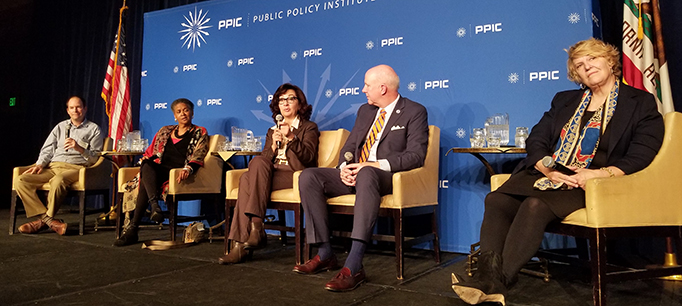
The three panelists—Jelena Hartman of the California State Water Board, Adam Link of the California Association of Sanitation Agencies, and Nina Hawk of the Santa Clara Valley Water District—discussed the interactions between water use and wastewater, lessons learned from the latest drought, and ways to improve coordination and information sharing with water suppliers going forward.

Hartman noted that with the 2012‒16 drought emergency behind us, “it’s a good opportunity to talk about what worked, what didn’t work” for managing future low-flow situations. “We need to plan, adapt, and be prepared, because the next drought will come,” she added.

Hawk said her agency is fully behind efficient water use but also recognizes that conservation can have impacts on wastewater management and recycled water supplies. “We really have to step back and take a planning look at it,” she said. Collaboration between water suppliers and treatment agencies is key to managing wastewater for multiple uses, she noted.

Link highlighted the difficulty in planning for future capital improvements for both sanitation and recycled water in a changing climate. “If you’re not sure how low your flows will go, how do you plan for a plant that will be useful 30 years from now?” This may require more creative planning for capital investments to ensure that new infrastructure is flexible enough for changing conditions—for example, connecting recycled water plants to groundwater and surface storage to help them weather drought.

We invite you to watch the video from the event.


Video: State and Federal Experts Discuss San Joaquin Valley’s Water Future

How can state and federal agencies help California’s largest agricultural region address its difficult water management problems? This was the theme of an event last week that brought together PPIC experts with top officials working on issues related to water, agriculture, and natural resources.

Ellen Hanak, director of the PPIC Water Policy Center, launched the event by summarizing findings from a new report on the valley’s water- and land-management challenges and outlining some strategies for addressing them.

Groundwater overdraft is the valley’s key water challenge. A state mandate to bring groundwater use to sustainable levels will have broad effects on valley agriculture and the regional economy—most likely including some permanent idling of farmland to balance water budgets. Hanak noted that only about a quarter of the valley’s groundwater deficit can be filled with new supplies at prices farmers can afford.

According to Hanak, the most promising solutions fall into three buckets: “Ways to increase flexibility in how we manage water and related land resources; ways to provide incentives so that growers, who are some of the key decision makers on the ground, can do this so it makes business sense to them; and ways to stack benefits so you get more than one thing out of it—maybe you get groundwater recharge and wetland habitat, for example.”

The three panelists—Wade Crowfoot of the California Natural Resources Agency, Karen Ross of the California Department of Food and Agriculture, and Thomas Hedt of the Natural Resources Conservation Service’s California office―discussed key issues and ways their agencies can partner with local stakeholders to ease the process of replenishing groundwater in coming years.

Crowfoot highlighted the importance of working with local communities, governments, and water agencies to address water challenges. “State government doesn’t actually have the solutions. We have the resources and the power of making new laws, but the solutions that are going to help limit disruption as it relates to water are going to be found on the ground,” he said. “The question is what can we do at the state level to empower the locals to find those solutions.”

Ross said multi-benefit approaches will be critically important, particularly for reaping environmental benefits when land is fallowed. “New partnerships and unusual allies” are key to achieving such benefits and finding durable solutions, she noted.

For example, she added, “the environmental justice community and agriculture community continue to partner to find drinking water solutions”—a process that “also bodes well for what we can do on the land.”

Hedt described new federal pilot projects to improve wildlife habitat and promote groundwater recharge. He noted that a key federal farm program has been made more flexible to allow broader partnerships that can enable habitat conservation on farmlands and address other challenges more efficiently.

We invite you watch the video from the event.

This was the second public event about this research; the first was held in Fresno in February.

Testimony: Upgrading California’s Water Grid to Meet 21st Century Needs

Ellen Hanak, director of the PPIC Water Policy Center, testified today (April 2, 2019) before the House Subcommittee on Water, Oceans, and Wildlife, at a hearing on the state of western water infrastructure and innovation. Here are her prepared remarks.

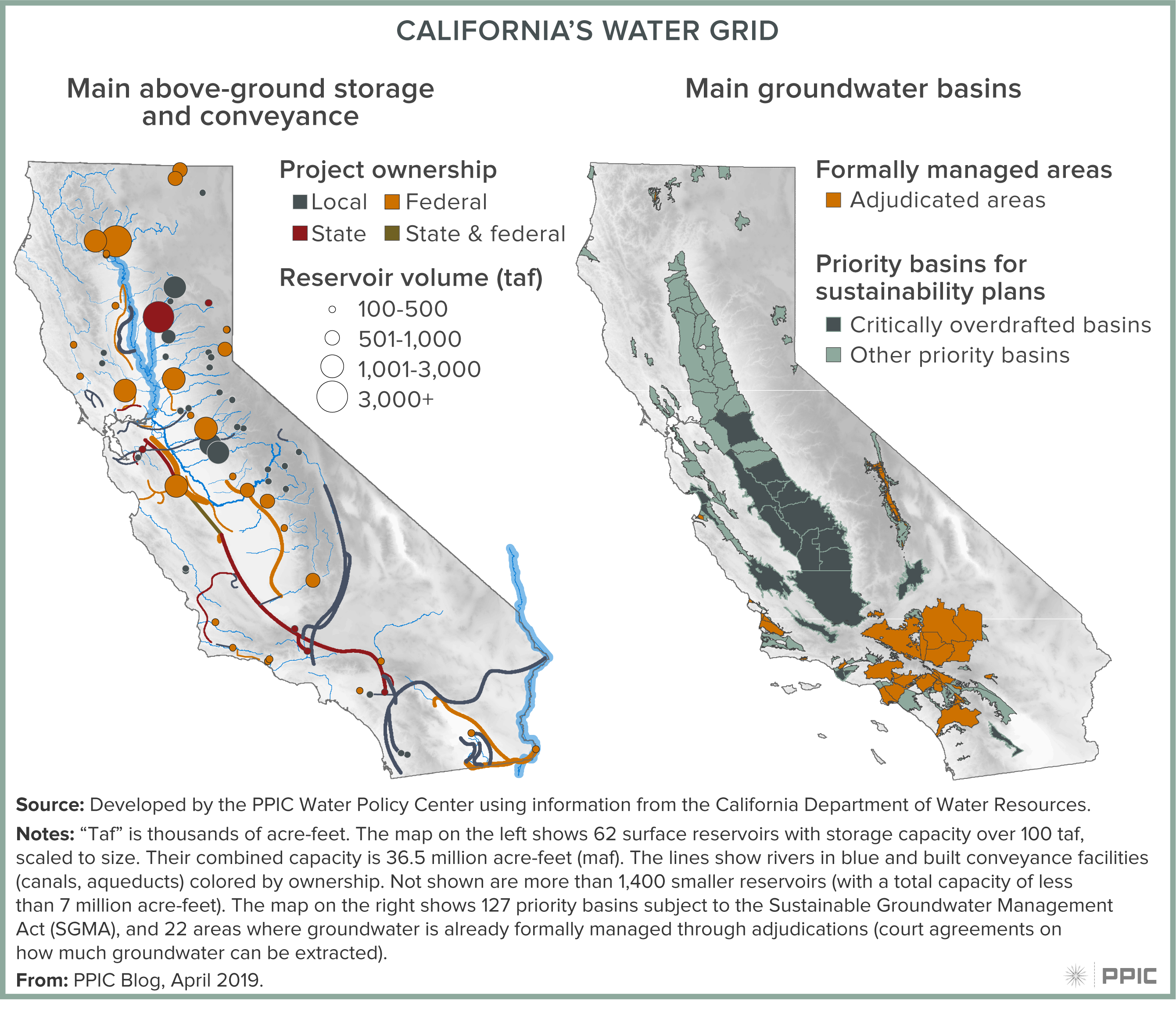
Most western states rely on water “grids”—networks of above- and below-ground water storage and conveyance systems—to manage their water supplies. California’s water grid is unusually extensive and connects most water use in the state. It is also complex, with different elements owned and managed by a wide array of local, state, and federal entities.

California’s water grid provides numerous services: it stores water, reduces flood risk, generates electricity, helps maintain downstream ecosystems, and provides recreation. But various factors are putting stress on this system. As the 2017 Oroville Dam crisis showed, the state’s above-ground infrastructure is aging—much of it is more than 50 years old. And in many areas, groundwater basins are being depleted, making wells go dry, raising pumping costs, harming ecosystems, and causing lands to sink and damage vital infrastructure. The changing climate is compounding these pressures.

figure - California's Water Grid

The PPIC Water Policy Center put together a team of experts in climate science, hydrology, ecology, engineering, economics, and law to review the weak points in California’s water system and recommend actions to build the system’s climate resilience. Our 2018 report Managing Drought in a Changing Climate found that five climate pressures—warming temperatures, shrinking snowpack, shorter and more intense wet seasons, more frequent extreme wet and dry years, and rising seas—will greatly challenge water management in coming decades.

Indeed, many of these effects are already occurring. Warmer, more intense droughts—such as the one California experienced from 2012–16—increase pressures to draw down groundwater reserves. Warmer, more intense storms add stress to surface reservoirs, making it harder to meet sometimes competing objectives of supplying water and protecting people and property from harmful floods.

California’s water grid is not prepared to handle these mounting pressures. Yet it is also the state’s most valuable asset for adapting to the changes in store. What’s needed is a more robust, better-integrated water grid. This will require investments to modernize not only the infrastructure, but also the way the system is managed. Here are some top priorities:

  • Enhancing groundwater storage. Groundwater is a vital drought reserve, and many California basins have considerable potential to affordably store more water. But the lack of active management—including tracking groundwater use—has been an obstacle to these investments. One very positive outcome of the latest drought was the enactment in 2014 of the Sustainable Groundwater Management Act, which requires local water users to develop and implement sustainability plans. The first plans are due in early 2020, and many will focus on new recharge efforts. In addition to expanding dedicated recharge ponds, some farmers and irrigation districts are experimenting with new methods, such as flooding suitable cropland during the winter months.
  • Repairing and upgrading dams, canals, and aqueducts. Addressing infrastructure weaknesses and gaps is essential for both flood protection and water supply. Expanding conveyance capacity will be key for getting water from winter and spring storms to where it’s needed for replenishing groundwater storage. This can also facilitate water trading—an important way to increase the flexibility of water supply and reduce the costs of water scarcity during droughts.
  • Rethinking infrastructure operations. California will be able to store more water if it manages surface and groundwater as a system to increase their combined potential. For instance, moving more water out of surface reservoirs and into aquifers in the fall can free up room in reservoirs to capture winter and spring storms. As another example, promising efforts are underway in some watersheds—including the Russian River, the American River, and the Santa Ana River—to update dam operations using advanced weather forecasting technology. More accurate forecasts can help managers decide whether they need to release water to protect downstream areas from flooding, transfer water to groundwater basins, or keep water in storage for later use.

There are many ways the federal government can help update the grid to meet 21st century needs in California and throughout the West. Here are a few priorities:

  • Assessing and improving system capacity. As owners and operators of major surface water infrastructure, federal agencies—especially the US Bureau of Reclamation and the Army Corps of Engineers—will be essential partners in assessing system capacity issues and the potential for new investments and operational changes to improve the grid’s performance and resilience.
  • Providing essential data. A variety of federal agencies—including the US Geological Survey and the National Oceanic and Atmospheric Administration—are key providers of data needed to better manage the grid under changing conditions. This includes essential metrics such as stream flows, weather forecasts, groundwater models, and space-based imagery to measure water use. These agencies also provide crucial biological data to help manage the grid sustainably. Some of these efforts have faced budget cuts in recent years, dampening their usefulness.
  • Supporting groundwater reform. To date, the federal government has been less engaged on the key issue of groundwater management—an underappreciated part of the grid whose importance will grow as the climate warms and water stored in the mountain snowpack diminishes. California is in the midst of a major, locally driven groundwater reform that will provide valuable lessons for improving the management of this vital resource across the western US and beyond. As owner and operator of the Central Valley Project, the US Bureau of Reclamation can support this effort by making it easier for its local water customers and others to recharge groundwater in suitable areas. As the regulator and manager of flood control systems throughout California, the Army Corps of Engineers can help local flood control agencies capture storm runoff and increase groundwater recharge. And as a major source of funding and technical assistance to farmers, USDA’s Natural Resource Conservation Service could help spur innovation by recognizing groundwater depletion as a resource concern, making it eligible for support.

California, like all western states, is facing major water management challenges as the climate warms and population grows. Weather extremes over the past decade have given us a glimpse of what the future holds. The best way to adapt to these changes is to modernize water grids. The federal government has been an essential partner in developing and operating these grids for more than 100 years. Given the challenges ahead, it is time to modernize this partnership, not just the grid itself.  This includes integrating federal support, operations, and technical expertise into all phases of water management, particularly groundwater.  From our many conversations here at PPIC with state and local water managers, California appears ready for an improved state-federal partnership.  I encourage members of this subcommittee to engage in finding ways to help modernize this relationship.

Colorado Drought Deal Close, But Not Done

Last week Arizona and California missed a deadline to submit final plans for how they will manage water shortages in the Colorado River Basin over the coming decades to prevent Lake Mead levels from dropping so low that water cannot be released from the dam. The other five states that share the river’s waters have already submitted their drought contingency plans. We talked to John Fleck—director of the University of New Mexico’s Water Resources Program and a member of the PPIC Water Policy Center research network—about the situation.

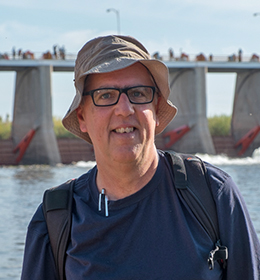
photo of John Fleck

PPIC: What is the drought contingency plan intended to do?

John Fleck: The key problem on the Colorado is that the basin’s water is over-allocated. It was really wet in 1920 when the allocation rules for the river were developed. So the rules allocated extremely large water shares to the “lower basin states”—California, Arizona, and Nevada—that hydrologic reality can’t support. We’ve been struggling ever since to come to terms with that reality.

The drought contingency plan is a voluntary program involving the lower basin states to decrease their use of the river’s water in an attempt to reduce the over-allocation problem. There’s an overall agreement describing the conditions that would require each state to use less water. Then each state has to have its own separate internal set of agreements on how to share those cuts.

There are a couple of different ways you can approach this over-allocation problem. The federal government can just reduce everyone’s allocation. Or you can have the water users themselves acknowledge the problem and agree to a voluntary, collaborative approach. The latter approach is far more likely to succeed, so I definitely think this was the better way to go.

Even though the lower basin states are close to having final plans, federal officials have said that “close isn’t done.” The states now have until March 4 to submit their final plans. No one wants to have an imposed federal solution—and I don’t think we’ll end up there—but it’d be better than doing nothing. The threat alone might push people to finish up.

PPIC: What are some important steps the states have agreed to?

JF: The agreements reduce water use in the lower basin by 1.5 million acre-feet per year; it’s a very big deal. Arizona has now agreed to a plan that could eventually reduce the Central Arizona Project’s flow of Colorado River water into the valleys of Tucson and Phoenix by nearly half of current levels. They did this voluntarily, without any litigation. That’s real progress. And Imperial Irrigation District (IID)—the biggest agricultural user of California’s allocation of Colorado River water—has already given up 500,000 acre-feet a year, which is a huge amount of water.

One of the complications of reductions in Colorado River water is the drying of the Salton Sea, which relies principally on runoff from farms in IID. California promised to mitigate the public health and environmental problems associated with the shrinking of the sea, particularly the air quality impact on poor communities. Solving this problem is a work in progress made more challenging by reductions in Colorado River water.

PPIC: Do you think the states’ plans go far enough, given the warming climate?

JF: We can’t be sure, because we don’t know how much impact climate change will have, on what time scales. Since we don’t really know where the bottom is for the Colorado River, hydrologically speaking, we don’t how far we’re going to have to go with water cutbacks in the long run. Drought planning is a really important step to prepare for a climate-challenged future—it creates a framework for deeper cuts.

It’s important to see the drought contingency planning as the latest development in the evolution of long-term management of the river’s waters. There are a bunch of unresolved problems—both hydrologic and institutional―and a lot of work remains to be done, but we can’t solve all these problems at once. Though drought planning is an incredibly important step, it’s certainly not the last one.

Fleck is a co-author (with Eric Kuhn) of the upcoming book Science Be Dammed: How Ignoring Inconvenient Science Drained the Colorado River, to be published this fall by the University of Arizona Press.

How Climate Change Drives Disaster Cascades

California has had a devastating series of natural disasters recent years, prompting questions about the role of climate change in worsening fires, droughts, and floods. We talked to Amir AghaKouchak—an associate professor of civil and environmental engineering at UC Irvine―about how a warming climate is affecting natural hazards.

PPIC: Can you talk about how climate change is causing chains of extreme events?
Amir AghaKouchak: Climate warming can compound hazardous events. For example, this sequence of events led to devastating compound impacts in California: (1) severe drought in 2012‒16 weakened or killed many trees and vegetation; (2) record winter precipitation in 2017 caused epic growth of fine fuels like grass; (3) a warm, dry spring and summer dried out vegetation, leading to record-low moisture levels in this vegetation, (4) Diablo winds in Northern California and Santa Ana winds in Southern California set records for low humidity and sustained wind velocities; (5) record-setting fires occurred (e.g., the Thomas Fire in December 2017); and  (6) intense rainfall near Santa Barbara in January 2018 created the most deadly debris flows in history.

Cascading events are a special form of compound events. Sometimes the drivers involved in a cascading event are physically independent (e.g., a wildfire in summer and a rainfall event that winter), but they are linked through their impacts. The Thomas fire in Southern California didn’t cause the related mudslide. But the order of these events—they were about a month apart—had an extreme impact. Models show that a warming climate will bring more wildfires to California, which means a higher chance of future mudslides and debris flows.

We know, for example, that drought and heat waves are connected. It’s widely acknowledged that California’s climate is warming. But what’s striking is that our droughts appear to be warming much faster than the overall average. Heat waves often have atmospheric origins, but they can also be worsened by dry conditions. The way soil cools down is similar to what our bodies do—we sweat and are cooled by its evaporation. The land’s surface cools the same way. But when there’s little or no moisture for evaporation, the sun’s radiation warms the surface and intensifies heat waves. A hotter future will bring drier soil, which can lead to more intense heat waves.

PPIC: What can be done to better manage future extreme events?

AA: Historically, we have usually ignored the relationships among the variables used to assess risk. For example, US Geological Survey guidelines for flood risks in coastal areas do not consider the dynamics of the oceans. Sea level rise brings a greater chance of flooding in coastal areas due to higher tide and surge baselines. We need to develop methods that allow us to do more comprehensive risk analysis for floods, wildfires, mudslides, etc. On the science side, we need better methods to analyze the risks of related events. More public education and outreach about these types of events are also very important. Moderate rainfall may not worry you, but if it’s after a wildfire it could lead to extreme risks. We need to make sure people understand that moderate events can potentially lead to an extreme disaster cascade.

PPIC: What are some changes we should start making now to boost resilience for these “disaster cascades”?

AA: Policy change isn’t easy. But California is very progressive and has even formed a committee, which I’m a member of, to assess how climate change information can be used for improving engineering design and management of infrastructure. Our report identifies gaps and challenges, and offers nine major recommendations for making the state’s infrastructure “climate safe.” For example, we call for updating design and maintenance codes to enhance resilience. We also recommend funding collaborative efforts between state infrastructure agencies and climate scientists to develop tools for improving resilience.

Addressing these gaps won’t be easy. The good news is that the working group has had representation from all the major state agencies―including the Department of Water Resources, Caltrans, and the California Energy Commission. The agencies are interested in working together to improve resilience down the road. This is a very promising sign for the future.

Reducing Drought Risks in Rural Communities

Disadvantaged rural communities are disproportionately exposed to drinking water risks in California. Too many experience insecure supplies and contamination of their water sources. While there are growing efforts by policymakers to address water contamination, many communities will need further help to prepare for future droughts. Improved planning efforts could help avert water shortages.

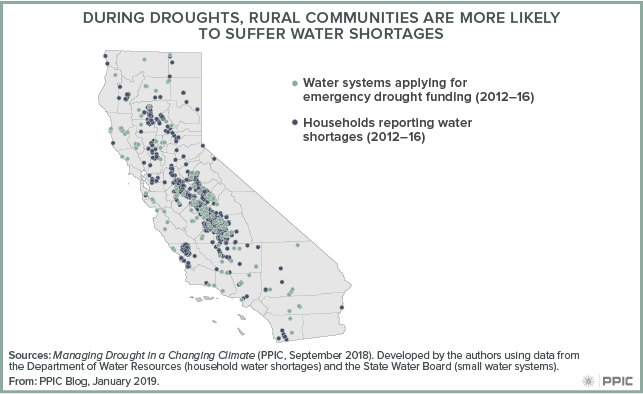
Rural residents are more vulnerable to running out of water during droughts because they are more likely to rely solely on groundwater from small community wells or domestic wells. These wells tend to be relatively shallow, so they are susceptible to running dry when pumping lowers groundwater levels. During the 2012‒16 drought, farmers and cities pumped extra groundwater to make up for surface water shortages. Thousands of wells went dry―mostly domestic drinking water wells in rural communities, especially in the San Joaquin Valley. And roughly 150 small community water systems sought emergency assistance to keep the taps flowing.

Although the state’s Sustainable Groundwater Management Act (SGMA) is expected to lead to balanced groundwater use and reduce over-pumping in the long term, California’s highly variable climate means that groundwater levels will still drop during droughts. This could result in more drinking water wells going dry. In a recent submission to the California Water Data Challenge, several colleagues from UC Davis and I found that a drought similar to the latest one could cause more than 4,000 domestic wells to go dry in the Central Valley.

A recent PPIC report on managing drought in a changing climate offers two ideas for reducing these risks:

  • Develop drinking water plans for rural communities and identify durable funding sources. Small rural systems do not have the financial capacity for drought planning and mitigation. State and local partners should use their experience from the recent drought to identify communities at highest risk, connect them to larger systems where feasible, and devise drought response programs for the others with reliable funding sources. The newly formed groundwater sustainability agencies, working with local partners such as counties and agricultural and urban dischargers, could help coordinate actions and streamline funding mechanisms.
  • Ensure groundwater sustainability plans include mitigation actions for dry drinking wells. Sustainability plans should describe preparation for groundwater drawdowns during severe drought similar to the one in 2012‒16. For instance, as groundwater sustainability agencies develop their plans, mapping drinking water wells that might be at risk for different drought scenarios and proposing mitigation actions that proactively decrease the risks are both imperative.

Studies of institutional responses to the latest drought largely find that planning for drought response and recovery paid off. Making an action plan to avoid further water-supply risks in disadvantaged rural communities―as well as identifying reliable funding mechanisms to implement it―should be top priorities for California policymakers.

Adapting to an Uncertain Water Future

As the world’s biggest climate meeting continues in Poland this week, the growing threats from climate change―and the lack of large-scale action to match the risks―have been much in the news. Global, national, and statewide assessments all point to severe consequences if greenhouse gas emissions are not greatly reduced. Evidence is growing that climate change is a “threat multiplier,” increasing the frequency and intensity of natural disasters worldwide and here in California. And just this past week, the Global Carbon Project reported that emissions are rising rapidly, making it even more difficult to meet the goals of the Paris Agreement and heightening the possibility of more-frequent and more-damaging climate impacts.

These reports all point to the same policy direction for California. While it is important that the state continue its leadership on reducing greenhouse gas emissions, it is time to greatly increase efforts at adaptation.

Water is where climate change is having its most direct and measurable impact in California. A recent PPIC report found that five climate pressures—warming temperatures, shrinking snowpack, shorter wet seasons, more volatile precipitation, and rising seas—affect all aspects of water. We recommended a suite of integrated reforms to adapt to these changes. These include better planning for water use in cities and farms, and for the environment; upgrading the state’s water management infrastructure; improving the way the state allocates water; and coming up with innovative new funding mechanisms.

Although all of the reforms are important, two—upgrading infrastructure and providing adequate funding—are the most critical. California’s water management infrastructure is vast and complex. Nearly 1,500 dams and reservoirs provide numerous services, some of which are at cross purposes with each other: they store water, reduce flood risk, generate electricity, help maintain downstream ecosystems, and provide recreation. Large volumes of existing and potential storage occur in more than 500 groundwater basins.

The above- and below-ground storage is linked from far-northern California to the suburbs of San Diego by a network of thousands of miles of canals and aqueducts, as well as rivers that function as aqueducts. California could not function without this networked “grid.” This grid is the state’s most valuable asset for adapting to an uncertain climate future.

We recommend that this grid be upgraded. A top priority includes repairing or strengthening dams, canals, and aqueducts—most of which were designed and built more than 50 years ago using outdated hydrology that doesn’t reflect a changing climate. Another upgrade is adding connections to the grid so that water can be conveyed more easily to where it’s needed for replenishing groundwater storage or to support water trading. And integrating operations of the grid, possibly involving a wholesale change in the way it is managed and governed, should also be prioritized.

But talk about upgrading the grid will be insufficient if the state does not find a way to pay for it. The defeat of the statewide water bond, Proposition 3, in November may be an indication of “bond fatigue.” Instead, the burden for paying for this upgrade is likely to fall upon local communities, who already shoulder about 85% of the costs for water management every year. This will be a contentious but necessary public debate. Without new resources, upgrading the grid will be very difficult.

The climate is changing, and the direction of change poses great challenges for California water management. But the state has a very large portfolio of assets to help adapt to this change. If these assets are managed well—and California makes well-funded investments in upgrades and focuses on sustainability—the state can weather these changes with minimal social and economic disruptions.

Local Measures Address Water, Fire in the Midterm Elections

The biggest water news from the recent election was the failure of the $8.9 billion statewide water bond, Proposition 3. This was the first time voters have rejected a statewide water bond since 1990. But this wasn’t the only story for water-related measures on Californians’ ballots. The midterms saw 33 local measures go to the voters that addressed issues ranging from flood protection to fire resilience. Here we summarize a few key votes.

In Los Angeles County, Measure W passed. This measure allows the county to collect a parcel tax of 2.5 cents per square foot of impermeable surfaces (such as concrete sidewalks and pavement) to fund rain and stormwater capture and clean-up projects, in addition to projects addressing water quality and groundwater recharge. The measure exempts permeable surfaces from the tax, which could incentivize developers to incorporate more green solutions into development and renovation projects.

In the Bay Area, San Francisco and San Jose both passed local bonds to modernize infrastructure. San Francisco easily passed Measure A, which will issue $425 million in bonds to strengthen the Embarcadero seawall to better withstand earthquakes and rising sea levels. San Jose’s Measure T will allocate $650 million in bonds to repair the city’s aging infrastructure. Although almost half of this bond is dedicated to repaving streets, the measure also includes $85 million for flood protection—a response to the 2017 Coyote Creek flood that caused $100 million in property damage. The bond will fund “green infrastructure” projects in the local floodplain to reduce the risks of future floods and groundwater contamination.

Across the state, the rise in devastating wildfires resulted in nine measures addressing fire protection and intervention services in communities, to be paid for through utility taxes, sales taxes, and parcel taxes. Four of these measures passed, while five failed.

Sonoma County’s newly adopted park and ecosystem restoration bill―Measure M, a one-eighth cent sales tax increase―will collectively fund wildfire prevention, ecosystem restoration, and projects to safeguard water supplies, including rivers and streams. Measure FF passed in Alameda and Contra Costa Counties; it extended an existing parcel tax to fund wildfire prevention and water quality activities on East Bay Regional Park District lands, as well as park maintenance. But voters didn’t approve Measure P in Laguna Beach (Orange County), which proposed a sales tax to pay for wildfire safety measures. It would have funded projects such as undergrounding overhead power lines.

Although the failure of Proposition 3 caught some by surprise, it’s important to remember that state bonds play a relatively minor role in funding California’s water needs. Local revenues—from water and sewer bills to taxes—provide 85% of water funding. The newly passed ballot measures carry on that tradition, with Californians across the state voting to address their communities’ needs and priorities for water, fire safety, and the environment.

Video: Water Priorities for California’s Next Governor

California’s many water challenges are complex, with many possible solutions and even more opinions about best approaches. How can a new governor forge a path forward in this critical area?

The PPIC Water Policy Center assembled a group of 16 experts this week for a half-day workshop in Sacramento to discuss how the new administration can promote water policies and practices that benefit the state’s people, economy, and environment. Lively discussions addressed three overarching topics: how local and state water policies intersect with California’s most pressing economic issues; innovations in policy, practice, and technology that offer better solutions for key water problems; and steps needed to adapt the state’s water systems to a changing climate.

Ellen Hanak, director of the PPIC Water Policy Center, summarized some major water challenges the new administration will face, including increased risks of drought and floods; poor water quality and drying wells in disadvantaged rural communities; and finding durable ways to pay for needed water system improvements. Leadership will be key to advancing solutions, she said.

“California has been a leader both nationally and internationally” on climate change mitigation and reducing emissions, Hanak said. “We think California has the potential to be a leader when it comes to climate adaptation as well.” She noted that water is a lynchpin issue for addressing the effects of a changing climate.

The first panel shed light on the links between water and the state’s leading economic challenges, from housing affordability to jobs. For example, growing water scarcity in the San Joaquin Valley—one of California’s fastest-growing areas―will affect plans to build new housing there. And regulation can complicate efforts to build affordable housing. Dan Dunmoyer of the California Building Industry Association noted that some water-related regulations—such as strict rules to prevent runoff from construction sites during the rainy season—can significantly increase building costs. Panelists agreed that better coordination could help open up many of these bottlenecks.

Denise Fairchild of Emerald Cities Collaborative highlighted the potential for job training programs in the water sector—which is grappling with the “silver tsunami” of an aging workforce—to create economic opportunities for low-income communities. “If we take this opportunity to rebuild California’s water infrastructure, it has great job generation potential” in communities affected by a historical lack of water sector investment.

The next panel looked at technical and policy-related innovations that can improve water management, such as weather forecasting tools that enable more nimble water management in dams—key to adapting to an increasingly volatile climate. Also, better information on agricultural water use can “empower communities to stop arguing about numbers and start working on solutions,” said Robyn Grimm of Environmental Defense.

The final panel explored opportunities to modernize the state’s water “grid”—its vast network of reservoirs, aquifers and conveyance systems—to make it more resilient in the face of five climate pressures: warming temperatures, shrinking snowpack, shorter and more intense wet seasons, more volatile precipitation, and rising seas. Improving water conveyance and reworking the current system would enable the state to “take advantage of bigger storms” linked to climate change by capturing their water for recharge, said Ashley Boren of Sustainable Conservation.

Each panel discussion included a quick round of “elevator pitch” advice for the governor-elect. Jennifer Pierre of the State Water Contractors captured the mood of the group with her pitch: “In water, flexibility is the name of the game—we need it for managing the existing grid, and for grid improvements. Don’t wait for the perfect plan; we’ll suffer every year that we delay.”

We invite you to watch the videos from this event and hope you find the discussions helpful: