How Oroville Is Changing Dam Safety in California

California’s 1,500 dams are regularly inspected and most have been safe for generations. Before last year’s Oroville Dam spillway crisis, the last dam disaster was the deadly 1928 Saint Francis Dam failure in Southern California. But the scale and drama of the Oroville crisis jolted the state into action, resulting in a stream of safety reviews, forensic analyses, and policy changes.

Within weeks of Oroville’s spillway incident, Governor Brown announced a 4-point plan to bolster dam safety and flood protection. And with the enactment of Senate Bill 92, a new dam safety regime has strengthened the state’s existing system.

We asked two experts about the lessons of Oroville for dam safety in California: Jeff Mount, a senior fellow at the PPIC Water Policy Center and an expert in hydrology and geology; and Jay Lund, director of the Center for Watershed Sciences at UC Davis, a member of the National Academy of Engineering, and an adjunct fellow at PPIC.

“First, we have to do a more complete job of assessing infrastructure,” said Lund. “We need to look for potential cascades of failures, which is what happened at Oroville. And we need to look at all of the outlet structures, which are essentially a dam’s safety valves.”

He noted that all federally regulated dams are subject to safety analysis every seven years, “yet they didn’t pick up the problems of Oroville. The lessons here are that you can never stop worrying about infrastructure and that we have to be prepared for things to fail.”

Mount seconded the need to stay vigilant, noting, “Water has a way of finding weaknesses in planning, design, and maintenance. If you miss something, eventually water will find a way to tell you so.”

Another new dam safety bill, Assembly Bill 1270, requires the state to consult with independent experts to update dam safety practices every 10 years. Lund said that will encourage the use of new kinds of technologies and practices. “But I think more important than the law itself is the culture of the people in charge of dams and dam safety, and whether they’re given the right resources and the mission to do more thorough assessments of old problems lurking in these structures.”

Mount noted that climate change is a complicating factor. “The inspections and upgrades are a good start,” he said. “But many of our dams―including Oroville―were designed more than 50 years ago. We need to evaluate how to operate them under changing hydrologic conditions.”

He added that many large dams try to fulfill multiple, conflicting objectives. “For example, a flood manager wants an empty reservoir during flood season while a water supply manager wants to fill the reservoir as much as possible. We’ll need to take a second look at how we manage dams for competing objectives and will likely face some tough trade-offs.”

Oroville also raises the question of how to pay for dam safety over the long term. “The Oroville episode will probably end up costing slightly less than $1 billion,” Lund said. “At 5% interest, that’s $50 million a year. A $50 million annual flood safety program might have avoided this. There is probably a good financial argument to increase spending on maintenance and inspection of major infrastructure.”

World Water Day through a California Lens

Happy World Water Day―a day that brings attention and, hopefully, action to some of the world’s most pressing water challenges. This year’s theme is “exploring nature-based solutions to the water challenges we face in the 21st century.” It’s a concept that shows the deep linkages among many water problems—and the need to tackle these problems jointly.

California’s complex array of water challenges make it something of a policy lab for trying out a “portfolio approach” that addresses issues in an integrated way. Although California has one of the world’s largest economies, the state faces many of the same water problems seen around the world. Too many communities don’t have access to safe drinking water. Some critical water infrastructure is in poor shape. The state’s ecosystems are in decline, with many aquatic species hovering near extinction. To complicate things, we have an extremely variable climate—so both droughts and floods are a reality Californians live with.

Our recent policy brief, Priorities for California’s Water, provides a road map for taking on some of these challenges. The report highlights linkages among key issues and points to integrated solutions that can bring multiple benefits—approaches that are especially important in light of the changing climate.

For example, wildlife-friendly farming can support ecosystems while maintaining the economic viability of farms. Cooperation on storing and releasing water from reservoirs can benefit fish while meeting downstream users’ needs. Investing in healthy watersheds can help protect drinking water supplies and reduce the risk of extreme wildfire. Flood protection projects that reconnect rivers to their floodplains can provide fish and wildlife habitat. By capturing and treating stormwater runoff, cities can improve water quality, augment their water supplies, and enhance wetlands or open space. Across California, there are promising examples of such approaches, but they are still the exception rather than the rule.

Here at the PPIC Water Policy Center, we could be accused of thinking every day is California Water Day. But we’re happy to be reminded that there’s a global effort to tackle critical water issues and growing understanding of the linkages among the world’s biggest water challenges. Finding solutions that can work in unison won’t happen overnight. It will take creative thinking and bold action from all quarters—water managers, governments, agricultural and urban water users, community and environmental advocates, business and scientific leaders. World Water Day reminds us we all live on the same blue planet and that solutions are within our reach.

California Makes Progress on Water Accounting

California’s water accounting system—the balance sheet of where and when water is available and how it is being used—lacks common standards, suffers from major data gaps, and is in need of modernization. A 2016 law, the Open and Transparent Water Data Act (AB 1755), directed several state agencies to improve this system. The Department of Water Resources (DWR)―in concert with other state agencies, non-governmental organizations, and universities―is taking the charge seriously and has set ambitious objectives to be completed within a tight timeframe.

The law requires California to create a statewide system for organizing and sharing water data by September 2019. Currently, water-related datasets are stored in many ways, including on public websites, on non-public servers, and even in paper filing systems. The proposed system will make it easier to find and use the data needed for water management, consolidating datasets into several agency-level collections and allowing users to search from a centralized search engine―similar to how an inter-library loan system works.

DWR collaborated with several research institutions to develop guidance for implementing AB 1755. The researchers examined how local, state, and federal water managers, businesses, community groups, and environmental organizations currently use water data to make decisions. Their findings highlighted situations where better data organization could lead to more efficient and effective decision making.

“We recommend that the new system be designed to reflect real-world water management decisions, to ensure that the final product is relevant and useful to water managers and other stakeholders,” said Alida Cantor of Portland State University, who led the research on behalf of UC Berkeley’s Center for Law, Energy & the Environment.

Beyond problems of data organization, California also has some major data gaps, including accounting for groundwater use and recharge, managing water for ecosystems, and assessing rural communities’ access to safe drinking water.

While AB 1755 doesn’t require the state to fill these data gaps, the new guidance by research institutions has improved understanding and flagged some specific gaps that hinder management decisions.

For example, information on surface water rights and the location of many groundwater wells is not in easily accessible formats. And streamflow monitoring is unavailable for many important aquatic ecosystems. These three data gaps make it difficult for regulatory agencies to permit water trading between water users and the environment—a way to dedicate water to improve the in-stream environment. A current legislative proposal would have the state take a closer look at where more stream gages are needed.

AB 1755 is a “foundational first step” in the path toward better accounting for California’s water, according to Mike Kiparsky, director of UC Berkeley’s Wheeler Water Institute, who helped develop the new guidance. DWR and its partners will prepare a final strategic plan for the new statewide data system in spring 2018. This may also be an opportune moment to take a closer look at high-priority data gaps and develop concrete plans to address them.

Learn more


An Alternative Approach to Managing the Delta

The State Water Board is updating the water quality plan for the Sacramento–San Joaquin Delta. This plan sets flow and water quality standards for the Delta and its watershed, affecting water supply to more than 25 million Californians and millions of acres of Central Valley farmland. Parties that would be affected by this plan—water suppliers, fish and wildlife managers, environmental nonprofits—are negotiating voluntary agreements to present to the board for consideration.

Members of Governor Jerry Brown’s administration asked PPIC to assemble a small group of independent experts on the Delta to develop ideas about how to resolve the linked challenges of water quality, habitat, and water supply in the Delta and its watershed. This group—most of whose members are in the PPIC Water Policy Center research network—proposed a new approach, detailed in three commentaries posted on UC Davis’s California Waterblog. The recommendations are summarized below.

Tackle a manageable set of problems. Rather than trying to solve all of the Delta’s problems simultaneously, the board and those involved in negotiations should identify a smaller, well-defined set of issues that can be addressed over the next 15 years through this plan. Priorities include: (1) reversing declines in food resources for the Delta ecosystem, (2) maximizing a high-quality habitat that favors native plants and animals, and (3) managing nutrient pollution to reduce harmful algal blooms. Given the inadequacies of past efforts focused on single species recovery, these actions should instead focus on improving overall ecosystem function and condition.

Coordinate the management of freshwater flows, tides, and changes in the landscape. Traditional approaches to improving habitat in the Delta have tended to focus separately on freshwater flows and landscape changes. Where possible, an integrated, ecosystem-based approach—in which freshwater flows, tidal flows, and landscapes are managed together—is more likely to be successful and to result in a more efficient use of water and financial resources. Efforts should be concentrated in the north Delta and Suisun Marsh, and include strategies for reducing harmful algal blooms.

Bolster current science programs to guide implementation of the plan. Although there is a strong scientific basis for undertaking the approach outlined here, there are still many uncertainties about which specific strategies will bring success. This is why a robust science effort is needed to guide actions and evaluate progress. Scientific research on the Delta and its watershed is not well organized to do this. A new program—housed within the state’s existing Delta Science Program—should develop the science necessary to implement the Water Quality Control Plan. To make this program successful, a Delta Science Joint Powers Authority (JPA)―made up of the various agencies engaged in Delta management―should be established. The JPA would pool resources to fund the Delta Science Program and broader efforts in Delta science. The JPA would also be a forum for agencies, water users, and other stakeholders to develop consensus on science-based management. This will increase the efficiency of scientific efforts and reduce conflict over findings.

Is this ecosystem-based approach legal? In a word, yes. Management of the Delta needs to shift away from efforts to recover a few species of endangered fish and toward improving ecosystem conditions to meet a broader range of objectives. If the regulatory agencies can document the benefits of this approach, there are no barriers under current law.

These recommendations challenge some historical approaches to management of the Delta.  But ecosystem-based approaches that use an array of tools have the prospect of being a more efficient use of resources—including the critical resource of water for the environment—with broad benefits for fish and wildlife as well as the people who rely on Delta water.

Learn more
Read California’s Water: The Sacramento–San Joaquin Delta (PPIC Briefing Kit)
Watch a short video on the Delta
Visit the PPIC Water Policy Center’s Delta resource page

A Bottom-Up Approach to Groundwater Sustainability

California’s Sustainable Groundwater Management Act (SGMA) requires communities with ongoing groundwater deficits to bring their aquifers into balance in the coming years. This will be a difficult and complex process, but it’s also an opportunity to devise workable solutions at the community level. We talked to Eric Averett of the Rosedale–Rio Bravo Water Storage District about groundwater management innovations being tried in his Kern County district and lessons learned that might have wider application.

PPIC: What are the priority areas for addressing groundwater sustainability in your district?
Eric Averett: The most challenging area is managing and mitigating impacts associated with demand reduction. Rather than mandating that individual landowners reduce demand, our district has pursued a path that we think gives individuals greater flexibility. The idea is that every acre will be assigned a water budget based on what the district can provide or considers sustainable. If a landowner uses more than that amount, it triggers a water charge. The district will use those funds to develop water supply programs or purchase land from willing sellers to retire it from production. Either way, this system doesn’t take anything away from landowners’ ability to manage their own water, it just gives them more options.

Another important area we’re looking at is water trading within our district’s boundaries. We’ve implemented a pilot study that empowers landowners to act as buyers or sellers in managing their water resources. We think water trading will be an essential tool to getting aquifers into balance and maximizing the value of the resource. For example, during a drought, a small grower with row crops may find greater value in fallowing a field and selling the water. At the same time, a grower who may be short of water and facing the loss of a permanent crop may enter the market as a buyer. If we don’t find a way to create these buy/sell opportunities, we strand the asset.

A third area we’re working on is creating individual groundwater bank accounts for landowners. We have a number of landowners who’ve committed to make their land available for recharge in exchange for a portion of the recharged water being credited to their account. Alternatively, some landowners have acquired a source of water and asked the district to use it for recharge on their behalf. Both types of programs were tested successfully in 2017, and we look forward to expanding the concept.   Ultimately, we’re looking at ways the district can assist landowners in becoming sustainable and mitigating SGMA impacts.

PPIC: How are you handling the issue of dry wells?

EA:  During the most recent drought, we experienced a number of wells that went dry. Kern County’s groundwater levels can be very dynamic, in part because of the groundwater banking projects within the region. These projects pump out large volumes of water during droughts, causing the water table to drop a lot and fairly quickly. We’ve developed a unique mitigation program in partnership with the banking projects. We utilize a groundwater model to evaluate the well in question. If it’s determined that the well’s failure was due to water level impacts from the banking projects, we mitigate the impacts. Within 24 hours of the well going dry they’re connected into a temporary water supply. To date, we’ve spent more than $1 million replacing and repairing wells, or connecting people with dry wells to local service providers. The proof of success is that not one landowner has pursued legal remedies, and all have been satisfied with the results. We think it’s a good template for others to try and may be a model going into the groundwater sustainability planning process.

PPIC: What’s the big lesson from your district’s efforts?

EA In all of these areas, our goal is to have the district be a resource for sustainability, not a regulator. Each landowner is unique: some have thousands of acres, and the impacts on them may not be as great as for someone with a small parcel. A lot of smaller landowners may be unable to manage the fixed costs that will arise from implementing SGMA. We wanted to address the diversity in our district and not disadvantage any one user.

We’re emphasizing approaches that let growers decide what’s best for them—whether it’s helping them put unused water into a market or compensating them for using their land for recharge. Everyone in the district will have to live with the water budget we come up with, but we want to provide as many tools and options to get to sustainability as we can.

Governor’s Budget Banks on Voters Passing Water Bond

Governor Brown’s proposed budget―the last of his tenure―highlights his priorities for the state. For water, the proposal includes new funding to address some pressing public safety and environmental health issues, including improving drinking water quality in low-income communities, flood protection, groundwater management, and air and water quality at the Salton Sea.

Carrying out this proposal will depend not only on passing the budget, but also on getting additional approvals from California voters and the legislature for some of the needed funds.

To pay for most of the new initiatives, the governor is banking on California voters approving a $4 billion parks and water bond (SB 5) that will be on the ballot in June. More than $400 million in proposed spending on water for 2018–19 is contingent on SB 5, including safe drinking water projects ($63 million), flood management ($99 million), groundwater sustainability ($146 million), and restoration of the Salton Sea ($30 million).

To improve water quality in impoverished communities, the budget proposes using $4.7 million of general fund dollars to administer a new program to cover the ongoing costs of providing safe water. But the governor is counting on the legislature to approve a funding stream for the program itself—on the order of $100 million annually. One current measure (SB 623) would do this by assessing fees on agricultural chemicals and water bills. Or the governor may propose a similar measure as a trailer bill to the budget. Like any new tax, this kind of fiscal measure requires approval by at least two-thirds of both houses, which can be a significant hurdle. To date, water agencies have opposed this measure.

The budget proposal’s heavy reliance on bonds to pay for water projects continues a tradition that voters have supported over the past two decades. Since 2000, seven state general obligation bonds—voter-approved debt reimbursed with general fund taxes—have provided roughly $22 billion for water projects. State agencies are still awarding funds from Proposition 1—a $7.5 billion bond approved in November 2014. Bond funds have generally gone to “fiscal orphans”—areas of public and environmental health that do not have adequate alternative sources of funding. But bonds have not created a reliable way to fund ongoing needs.

The current proposal to create a steady stream of funding for the costs of safe drinking water programs is one way to break from this tradition. But it can also be a more difficult path. Setting up long-term funding streams, such as new taxes and fees, will require going beyond bonds. Leadership at the state and local levels are needed to pave the way.

A Look Back at the Year in Water Policy

A year of extreme events—from heavy rains that strained dams to high heat and massive wildfires—revealed the many ways California’s variable climate can impact water management. In 2017 the PPIC Water Policy Center explored how the state is managing such extremes and suggested improvements to help us prepare for an even more volatile future climate. Here are a few highlights.
  • Our evaluation of California’s urban water systems revealed that they have become adept at drought management thanks to diversified supplies, cooperation with neighbors, and programs to manage demand. But the state’s conservation mandate in 2015 opened a debate on how to manage water scarcity. We reviewed evolving state and local roles in urban drought management and described areas for improved cooperation to strengthen resilience.
  • Five dry years took a toll on groundwater, a critical drought reserve. Some farm areas saw steep declines in local aquifers. Our assessment of water stress in the San Joaquin Valley—California’s largest agricultural region and “ground zero” for groundwater concerns—summarizes sustainable management solutions. Our survey of groundwater recharge practices by valley water suppliers sheds light on what more can be done to advance recharge efforts.
  • The state’s headwater forests are in poor health and at increased risk of severe wildfire. Our review of current management practices explains steps needed to shift the emphasis from fire suppression to forest management and how to pay for these improvements.
  • The way California manages water for the environment is focused on responding to crises rather than building capacity to weather future dry spells. We undertook an in-depth evaluation of how to improve conditions for native fish and reduce conflict over water for the environment. We also proposed a better way to account for environmental water, with an example from the Sacramento–San Joaquin Delta.

The PPIC Water Policy Center’s efforts were collaborative in nature—involving research teams from across California and conversations with policy makers, water managers, and other stakeholders—and we broadened the conversations through a series of public events.

This year will bring major decisions on funding for safe drinking water, investing in water storage, sharing scarcity on the Colorado River, and conveying water through the Delta. To help inform the debate on these and other complex issues, we created a policy brief that summarizes problem areas and priorities for action. This brief was released in conjunction with our second annual water conference, which brought together leaders from across the state to discuss the ways forward.

Looking ahead, the water team is working on the potential effect of climate change on future droughts, pathways to water sustainability in the San Joaquin Valley, and the impact of drought on water quality and wastewater management.

The mostly dry December has left many wondering what 2018 will bring. But one thing is certain: we’re thankful for the opportunity to promote creative and collaborative solutions to California’s most difficult and pressing water challenges. And we are thankful for your support of this important work.

With best wishes for 2018,

Ellen Hanak

P.S. If you’re not yet receiving our weekly blog post by email, you can sign up here. And if you’d like to support the center’s work, learn more here.

Commentary: California Should Plan as if Drought Has Returned

This commentary was published in the Sacramento Bee on December 20, 2017.

The unusually warm, dry start to this winter—along with intense wildfires in southern California—has many Californians experiencing “drought deja vu.” Despite this uneasy feeling, we are not in drought. But it might be prudent to act as if this is the beginning of the next one. Here are some short-term priority areas for drought planning that we think can help the state prepare.

Read the full commentary on sacbee.com.

Modernizing Water Systems in Disadvantaged Communities

The water supply problems of disadvantaged rural communities can reflect not only a lack of resources, but also weak connections to the broader professional water community. The Mojave Water Agency in California’s southern desert has an innovative program to help small systems under its jurisdiction make improvements. We talked to Lance Eckhart, the agency’s director of basin management and resource planning, about this program.

PPIC: Describe the program.

Lance Eckhart: It started a few years ago when we to updated the agency’s regional water management plan, which included getting public input. Our agency covers 5,000 square miles—so we took our planning process on the road and visited many disadvantaged communities that previously had been underrepresented.

We have 40 small water districts scattered across the region, which are a backbone of these rural desert communities. We learned that they needed a lot of help. They hadn’t been keeping up with system upkeep. The rules had changed over time, and they weren’t always aware of best management practices. Maybe they hadn’t raised water rates in 20 years. They didn’t have the capacity to make many upgrades that the county wanted.

We’re a water wholesaler—we have no experience running very small community water systems, and we needed help. We engaged a local nonprofit, the California Rural Water Association, to join us. They help build technical, managerial, and financial capacity. We initially asked our board for $200,000 in “seed money” for the program. Half of that was to “get stuff done”—basic engineering, legal analysis, audits, system checks—anything that can be stapled to a grant application to help raise funds for capital improvements. One condition to get our help is that agencies have to upgrade their technical, managerial, and financial practices. It’s more of a leg up than a handout.

Another really important element was to develop training systems so these agencies can manage themselves. We hold free quarterly operator trainings on skills tailored to the region’s needs. This allows people who were fairly isolated to talk to each other in one place, and gives us a venue to share information about the program.

PPIC: What are some problems that rural water suppliers in your basin need help with?

LE: There’s a general lack of maintenance. Many have inadequate flow to fight fires. Too many have no redundancy if the local reservoir fails. Some are dealing with natural contaminants. Many systems have no financial reserves, so if a pump breaks they have to pass the hat. Many don’t have emergency plans if the well goes down or a fire or power outage cuts off water. A lot of these systems don’t have meters, so they don’t know if they have leaks or when to conserve.

With our help, water suppliers are now talking to each other and looking for ways to back up neighboring systems—for example, with interties. We are starting to bundle many systems in to one grant for the region.  For example we grouped 26 disadvantaged systems together for a leak detection grant program, which will be the foundation for future capital improvement grants—something likely not possible if individually pursued.  Also, some systems are realizing their best path forward is to consider consolidation with bigger agencies, which is a big change.

PPIC: What are your hopes for the future with this program?

LE: We’re excited that this model is now being adopted for a much bigger area. The granting agencies and state Department of Water Resources are beginning to encourage local nonprofits to partner with water agencies. I’d like to see this kind of partnership expand even more. While each underserved water system is unique, there are repeating problems. We know we can create a formula that can be used over and over again. We’ve shown how to bundle different small systems into a single grant. Being efficient in addressing this problem is good for the state, and good for the locals.

I also hope that the disadvantaged communities continue to realize they are not alone. I hope they continue to have a collective voice and stay cohesive—because that’s the best way to keep this issue alive and on the radar of the state and bigger agencies.

Read Priorities for California’s Water (PPIC policy brief)

How California’s Water Bond Is Being Spent

California has many unmet needs in its water system—most notably in the areas of flood protection, safe drinking water, stormwater treatment, and ecosystem support. While dedicated funding over the long term has been hard to come by, water bonds have helped fill some gaps in these areas. Looking at how the 2014 water bond is being spent can give us some insights into how bonds are turned into projects on the ground. This is particularly important as three new bond proposals are floated for 2018.

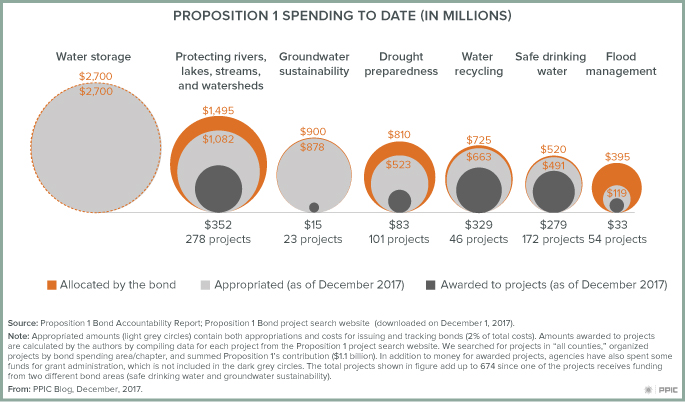
The state’s 2014 bond, Proposition 1, provides $7.5 billion in funding. The money is broken into seven funding categories. The bond language preauthorized $2.7 billion for water storage projects. For the other six areas, spending must be appropriated in the state budget. Once the funds are appropriated in the budget, the state agencies distribute them to selected projects.

With the 2017–18 budget, the legislature has now appropriated more than 86% of Proposition 1 funds. The largest new appropriation is more than $200 million for “Integrated Regional Water Management,” a grant program for collaborative regional projects to address complex water management challenges. In addition, more than $111 million was appropriated for flood management, reflecting statewide concerns about dam and levee infrastructure after the Oroville dam incident.

Of the Proposition 1 money appropriated, approximately $1.1 billion has been awarded for spending. That is roughly a billion dollars since June 2016. The number of projects has spiked since then as well, from 117 to 673. Even with this large increase in spending, only 14% of the bond has been awarded so far. This pace of water bond spending—about $785 million per year—is on par with patterns observed since the early 2000s.

Ecosystems in decline and disadvantaged communities that lack access to safe drinking water—problems made worse by the latest drought—lead the way in number of projects awarded, with 278 and 172 grants, respectively. Fifty-four grants have been awarded for the maintenance of Delta levees. Another 101 grants will foster regional drought preparedness. And 46 grants will be used for urban wastewater recycling projects.

The largest pot of money—$2.7 billion for water storage—is expected to be awarded in June 2018. In total, 12 projects—seven for surface water storage and five for projects that focus on storing more water underground—are competing for some portion of the money. The California Water Commission is now reviewing proposals. The winning bids will only receive funding for “public benefits” resulting from the new storage. At least half of these benefits must be for improving ecosystem conditions. Other qualifying benefits include flood protection, recreation, emergency water supplies, and water quality improvements.

About $900 million is allocated for groundwater sustainability—an area in which there is a growing need for funding to implement the 2014 Sustainable Groundwater Management Act. Of this total, $100 million is allocated to help the more than 250 newly formed Groundwater Sustainability Agencies (GSAs) develop their plans. The Department of Water Resources is now receiving proposals for these grants.

Looking beyond Proposition 1, three other water bonds have been proposed for the ballot in 2018. The $4 billion California Parks, Environment, and Water Bond was approved by the legislature, signed by the governor in September, and will appear on the June 2018 ballot. This bond would distribute a third of its revenue to park improvements, and the rest to environmental restoration and water and flood infrastructure. Specific areas include Salton Sea restoration, ecosystem improvements in the Sacramento and San Joaquin River watersheds, groundwater recharge, and safe drinking water.

Two other bonds—which would be put on the November 2018 ballot through the initiative process—are still under consideration. A bond proposal from Gerald Meral, a former state water official, would authorize $8.9 billion for various water supply and water quality projects, including water infrastructure improvements, safe drinking water projects, habitat protection, groundwater replenishment, and dam repairs. And a $7.99 billion bond proposed by environmental lawyer Joseph Caves would award half of its funds to drinking water safety improvements, and the rest to ecosystem restoration, and state and local park projects.

Clearly, bonds are an important source of one-time funding for some of the problems dogging the state’s water system. But state bonds only make up about 2% of total annual spending in California’s water sector. California must look beyond bonds to fill persistent funding gaps.

Learn more
Read our June 2016 blog post, “How is California Spending the Water Bond?”
Read California’s Water: Paying for Water (from California’s Water briefing kit)